
Yugoslavia
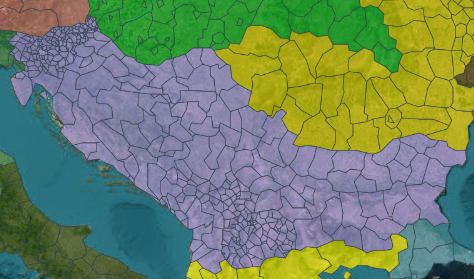
The Kingdom of Yugoslavia is a large nation in the Balkans bordering Greece, Turkey, Hungary, Romania, North Italy, and Germany, encompassing a number of smaller states from the defunct Habsburg Confederation.
History
Many of the states that would make up of Yugoslavia had been arguing for a united kingdom for the South Slavs. Yugoslavia itself meaning "Land of the South Slavs". This was viewed as a driving force behind the assassination attempted of Archduke Leopold of Austria by Serbian nationalists. During the subsequent investigation done by Ukraine, the Serbian government itself was exonerated of such misdeeds, though many of the individual officials were arrested.
During the Great War, the states of Yugoslavia were divided, as many of them were still under the dominion of the Austrian Empire. This caused dissent among the Slavic soldiers in the Austrian Empire, breaking down morale. Serbia, on the other side, had been inflicted with massive casualties, losing roughly 29% of their total population.
Following the war and Austria's defeat, the now Emperor Leopold II attempted to enact reforms and quell the calls for nationalism among the empire. He formed the Habsburg Confederation, in which the states were drawn among ethnic lines and each granted their own parliament. However, the Slavic states worked with Serbia and Montenegro in order to unite under the Serbian king instead. In 1930, during the Austrian uprisings, the regions of Croatia, Carniola, and Vojvodino declared their independence and requested annexation by Serbia. The states would declare the Kingdom of Serbs, Slovenes, and Croats, later Yugoslavia, in 1931.
The Kingdom received mixed relations from the start. Austria was slow to recognize the formation of Yugoslavia, as they had not wished to relinquish their claims over their former territories. Likewise, Italy initially refused, as they had sought the Dalmatian Coast of Croatia for themselves. However, recognition from Germany and Russia helped secure international standing in Europe. Greece welcomed the new state, and, along with Romania and Turkey, formed the Balkan League as a bulwark against Bulgarian irredentist claims in Macedonia.
During the late 1930's and early 1940's, Italy began to press its claim on Albania, leading to an invasion and annexation in 1941. Yugoslavia was among those that protested, but Italy undermined this by offering a two state solution for Transylvania to Hungary and Romania. Romania subsequently left the Balkan League. When Italy then invaded Greece in 1944, Yugoslavia honored the League and declared war on Italy. Yugoslavia invaded Albania, capturing much of the northern third.
During the World War, Bulgaria joined on the side of Italy, attempting to split the Yugoslav position. This was until 1948, when Tsar Ferdinand I of Bulgaria died without a male heir, and Yugoslav ministers negotiated unification. Following the war, Yugoslavia was granted control over the regions occupied in Albania as well, with Albania being partitioned with Greece.
In 1965, the Trino Nuclear Disaster greatly affected the waterways around Yugoslavia. King Peter II demanded recompense, issuing irrelevances against North Italy and the Comintern Union. Yugoslavia calls upon the Balkan League, the nations most affected by the disaster, to fight against the Comintern. Yugoslavia began to be seen as a bulwark of green energy in Europe, seeing Germany's usage of the atomic bomb in the World War as a precursor to the disaster.


Comments