
French Socialist Republic
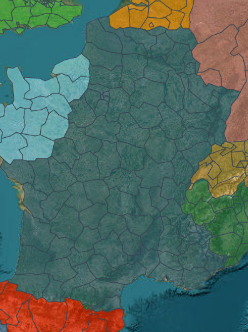
The French Socialist Republic is a powerful nation in Western Europe bordering Brittany, Germany, Spain, Aragon, Democratic People's Republic of Italy, Dutch People's Republic, and Switzerland.
History
The concepts of the French Socialist Republic began in 1848, with the dissolution of the French July Monarchy and the presidential election of Louis-Eugene Covaignac. During the French Civil War, many within Paris demanded a socialist regime, as they argued republicanism and monarchism had failed them numerous times. Following the end of the war in 1853, Louis Blanc was elected President of the French People's Republic.
During the Great War, France had declared their neutrality. However, this neutrality was not respected by either Holland or Occitania, who drove the French nation into trench warfare. French citizens fought the armies of both sides.
During the conflict, Vladimir Lenin, who had been in exile in Switzerland, entered Paris and began to call for the absolute end of hostilities. This resonated with the French people, and began to disseminate among the Dutch and Occitan forces. As the war raged on, communists began to protest and eventually revolt in Toulouse and Amsterdam as well. The monarchies with the two fell to the revolutions, and communist rule were established. In 1922, the three soviet republics joined as the Comintern Union. While the Dutch Royal Family managed to escape into exile, the Occitan Royal Family was placed under house arrest and later executed.
The establishment of the union was immediately protested and challenged throughout Europe. Similar uprisings in neighboring nations were crushed by the military, and effectively suppressed. Spain fell into civil war, having split into the Spanish Republic and Aragon. A communist mutiny in the German navy was crushed, as General Paul von Hindenburg effectively became military dictator with Erich Ludendorff and later Chancellor of Germany.
With Italy forming the Latin Bloc in 1938, The Republic demanded Brittany decline entry, as they did not wish to be surrounded by hostile nations. However, when Celestin Laine was appointed Prime Minister of Brittany, he had very strong anti-communist sentiment. Siding with Italy, Brittany negotiated entry into the Latin Bloc in 1940, with territorial claims on France.
During the World War, a terrorist attack in Brittany was blamed on France and the Union. Brittany, along with the Latin Bloc, declared war. Aragon declared war on Spain as a result as well. France performed well against Italy and Spain, but recieved frustration against Brittany. In order to secure their northern front, France agreed to cede the region of Normandy to Brittany. With peace in the north, France focused on invading Italy. The French performed well, having better luck than Germany.
In 1948, With Italian politicians forcing a general election, communists and sympathizers won in the north. After a brief conflict, Italy was likewise partitioned along ideological lines. Northern Italy was declared the Democratic People's Republic of Italy, and with Aragon, joined the Comintern Union.
In 1950, the British scientist Alan Turing left for Paris, fleeing persecution for his homosexuality. Having been working on breaking the code the Germans and Americans were using to fight the World War, Turing took this research to the French Communists. The French worked to break the code despite being nonbelligerent to Germany, and used this as a backbone for the French computer program and the Comintern intranet. Though Turing desired for the technology to be global, the growing discontent between the Comintern Union and the combined Zollverein and Pan-American Confederation led to a discontent towards French engineering.


I’ve been looking forward to this one! I think it is a great article, and a keystone to the setting.