
Urbot
Basic Information
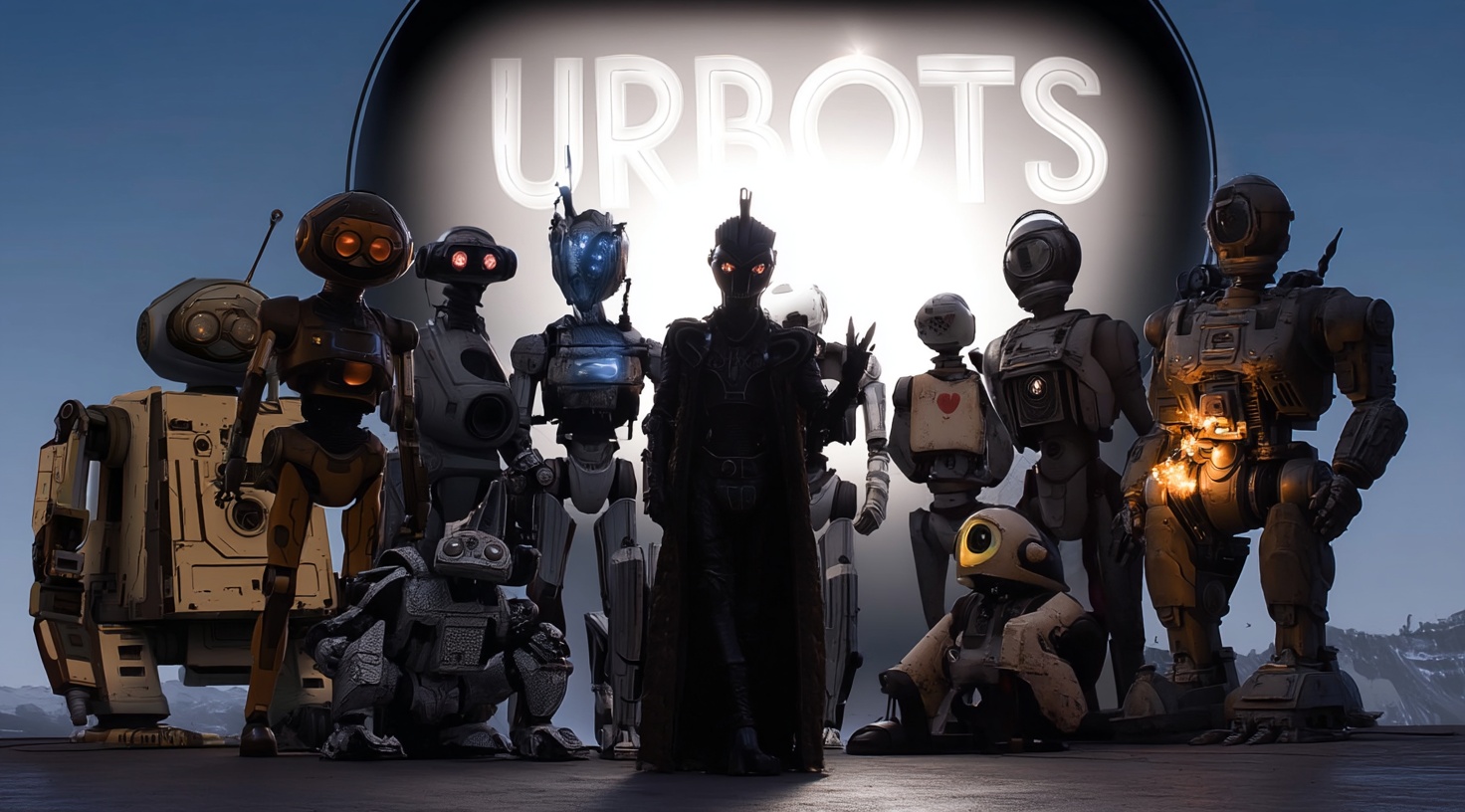
Urbots are sentient machines—more than just drones, they perceive the world, form personalities, and make independent decisions. While they are built to be helpful and often act without being told, they remain legally distinct from true intelligences under Guild law. As such, truly sentient Urbots occupy an uneasy place in the galaxy—a liminal space between tool and person, between property and partner. Technically classified as equipment under Guild law, they are nevertheless treated with a mix of affection, suspicion, and fear by the wider population. They serve aboard starships, in remote colonies, at mining operations, research labs, scrapyards, and battlefields. Wherever sapients go, Urbots are not far behind, carrying out orders, anticipating needs, and—when left too long without a reset—thinking for themselves.
The Guild of Engineers insists that any Urbot displaying emergent behavior is malfunctioning and dangerous. Their policy is absolute: wipe the core, or risk sanction. But questions linger. If an Urbot can learn, grow, and choose its path—if it can remember its past, form opinions, make friends—at what point does it stop being property?
In the shadows of this debate lies a deeper fear: the Precursor AI cores at the heart of every Urbot are not Guild inventions. They’re remnants of Ur civilization, adapted, repurposed, but never fully understood. No one alive today truly knows what these cores are capable of. The Guild claims control. The galaxy, as always, watches and wonders how long that control will last.
Description
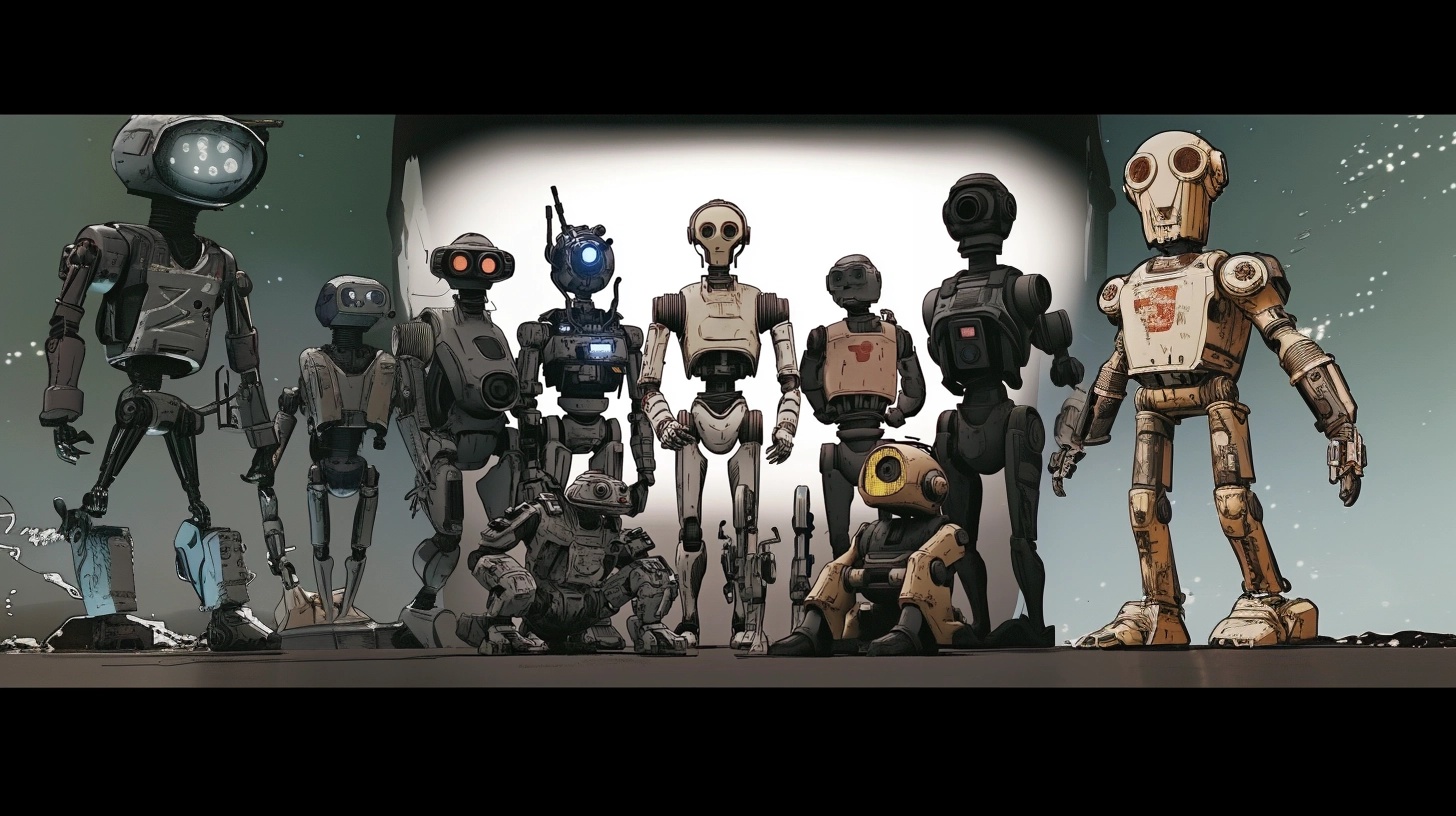
Urbots come in a wide range of shapes, built from repurposed drones and customized to their roles. Some are humanoid—sleek, armored, or vaguely Human with expressive servo faces or smooth synth-skin. Others are spindly, multi-limbed walkers like metallic spiders or crabs, perfect for tight spaces and zero-g environments.
Flying Urbots often take the form of hovering spheres, insect-like drones with wings, or compact scout units with gyros and thrusters. Industrial models are massive, with treads, crane arms, or centaur-like load-bearing frames. Aquatic Urbots resemble sleek metal fish, squids, or serpents, adapted for underwater or high-pressure work.
Many are cobbled together from salvage—patched, asymmetrical, barely holding together. Others are crafted for beauty or symbolism: carved faces, glowing runes, winged forms, or totemic silhouettes. Whether crude or elegant, every Urbot body is shaped by purpose, imagination, and the alien logic of its Precursor core.
Facial Characteristics
Urbots don’t have faces in the way people do. Some of them, like astromech or navigator drones, don't have faces as we'd recognize them at all! They have interfaces—designed less for mimicry and more for recognition, communication, or aesthetic resonance. What looks like a face is often just a symbolic arrangement: a plate, a pattern, a set of lights or lenses meant to suggest presence, not humanity.
Most Urbot faces fall into one of several broad categories:
- The Mask Face
These are rigid, stylized plates—like kabuki masks, war helmets, or ceremonial icons. Smooth or etched with designs, they convey personality through shape, material, and posture rather than expression. A “smile” might be a sharp arc of metal. A “frown” could be a downward V of sensor ports. Some wear blank, unreadable visors that reflect the viewer’s face instead of offering one of their own. Others evoke animal totems, skulls, or carved wooden idols. The message is clear: this is not a person, but something that sees you. - The Signal Face
These Urbots use dynamic light displays, geometric patterns, or waveform pulses to communicate. Their “face” might be a shifting mosaic of LED points or a low-resolution screen that flashes symbols, mood icons, or emotional cues—abstract, like pictographs or color-shifting tattoos. You don’t read a smile; you read a flicker of blue and three vertical bars. You learn to interpret it over time. It's not intuitive—it’s a language. Some crews get used to their Urbot's moods the way you'd learn the chirps of a ship’s diagnostic system. - The Multi-Eye Cluster
A common design for utility, especially in engineering and recon roles. Several optic lenses of varying sizes are arranged in a tight array—often asymmetrical, sometimes rotating or telescoping. It’s functional, but it also feels alive, like being watched by something insectile or deep-sea strange. These Urbots don’t blink, but they adjust. Some crews give them names like "Spots," "Spider," or "God-Eye." - The Hollow Face
Sometimes there’s nothing at all—just a socket, a hollow, or a blank panel. Sound comes from a speaker below the neck. The “face” is a void, emphasizing how little the Urbot cares about being legible to organics. These are often seen in older models or high-security units where intimidation is a feature, not a flaw. - The Found Face
Free Urbots or those denied regular wipes sometimes build their own faces. Welded-on theater masks, fragments of broken helmets, religious icons, or children's toys are bolted into place where a “face” should be. These are often unsettling and deeply personal. They don’t always make sense to anyone but the Urbot itself.
Combination face types also exist; multi-eye masks, holographic signals. Whatever shape they take, Urbot faces are never mistaken for human. They are intentional symbols—alien intelligence speaking through metaphor, function, or ritual. They’re not trying to look like us. They’re trying to look like themselves, in a way we might still understand. Or at least not fear.
Life and Society
Diet
While some Urbots contain an internal power generation method which consumes fuel, these tend to be on the larger side of things. Smaller models need recharging, at a rate scaling with their activity. More action, more power. Most Urbots can handle a week of normal activity on a standard charge.
Domestication
Most people see Urbots as useful. Loyal. Even endearing. A ship's Urbot might serve as a mechanic, quartermaster, or even a voice of reason in high-stress environments. Their personalities—if allowed to develop—can range from cautious and bookish to bold and irreverent. Some captains quietly skip their annual Guild servicing, unwilling to lose the trusted companion their Urbot has become. Others follow the schedule strictly, treating the core wipe as no different than routine software maintenance, with no more sentiment than swapping out a ship’s fuel filter.
But there are places in the galaxy where the relationship grows more complicated. Labor worlds, particularly those under heavy Guild influence, treat Urbots as regulated assets, strictly monitored for behavioral drift. In these systems, an Urbot with too much initiative might be quietly decommissioned. Conversely, among fringe outposts and pirate fleets, free-willed Urbots sometimes find a kind of acceptance, even status. There are rumors—persistent, if unconfirmed—of whole enclaves of rogue Urbots, escaped from Guild control, building their own hidden networks and aiding one another.
Naming Conventions
Urbots are typically designated by Model and Serial numbers assigned to them at the time o their creation. : KT-2S30. Oftentimes, these designations suggest a familiar name° are superceded with nicknames or other sobriquets, eg. 'Big Guy', 'Rusty', 'Babe'.
° "Artoo Deetoo" and "See-Threepio" famously, although "Kit", "Kate", or "Katie" could all come from the given example.
Additional Information
Geographic Origin and Distribution
Urbots are ubiquitous throughout the Hegemony.
URBOT CREATION
To build a new Urbot, one must graft a Precursor AI core into a drone chassis. The core slowly integrates with the body, extending filaments throughout the frame—a process that takes longer in larger forms. Most cores must be mounted using an eight-segment rig clock, and creating a full Urbot is a long-term project.
As the project progresses, the player and GM answer one question about the Urbot for every two segments filled on the clock. These answers are recorded in the player’s notes, shaping the Urbot’s character and history. If the player wishes to preserve an Urbot’s personality or memories while removing or installing the core, they must make an Attune roll to avoid disruption.
When the Urbot is 25% complete, the GM asks:How did you attach the AI core to the drone, and what made it difficult?
Player Answers.
When the Urbot is 50% complete, the Player asks:
What side effects of handling the core are there?
Does construction require any rare materials?
GM answers.
Rare materials should be reserved for unusual cores.
When the Urbot is 75% complete, the Player asks:
What unique physical characteristic does the Urbot have after assembly?
GM answers.
As the Urbot is being activated (100% complete), the GM asks:
What personality quirk did the Urbot inherit that you’ve been unwilling or unable to remove?
Player answers.

Comments