

Temple of Ishkibal the Dragon
Draconic Ishkibism
Ishkibism is a religion that believes that world is a terrible site of struggle that can be saved through redemption and through courage against evil. It is a militaristic religion that incorporates martial training into its community worship. It is also a religion laced with species-prejudice, as Dryads and Prisms are seen as having demonic heritage that can only be overcome with penance, prayer, and ritualistic purification.
The Temple of Ishkibal the Dragon is a splinter-sect of that religion that tones down the militarism and the prejudice. The Temple also introduces major theological changes: it teaches that the Lunar God Ishkibal, supreme prophet and chief god of Ishkibism, is actually an aspect of a Supreme Good God called the Divine Dragon. The Divine Dragon, typically also called Ishkibal or perhaps Asala, is the source of all magic on the planet and moves physically through the weave of magic to redeem and lift up. The Divine Dragon formed Ishkibal the Man as either an avatar or a mortal son to teach good to mortals. Through the Divine Dragon, Ishkibal is both alive and in all places. In this way, the 'Demon Gods' have had their influence over the world dampened and all demonically-blooded species are born without any malign influence.
The Temple of Ishkibal the Dragon may disagree with mainstream traditional Ishkibism on important points, but the Draconic Temple works with the First Temple of Ishkibal quite readily: when the holy city of Kenahai comes under attack, the Draconic Temple sends soldiers and supplies. The Draconic Temple has its own leader and its own organization, but they are on good terms with the other Ishkibites of Izekra.
The Temple of Ishkibal the Dragon is based out of the city of Asalay and local Azalen beliefs have deeply influenced the Temple's rituals and teachings.
Structure
The Temple of Ishkibal the Dragon is organized in the following ranks:
This system organizes followers into geographic zones called Ecclesia. Each Ecclesia is composed of different regional Conclaves (overseen by their associated Archpriests). Ecclesia are perhaps the most important regional division, as they have significant autonomy.
There are six Draconic Ecclesia, pictured below:
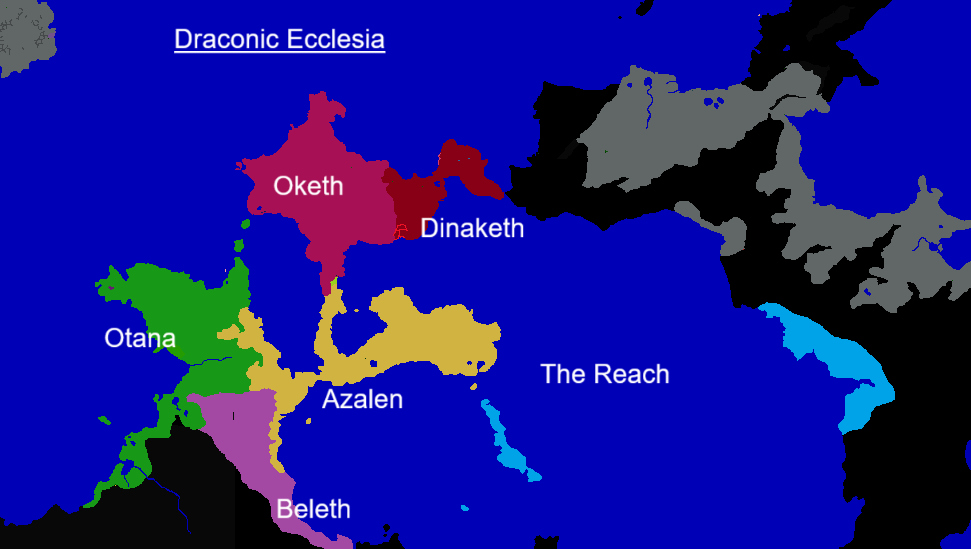 This map also includes territories not under Ishkibite political control but which Ecclesia lay claim and preach to.
Of these six Ecclesia, only four serve the Draconic Eminence alone:
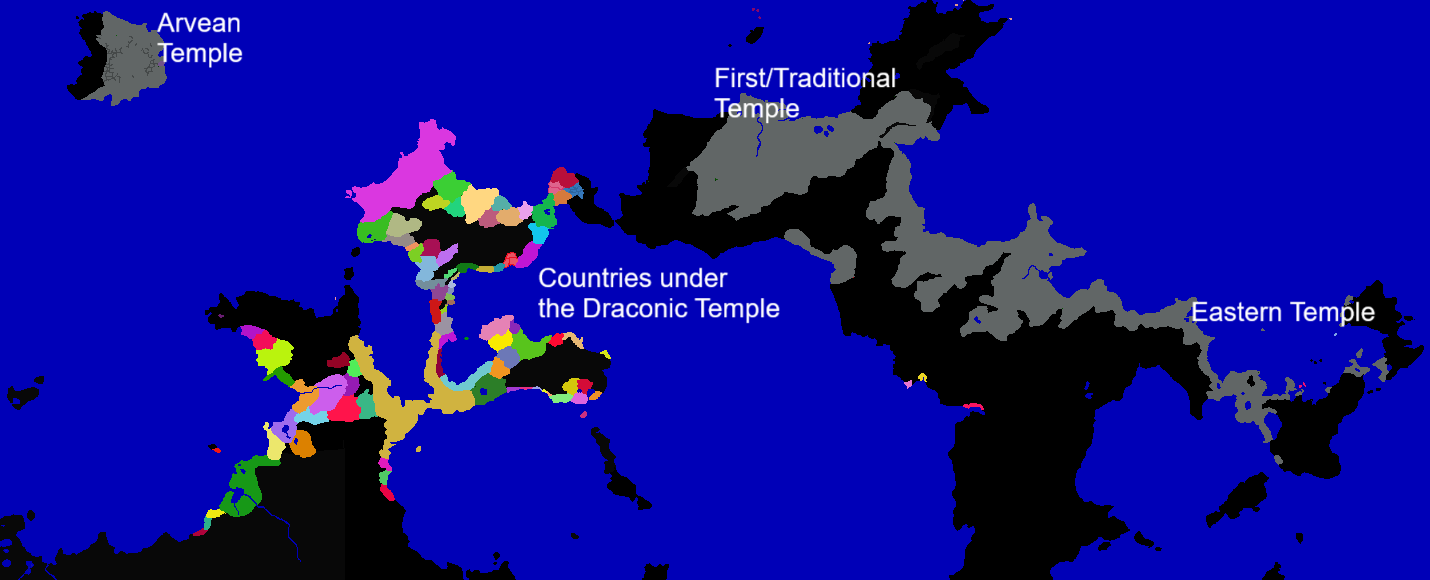
This map also includes territories not under Ishkibite political control but which Ecclesia lay claim and preach to.
Of these six Ecclesia, only four serve the Draconic Eminence alone:
- The Draconic Eminence leads the Temple as the top authority and holiest spiritual figure. The Eminence is chosen by Ishkibal from a roster of the Temple's greatest paladins and priests
- Temple Elders are the top priests immediately under the Eminence, who act as their advisors and who manage core temple functions
- Ecclesiarchs are the top priests of larger regions, chosen from Ecclesia (regional councils) by the Eminence or Ishkibal
- Archpriests are the regional priests, who manage temple clusters. Chosen either by priestly election or by the Ecclesiarch.
- Temple Priests manage individual temples or congregations
- Acolytes are apprentice priests who serve the temple full-time. They may become Temple Priests or they may take on other administrative work.
- Shrinekeepers are pious layfolk who serve the temple but often also work other jobs
Ecclesia
- The Azalen Ecclesium is the core of this organization and is more or less directly controlled by the Draconic Eminence.
- The Otanan Ecclesium preaches in the West and often conflicts with the Halikvar there. Very evangelical and intolerant of rival organized religions.
- The Okethi Ecclesium preaches in the North and is known for its sly political games. They also have a lot of competition with the Halikvar, but they are known to be far more cordial and cooperative with the druid-priests there. Still, the Okethi Ishkibites are working to achieve political dominance over the Halikvar in the region's great kingdom of Lurelay.
- The Beleth Ecclesium preaches in the South and ministers to the tropics. This Ecclesium is known for their evangelizing missions, syncretic leanings, and their complete rejection of Traditional Ishkibite prejudices.
- The Dinaketh Ecclesium preaches in the Northeast, and is entirely focused on the brutal wars of religion there in Dinaketh. Decentralized, militarized, and zealous. Also reports to the Traditional Temple.
- The Ecclesium of the Reach is a Draconic Ecclesium in the Izekran Isles and the Flower Coast. This is a group of Ishkibites loyal to the Draconic Eminence, but they are in competition with several parallel Ecclesia in the region who serve the Traditional Temple and the Eastern temple.
Culture
Species: Favoring the Common
Purity and Impurity
History
The Temple of Ishkibal the Dragon has very old roots in the area around Asalay, though it has only blossomed in the last few centuries.
In the oldest days known to history, the people of the Asalay Isthmus worshipped the Goddess Asala as their patron deity. Asala was seen as a powerful goddess and ancestral hero who was the first of their people and who watched over them from her prison in the Underworld. She was the spirit of the megadungeon there who was said to manifest as a powerful silver dragon who often walked as a woman with silver hair in the magical depths under Asalay. The Azalen people and the city of Asalay borrowed their names from this patron Goddess, it is said (though it is a bit of a chicken-or-the-egg situation).
In the 500s ME, the keepers of the magical realm under Asalay organized as a warrior-cult devoted to Asala known as the Order of the Dragon. Asala became known as Asala-Yakara, or Draconic Asala, as reports and interactions with her the mysterious silver-dragon woman grew. The Order of the Dragon grew in religious importance as their expeditions became more profitable and important to all parts of society. And when they brought Flowyrms from the Underworld, the Azalen people agreed that these creatures were proof of Asala’s blessings.
The Order of the Dragon fell into civil war and was subsumed by a rising monarchy in the 750s ME, but their doctrine and rituals remained. And as the Kingdom of Asalay expanded militarily, they brought their patron God and their religious beliefs with them. This early religion was tolerant of conquered gods and beliefs and wasn’t very dogmatic, but these conquests still spread Asala’s cult and introduced it into new political contexts.
In 875 ME an Ishkibite missionary converted Asalay’s monarch, Efeden Melidanvia, to Ishkibism. Efeden didn’t just convert and bow to the Ishkibite Eminence, though. He built his own priesthood, which incorporated many leaders of the old Dragon cult into the new temple structure. The old traditions would, in Efeden’s thinking, keep these foreign priests under the monarch’s control. And so a highly syncretic local temple was formed. This early Temple of the Dragon was very fluid and unstable theologically. Some members rejected traditional beliefs, while others just draped Ishkibism over them.
For centuries after, Asalay’s religion was a weird mix of state-sponsored cults all wearing the shared symbols and labels of Ishkibism. Over time, these cults learned to get along and found a common language of symbols and stories to bridge the gap between them. And as Dungeoneering into the Underworld grew into a larger source of income and influence, foreign Ishkibites came to respect Draconic Ishkibism as a necessary form of mysticism for generating wealth and power for the whole religion.
In the mid-late 1000’s ME, Ishkibal himself began intervening in favor of the Draconic Temple. In prior centuries, he had plainly disagreed with the Draconic legends and beliefs of the Temple. But suddenly, the Sage himself began to agree with the Draconic Temple as more correct than his original one. This led to a whole crisis of theology in the First Temple, which was eventually resolved by the priests in Kenahai deciding that the older writings were inherently more correct. But this sudden change in favor led to some dissident priests going to Asalay to find the “true Ishkibism”. These dissident priests were far more concerned in “truth” and “dogma” than prior Draconic cults, and their writings formally differentiated the Temple in Asalay from the Temple in Kenahai. By 1150 ME, the Temple of Ishkibal the Dragon was a full competitor to the Kenahai temple.
Before the two Ishkibisms could fight, an outside force suddenly invaded that forced cooperation under Ishkibal’s guidance: the Halikvar invasion of 1150. This began centuries of religious war between Ishkibites, Halikvar, and Orthodox Desmianism. All this war created strong institutions binding the different Ishkibite sects together. And over time it became far more profitable for the First Ishkibite Temple and the Draconic Temple to cooperate than to squabble over dogma. If Ishkibal approves, why not work with them?
In 1250 disaster struck Asalay: tunnels collapsed in the Underworld, monsters swarmed those that remained, and the city’s trade in magical materials and precious metals suddenly halted. While the crisis subsided and repairs were made, the damage to the city was lasting. In the 1300s, a major civil war collapsed Asalay’s government, leaving the Draconic Temple autonomous but in a state of dwindling influence and wealth. The new government completely cut the Draconic Temple out of government, opening The Underworld to outsiders and selling off sacred lands.
The Draconic Temple fought back, but increasingly had to rely on a powerbase outside of the city of Asalay. A long period of decline followed, during which the First Temple once again threatened to absorb the Draconic one. The Draconic Temple became more militaristic and defined itself more and more through the rejection and wars with the Halikvar and the Desmians.
In the late 1400s, as Asalay began booming once again, the Draconic Temple used what influence it had to re-assert its power over the Underworld and its rights to power in Asalay. An assertive and ambitious Draconic Eminence, Benethin the Brave of Oketha, gambled everything on a grand political push in Asalay. And while Benethin appealed to the citizenry’s sense of piety and sanctity, he also positioned the Temple as a financial institution in the city. The Temple became a merchant house, adventuring sponsor, and monstercrafting guild, using its moral authority and financial clout to consolidate control over the largest entry into the Underworld - what would become known as the Golden Gate.
This bold strategy made the Temple many enemies, including the royal dynasty of Asalay at the time. The Temple battled with mercenary companies, rival noble factions, and the crown itself over the next century. This culminated in the monarch’s attempt to abolish the Draconic Temple in 1590, which failed and led to the Draconic Eminence ousting the monarch in 1595. A period of intense political and violent conflict ensued from 1595 to 1616. In 1616, a new dynasty, the Yakaranvias, seized the throne and launched a series of purges targeting unruly mercenaries and nobles. The Yakaranvias reconciled with the Draconic Temple and forged a new peace between secular and religious authority in Asalay.
After the 1616 pact between King Malven Yakaranvia and Her Draconic Eminence Meldatha the Shrewd, the Draconic Ishkibite Temple was back to being stable and influential. The Temple was also quite autonomous from secular authority, after centuries of distance between church and crown. The new dynasty also wanted a state with room for foreigners of many faiths, to best capitalize on growing foreign immigration and trade. The new dynasty invited an ambitious selkie clan known as Clan Mikiraka into negotiations with crown and temple, and over the 1700s a number of leading priests were quite dissatisfied with the surging number of heathens in their holy city. And yet, the 1616 pact guaranteed space in the city for them.
The late 1700s and 1800s were a time of institutions - and the 1616 Pact and Mikiraka Pact provided legal foundations for a new system: the Banots. The Banot system has old roots in early foreign enclaves and the rules around them, but the Temple and Crown overhauled this system into an elaborate formalized ruleset in the 1700s. There was a lot of fear surrounding mixed-faith neighborhoods. These were finally legalized in 1840, following the 1830s succession crisis and the rise of a new royal branch (the Laranharta-Yakaranvias). This easing of the Banots came with even more lawmaking and court precedence. The Temple of Ishkibal had gone from overtly mystical back in the 1500s to extremely legalistic, as the city had entered a new era of institutions and control. While Eminences of old had been suspicious of foreign heathens in the sacred Underworld, new Eminences played the game of capitalism quite well. Indeed, by 1962, the Temple of Ishkibal the Dragon’s bank had become the kingdom’s de-facto public bank and a major financial institution for corporations foreign and domestic.
While the Draconic Temple has perfected its role as the “chill, nice Ishkibites” in Asalay, they have certainly done their share of warring and espionage against neighboring heathen kingdoms. But even that has begun to wane: in 1980, the Temple of Ishkibal the Dragon signed an Edict of Co-existence and Tolerance with the Halikvar of the Kingdom of Lurelay. In doing so, the Temple has set a precedence for peace over war - soft influence over hard violence.
Ancient Azalen Religion
The Early Temple (875 - 1250)
The Shadowed Era (1250 - 1616)
Modern Changes (1616 - Present)
Mythology & Lore
The Story of Creation
The Story of Salvation
Cosmological Views
Ishkibite cosmology sees Good and Evil locked in an eternal battle. Every good act strengthens the ancestors and Gods; every evil act feeds the Demonic Gods. The Struggle is not only a physical contest of arms, but the everyday choices to be honest, to be welcoming, to be dutiful, to be pious over temptation. The afterlife is divided between the Pure Lands of the just and the Torment of the Impure.
Evil and good are transformative both spiritually and physically. By performing evil acts, humans can become demons; by seeking redemption, any physical demon is transformed into a person.
Tenets of Faith
- The Faithful is Dutiful, Relentless, King, Generous, and Brave.
- Evil and Good are both Inherent. The Faithful must seek the good in themselves at all times, lest they fall to the evil
- The True War Wages Within. You can and must become a better person. It takes constant effort to be good and improve, but it is what you and those you cherish deserve.
- Redeem and Forgive when you can. If possible, seek the good in those you meet. Slay those demons who threaten the innocent, spare those you can.
Worship
Draconic Ishkibites attend a weekly purification ritual, known as the Cleansing March in mainstream Ishkibism. Unlike in other sects, the Draconic Cleansing March has very few physical training components and is far more oriented to moral guidance, penance, and community identity building.
During the Day of Blood, which is thankfully not a day where much or any actual blood rains, the Draconic Ishkibites hold a grand feast and sanctify each member by dousing them with ritually-prepared water. This water represents the Celestial Blood of Ishkibal and may include red dyes. Some elites actually get real Cursed Blood from Izekra and Desmia for their rituals, or provide this blood to favored communities as a spiritual donation. The faithful often pay tithes before this holiday as well.
Outside of these community rituals, individual Ishkibites may give prayer to Ishkibal and the Divine Dragon for blessings or to ask for forgiveness.
Priesthood
Draconic Ishkibite priests wear black and white robes to mark their status. Priests are recruited from among the Acolytes, who wear mostly-Black with white fringes, and who act as apprentice priests and temple staff. Temple Priests often handpick their successors, but if there is no pre-ordained heir the Archpriest selects their replacement. Archpriests may also select promising Acolytes to become full missionary priests, detached from a Temple and sent to minister to foreign lands.
Priests preach to the public, conduct community purification rituals, hold penance meetings with the faithful (during which the faithful report sins and ask for the appropriate act of penance for forgiveness), and oversee temple functions.
Archpriests often wear a white collar or neckband, usually sewn with a sword-like pattern.
Ecclesiarchs often wear red or purple fringes. Red usually signifies a war-footing, while Purple is more expensive and marks a desire to redeem.
"Ishkibal is Everywhere"
Founding Date
875
Type
Religious, Sect
Demonym
Draconic Ishkibite
Parent Organization
Permeated Organizations
Deities
Location

Comments