

Dohobeb Priest-State
The Dohobeb is the sacred order of the world. It is right and wrong, good and evil, law and sin. It defines the fundamental nature of things and assigns all things to their places. The rituals of the Dohobeb are said to regenerate and preserve the world, while all actions taken against the Dohobeb weaken the world's foundations and strengthen the forces of evil. The Dohobeb preaches a binary worldview: there is Good embodied by the Good God Kailio and there is Evil embodied by the Evil God Apex. The Great Otter wars against the Father of Darkness at all times and we must do our part to help that Otter win.
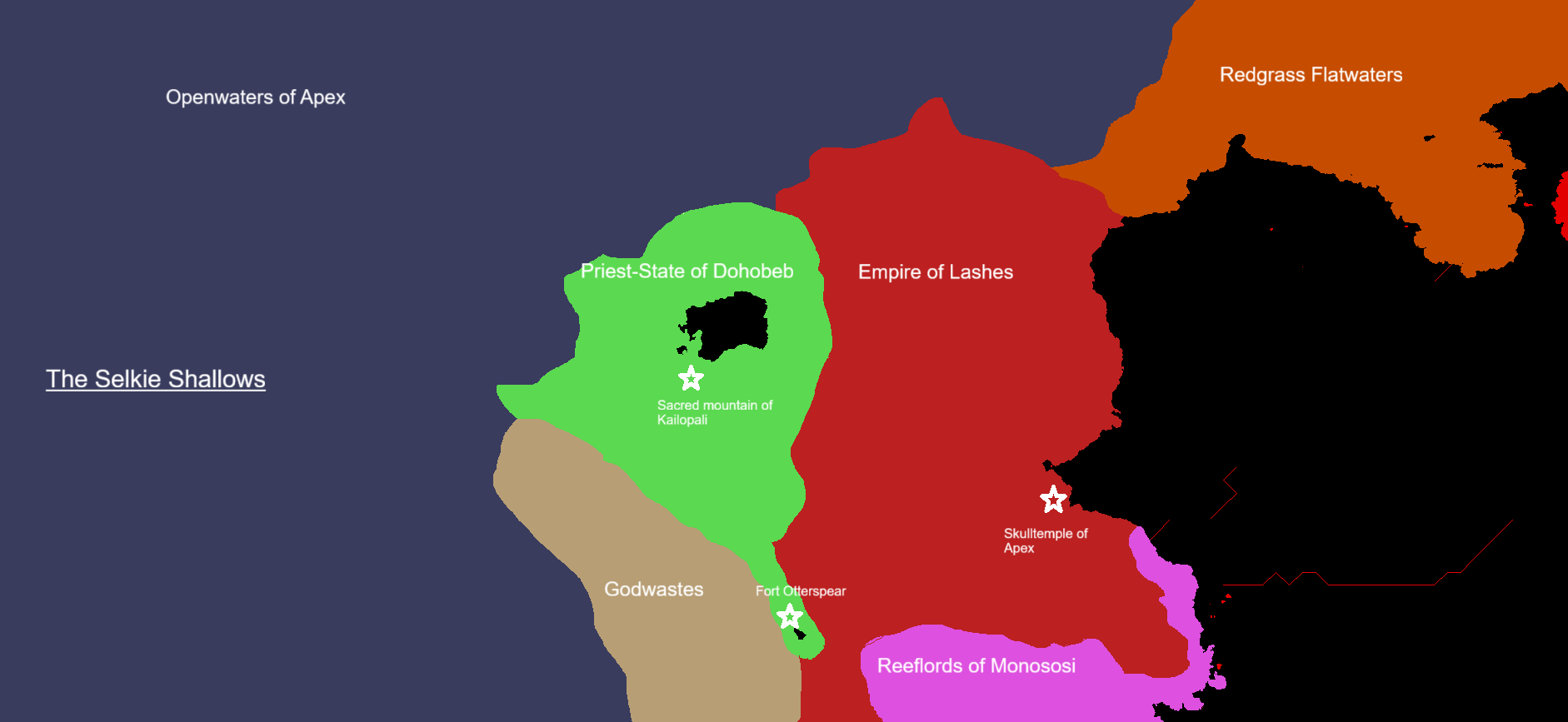
The Dohobeb Priest-State is the political organization built to enforce that Dohobeb worldview in the Selkie Shallows. The priests control the underwater territory immediately around the Khilaian Isles and are based in Kailio's sacred underwater mountain of Kailopali. The priests see the religion and government as indistinguishable; Kailio is their leader and their God and his will is their will. Practically speaking though, the Great Otter is not making policy decisions. Kailio is a sleepy demigod-kaiju with great power and a very narrow focus on responding to threats, and he has no desire to set taxation policies or make infrastructure decisions. He can be convinced to weigh in on issues with bribes of food and entertainment, but he considers himself to be a protector rather than a ruler.
The Dohobeb is an aquatic Cephaperson polity with no influence on the surface world outside of some minor trade relations and elite communications with the nearby Selkie Khilaia. The two groups prioritize sharing the space and avoiding conflict rather than materially helping each other.
Structure
The Dohobeb is ruled by a group of priests known as the Heart of Kailio, who operate out of a large woven fortress-temple at the base of the underwater mountain of Kailopali. The Heart of Kailio is headed by the Primeheart, a council of five elder priests who are Kailio's favored attendants. Beneath the Primeheart are the Twin Brachials, two five-person council "hearts" that manage much of the day to day duties of the government. The Brachial of Prosperity coordinates tribute gathering, farming, herding, infrastructure, and conflict dispute; the Brachial of Strength handles war, hunting, fishing rights, and trade. There is also the Farheart, a group of three priests intended to serve as the chief government in Fort Otterspear - the chief military base outside of the prime island zone.
Each of these councils is advised and supported by a small staff of Heartwards, the elite priestly caste of Dohobeb. Every cephaperson to receive direct instruction from Kailio is considered a Heartward, and the entire caste is conceptualized and understood as the household staff of the Great Otter himself. Theoretically, every Heartward Squid has been personally chosen by Kailio, but in reality most of the Heartwards are chosen by one of the councils from among the lower priesthood. The Primeheart also chooses which councillors will serve on the Brachial councils, and Brachial Councillors are selected among the elite priests whenever a new Primeheart Councillor is needed. The Farheart Councillors are chosen by the Brachial of Strength, as they are more-or-less the emissaries of that council.
Beneath the Heartwards are the Tendrils: the lower priesthood, who act as the managers, officers, ritual specialists, and civil servants of the Dohobeb. The Tendrils make up the vast majority of the Dohobeb government. Tendrils account for most positions of power in Dohobeb waters, and the rank of a particular Tendril depends on how much power was invested in them by a patron. The Heartwards can change a Tendril's relative rank with ease; if a Heartward decides that a Tendril warleader is less competent than their underling, the Heartward can have their positions switched with a word as long as the order doesn't contradict that of a higher-status Heartward. This makes for administrative chaos at times, but that is avoided by having the various councils delegate out command to favored Tendrils. These Favored Tendrils are the generals, overseers, and chiefs of staff, but their status depends on maintaining favor with the Hearts. The Dohobeb is not large enough to have much of an advanced or hyper-specialized bureaucracy beyond these individualized chains of command. New groups may be made when problems arise, and dissolved when the problems are solved.
Below the Tendrils are the Commonsquid, which comprises of every Cephaperson outside of the priesthood. The Dohobeb has relatively egalitarian ideals for the commonsquid - that every faithful member of the community should live as equals. Some individuals and groups are regarded with higher status and afforded more access to resources as a result, but there are few formal castes or hierarchies outside of the clergy. There are only two categories of person below the average commonsquid in terms of law: the penitent and the foreigner. Penitents are essentially criminals, screwups, or deviants who have in some way violated the community laws and norms of the Dohobeb. Penitents carry signs of their transgressions and generally are sentenced to more odious and grueling jobs. Penitents who have done something truly terrible, like murderers, live degraded lives as community servants - this status is not inheritable, nor does it reduce them entirely to property. Foreigners, meanwhile, are meant to be welcomed but have no legal rights as people until they are initiated into the Dohobeb. There used to be formal categories of foreigners and their descendants, but Kailio dissolved those categories into a clear binary some decades ago. While this led to many foreignborn cephapeople gaining full rights and status, it also meant that protected foreign categories were dissolved. Now, killing a foreigner isn't a crime - though a commonsquid killing a peaceful foreign merchant will almost certainly attract the ire of a Tendril. If there are no witnesses, or if a Tendril is the one endorsing such violence, though? Bad luck to be an outsider. The core waters are almost always safe for foreigners to be in, but a rich traveler in peripheral waters may be a target for legal banditry.
Culture
The Island of Civilization
Optimism and Confidence
Sharing and Inclusion
Demography and Population
Between 1 and 2 million people live in the Dohobeb - estimates are hazy. The population is 85% Squiddle, 10% Cuttlefolk, and 5% Octoperson.
Territories
Dohobeban waters reach 450 miles across at their longest point and are 270 miles wide.
Military
The Dohobeb has two standing armies: the semi-feudalistic central commanders, who are assigned to posts on the periphery of the main territory of the Dohobeb, and the Forward Army at Otterspear.
The central waters of the Dohobeb are protected by the Favored War-Tendrils, a dozen or so powerful commanders. Each commander has ten assigned captains, each of whom operates a warband of ten to one hundred warriors. These Favored War-Tendrils have significant autonomy and report directly to the Brachial Council of Strength at Holy Kailopali. Warriors are recruited more-or-less profesionally rather than as levies, and each captain is assigned a fief of territory to collect food and supplies from through their civilian government liasion. Warriors are often recruited from these peripheral territories as well. These outer garrisons often engage in trades and farming when there is no active threat - in areas of lax leadership or low danger, they are basically militia.
The Forward Army, meanwhile, is a more disciplined and active fighting force with a dedicated supply line back to the Sacred Mountain and an entire civilian community at Fort Otterspear dedicated to producing military supplies. The Forward Army is directed by the Chosen General, the most respected and revered military officer in the state who is directly overseen by the 'Far Heart' (emissaries of the central government). This force is smaller than the central garrisons, but is more consistently drilled and dedicated towards combat alone.
Dohobeban fighting is all about a mix of highly mobile javelin-armed skirmishers, axe-and-spear wielding heavy infantry, and mobile fortifications. Sledge-mounted woven structures are dragged onto battlefields as bases and fortifications, and fighters within use a mix of javelins, pikes, and spears to make direct attacks hazardous. These mobile defenses then serve as supply hubs and bases of refuge for the skirmishers, while heavy infantry waits nearby to move in to charge any enemy who approaches. Pikes used from below are often used in block formations as well, driving the enemy up while skirmishers seek to flank and lob javelins on the retreating enemy from above. This mix of combined fire and coordination can easily disorient and frighten less-coordinated enemies - these battle tactics were incredibly effective against the "Hundred Nation Horde" a century ago. Unfortunately, the new enemy of Dohobeb (a warlord named Ten-Lash) has been far more successful in exploiting the predictability and slow movement of this fighting style.
Agriculture & Industry
The economy of the Dohobeb is overwhelmingly agricultural. Crabcow ranching is common, as is shellfish farming. Dohobeban agricultural practices overlap with their fish-hunting and fish-farming practices: Dohobebans curate and garden the local seagrass and weave seagrass clusters into useful fish and crustacean nests. Essentially, they create a landscape of woven seagrass semi-reefs. This is a unique semi-wild ecosystem that has thrived over the last few centuries. Reef fish have even started to adapt and move into the region, competing with the local indigenous fish. The magical calm created by Kailio helps keep this environment pristine, though it also takes immense effort in the part of the Dohobeban people.
The Dohobebans are largely rural and are dispersed into many villages across the territory. Many villages include elaborate woven structures that combine mud-packed seagrass and stone. Woven buildings are even placed on sledges and pulled by Crabcows and Giant Lobsters.
Every part of Dohobeb's economy relies on that relationship between people and seagrass - it is the source of Dohobeban architecture, basketry, clothing, agriculture, and infrastructure. Specialty seagrasses have been more or less domesticated as well and refined for their consistency, color, weight, flexibility, and durability. Dohobeban baskets are well-regarded: they are so carefully woven and tightly bound that they are actually water-tight and serve as perfect liquid seals.
Trade & Transport
Once, the Dohobeban army was actually very involved in trade. Promising warriors were sent out with goods as training caravans to gain battle experience, learn new styles of war, and make a profit abroad - and were rewarded for their success with loot and rewards. These expeditions were called "armed pilgrimmages" and at their peak they essentially transformed Dohobeb's fighting force into a sprawling mercantile web. These caravans have become extremely rare in the last thirty years, after the fall of Dohobeb's nearest ally (the Reef-State of Monososi).
Groups of warriors still go on "armed pilgrimmages," though these often turn out to be little more than minor raids and scouting missions. The ambitious youth who carry goods with them and venture out to seek the old trading partners usually never return, and such expeditions are discouraged. The Otterine Banner, the flag carried by trade-warriors to mark their status and discourage raids, has gone from a badge of safe passage to a dinner bell for opportunists.
"By the Otter We Hold Up the World"
Type
Geopolitical, Theocracy
Capital
Demonym
Dohobeban
Government System
Theocracy
Power Structure
Unitary state
Currency
Shell-tokens, which represent baskets of food
Deities
Location
Controlled Territories
Neighboring Nations
Notable Members
Related Plots

Comments