
Roderic's Cove
A Town of Salt & Silence
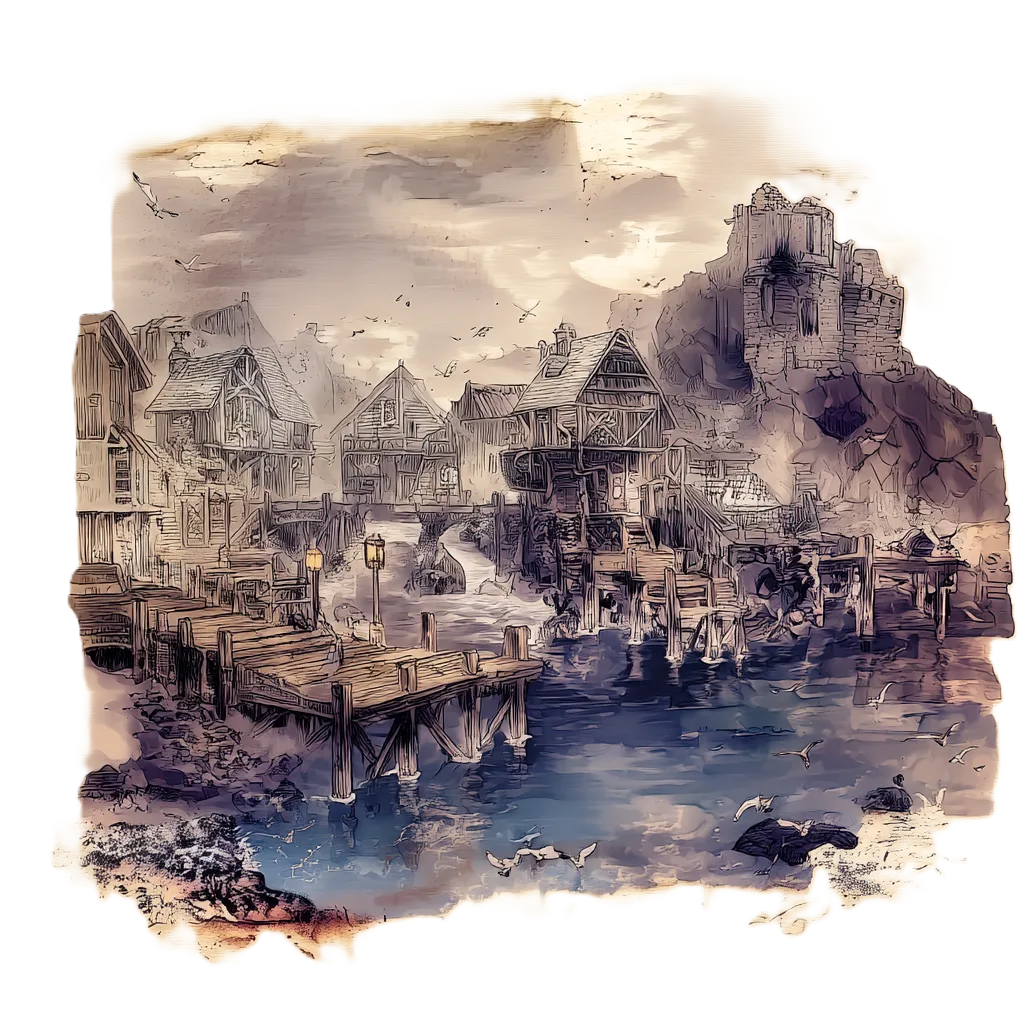
They call it Roderic’s Cove, after a privateer long turned to dust. But what remains here now is no bastion of light. Just a crooked cluster of salt-worn homes clinging to a haunted shore, where the gulls scream louder than the prayers.
You can smell the town long before you see it. The stench of fish seeps into the wind, mixing with the smoke of seaweed fires and the damp of old timbers that have never known a dry season. The cliffs rise grey and jagged to the east, crowned by the shattered bones of Roderic’s Wreck; the ruined remains of the founder's home and a place locals respect, though most are too afraid to climb it.
The people here live small lives. They mend nets, mend roofs, and whisper to ghosts. There’s a story for every shadow; the drowned knight, the weeping widow, the child who never stopped crying. And in a place so crowded with hauntings, no one dares make room for the living. They fear what they cannot name, and hate what they fear. Especially when it looks back at them with the eyes of their enemies: yellow, wild, and unyielding.
That was how Roderic’s Cove greeted the orphan of our story.
They found him on the shore one morning, wrapped in nets and seaweed, half-dead from the cold. No one knew where he came from. No one wanted to. An old fisherman dragged him out of the surf, muttered something about bad omens, and left him at the orphanage door. The women there tried, I’ll give them that. But when the babe growled instead of cried, they took it for a sign. Agr’ro, they called him - half a laugh, half a curse - like the sound a beast makes when it’s trying not to bite.
He grew up in the alleys and markets, where fish guts and rainwater were his first teachers. Some tossed him coins for hauling nets or scrubbing decks, others tossed stones for daring to exist. The kindest souls left him scraps of bread and looked away before anyone noticed. And yet, for all its cruelty, the Cove shaped him. Its storms taught him how to stand, its silence how to listen. Every sneer and beating became a lesson in restraint - not because he lacked the strength to strike back, but because he knew that one day, he would.
A Light by the Cliffs
But even in a place like Roderic’s Cove, the sea gives a man one kind day now and then - just long enough to make him forget she’ll take it back.
Time passed, and the boy became a man. The anger dulled, though never vanished; like an ember hidden under ash. He worked the docks when the captains would have him, carried crates, patched sails, hauled nets. For a while, folk almost stopped staring. Almost.
The Cove can pretend tolerance the way a snake pretends sleep.
It was during one of those quieter seasons that she came - Anya, the stranger from the south, and by all accounts, a strange one indeed. Pale as moonlight, eyes like the dawn, hair long and straight like liquid silver. Folk stopped to stare; not because she was beautiful (though she was), but because she didn’t belong. In Roderic’s Cove, difference is a mirror people can’t stand to look into for long. Some whispered she was blessed, others took her arrival as a new curse. She was an aasimar, though no one dared say it aloud. Around there, being touched by angels gets you treated about the same as being touched by orcs: folk don’t like what reminds them of the heavens or the hells.
She had come looking for peace. She was simply tired of being worshiped, judged, expected to shine. And Agr’ro was the only one to understand that kind of exhaustion.

Anya took work mending nets, singing soft while she worked; songs no one recognized, full of stars and faraway places. Agr’ro watched her from the pier at first, same as the rest, but where others saw strangeness, he saw peace. When she looked at him, the whole harbor seemed to breathe for the first time in years.[ At first, they spoke little. A nod on the docks, a shared meal when the rain drove everyone else indoors. But little by little, the walls between them began to crack. She didn’t flinch when he looked her way. When he offered to carry her basket home one night, she smiled - simple, unafraid - and that was it.
Aye, I see your faces. You think it sounds like a fairytale. And so did they.
They’d walk the cliffs at dusk, her hand resting on his arm, the wind tugging at their clothes. She’d tell him stories about skies without storms; he’d tell her he didn’t believe such places existed. She’d laugh, and Agr’ro would believe her, because in her smile every impossible felt suddenly real.
And so, just as naturally, they built a home.
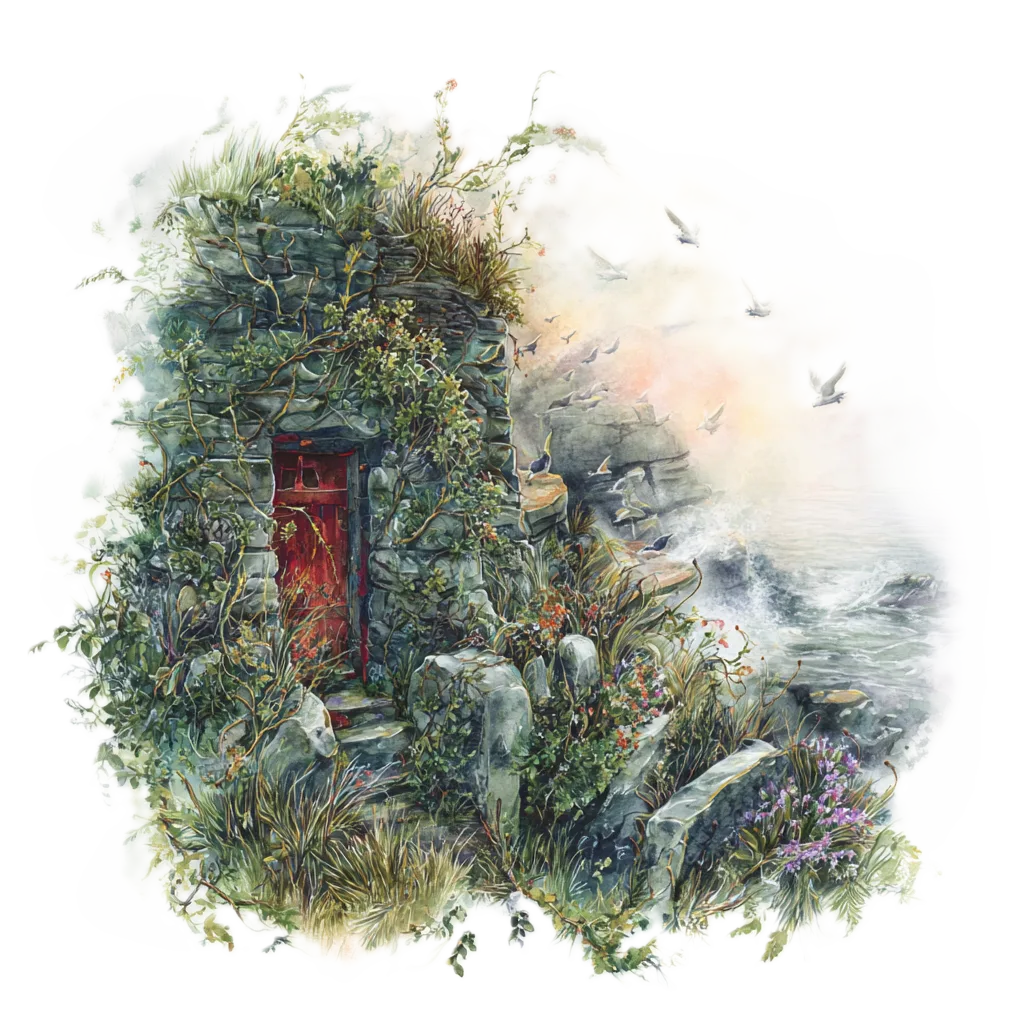
It was a crooked little house with a red door and herbs growing in clay pots along the sill. The sea stretched wide before it, the town crouched small behind. Out there, they could breathe. From their window, Roderic’s Cove looked almost kind. Lanterns flickered along the harbor, smoke curled from the chimneys, and the sound of the waves drowned out the gossip. To them, the town wasn’t a cage anymore - just a distant noise. For the first time, Roderic’s Cove seemed to forgive them. Maybe even bless them. The gulls grew quieter. The fishermen stopped muttering when Agr’ro came to trade. Children, braver than their parents, sometimes waved from the docks.
For a while, that was enough.
The Turning Tide
"You can live your whole life thinking the sea is cruel because of the storms.
Truth is, it’s the calm between them that breaks you.”
For a few years, their peace held exactly as they imagined it.
Anya’s laughter filled the cottage, her songs drifted down to the harbor - soft, lilting things about love and color and the small kindnesses most gods forget to mention. Folk said her voice could still the waves, though they said it like a warning, not a blessing.
She worshiped Shelyn, the Lady of Beauty and Art, in her own quiet way. No altars, no sermons - just melody, gentleness, and the belief that beauty could heal what the world broke. Agr’ro had never understood faith before her. But when she sang, something inside him - the part that had only ever known rage - went still.
When her belly began to swell, he almost believed the curse had lifted. He swore their child would be born into that same light. He worked the docks from dawn to dusk, saving what little coin he could. He built a cradle with his own hands, lined it with bits of sailcloth and herbs she loved, and praised his luck in silence, afraid that speaking it aloud might scare it away. She sang to the growing life inside her, voice clear through the cottage walls. The town listened, even when they pretended not to.
Then came the seventh month - and the music stopped.
The pain struck without warning, sharp and merciless. She fell in the garden, breath caught between screams and prayers. Agr’ro ran for help to the town, boots sliding through the mud, heart pounding louder than the surf.
He begged. He shouted. He offered coin, labor, his very soul - anything.
But door after door, all stayed shut. Faces watched through cracks in the wood, whispering of curses and punishment. Even the local priest barred the temple door, muttering that some fates are best left to the gods.
After a while that felt like eternity, one man stepped forward. He was a traveler, an alchemist bound for Riddleport. Thin, polite, the sort who studied people like puzzles. He said he’d help. Agr’ro didn't have to think it twice - he just led him back through the rain.
The man worked through the night while Agr’ro waited outside, hands bleeding from where he’d clawed at the doorframe. The candlelight flickered behind the shutters; Anya’s cries rose and fell, until they didn’t.
The alchemist came out near dawn. His face said what his words barely needed to.
Neither mother nor child had made it.
Agr’ro went back inside.
He sat beside her for hours, holding a hand already cooling, whispering words that weren’t prayers but sounded enough like them that maybe Shelyn heard. Then he took her wedding ribbon, tied it around the small, swaddled bundle the alchemist had left, and carried them both to the garden. He buried them there, beneath the herbs she tended and the door he had painted red - in the home they had built together to hold their common dreams.
When the tide came in, Agr'ro didn't move.
And by the time it went out, he was gone.
Favor for a favor
You know what, friends? Grief doesn’t end when the tears do. If you let it, it just dries into something sharper. And that’s exactly what happened to Agr’ro, and to Roderic’s Cove when he returned.
Because he did return. And, as he once said, he only came back to return the favor… and pay off the debt.
For a while, the people of Roderic’s Cove thought Agr’ro was dead. Some said he’d thrown himself from the cliffs. Others swore they’d seen him walking the sea floor; a drowned man turned into another haunt. Either way, the town sighed with relief.
But as you already know, Agr'ro was not dead at all.
Now, you’ve heard of Riddleport, the city that stinks of smoke and secrets. That’s where he found his uncle: Captain Scarbelly, a man with salt in his veins and blood in his prayers, the kind who’d sell his own shadow if the price was right.
Agr’ro didn’t ask for coin.
He asked for a place. A deck. A cause.
And his uncle - gods curse him - saw something useful in those eyes and agreed.
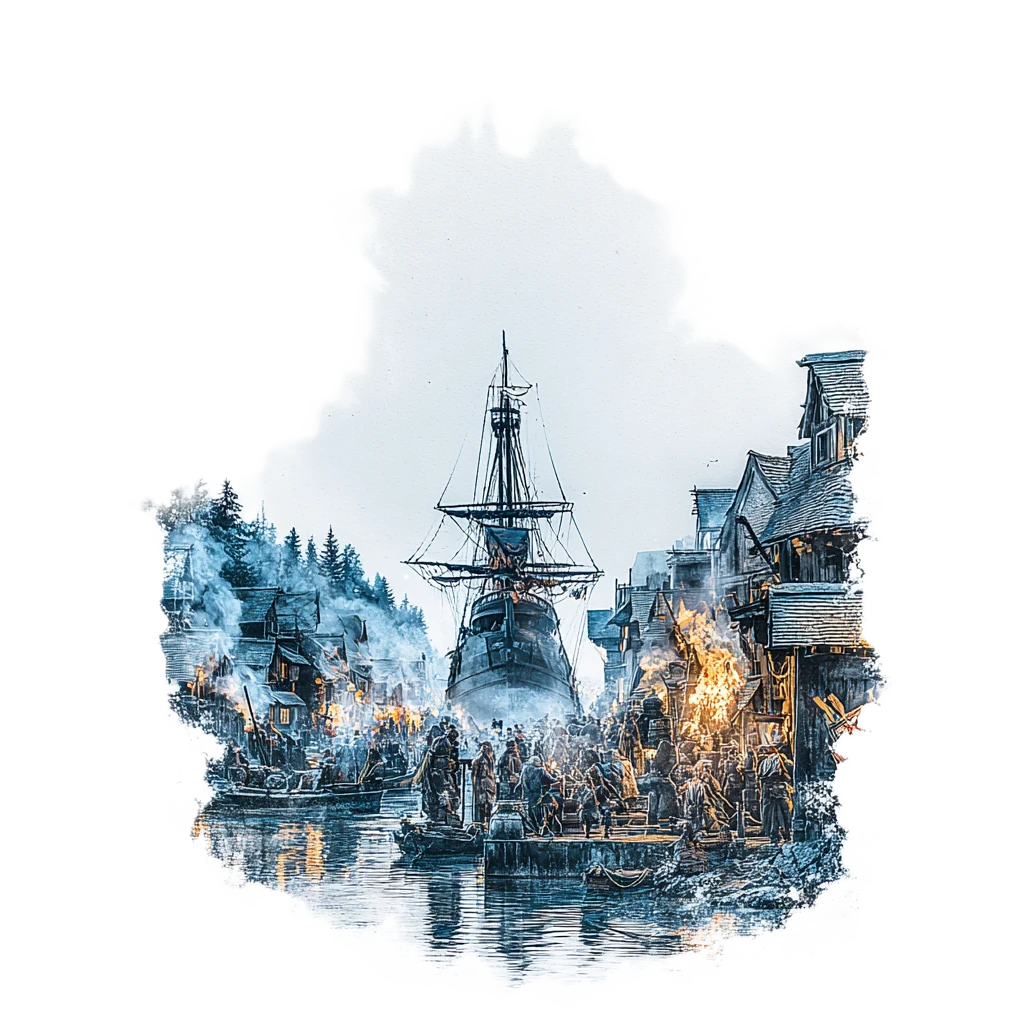
A year to the day after Anya’s death, black sails rose on the horizon of the Cove. The Bloody Mist, they called her - teeth painted red, hull black as the abyss.
The bell tolled at dawn, not for worship but for warning. The pirates came swift and silent; the kind who know a town’s worth before they even touch the sand.
The townsfolk woke to smoke and screaming, to blades flashing in lanternlight. Some say the pirates came for plunder, others for vengeance.
Truth is, I think the Cove burned for both.
And at their head - or maybe behind them; no one agrees which - was Agr’ro.
He just walked through the smoke with a calm that froze men faster than any blade. He wasn’t there to steal.
He was there to balance the scales.
He found the priest first - the one who’d barred the temple door. The old man dropped to his knees, begging forgiveness.
Agr’ro didn’t speak.
He only handed him an empty bucket, spat on him, and walked on.
The alchemist was long gone by then, back to Riddleport, or deeper into whatever trade he served. The rest of the town wasn’t so lucky.
By nightfall, the harbor was ash. The red door was gone too, burned down to stone. But the garden... they say it never caught fire.
Not a leaf. Not a flower.
Even now, it grows wild; the herbs taller than a man, their scent carried by every wind that comes in from the sea.
I’m not here to tell you he was right. But I’ll tell you this: every man in that town who closed a door on him died hearing their crying for help go unanswered.
When it was over, he didn’t stay to watch the flames die. He walked to the shore, stepped into the waves, and boarded the ship that had carried him there. The Bloody Mist turned north, black sails cutting through smoke and sunlight alike.
Some say he never looked back. Others that he stood at the stern until the town was nothing but a smudge on the horizon.
What Remains
Roderic’s Cove was rebuilt, as small towns often are. New wood on old stones. New prayers over the same graves. Children grew up who never knew what the smoke once meant, though their parents still flinched when the wind came from the north. They painted new doors, cast new nets, and learned to tell themselves the fire had been an accident or a raid of vile souls.
Anything but the truth.
I am sorry for getting emotional here, but Agr’ro’s tale always gets to me.
He wasn’t born cruel; the world carved him that way - cut by cut, silence by silence. Roderic’s Cove turned him into a weapon, and for a long time, he mistook that for purpose.
I can’t fault him for it. Some of us only learn what we are once we’ve already been broken into pieces.
But the strange thing about weapons is this: they don’t decide what they’re used for. Someone has to reach out and take them - and, gods bless ’em, those who did had goodness in their hearts.
A band of fools and wanderers, misfits through and through. They gave him a place again. Not a crew, but a family. And, in time, he found love once more.
Maybe that’s what saves us all in the end.
Not faith. Not justice. Just the right people arriving before the darkness takes us for good.
Agr’ro never made peace with his past - men like him don’t. But the man I knew had learned to turn his wrath into something worth fighting for.
And that’s why his story isn’t a tragedy, no matter how it’s told.
It’s a beginning.
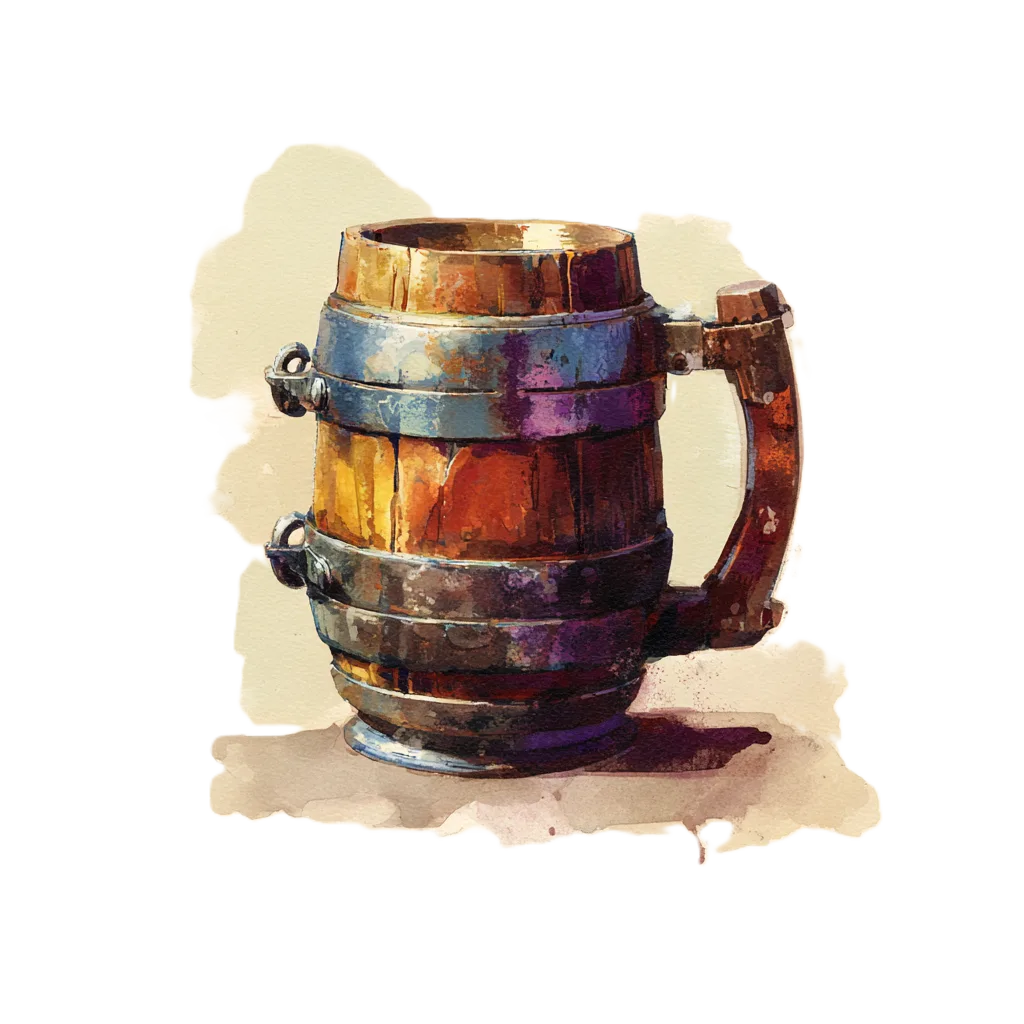
So please - let’s raise a glass for him.
To Agr’ro.
To the vessel that finally found its shore.
May his soul rest in the calm he never knew in life.

Worlds you may also like
Do you enjoy the tales of the Misfits? If that's the case, here are some more worlds I believe you will enjoy as well!
If you pay them a visit, make sure to give them some love. They absolutely deserve it!

Very cool. I like how it's written as if an old sailor were telling the tale. Very evocative.
Thank you so much for this lovely comment :)