
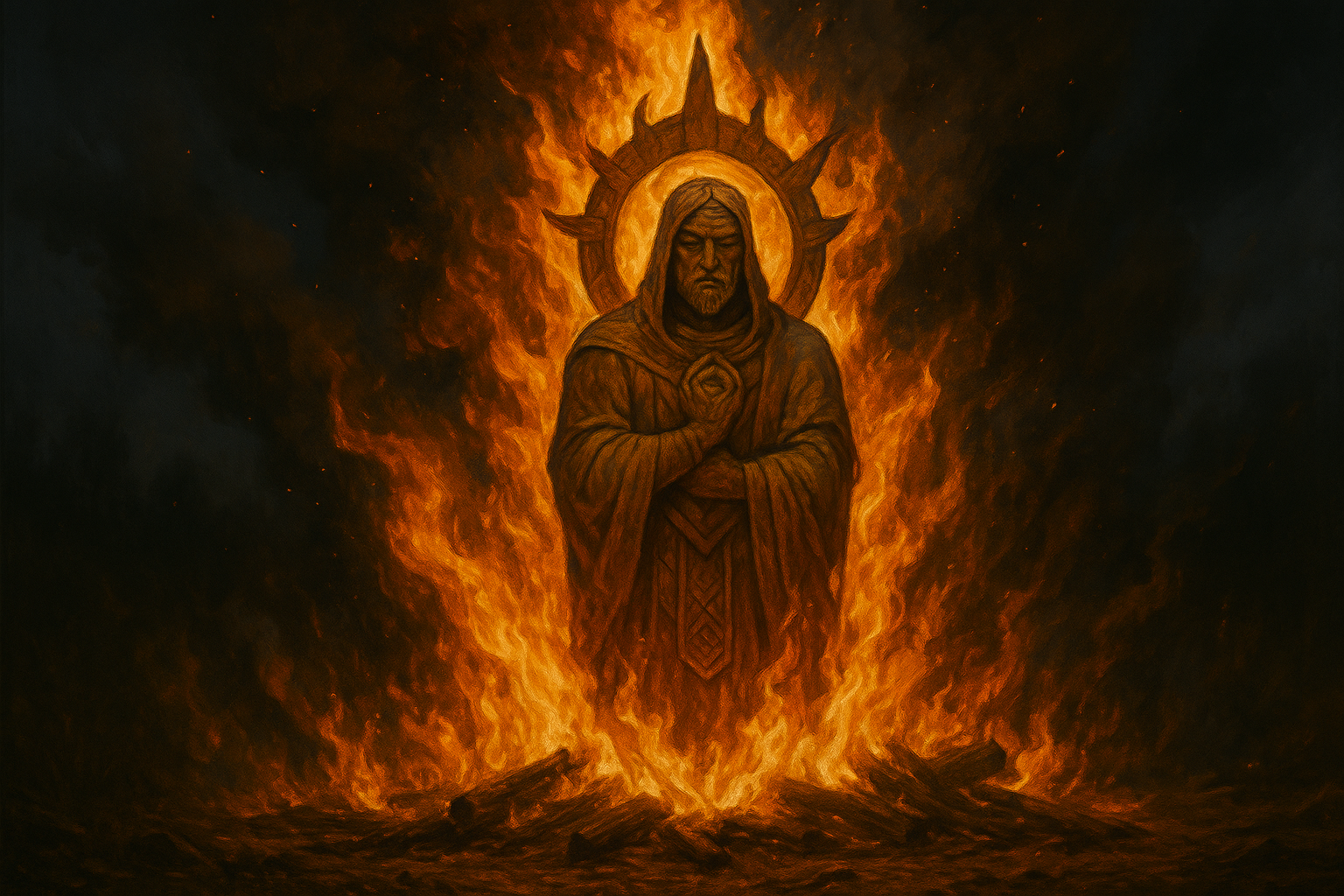
Tulpas and False Gods: The Madness of Belief:
in Religion:"A god is a thing of nature, of the Arcane’s grand design. A false god is a thing of man, shaped by the will of the desperate and the blind. And between the two, tell me, does it matter which one kills you?"
The true gods of Gaiatia are inevitabilities, not inventions. They are fragments of the world itself given voice, Druvain is the fire of labor and transformation, Ny'yala the wheel of fate, Chiniae the still hand of mercy, Xaethra the gnawing hunger that never ends. They are not conjured by prayer, nor birthed by imagination, they exist because their domains exist. They endure whether worshipped or not. Yet faith has its own terrible alchemy. Belief, relentless and unyielding, can call phantoms into being. These are the Tulpas, the false gods, entities not woven into reality’s bones but conjured from mortal desperation. When enough tongues whisper the same name, when fear is repeated in lullabies, curses, or superstitions for generations, the air itself warps. A fiction becomes a figure. A story becomes a spirit. Over time, it ceases to be invention, it becomes real. Such beings are narrow, brittle, yet absolute within their scope. Where Ny’yala turns the cycle of all endings and beginnings, a Tulpa might hold sway only over the death of crops in a single valley. Where Orram embodies the silence of secrets, a Tulpa might linger only in the sound of footsteps on cellar stairs. But within their small dominions, their power is unquestionable. For those whose prayers they answer, the difference between Tulpa and deity is meaningless. Here lies their danger. The pantheon is vast but silent, their interventions rare and overwhelming. Tulpas whisper back. They grant visions, strike bargains, fill the void left when the true gods withdraw. They thrive not on cosmic domains but on mortal longing, terror, and grief.
A Cleric of Druvain serves labor eternal, whether or not he believes. A Warlock who serves a Tulpa sustains his patron with every drop of faith, their god as fragile and fleeting as the minds that imagine it. Both wield miracles, but one’s source is the foundation of reality, the other a scaffolding of madness. Most Tulpas are not born of hope, but of suffering. Despair gathers faster than devotion. Villages stricken by plague will conjure a devourer before they dream of a healer. Starving farmers whisper prayers not for salvation, but for vengeance. Faith is power, and fear is the purest faith of all. Some scholars in the Scholar’s Guild whisper a darker speculation: that false gods are not the invention of mortals alone. Perhaps despair itself, when spread wide enough across an age, becomes its own worship. The Civil Age has known endless war, famine, betrayal, and ruin. What if these centuries of suffering have not merely scarred history, but rewritten reality? What if Gaiatia itself has been shaped into a Tulpa, a broken reflection born of collective despair? Not cursed by Druvain, nor doomed by Ny’yala’s wheel, but made into a self-devouring world because mortals have believed in nothing else for too long. If faith can birth gods, then despair can birth prisons. And until that cycle is broken, the false gods of Gaiatia, those hungry echoes of our own fears, will continue to whisper in the silence where the true gods refuse to answer.
All writing and lore by author Patrick Enger; All art done by Chat-GPT (for now).