
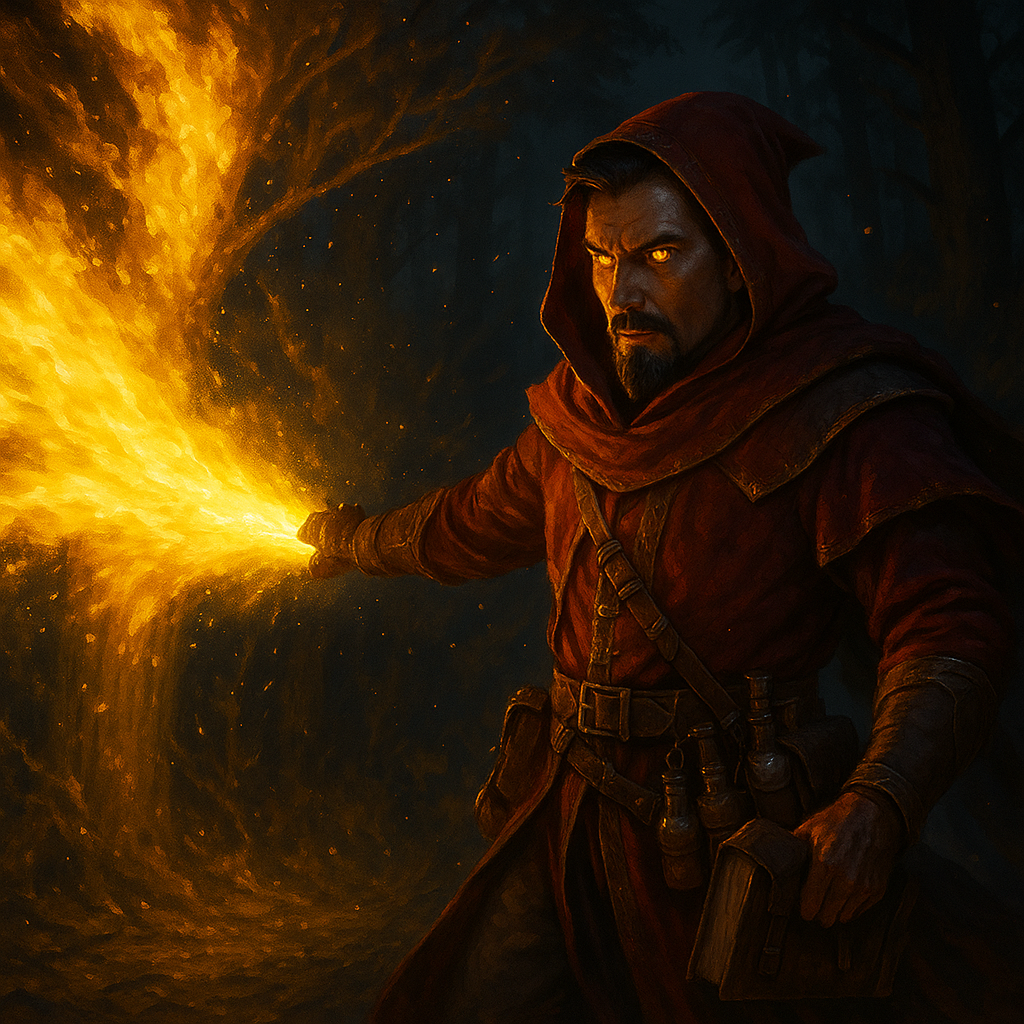
Warlock
"Faith is a leash. A pact is a knife you learn to twist."
Warlocks are the covenant-breakers of Everwealth, those who scorn the silent pantheon and seize forbidden bonds in their place. Where clerics serve tenets and paladins bend to divine command, warlocks see the gods not as covenant but as cage, absent caretakers who abandoned mortals after The Fall to 'preserve cosmic balance' and left them to suffer the Schism. Instead, they turn to Devils who brand the soul with contracts, to witches and god-kings who hoard stolen divinity, to Tulpas conjured from centuries of belief, or to cursed relics and ancestral spirits that whisper bargains in the dark. Their power is not earned by study nor bestowed by covenant, but taken through debt, quick, potent, and perilous. To The Arcane Coalition, warlocks are breaches of their order, wielders of unlicensed magick that could threaten the kingdom, and must be destroyed. To The Knights of All-Faith, Everwealth’s steel-clad arbiters of scripture, warlocks are blasphemy itself, proof that mortals will sell their souls to the foes who once sought to unmake the world. Among common folk, warlocks inspire equal parts fear and envy, neighbors who return from the forest with shadows that move apart from them, or whose tongues speak with two voices. Some become healers and defenders, binding themselves to guardian spirits or ancestral shades out of necessity. Others fall to cruelty, indulgence, or the subtle leash of their patron. What unites them is not morality but contract. Every warlock is bound, whether to protect, to corrupt, or simply to survive. The burden of the warlock is this: no pact is ever free. Devils twist words into chains, Tulpas demand endless faith, Witches vanish when whim takes them, relics drain blood as tithe. Yet the allure endures, for in a world where the gods are silent, patrons speak. Warlocks embody the gamble that defines Everwealth itself, that power can be seized, but never without cost, and that even fire in the hand may burn the soul to ash.Qualifications
Unlike Clerics, warlocks are not cultivated by scripture or order. They are chosen, or rather, ensnared.
- Devils. The most infamous patrons. Devils imprint upon mortal souls through contracts, their magick an extension of the pact itself. Every word is binding, every omission a snare. A Devil’s warlock may wield incantations of fire, conjuration, or transmutation as if their own, but every use deepens the contract’s hold. The stronger the Devil, the harsher the terms, from subtle whispers of influence to full forfeiture of soul at death.
- Tulpas. False gods born of faith and fear. A Tulpa may only hold dominion over something small, the famine of a valley, the shadow on a stair, but in its sphere it is absolute. Warlocks who bind to Tulpas inherit narrow but terrifying magicks, often fueled as much by their own devotion as their patron’s fragility. As the Tulpa thrives, so too does the warlock, but if belief falters, so too does their power.
- Witches and Mortals Ascended. Some patrons were once mortal. A witch who became more curse than woman, a tyrant-king who drank his own reliquary of souls, or a magickal dynasty that branded its heirs as living altars. These patrons grant power not as gods but as god-thieves, their warlocks wielding rites steeped in blood, famine, or dream.
- Cursed Relics. Some do not choose their patrons at all. A sword that whispers bargains to its wielder, a mirror that shows a second face, an amulet that demands blood for each blessing. Such artifacts forge bonds every bit as binding as Devil’s law, warlocks finding themselves enslaved to the relic even as they wield it.
Requirements
To serve, warlocks must:
- Honor their pact, at least in its broadest terms. Devils enforce loopholes ruthlessly.
- ustain their patron, whether with faith, sacrifice, or obedience.
- Accept consequence, for every boon has its toll.
Appointment
There is no ceremony but the pact itself. A warlock’s appointment is sealed at the moment of bargain:
- A name signed in blood.
- A relic clasped until it bleeds.
- A whisper answered in dreams.
Duties
Warlocks are not bound to any universal order, but their duties stem from their pact.
- Devil-bound enforce contracts, spread influence, and tempt others into bargains.
- Tulpa-bound must nurture the cult’s belief to keep their god alive and make them stronger.
- Relic-bound feed their tool with blood, use, ritual killings or sacrifices made with the item.
- Witch-bound serve as apprentices, errand-runners, or inheritors of forbidden craft.
Responsibilities
Responsibilities are as shifting as their patrons. A warlock may be sent to corrupt a noble’s court, to preserve a ruin, to slay a rival, or simply to survive and grow in strength. They must balance their mortal lives with obligations to their patron, often walking a knife’s edge between secrecy and service.
Benefits
Warlocks gain magick not from years of prayer or study, but instantly, through their pact. Their gifts depend on the patron:
- Devils: Binding contracts, enchantments of body and soul, conjurations of flame and ash.
- Tulpas: Narrow but absolute powers (crop-blight, shadow-walking, plague-calling).
- Relics: Specialized abilities tied to the object, a sword that drinks blood, a mask that sees lies, a lantern that calls the dead.
- ches/spirits: Shamanistic craft, curses, illusions, transformation.
Accoutrements & Equipment
Warlocks are defined by their pact-mark. Many bear:
- Scarred brands or runes that pulse when spells are cast.
- Pact-blades or cursed relics.
- Grimoires written in both mortal tongue and patron-speech.
Grounds for Removal/Dismissal
A warlock cannot be “dismissed” by order or court, only severed by their patron. Such severance is rarely merciful. Patrons reclaim what they have given, often violently. Those who attempt to break free without permission are consumed, enslaved, or driven mad. The Knights of All-Faith treat captured warlocks as heretics to be executed; Or enslaved to line the Church's treasuries.
History
The first warlocks appeared far before the first clerics. Where the gods answered the cries of mortals during The Fall for the first time in history, not every voice cried towards the heavens. Some had already spoken in-depth with other powers for a long, long time. False gods sustained by cults, relics with voices long buried lying in wait. Where clerics found miracles and a sudden, jarring creation; These others relied on the safety of old whispered bargains. The earliest warlocks were branded heretics as they still are today, but their strength cannot be ignored. New forms of Warlock who make deals with the infernal races of Devils and their contract-like magick powers. Or far older tulpa-bound cults that rose and fell across the Schism, birthing gods that ruled for decades before belief faded and them in-turn. Cursed relics were uncovered in the ruins of the Fall, and many a desperate soul wielded them and their promised power with little regard for the consequences the provide in-exchange. Unlike clerics or paladins, warlocks never formed unified orders. Their history is scattered, individual cults, covens, secret brotherhoods. They have been both scourge and salvation, despised for their corruption but sometimes celebrated as the only ones willing to defy the gods’ silence. In The Civil Age we live in today, warlocks remain both plentiful and hunted. The Arcane Coalition condemns them for bypassing sanctioned magick. The Knights of All-Faith burn them as oathbreakers. Yet they endure, for every famine, war, or grief breeds mortals desperate enough to bargain. Where clerics embody conviction, warlocks embody desperation.
Cultural Significance
To common folk, warlocks are terrifying, the neighbor who whispers to shadows, the outcast who returns from the forest with black fire in their eyes. To nobles, they are both tool and threat, capable of swaying fate with a single pact. To scholars, they are dangerous anomalies, proof that magick flows not only from gods or study, but from desperation and debt. Yet despite their stigma, warlocks often occupy the same paradoxical space as inquisitors or hedge-mages. Communities shun them, fearing the whispers of their patrons, yet when plague strikes, crops fail, or a revenant haunts the village graveyard, it is often a warlock who is called upon in secret when no cleric will come and no sanctioned mage dares risk the ire of the Arcane Coalition. They are both pariah and necessity, condemned in daylight yet sought out in desperation by night.
Notable Holders
- Arvath the Black-Tongued: Warlock of a spirit known only as 'She -Who-Eats'. His sermons brought down an entire province by convincing its people to consume eachother to achieve transcendence.
- Mirella Candlehand: Relic-bound warlock whose hand burned eternally after seizing a lantern from a ruin. She used it to lead armies of revenants before being put to death by a band of Paladins from The Knights of All-Faith.
- Tharos Dreeve: Contract-keeper, servant of the Devil known as Little Horns who tricked a duke into selling his soul in exchange for lavish luxury. The luxury came, but so did plague, and the duke’s house collapsed within a year, experiencing luxury indeed, but not for long.
- Eiran of the Shallows: Warlock of an ancestral spirit, remembered as one of the few whose pact brought more healing than harm. His descendants still keep the spirit’s shrine.
- Varoch the Untethered: Said to have bargained with devils, witches, and tulpas alike, betraying and devouring each patron until none could bind him. Now whispered to walk unbound, wielding all their powers at once, proof of warlock freedom, or a herald of calamity.
Status
Warlocks are outlawed in most regions, though cults and covens thrive in secret. Some are tolerated in lawless ports, or hidden within noble courts. None are sanctioned openly, though their presence is everywhere.
Form of Address
Warlocks are rarely addressed formally. In cults, they may be called 'Binder', 'Covenant', 'Oathbound'. Among foes, they are 'Heretic', 'Curse-Bearer', 'Black Tongue'.
Alternative Naming
'Oathbreakers', 'Pact-Bearers', 'Witchmarked', 'Devil-Tongues'.
Equates to
- Human Kingdoms: Warlock, often used as synonymous with traitor.
- Orcish Clans: Curse-Sworn, those who trade strength for doom.
- Elfese Tribes: Shadow-Binders, said to weave with false gods.
Source of Authority
Unlike clerics, whose authority flows from gods, warlocks’ authority derives from their patrons directly, devils, tulpas, relics, witches. Their legitimacy is always questioned, for they wield power without sanctioned covenant.
Length of Term
For as long as the pact lasts. Some bargains bind for life, others for years, others until a specific act is completed. Few escape their terms alive, and fewer still keep their freedom.

Comments