
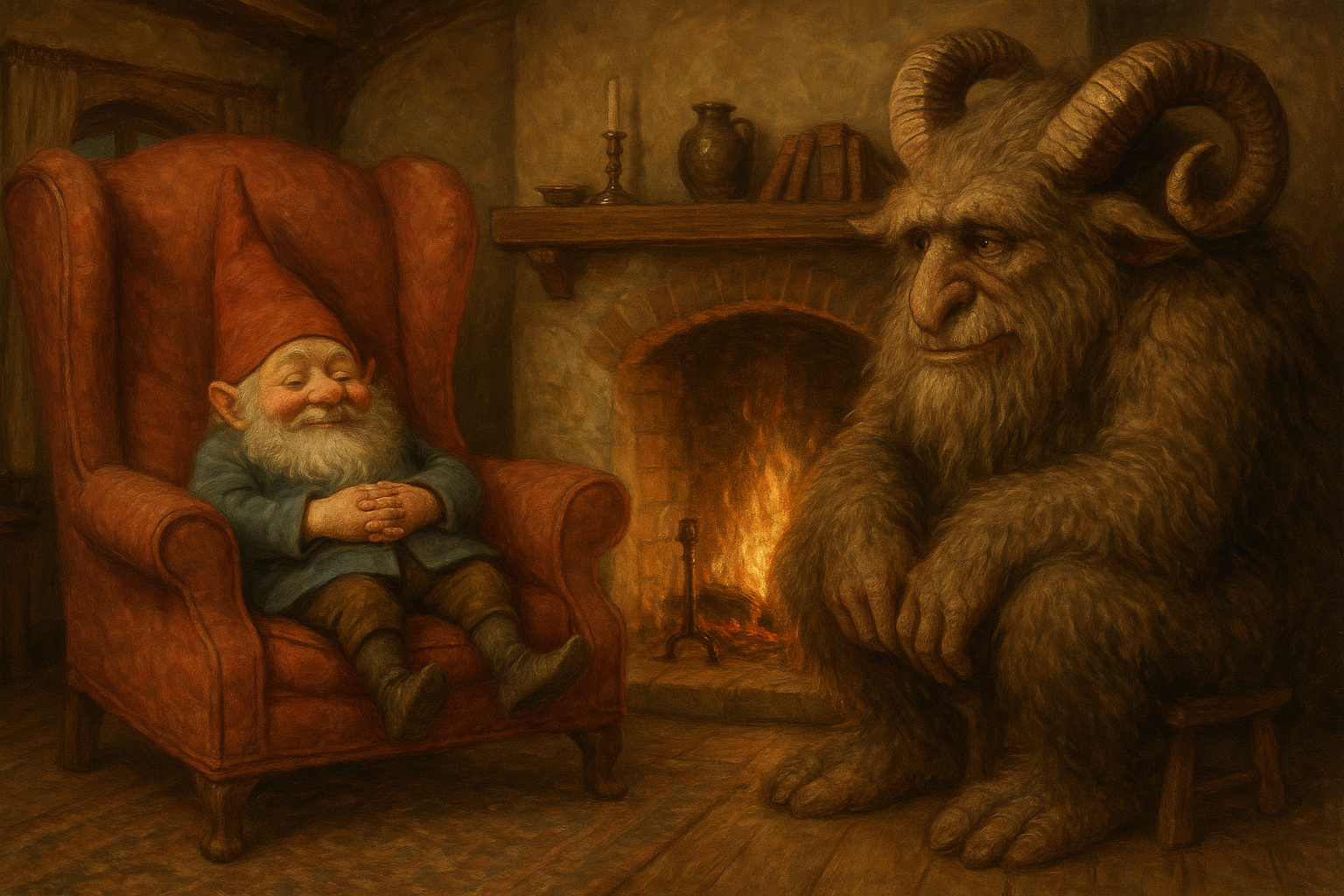
The Fae:
in Races:"Sure ye wouldn't like me to move Bagrax? Know I was here first n' all but feels wrong takin up f yer comfy chair in yer own home."
"BUUUURP! Scuse me..." "No, you stay... You friend..! You drink!!!"
The Fae of Everwealth are not a single people but a tangle of kindreds, Faerie, Gnomish, and stranger cousins besides, bound less by blood than by temperament. They hail from The Otherworld, where roads grow like vines and laws are sung rather than written. To mortals, they are contradiction made flesh, radiant and cruel, generous and exacting, playful and perilous. Their customs blur the seam between hospitality and entrapment. A compliment can be a contract; a broken promise, a declaration of war. They trade in stories and spectacle. What passes for morality among them is less right-versus-wrong than balance-versus-ugliness, beauty honored, debts remembered, stories paid for in kind. Thus mortals mistrust them, and the Fae, in turn, find mortals charming precisely because they do. When The Fall shattered Gaiatia, portals of Devils yawning over our every nation at once. They did not open over the wilds of the Otherworld. Not for lack of malice, but because even Vile, the devil at the head of these armies, for all his talents could not tear two worlds at once. Make no mistake, they were next in-line. But the Otherworld is unpredictable, layered, and quarrelsome; to walk it is to battle a thousand courts that cannot agree on what a battle even is. So he chose The Folklands, our realm, as the easier first opponent. He was right, and nearly won. The Fae were spared, but not idle. Their wardens raised hedge-walls of thorns hardened like iron, laid roads that turned invaders backward, braided moonlight into nets that snared anything with a Hell-born name. They braced for the second front that never came. When Vile betrayed Xaethra, the god that set him upon us, and damned his own armies, the Fae finally exhaled, briefly; Because then came the Schism. Mortals set upon mortals, kingdoms upon kin.
The Fae folded their bridges, shuttered their markets, and retreated behind the very barricades they had woven for the devils. Not from cowardice, but from arithmetic. Magick flows thick within their world, cities fed by charming aqueducts into place, orchards ripened by rhyme, whole valleys moved three steps left because they preferred the view. Outside it, magick thins to common weave, minor miracles that wilt into illusory falsehoods under the iron and reason of the physical world. They could not halt the Schism with parlor tricks, nor had they developed sciences in almost any measure; Why build engines when a chant turns millstones? Why chart stars when the sky will bow if asked politely enough? With nothing then to provide but fables and whimsy, they chose to wait-it-out, watching, keeping their blades ready for war. A war that, mercifully, did not arrive. Yet they never completely vanished even in their century of absence during the Schism. Seeing new opportunity in the new world to come, many chose to stay of their own accord, facing the Schism head-on. Even as our world ended, some of them couldn't help but stay. Still at the crossroads and fairs as we waged war against our friends and families, bartering secrets, buying bright-eyed adventurers with applause and impossible wages. They love mortals, our recklessness, our need to be seen, and mortals love them back just enough to be ruined. They are marvels and menaces at once. A misplaced “always” can bind a lifetime; a well-placed “perhaps” can save it. Most who bargain walk away delighted, until delighted becomes owned. Today, the Fae walk Everwealth’s as brightness and fearful whispers. They remain what they were, caprice wearing skin, bound by beauty and oath. We call them fickle. They call us impatient.