
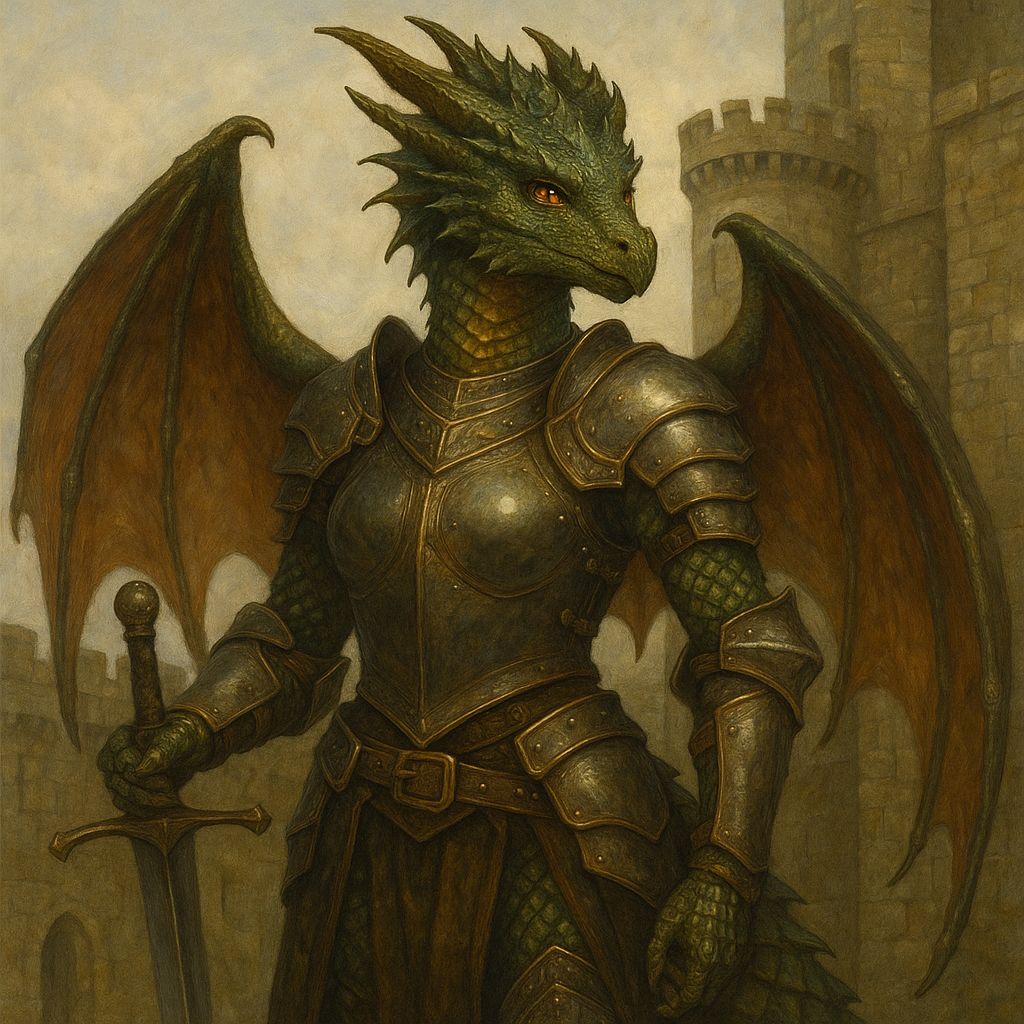
Half-Dragons
"You can always tell a Half-Dragon by the silence. A room quiets when they enter, not out of fear, but reverence. Or perhaps the hush of unspoken questions. Are they cursed or chosen? Beast or kin? No one truly knows. Maybe they don’t either."
The Half-Dragons of Gaiatia are not a people, they are what remains after something sacred was broken. No two are alike, and none belong anywhere. They are the living residue of ancient crimes, the burnt fingerprints left on history’s throat. Some scholars call them the fallout of The Lost Ages’ experiments, where alchemists sought to fuse mortal flesh with draconic essence. Others whisper they are the Dragons’ most heinous indulgence, the unwanted consequence of power taking what it desired, and leaving the world to bear the proof. Whatever their origin, the truth is constant, they were not born of love. The Dragons that made them were gods in appetite and monsters in form, creatures whose dominion was so complete that resistance itself became worship. To be chosen by such a being was never an honor, it was survival wrapped in pain. Those who endured their touch birthed the Half-Dragons, children whose bones hum with trapped thunder, whose eyes gleam like molten coin, whose breath stirs ashes even in silence. Their creation was not a miracle but an echo of violence, and every breath they take is a reminder that the world forgave neither parent. There are perhaps a dozen alive in all of Everwealth at any one time, wanderers by necessity, outcasts by nature. They cannot live among men without kindling fear, nor among dragons without being devoured for their impurity. They drift through ruins and storm-breaks, haunting the edges of civilization like ghosts that never learned how to die. Wherever they linger, the world grows restless, fires spark in their dreams, animals flee their scent, and magick bends as if uncertain what they are. They leave no lineage, no monuments, only scorched footprints and silences that last long after they’ve gone. In Woodsend, Middleglade, and all Everwealthy provinces bordering The Grandgleam Forest, their presence is outlawed. True Dragons haunt those skies in droves, and the belief persists that Half-Dragon blood is a beacon, that the smell of it can draw wyrms from leagues away. When one is discovered, the law does not arrest; it erases. Quietly, cleanly, before the clouds begin to circle. In other lands, they are tolerated only as long as they keep moving. Taverns empty when they enter. Priests bar their doors. Some folk cross themselves; others simply whisper “fire follows pity.” And still, they wander, wrapped in hoods and shadows, breathing carefully so as not to wake the ruin in their throats. They do not pray, and no god would answer them if they did. Theirs is a life of restraint, of endless exile within their own skin. Half-Dragons, half mercy, half curse, born from horrors that would burn the world to smoldering ash with a smile if given the chance.
Naming Traditions
Feminine names
- Seraka.
- Thalmyra.
- Velixia.
- Nyssandra.
- Dravella.
Masculine names
- Kaelvorn.
- Rhazek.
- Thurnax.
- Dovrak.
- Malgorr.
Unisex names
- Ashkar.
- Zyrrin.
- Vaelth.
- Korran.
- Myrrak.
Family names
- Stormbrand.
- Of the Iron Brood.
- Ashwing.
- Fire-Claimed.
- Son of the Hollow Scale.
Other names
Ash-Blood (slur), Talonkin (colloquial), Voice of the Scale (druidic honorary title), Flame-Touched.
Culture
Major language groups and dialects
Half-Dragons speak what the locals speak, though most carry the ruin of Draconic in their throats, low, broken syllables that rasp like coals in wind. They rarely use it in public; the sound alone unsettles animals and listeners alike. When angered or pained, their words sometimes shift mid-sentence into that guttural tongue, as if something older speaks through them.
Culture and cultural heritage
There is no true Half-Dragon culture. There are only survivors of something the world would rather forget. Most trace their bloodline not to love, but rape, the spoils of Dragons who took rather than asked, who saw in mortals only new shapes to break or breed. Every Half-Dragon carries the echo of that first violence, an ancestry that was never chosen, only tearfully endured. They are the children of appetite, the proof that even gods commit crimes when bored. Some cling to the husks of old Dragon lairs, believing that to sleep where their sires once fed might quiet the hunger in their own blood. Others wander endlessly, driven by instincts that feel borrowed, seeking heat, hoard, or prey they can’t name. They scavenge relics of their forebears not for reverence but recognition, desperate to see themselves in anything older than their pain. The myths they murmur around their own fires differ wildly. Some claim they were born to end the Dragons’ cruelty; others believe they exist to continue it. Most no longer care which truth burns hotter. Wherever they linger too long, ill omens follow, storms that echo their breath, beasts that turn feral, children born still and smoking. In places like Woodsend or Middleglade, their mere presence is outlawed. Farmers say they smell thunder before a Half-Dragon arrives, and priests swear their shadows move even when they stand still. To every civilized heartland, they are not citizens or curiosities but reminders, that the line between man and monster is thinner than prayer.
Shared customary codes and values
If any philosophy remains among them, it is not one taught but one learned through fear:
- Endure what the fire left. The blood remembers what it suffered; survival itself is a form of defiance.
- Show no weakness before the small. The world hunts what it pities. Better to be hated than pitied.
- Never beg. To ask is to recall the first time their kind was taken, and they will not repeat it.
- Black: Descendants of dragons that nested in high ranges or thunderous peaks. Their breath manifests as electrical stormfronts, sudden gales, arcs of blue-white lightning, and rolling thunder that shakes stone and skull. Many who bear this bloodline are found wandering shattered passes or mountain ruins.
- White: Traced to dragons of Arcryo or lakes during cold seasons. Their breath releases a plume of freezing mist and rime; temperatures drop instantly, and unguarded flesh turns brittle as glass. Some say these Half-Dragons unconsciously lower the temperature around them even when asleep.
- Blue: From dragons of the sea cliffs and reefs. Their breath expels scalding vapor, dense fogs and suffocating salt mist that corrodes metal and blinds foes. When agitated, they leave behind condensation patterns said to resemble tidal runes.
- Brown: The rarest strain, tied to the deserts of Kathar. They exhale deafening, slicing winds, gusts sharp enough to flay bark and strip sand from stone. Local myths claim they can speak only in whispers, for their breath can peel paint and flesh alike.
- Green: Descendants of dragons that dwelled in fetid forests and ancient bogs. Their breath releases a virulent mist of acidic bile, corrosive to skin, metal, and spellwork. It smells faintly of sweet rot, a scent that lingers for days after their passing.
- Red: Descendants of dragons born from molten plains or active volcanic regions like Mount Kilgore. Perhaps the most famous draconic variant despite it's rare presence. Their breath looses plumes of roaring flame; And fire does as fire does.
Average technological level
They possess no craft of their own, only what they can salvage, melt, or bend. When they forge, it is by accident of rage, their breath reshaping metal beyond mortal smithing. Scholars prize these remnants, “wyrmglass,” “char-steel”, though few will admit where they come from.
Half-Dragons’ tools are crude, singular, and often burned with draconic residue. No two are alike, because no two Half-Dragons live long enough to pass down anything learned. What little invention they achieve dies with them, their genius burns away faster than their flesh.
Common Etiquette rules
- Do not mock a Half-Dragon’s lineage.
- Do not touch their wings or tail without permission.
- Offer gifts with both hands and no expectations.
Common Dress code
Most Half-Dragons wear practical garments suited for travel or battle, often tailored to accommodate wings and tails. Cloaks of dragon-hide, ornamental scales, and runic tattoos are common.
Art & Architecture
Rare. Their art is often etched into stone, wood, or armor, symbols of storms, fire, and beasts. If a city of Half-Dragons ever existed, no one alive has found it.
Foods & Cuisine
Carnivorous diets dominate, often charred or seared. They enjoy intensely seasoned meats, volcanic herbs, and salted bloodwines.
Common Customs, traditions and rituals
There are no ceremonies among Half-Dragons, only habits born from instinct and survival. They repeat gestures without knowing why, sleeping atop piles of stone or metal, hoarding firewood they never light, watching storms for hours as if listening to a voice inside them. These compulsions are the remnants of something older, inherited not through teaching but through fear remembered in the blood.
- They often avoid mirrors and still water; Feeling disturbed or off-put by what they believe their 'cursed transformation'.
- When wounded, they burn the wound shut, even if healing magicks are available.
- They prefer solitude when eating, claiming it quiets “the inner echo.”
- Before travel, many mark stone with claw or ash, not words, just presence.
Birth & Baptismal Rites
Few are ever born in their Half-Dragon form, Most are transformed, their draconic blood igniting without warning in mortal veins; Wings and tails sprouting from the spine as flesh becomes scale in a lengthy, painful transformation during early childhood. Families hide or abandon them, believing the child cursed or possessed. Midwives record strange signs, eggshell-like skin sloughing off, eyes that open before the first breath, infants who hiss violently when drawn away from fire. Those who live through their painful transformation alive, must now go through its aftermath alone, unclaimed by kin and clergy. On rare occasions, a wandering Half-Dragon might find another of their kind and form a small family of travelers. When such infants are born, their brow is sometimes marked with ashes; A 'ward' for the fires of transformation and hatred they will assuredly have to endure.
Coming of Age Rites
There is no shared rite, only realization, the moment they understand that their nature will never be forgiven. Some mark this by leaving civilization entirely; others by testing their strength against beasts, storms, or volcanoes. Surviving such trials is not celebration but resignation, a quiet acceptance that there will be no homecoming afterward.
- A Half-Dragon’s first true exhalation of flame is often the end of their childhood.
- Many keep one relic from that day, a melted weapon, a scorched stone, a name burned away.
Funerary and Memorial customs
No graves bear their names. When Half-Dragons die, their remains often ignite on their own, leaving behind a thin crust of glass and black sand. Locals call these sites Wyrm’s Mirrors, and few dare touch them, they say the surface hums faintly when held to the ear.
Those few who die peacefully are sometimes carried to high cliffs or volcanic vents by those rare mortals who pitied them. The gesture is not religious, it’s pragmatic. Fire wants fire back.
- Some Half-Dragons carve their own names into stone before they die, then shatter the slab to deny others the satisfaction of remembrance.
- To leave a corpse unburned is considered a curse; the soul must not cool.
Common Taboos
Most Half-Dragons live by silence, but what few taboos they keep are absolute, drawn from instinct and horror more than belief.
- Do not pretend to be human. Passing as mortal is seen as cowardice, and worse, denial of blood.
- Never kneel. Submission recalls the origin of their suffering.
- Do not breed. Some do, but almost all fear what may hatch from their bodies.
- Do not share fire with the faithless. It invites attention from what sleeps above.
Common Myths and Legends
The world spins many stories around the Half-Dragons; they tell none themselves. The tales mortals whisper are equal parts awe and warning:
- The Wingless Flame: A draconic bastard who slew its sire without wings or weapon, dying laughing as the sky burned red.
- The Hollow Scale: A Half-Dragon who ripped out its own heart to keep from transforming fully, whose heartbeat is still heard beneath some volcanoes.
- Ash’s Lineage: Scholars claim the first Half-Dragon still walks among men, his fire banked so long that the stars themselves forget his shape.
Historical figures
No living Half-Dragon admits ancestry, and few written records survive. yet some names persist like smoke in ruined libraries:
- Vythira Emberwing - Said to have ended a siege by melting an entire citadel. Some claim she became the molten lake that drowned it.
- Tyros of the Wyrmbound - A wanderer who carried plague victims from burning settlements.
Ideals
Beauty Ideals
Symmetry of horn, smoothness of scale, wingspan, and posture. Scars are marks of survival, not shame.
Gender Ideals
Gender is fluid among Half-Dragons, with traits of strength, presence, and fire taking precedence.
Courtship Ideals
Displays of prowess, breath contests, flight duels, or sparring. A shared hoard often marks a union.
Relationship Ideals
Fierce loyalty and independence. Lovers are equals or rivals, never one without the other.
Interesting Facts & Folklore
Idioms & Metaphors
- Some Half-Dragons can fall asleep mid-flight and remain aloft.
- A Half-Dragon's first emission of magickal breath may occur during birth.
- Elders say their dreams are shared with dragons still living.
- It is said no Half-Dragon has ever died from age, only battle, starvation, or sorrow.
- "She breathes backward" One who hides their power too well.
- "His wings weigh more than his bones" A Half-Dragon burdened by lineage.
- "Scaled but rootless" Someone mighty but directionless.
- "Talon behind the gift" A hidden threat.
- "Drank from the Flame" A warning of overwhelming obsession or power.

Comments