As with almost all
Rodinians, Kalrin's upbringing was stable, comfortable, and predictable. Guided and raised by two loving parents and ringfenced by a strong
Kellvass Commune, his life was entirely absent of loneliness, abuse, or destitution. At initiation academy, where all young Rodinians learn how to use
Psikinetics, unlock their genetically and spiritually stored knowledge, and learn how to integrate in a multispecies civilization, he never faced the daily cruelty of other children bullying him. There was something about Kalrin that lurked behind his kind and empathetic façade, like a door slightly ajar just enough to show the abyss on the other side. People could sense, even at a young age, how this juvenile Rodinian's power wasn't something to be poked at. They'd still talk about him behind his back however. About how he'd sit for hours playing with insects, building little cities for them to live in, feeding them, looking after them. He loved creating terrariums, building miniature ecosystems that he designed down to the exact bacterial and fungal species in the soil.
His exceptional skill with psikinetics expectedly caught the attention of talent scouts working for the Imperial Service, eager to recruit him into the Emperor's ranks and keep him and others like him away from the dynastic
Great Houses' claws. His superior spiritual and hence psikinetic power earned him a recommendation to join the 'God-Catchers', a division within the Imperial Service dedicated to investigating, hunting down and capturing rogue Rodinians who broke non-intervention law.
The job had several perks. God-Catchers were one of the few groups allowed to leave
Rodinia and its inner Weave of Worlds, to voyage among the stars as Rodinians once did during their imperial days. It paid well, due to the risk involved in fighting other Rodinians. For Kalrin however there was one more perk, something that enticed him on a deeper level than travel or wealth, and something hinting at his treachery even as far back as this.
The Imperial Service tried to leverage his empathy for others during recruitment, explaining how rogue Rodinians ruled and abused other species and civilizations as unopposable tyrants, crushing those beneath them in a psychotic, narcissistic pursuit of deification, attention, and hedonism. "You can help these people by ridding them of these tinpot gods," they said. Whilst this was true in many cases, it was similarly true that life throughout the cosmos was often crushed without tyrannical Rodinians oppressing them. It's just how civilizations tended to treat each other; the universe was a violent, paranoid place. The truth of this was often downplayed and contested by the Imperial Government who sought to uphold the current non-interventionist political paradigm, but it's hard to completely cover it all up. Someone as intelligent as Kalrin almost certainly sniffed out the holes in the propaganda glorifying the Rodinian Empire as being so successful in bringing peace and harmony to the cosmos that it made itself redundant.
It's hard to know for certain if Kalrin, at even this early juncture in his life, was planning to become one of these "tinpot gods" himself. If so, then he deceived the Imperial Service all through recruitment and training, tactfully wearing an alter ego that wasn't him, outwitting their teams of psychiatric consultants whose job was to sniff out megalomaniacs. This was no small feat, as it meant he fooled their
telepathic probing too. They were aware his empathy and love for creatures could eventually make him a liability, as his exposure to the reality of the cosmos increased; that he could abandon his duties and start intervening to help people. This was a risk the Imperial Service took with every God-Catcher they dispatched however. At worst, if he went AWOL, they'd simply send another God-Catcher to arrest him, as they've done many times before with rogue agents.
They were totally oblivious to the fate they'd consigned themselves to. The Rodinian they'd confidently in error let out into the cosmos was at least one thousand times more powerful than any other God-Catcher in their employ. That, too, Kalrin had hidden. His soul was an anomaly.
For six centuries he dutifully carried out his role as a God-Catcher, arresting dozens of Rodinians who refused the call to return home when the empire was dissolved. It's debatable how much he believed in what he was doing. Whilst there's no doubt he despised Rodinians who chose to rule over the crumbling cities of people they'd personally beaten into submission, there were more than a few branded as criminals for merely teaching other species how to live better. As someone increasingly visualizing himself doing the same, one has to wonder what went through his mind as he apprehended these targets.
Finally though, it happened. After nearly seven hundred years of being told to ignore the affairs of other civilizations, no matter how depraved, brutal or destitute they were, Kalrin and his fellow crewmates of the Quellor decided they'd had enough of standing back to watch people die.
Two-Lives
Now free from the reigns of the Imperial Government, he and the crew switched from being operatives of Rodinia's Imperial Service to being operatives of the Jalopek Enclave. Remnant galaxy supercluster capitals of the former Rodinian Empire who refused the call to return home, the Enclaves continue the work of the old empire as best they can. With vastly reduced numbers and the perpetual evasion of Rodinia's operatives, their work making the universe less brutal often feels endless.
Being a first responder in the Rodinian Enclaves is thankless work. These Rodinians are sent in as vanguards when a new distress call is picked up and chosen to be acted upon out of thousands constantly blaring, and they often witness raw, stomach-churning crimes in action. They see the ongoing orbital bombardments of planets, where gigaton explosions slam into cities, lights flickering out as millions of inhabitants are reduced to vaporized carbon. They rush through a gauze of smashed and melted ships, and the still warm bodies of the planet's selfless defenders now drifting lifelessly in space, to get to the perpetrators. They see the killings in the streets, the camps, the sorting of slave stock from those deemed too useless to live. They see the ugly universe up close, and it's their job to sow as much confusion and destruction within the perpetrators' ranks as they can, that they may slow or even stall the attack until the Enclave can respond properly. It's a job with a high turnover rate, and those who quit often require counseling.
It was whilst carrying out this role and responding to one of his first incidents when Kalrin met the Sahatrans. Their planet was invaded by a dime-a-dozen warmongering empire enjoying their brief moment of dominance within a region of their galaxy. This imperious rabble had a delusional, twisted religion where their god created them in its image with four arms instead of two, whilst two-armed creatures were the spawn of an evil god cast down from the heavens. They used this nonsense to justify enslaving and destroying species for nothing other than their basic anatomy. If it sounds insane, that's because it was. This civilization had totally lost the plot. Their society had been usurped by a fusion of wealthy barons on one side who were also members of this crazed cult, and fascists on the other who were simply psychopaths. Together they took over information sources consumed by the masses and spread propaganda and lies, then took over government, and then fully indoctrinated and suppressed the populace.
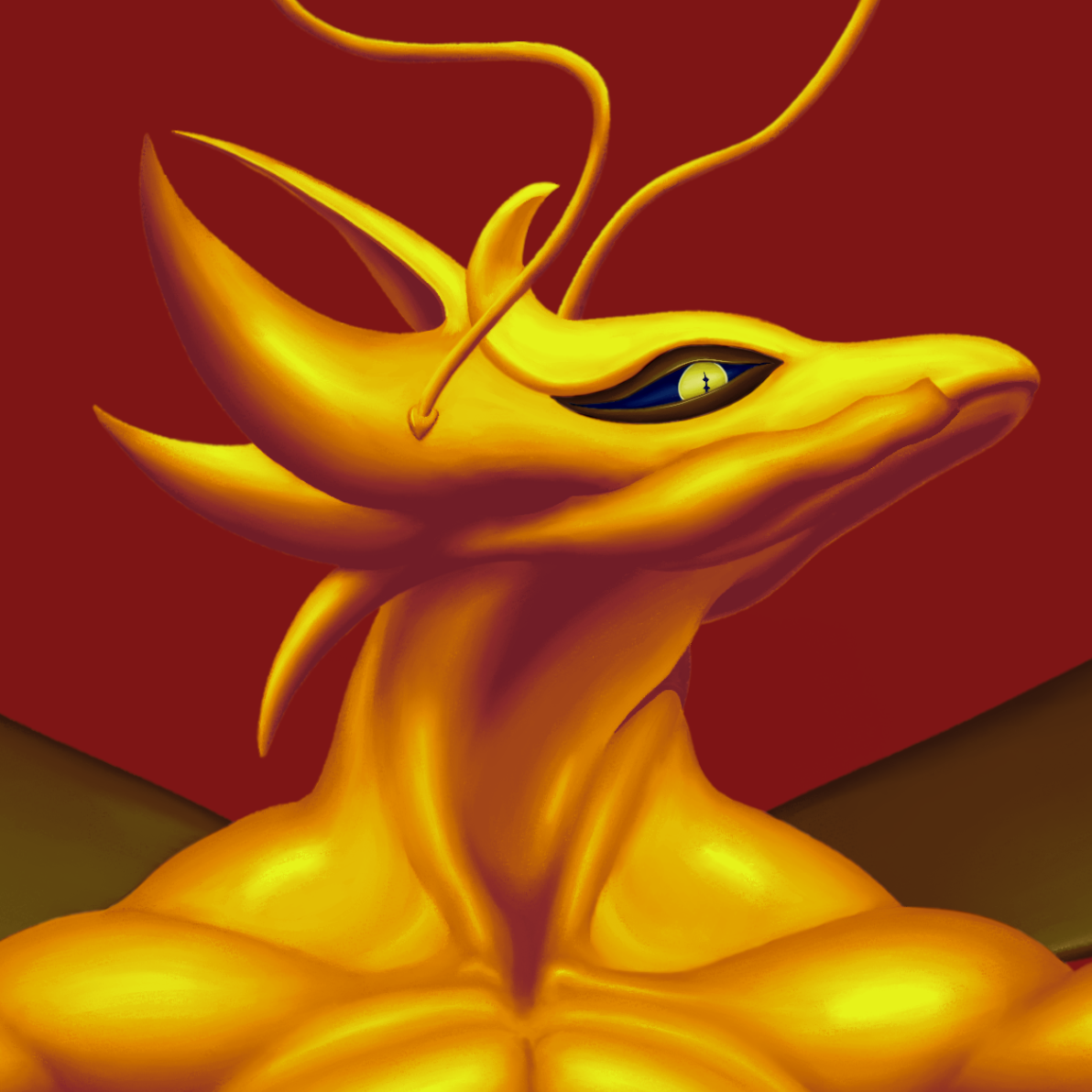
The Sahatrans didn't stand much of a chance. These buglike bipeds – unfortunate to have only two arms and be relatively near to this crazed empire – only recently put their first rocket into space. When hundreds of warships invaded their planet, most resistance was swept side overnight. But their great misfortune would transform, for a Rodinian Mycoship was nearby, investigating this warmongering empire's chain of bloody massacres. The invaders never knew what hit them. In minutes, half their fleet was gone, and their soldiers on the ground screamed over comms in panic and confusion about invincible "demons" butchering them in their hundreds. 'Demons', of course, because Rodinians mostly have two-arms. But one of them didn't. Kelvassian Rodinians, of which Kalrin's a member, have four, and he sent the tiny handful of surviving invaders limping back to their empire to spread a severe crises of faith.
The Jalopek Enclave didn't have the manpower to send a reconstruction and relief team to the Sahatrans, and the damage to their civilization was assessed as not being of a critical nature endangering them as a society. The Quellor crew left a probe and a few mycelial colonies to watch over the Sahatrans, then left. But Kalrin had other plans.
He would later return to Sahatra, and infiltrate their society posing as a god. The Sahatrans remembered him; they knew him as their savior, and saw how powerful these Rodinians were. They were therefore already more receptive than what they otherwise would have been, and so it was a golden opportunity for Kalrin to test his ideas. For centuries, he lived two lives. He'd spend up to a year on the Quellor, carrying out his duties part-time as a first responder. Then he'd leave, to return to Sahatra for a year to continue his project. His cover story was that he took on another role at a different Enclave in a different galactic supercluster, the Xaplacan Enclave, working as part of their second-line relief teams. No one on the Quellor really questioned it. Not initially. It's also known that whilst on the Quellor, he possessed a long-range dataspore linked to observational mycelial networks laced all across Sahatra, allowing him to keep tabs on the Sahatrans and guide them remotely. He ran a civilization, from a datapad.
The Vision
Kalrin wondered something during and just after helping the Sahatran when they were invaded: Why would a civilization be so blithely eager for going to war over something so ridiculous as a religious myth about two-arms bad, four-arms good, but not something like a religion where the rights and dignity of intelligent life were sacrosanct? Why were the most zealous religions with the willingness for going to war for what they believed also the most cruel, callous, petty and self-serving ones, more focused on oppression than freedom and dignity?
It could simply have been that religions based on cruelty, oppression and pettiness found themselves more conducive to the types of attitudes and personalities that started and waged war so easily. On the other hand, those that espoused any sort of value for peace, cooperation, compassion, freedom from suffering, and a right to dignity, found themselves unable to compete in the marketplace of aggression.
What if one could though? That's what Kalrin wondered. What if he could create a religion intolerant of intolerance; violent against those who sought first refuge in violence; oppressive of those who sought to oppress others? A religion rewarding kindness and the enrichment of life. Where compassion, empathy, dignity, and the elimination of suffering were its prime commandments.
And it could spread itself, he thought. All one had to do was light the match. But it needed gods to be capable of converting people. Real, tangible, visible gods displaying their power – their miracles. Myths and stories wouldn't suffice, and peaceful conversion was preferable to conquest. The presence of these gods would also be required to prevent interpretational drift of the religion's core message, ensuring it didn't lose sight of its purpose by veering wildly off track or undergoing schisms. But who would these gods be?
Well, Rodinians of course.
The Holy Rodinian Empire
The immediate barrier Kalrin faced however was that even among the interventionist Enclaves, this idea was considered abhorrent. Hardly anyone was willing to entertain the idea, considered fundamentally a form of cultural erasure. His idea was to erase and replace portions of intelligent species' cultures and identities, for there could hardly be any space for competing religions to exist. It was a bridge too far for many. It did however find purchase among certain sects of the
Vaalbaran faithful, especially those most zealous. Within the extreme flanks of the Vaalbaran faith who believed Earth-based life was superior and should be spread to all corners of the cosmos, the idea of it being considered the apex of life in the cosmos slotted into their worldview perfectly. Even though he wasn't particularly religious himself, Kalrin took note of these groups.
But he was also aware of how unpopular his ideas were beyond these fundamentalist sects, which is why he wanted results first. He'd prove his idea was worth the ethical problems by using the Sahatrans as an example. Then, he'd spread his religion to other nearby civilizations and, in his hopes, watch them join together under a common unifying cause. They'd organize and arrange their own societies around achieving the ambitions of this 'Rodinian Theocracy' – a world without suffering or hardship, and filled with goodwill and trust between intelligent species.
This solved another problem in his mind: the burn-out issue of the old Rodinian Empire. In this new Holy Rodinian Empire, no Rodinian would need to get involved in the internal affairs of governing civilizations to ensure compliance with the empire's goals. Species would do this themselves in line with their god-fearing and revering faith in their Rodinian gods. And the empire could spread itself through proselytization. Rodinians would be reduced to a mere presence, providing required course corrections to the faith and keeping it cohesive, whilst the faith largely spread itself, and civilizations governed themselves in line with its teachings.
Kalrin, in his hearts, is a being who despises seeing life wasted. For most, life's temporary and fleeting, and whilst it could be so rich and joyful, it causes him grief that for so many it's miserable, horrific and scarcely worth being lived. He's been told by many other Rodinians that "this is just the nature of life". Kalrin's fed up with that rhetoric. He intends to change the nature of life. An impossible task even for a Rodinian, but then, Kalrin's no ordinary Rodinian.


Comments