Beriv-to-Zun-Meril
Ring of Blood and Pleasure
Ruavine is home to a number of places that specialize in providing entertainment; of course, that is the true calling of any sophisticated Sura! However even among the theaters and arenas of the grand city, one venue, Beriv-to-Zun-Meril, stands above the rest... figuratively, but also physically because it is quite tall. For nearly 4,000 years, it has served as the pulsing heart of Incaendium, host to the Dark Sun nights, to numerous once-only theatrical events... and an enormous amount of blood-letting, of course!
Overview
Inside Ruavine, the beating heart of Amaya - and thus of Incaendium itself - there is significant importance placed on hedonism, pleasure, entertainment... as the case may be. This focus has become especially sharp in the past 4,000 years with the rise of Dominus Regas Samael Asther, a known lover of the arts... as well as a known lover of glorious battle.
Zun-Meril Basics
That being the case, the construction of Beriv-to-Zun-Meril is, perhaps, to be expected.
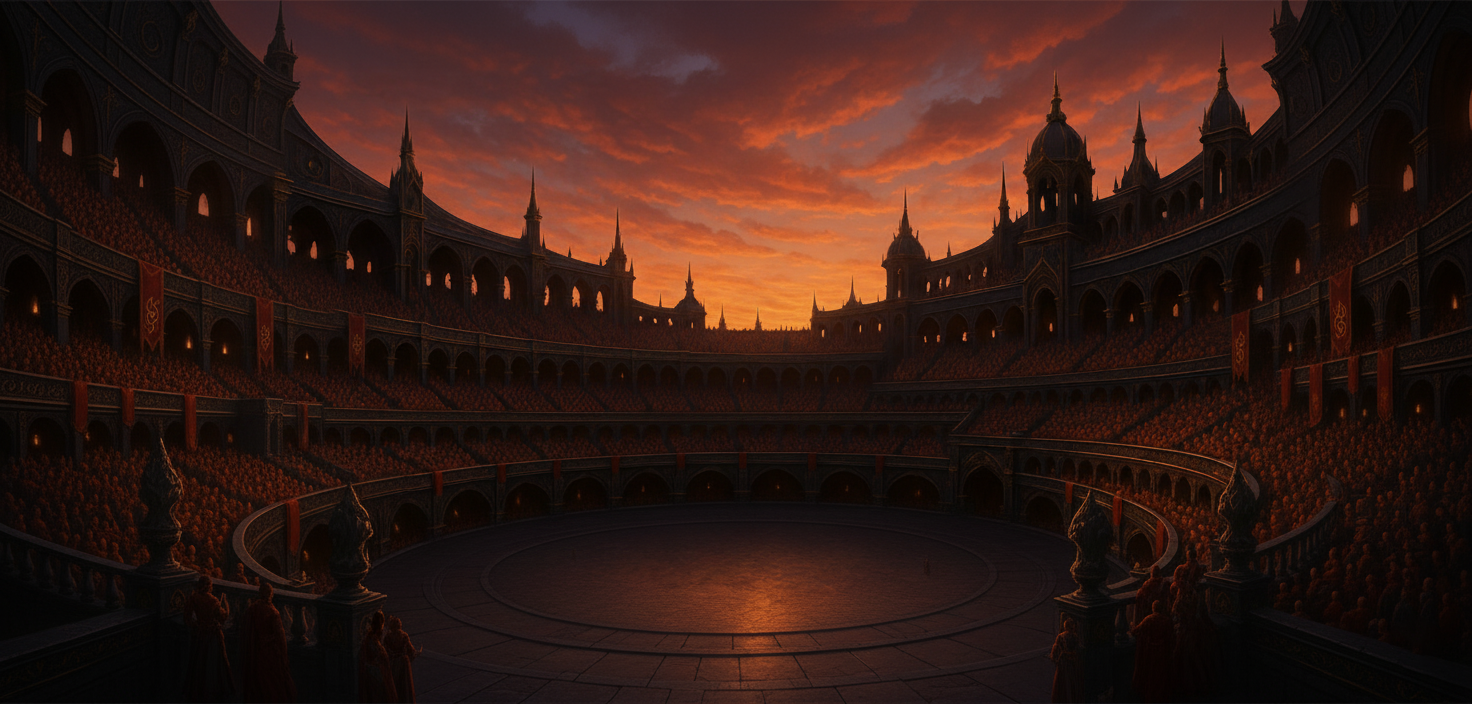
One of Samael's most impactful investments during his early (pre Endless War) reign, Beriv-to-Zun-Meril - often called simply Zun-Meril for short - is a Morasi that seats around 85,000 people. As the beating heart of the entertainment district in Ruavine, it is used to present plays, concerts, sporting events, tournaments, combat exhibitions and more - it has even been used to host food and shopping events.
Curiously, the "ring" in its name (beriv) is actually a verb - to ring, as in ringing a bell or causing a ringing sound via some other means. Thus the name itself roughly translates to "cause/make a ringing sound of blood and pleasure."
History
The predecessor to Zun-Meril was a coliseum called Teri-Girozo (The Blood Arena). An older structure, Teri-Girozo had been begun construction during the reign of Izavara Asther and completed after her death by her son, Imael Asther.
Physical Dimensions
With the fall of Gorgo and rise of Samael, this would change.
The Blood Arena No More!
One of Samael's immediate concerns was reversing the structural decay of Ruavine, with a focus on transforming the heart of Amaya from an oppressive militarized zone into a thriving city of arts and culture. While he had no objection to the violence of the land, being somewhat endemic to the Incaendian Culture, the man himself had a strong passion for theater and beauty, and so he brought that into the rebuilding and recreation of the capital.
Architecture
In Teri-Girozo's case, this meant being largely gutted and rebuilt as a grand amphitheater that could be used for any purpose involving mass gathering.
The construction was completed after approximately one year, after which Samael finished off its appearance personally, making use of his control over volcanic substances and earth to layer intricate black glass filigree pattern in strategic places throughout the building - a mark of his family's presence, and control.
The final building was christened Beriv-to-Zun-Meril: Ring of Blood and Pleasure.
The Center of a Changing World
While the initial debut of Zun-Meril was successful, it became increasingly so as Samael - and thus Amaya - began to rise in power and collect additional land. As is the nature for demons, they draw close to power, and soon Ruavine was not just the heart of the Domain itself, but of the Domains nearby, as well. Soon, Zun-Meril rose to become the most in demand venue in the eastern side of Incaendium.
That has never changed. It remains, to this day, the heart of Ruavine's entertainment sphere, coming alive often - sometimes nightly depending on the season! - to bring beauty, pleasure and violence to the people who love and embody those things the most.
Scheduling & Seasons
In order to make events more manageable, Zun-Meril's scheduling is organized by the suvy-teut (event scheduler), Jivavi Zanedine. Currently, Jivavi has assigned each quarter to a certain "flavor" of event; she is flexible enough to make necessary changes, but does try to be consistent more often than not.
1st Quarter: Spring
This is the season for new creatives to debut their work, to coincide with the theme of beginnings.
2nd Quarter: Summer
This is a season of sex and violence - many of the private events held are quite directly related to those things.
3rd Quarter: Autumn
This is the most popular time to debut new plays, operas or music for already established creatives.
4th Quarter: Winter
A month of dark glamour - imagine black feathers and jewel encrusted black silk gowns.
Jivavi breaks the schedule into 32 blocks of 10 days (called a ve-ny), with the aim of two to three events per 10 day block. This means a total of between 70 and 100 events per year. The unused days are for preparations for the event days! Additionally, high ranked families who want to hold events or gatherings of their own are able to request them on non-event days.
The general schedule guidelines can be found below:
Generally, each event will take 2-3 set-up days, so this pace keeps the space active without completely burning out the staff. Speaking of the staff, they rotate between cleaning and set up duties, with each person doing, for example, preparation on one event and clean up on the next.
Anchor Events
Dark Sun Events occur, of course, on the nights for which they were named. These events are usually among the grandest of the year; because Samael himself is a fan of the arts, the events are more likely to be linked to theater and music, for example, than combat exhibitions-- though on at least one occasion, it involved both.
Dark Sun theater events make use of magical effects and the greatest composers and actors in the Realm. Often, Samael himself will commission work from his personal favorite creatives to ensure a satisfying experience; many of these plays are only shown once -- and even more are only shown once in their grandest form.
Unveilings: Aside from the two introductory Unveilings, one doesn't normally know very far in advance when Samael will call for an Unveiling... but when he does, it may take place in Zun-Meril. An Unveiling can be anything that the Dominus Regas wants to make certain is publicly known. This could be an execution, a change in law, the introduction of a new consort or a new plan. Samael rarely calls for Unveilings.
The Year End Festival: Again, this is something that happens every year, but often changes form. The intention is to give people the chance to celebrate their successes and mourn, then release, their failures in order to move forward and achieve new wins in the coming year. It should be noted that, as Demons are immortal, new years are not as significant to them as they are to, for example, Mortals. As such, the typical Year End Festival is more a celebration than a spectacle. That said, larger events occur on every 10th and, in particular, on every 100th year.
Scheduling Politics
Jivavi avoids scheduling two events of the same type in a row, as this will create boredom and result in her getting a lot of obnoxious complaints that she would prefer not to deal with.
All proposed schedules -- and events added or removed from the schedule -- must be approved by the Throne. Samael does not typically look at minor changes himself, but he does look over a Quarter's proposed schedule, for example.


The great amphitheater of Amaya, constructed in the early days of Samael Asther's reign. Built from the bones of a combat-only arena that preceded it, Zun-Meril hosts any kind of gathering event from Unveilings to Concerts and from Bloodsports to Romantic Plays.
Ruavine, Amaya, Incaendium
A.K.A.Zun-Meril, The Ring
OwnerIt is owned by the throne of Amaya, currently inhabited by Samael Asther.
Construction29004Y 2Q 76D - 29005 2Q 77D
ContentsApproximately 85,000 seats.
A staging area designed to be easily refitted for different kinds of staging (storage for shop events, dressing areas for plays, preparation and recovery areas for tournaments or combat exhibitions, etc.

Comments