
Calibridge
Demographics
Social Classes & Distribution
Laboring Class (55: Mill workers, craftsmen, and servants. Concentrated in Westgate and The Mill. Families are large, with many children working from a young age.
Tradesfolk & Middle Class (30%): Shopkeepers, brewers, scribes, clerks, and skilled artisans. Found in Northgate and Greenshade, often aspiring to move their families into Brightwall.
Upper Class (10%): The Calibridge Family, wealthy merchants, guild leaders, and council members. Nearly all reside in Brightwall, maintaining polished estates.
Retainers of the Citadel (5%): Guards, caretakers, and scribes directly tied to the Calibridge family. Though they officially serve at Calibridge Citadel, many have homes in Greenshade or Brightwall.
Religion
Nearly all residents outwardly follow the tenets of Eternal Harmony. However, many of the working class (particularly in Westgate and Rainy Side) practice folk traditions, offering bread, flowers, or coins at small shrines to ward off restless spirits — especially those tied to the Citadel’s bloody past. The upper class tends to favor public piety, attending ceremonies to display status rather than faith.
Cultural Traits
Superstitious: Even those who scoff at ghost stories avoid the Citadel ruins after dark.
Tied to Legacy: Families in Calibridge often trace their roots back to the Citadel’s original builders or retainers, wearing this ancestry with pride (or shame, if linked to darker events).
Hardworking & Insular: Outsiders are welcomed politely but rarely trusted until they’ve proven themselves.
Government
Calibridge is officially governed by a mayor and council of aldermen, elected every five years. However, the Calibridge family’s influence often steers decisions behind the scenes, especially regarding land rights, trade tariffs, and use of the river docks.
Defences
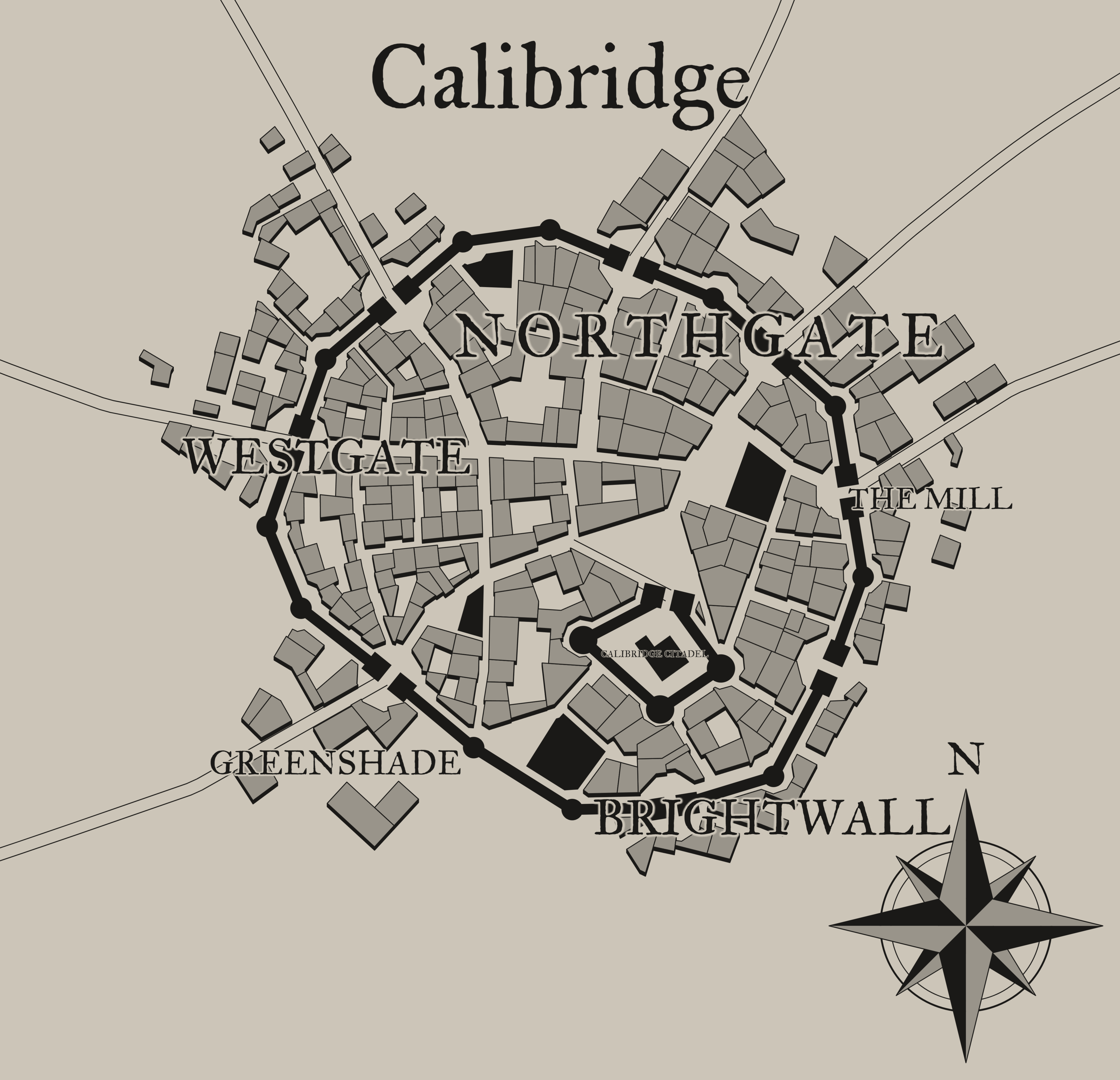
- A stone wall encircles the oldest parts of town (Northgate, Brightwall, and Greenshade).
- Watchtowers at both gates, manned by a modest town guard.
- The Citadel looms above as an implied defense, though its role is more symbolic now.
Industry & Trade
Milling: flour and textiles.
Crafts: blacksmithing, carpentry, leatherworking.
Agriculture: orchards and gardens from Greenshade supply much of the town’s food.
Tourism: visitors drawn by the Citadel and its grim legends.
Infrastructure
- Paved central roads leading to the Citadel gates and the town square.
- Water powered mills along the River Veyne.
- A modest sewer system, though only in the wealthier districts. Taverns, inns, and a central market square servicing both townsfolk and travelers who visit the Citadel.
Districts
Northgate
This is the entry point for most travelers, marked by the largest town gate. Inns, stables, and smithies cluster here to service merchants and caravans. It's known for its lively atmosphere and for opportunistic thieves preying on newcomers.
Westgate
Westgate is packed tight housing and is considered the working-class quarter. Laborers, dock workers, and lesser tradesmen call this district home. It is often the loudest district at night, with taverns and gambling dens.
Greenshade
A more tranquil district lined with gardens and orchards. Here one can find some of the better-off townsfolk, including minor scholars and scribes tied to the Citadel’s archives. Locals pride themselves on its quiet, “respectable” atmosphere.
Brightwall
Named for the sunlit white stone used in its construction. It is the wealthiest district, home to the town’s elite and council members. Streets are wider and cleaner, and guards patrol regularly. Often contrasted with Westgate — wealth versus poverty.
The Mill
Built around the watermills on the River Veyne, this district is the heart of local industry, producing flour, timber, and textiles. There is constant activity during the day, with a sharp division between mill owners and laborers.
Assets
- River Veyne trade routes connecting to Sadapintal and smaller villages.
- Strong industrial base via the mills.
- Historic connection to Calibridge Citadel, which draws scholars, pilgrims, and thrill-seekers.
History
1108–1110 AOE: Calibridge Citadel constructed under the Calibridge family’s commission.
1111 AOE: Workers, guards, masons, and families who had supported the Citadel’s construction settled permanently in its shadow, forming the first structures of Calibridge town.
The town grew as a service hub — supplying food, labor, and trade for the fortress. Over time, the settlement expanded along the River Veyne, becoming a self-sustaining town in its own right, though still tied to the fortunes of the Citadel. The Bloody Chapel Incident in 1611 AR cast a lasting shadow over the Citadel and by extension the town. Since then, Calibridge has been caught between prosperity from trade and the superstitions surrounding its dark history.
Points of interest
Calibridge Citadel: The looming fortress on the edge of town, infamous for its violent past. Locals avoid coming here at night.
The Mill District: Heart of industry, always bustling.
Brightwall Square: The polished heart of the upper class, lined with statues of past mayors.
Tourism
Ghost-seekers and occult scholars often come to study or experience the Citadel. Taverns in Northgate and Westgate thrive on this tourism. The town grudgingly tolerates the attention since it brings money, even if locals avoid speaking of the Incident.
Architecture
Mix of sturdy stone buildings near Brightwall and Greenshade and timber-framed housing in Westgate. Roads are cobbled in the central areas, dirt-packed elsewhere. Many buildings incorporate Citadel stone offcuts, giving parts of town a stark, imposing look.
Geography
- Located on the banks of the River Veyne, which powers the mills and serves as a trade artery.
- Built on a slight rise, allowing the Citadel to tower over it.
- Fertile land around Greenshade supports orchards and gardens.
Climate
Temperate but damp — frequent rains keep the river high. Fog is common in the mornings, especially near the Citadel. Winters are harsh but short; summers are cool and mild.
Natural Resources
- Timber from nearby forests.
- Stone from quarries once used to build the Citadel.
- Fertile soil in the surrounding lowlands.
- The river as both a resource and a lifeline.


Comments