
Taveton
Demographics
Predominantly followers of Eternal Harmony, with small undercurrents of folk traditions (ghost offerings, charms, and local superstitions).
Government
Independent local rule, headed by a Mayor and an elected council of merchants, guild leaders, and elders.
Authority is civic rather than noble — no feudal ties to great houses.
Law enforcement provided by a small town watch (20–25 members).
Defences
Defenses are minimal. There is a partial remnant of an old palisade wall near the Old District. There's a Town Watch for local disputes and small-scale crime. Volunteers form a militia in rare emergencies.
Industry & Trade
Brewing & Distilling: A primary export, known across Tacia.
Agriculture: Barley, wheat, hops, flax.
Smithing & Leatherwork: Blue Forge is known for the excellent quality work.
River Trade: River Veyne provides access to larger towns and Sadapintal, the capital.
Infrastructure
- Market Square at the town’s heart.
- Stone bridge over the River Veyne, essential for trade.
- Breweries, taverns, and inns sustain much of the economy.
- Smithing quarter (Blue Forge) supports trade and local needs.
Districts
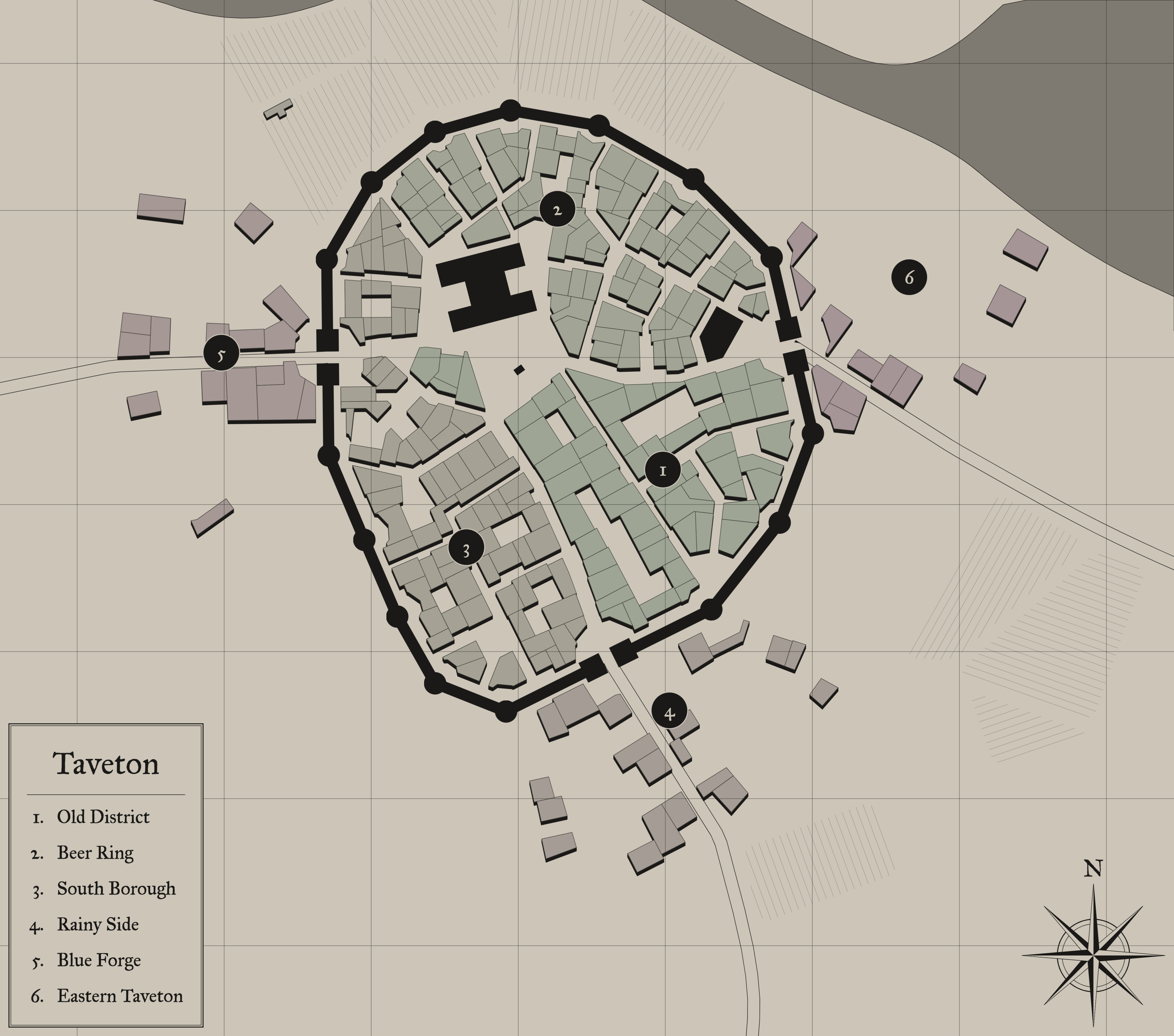
Old District
This is the original heart of Taveton, dating back to its founding in 1148 AOE. It's known for its narrow cobbled lanes, leaning timber-framed houses, and the oldest stone well in town as well as being a place of stories and superstition — locals whisper about the “old shadows” that linger in corners. Many of the town’s elders live here, keeping traditions alive.
Beer Ring
The pride and identity of Taveton. Here are the breweries, taverns, and guildhalls that make the beer Taveton is famous for. The air is thick with the smell of malt, yeast, and smoke from brewing vats. Beer Ring is home to the Brewers’ Guild, the wealthiest organization in town. Street festivals and beer fairs are held here, drawing traders and tourists alike.Despite the lively reputation, Beer Ring is tightly controlled by guildmasters — disputes over brewing rights sometimes get violent.
South Borough
South Borough is a bustling artisan quarter where craftsmen and workers live. Leatherworkers, carpenters, masons, weavers, and small traders dominate the borough. Lively markets spill into the streets, though conditions are crowded. There's a strong sense of community with many families here trace back several generations. Locals sometimes sneer that South Borough is “all noise and smoke,” but it is the lifeblood of Taveton’s industry.
Rainy Side
Located along the River Veyne, Rainy Side is prone to seasonal flooding. This is the poorest district of Taveton, with rickety wooden homes often in need of frequent repairs and muddy alleys. Many families of boatmen, fishermen, and laborers live here. It's known for its folk shrines, offerings of bread or flowers left to ward off ghosts believed to linger near the river. Outsiders dismiss it as shabby, but Rainy Side has a fierce loyalty among its residents — “Rainy folk” stand up for their own.Blue Forge
The industrial quarter, named after the bluish smoke that often hangs in the air from smithies and dye vats. Blacksmiths, armorers, toolmakers, and dyers work here, supplying Taveton and nearby villages and the clang of hammers and hiss of bellows are constant. Blue Forge is often seen as grimy and dangerous, but is respected for its vital role in Taveton’s economy. Apprenticeship in Blue Forge is considered a solid start for anyone seeking work.Eastern Taveton
The town’s newest expansion, developed over the last century. Eastern Taveton boasts of wider streets, cleaner houses, and better drainage than the older districts. It is home to wealthier merchants, minor gentry, and guild leaders. Taveton’s mayor’s hall and the town council chamber are located here and it is seen as “respectable” and a symbol of progress, though old Taveton folk mutter that it lacks soul.
Assets
- Whitesmith Investigations (founded by Lyra Whitesmith).
- Taveton Brewery Guild (largest employer and exporter).
- Market Square as the commercial hub.
History
1148 AOE: Founded as a river crossing hamlet.
1200s AOE: Brewing guild established, cementing Taveton’s identity.
1600s AR: Town expanded due to its strategic position on the River Veyne trade routes.
Modern Day: A modest but thriving town, known for its beer and resilience.
Points of interest
Market Square & Fountain: A hub of trade and gatherings.
Rainy Side Shrines: Small folk shrines maintained to appease wandering ghosts.
The Stone Bridge: Vital for trade and symbolic of the town’s founding.
Tourism
- Brewery tours and beer festivals.
- Pilgrimages tied to Eternal Harmony’s rural shrines.
- Folklore-based tourism, particularly Ghost-related legends.
Architecture
- Mix of stone and timber houses with steep tiled roofs.
- Colorful shutters and painted doors common.
- Breweries are squat, sprawling structures with tall chimneys.
- Eastern Taveton features more “modern” straight streets and larger merchant homes.
Geography
Taveton is located on the fertile plains of central Tacia, along the River Veyne. It's surrounded by farmland, rolling meadows, and patches of woodland and is easily accessible by trade roads and riverboats.
Climate
Taveton is a cool, wet climate with frequent light rain and mist, mild summers, chilly winters. There's flooding risk near Rainy Side when the river swells.
Natural Resources
- Barley, wheat, hops, flax from farmland.
- Timber from nearby woods.
- Iron ore (small deposits) used locally.
- Clean river water key to its brewing reputation.


Comments