
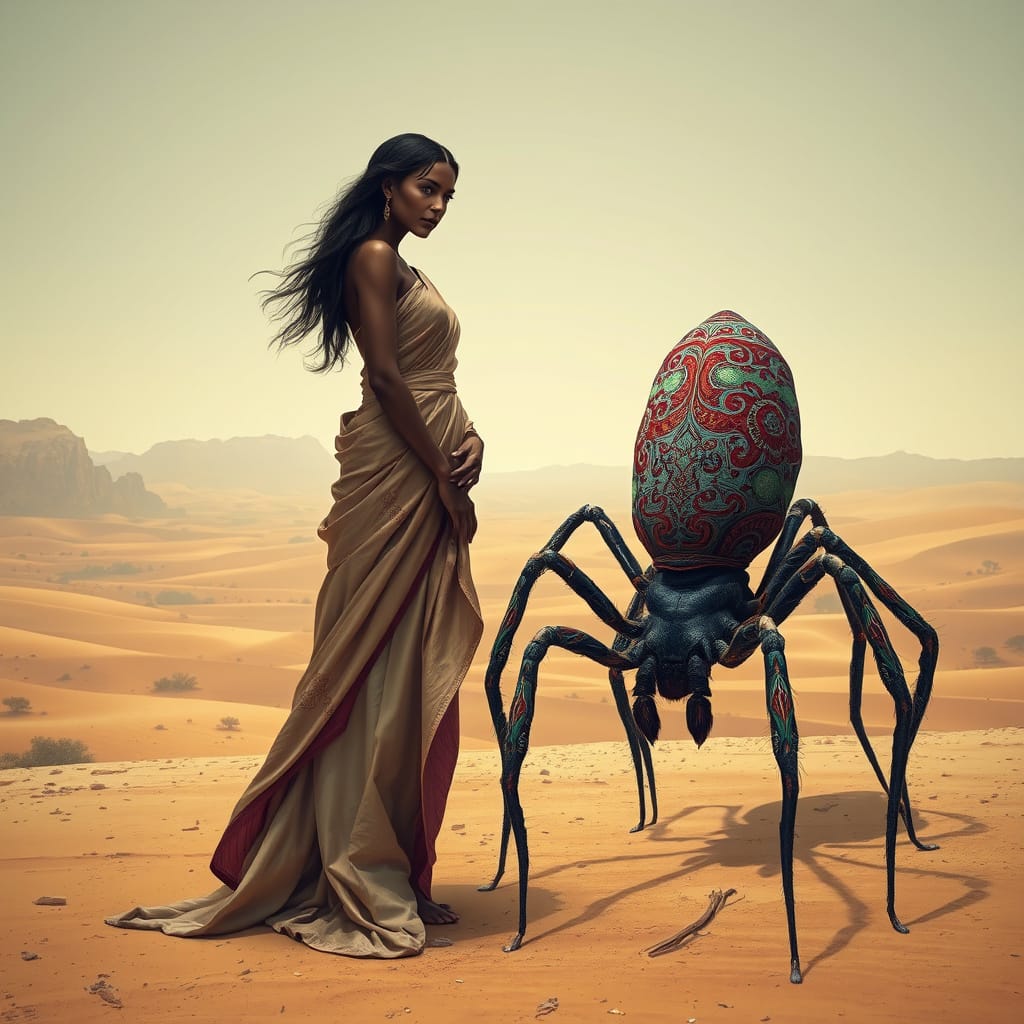
Kolobvol
Basic Information
Anatomy
Kolobvol in their true form resemble human-sized spiders with a variety of colorations. Some tones look simple or muted while other remain striking and vibrant, with most patterns inherited from an anadi's parentage. A typical Kolobvol measures five feet in length from their front legs to their rear legs when standing comfortably.
All Kolobvol possesse the ability to transform into a humanoid form. This form can resemble any humanoid ethnicity, but it's usually one that blends in with the region of a Kolobvol's hatching, or birth depending on the other parent. This form is chosen during their 13th birthday, and can not change except without additional difficulty throughout their lives. Kolobvol reach physical maturity after 13 years, going through multiple phases of molting along the way. A typical Kolobvol lives to be about 150 years old.
While in their true form, they have fangs, can climb walls and can generate silk, but cannot use any tools requiring manual dexterity. In their alternate forms, anadi can do anything that their alternate racial form could with their hands, but they lack the ability to climb walls and generate silk, and lose their fangs in this form.
Genetics and Reproduction
Kolobvol can reproduce with almost any race. As many races are concerned by their true forms, however, they primarily mate with either aulvi or other Kolobvol. Kolobvol who mate with non-kolobvol cannot return to their spider forms during gestation.
Growth Rate & Stages
Kolobvol mature around 13 years old and molt throughout their lives. Average anadi live to be 150 years old, with some living as old as 180 years old
Ecology and Habitats
Kolobvol can be found almost anywhere, though their natural habitats tend to be warm and moist, or simply hot. Their homeland is a combination of desert, volcanic mountains and lush jungles. Many Kolobvol, however still live under the enslavement of the Zevemlyan people and their god-king Galvander.
Dietary Needs and Habits
kolobvol in their true forms partake of primarily meat, honey, and blood/ichor. In their humanoid forms, however, kolobvol readily eat anything that a humanoid of their type would be able to eat
Biological Cycle
Each year a kolobvol molts, leaving behind it's outer carapace, but only while in the spider form. Kolobvol in colder climates tend to grow thicker fur than those in cooler climates. Kolobvoli molts are typically used as fertilizer supplements after being ground down.
Behaviour
The cooperative nature of Kolobvoli society and their dislike of violence means many anadi lean toward good alignments. They're more often neutral than chaotic or lawful, though the latter aren't unheard of. kolobvol live in communal tribes, sharing peaceful lives weaving. Their culture places great value on cooperation and mutual respect. Due to this cultural upbringing, kolobvol often have issues facing severe social conflict and often come off to other ancestries as very shy. Their history of dealing with arachnophobia in other peoples—which kolobvol understand is often instinctual and very difficult to control—likewise means that kolobvol do their best to be accommodating and comforting, even in situations that aren't necessarily fair to them.
Many kolobvol live with Aulvi , who they see as a kindred species. kolobvol have been captured as slaves by both Jant and humans seeking high-quality Tipø - Kolobvol silk in the past. This is much more rare in the present due to the assistance of the aulvi over the past 100 years, breaking the yoke of the jant in their homeland, and going to war with the human kingdom of Zevemlya who continue to enslave many of them. While not beholden to aulvi, the kolobvol see them as brothers and sisters, and those kolobvol not living in tribes, often live among aulvi in their shared communities.
The Kolobvol is the name they have for themselves as a people, it literally means "Day tribe" and referrs to the world of the living as the world of the day and the world of the dead as the world of the night. They are careful not to call the world of the dead the world of darkness or of shadow, as that could, they believe, give Brother Shadow more power over them in death. The Wowælobvol is the tribe of night and referrs to their ancestors. The gønvë agøbtæn, or Walking Ancestors are tangible spirits in the world, and traverse the paths of their living cousins during the nights. The Night tribe is said to protect the Day tribe while they sleep, just as the Day tribe protects the memories of the Night tribe during the sunlit hours.
Both the Day Tribe and the Night tribe are broken up into their respective tribes, the Pëblu Woblaek, Kët Woblaek, Tal Woblaek, Ikyæ Woblaek, Zo Woblaek, Vuën Woblaek, Yøllæn Woblaek, and Gæk Woblaek (fire, water, life, mountain, Air, Iron, shadow, and story tribes, respectively.) These Woblaek also have sub-tribes that travel separately, though along the same routes. Tribes rarely meet outside of the Great Pass and the Oasis, and it is in those places that the Kolobvol trade between tribes and meet new mates.
It is common for male kolobvol born to one tribe to find a tribe that is neither that of their mother, nor that of their father to marry into, and very uncommon for female kolobvol to do so due to the larger number of male kolobvol in the tribe. Furthermore, a large portion of kolobvol live permanently in the oasis city of Gënlèul- Land of Dawn among the aulvi and humans as a united people. Some, unfortunately, have been taken to Zevemlya as slaves and have remained there sseparated from their people for nearly a century or more. Thus, some kolobvol take it upon themselves to search for, and to free, their enslaved cousins.
Additional Information
Social Structure
Typically led by a wise woman (or on occasion wise man) and a chieftain, the group is otherwise communal, taking advice rather than orders from their chosen leaders. In aulven societies, they share democratic processes with the aulvi and humans.
Uses, Products & Exploitation
Kolobvol have been exploited for Tipø - Kolobvol silk and labor until very recently, some being maintained as permanent beekeepers for rich families while also producing silk for their clothes.
Facial characteristics
Characteristics vary between their true (spider) form and their humanoid form. In their spider form, they have many different spider-like visages, and their human form depends on the species they choose to emulate.
Geographic Origin and Distribution
Primarily found in jungles, deserts and mountains as well as caves, though depending on the tribe or mindset, some live among the aulvi, and others live nearer the shores, or even in or at the bases of volcanoes.
Average Intelligence
As intelligent as the average human, though more wise on average. Kolobvol are the spiritual center of many higher aulven population societies.
Perception and Sensory Capabilities
Web sense- Kolobvol who build webs can sense others on those webs, as though with tremorsense.
Symbiotic and Parasitic organisms
Symbiotic relationship with aulvi. Kolobvol who choose other races as their form typically are not as free about sharing their form with others. kolobvol have, up until the last century been used as slaves for humans and jant. While the slaves of the jant no longer exist, the slaves among the Zevemlyans and some Ngākauwhenuan provinces still exist.
Civilization and Culture
Major Organizations
Pëblu Woblaek- Fire tribe
Kët Woblaek- Water tribe
Tal Woblaek- Life tribe
Ikyæ Woblaek- Mountain tribe
Zo Woblaek- Air tribe
Vuën Woblaek- Iron tribe
Yøllæn Woblaek- Shadow tribe
Gæk Woblaek- Story tribe
Beauty Ideals
Beauty standards are typically related to patterns and fur consistency while in their spider form.
Beauty standards are typically focused on additions to the body, such as tattoos, piercings, and clothing choice. This is primarily due to the fact that kolobvol are shapeshifters and can choose their own physical form.
Gender Ideals
Males tend to be smaller (and therefore females tend to be larger) , but as the species is primarily communal, there are few gender ideal differences. In the past, males had done more hunting, while females had done more for war (typically as warriors against the jant slavers rather than against other tribes.). Both have done much of the house working and weaving. No color has a particular focus for either gender. Genders other than male or female are not uncommon among kolobvol, but aren't often questioned among the society.
Courtship Ideals
Average courtship relationships typically revolve around weaving. A colorful scarf would be the equivalent of a wedding band, though it is something the two would work on together rather than one surprising the other. This is in part because working on something together helps the kolobvol determine who they are likely to spend their life with. Many kolobvol mate for life, those who do divorce are not shunned, though there is a burning of the scarf ceremony related to this.
Kolobvol who's mates die maintain their mate's scarf (assuming a good union was preserved.) and keep the scarf in good condition for as long as they are able. kolobvol will remarry after the loss of a mate, and having multiple scarves is not seen as a taboo in the culture, but rather both a sign of honor, and a badge of their struggles.
kolobvol have a skewed sex ratio of 6:1 (male:female) and as such, it is not uncommon for female kolobvol in kolobvoli tribes to have 5-8 male mates. This has been alleviated somewhat due to the additional relationship of the kolobvol to the Aulvi, and many male kolobvol (and a few females) have found mates among their kindred allies.
Relationship Ideals
In a kolobvoli romantic relationship, both sides make a point to learn the other's skills. (Thus weaving their histories together). Much of the relationship is built around mutual support and experiences, and both families are tied together, this often leads in the tribal families to relationships between tribes to prevent in-breeding. Outside of tribes, especially with non-kolobvol, this is merged to varying degrees with the other member's culture. Occasionally, kolobvol will choose to live primarily as their alternate form, and will take on more of that culture's relationship ideals.
Average Technological Level
Kolobvol aren't as technologically advanced as many species, but they have exceptional skills with Tipø and between them and the aulvi, they have developed some technological marvels using this material. Kolobvol are also on par with even dwarves for spirituality, though they do experience their spirituality differently, and have different practices depending on tribe.
Major Language Groups and Dialects
Trade common
Continental common
kolobvoli
(Additional languages based on intelligence score, most often elven is chosen first.)
Common Taboos
Wear the scarf of another
Enslave another
spider form 4.5-6 feet long
While more dextrous than the average human, the average anadi is more frail than their human counterparts.
These vary widely both in their true form and their chosen forms.

Comments