
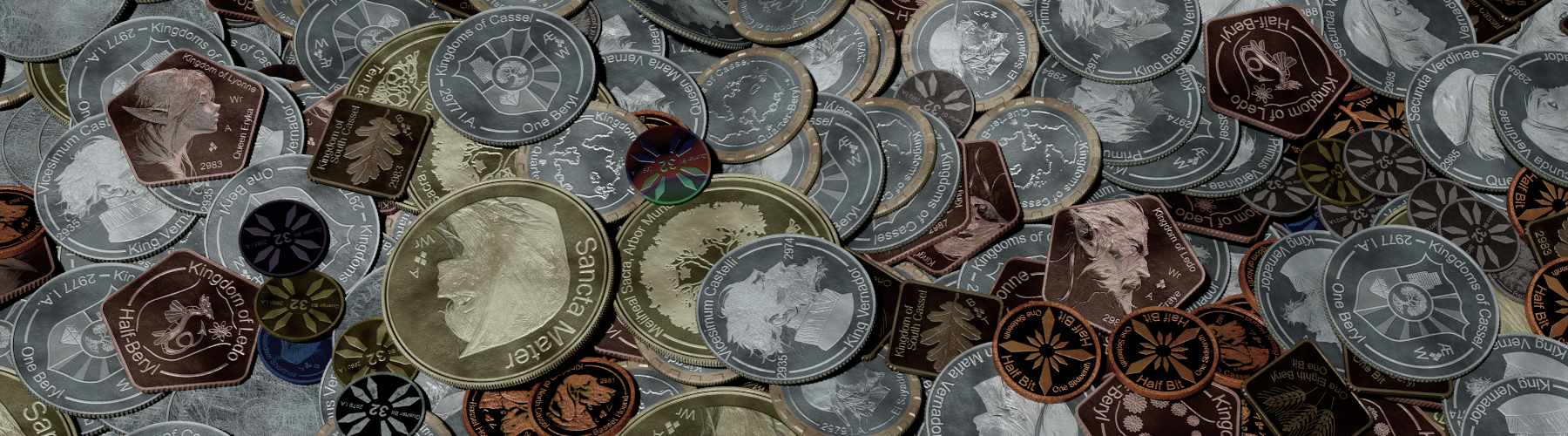
Casselian Coinage
History
Before Cassel was founded by the First Vernador, the currency used in the early Iron Age was primarily coins from even earlier ages. Aethercite crystals were also used as magic resources are always valuable. In the year 650, the currency was standardized, consisting of small polished chunks of Aquamarine and Emerald crystals. In Cassel these Berilli only came from the Mines of Rosika which made it easy to control the currency and set prices. Berilli is the origin of the term Beryl which is still used to refer to certain Casselian coins.
Older coins were for the most part confiscated and melted down. It is possible in other kingdoms even today to find an Olimian Coin from the Silver Age, still perfectly preserved. In Cassel, these are incredibly rare and can only be found in undiscovered Silver Age tombs.
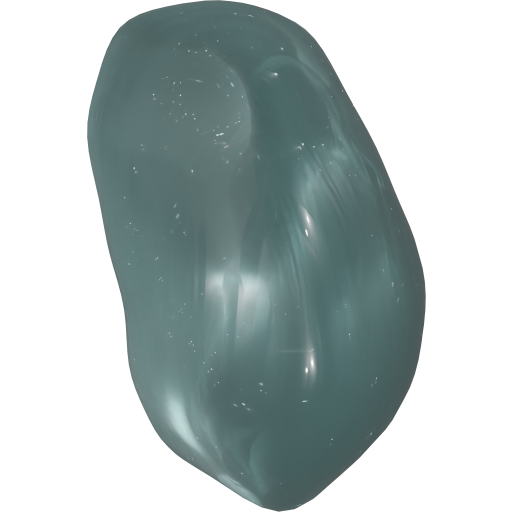
A thumb sized polished chunk of Aquamarine. This would be worth enough to buy a sack of grain, a quality dagger, or a night at an INN. this is about the same value as two beryl coins in current times.
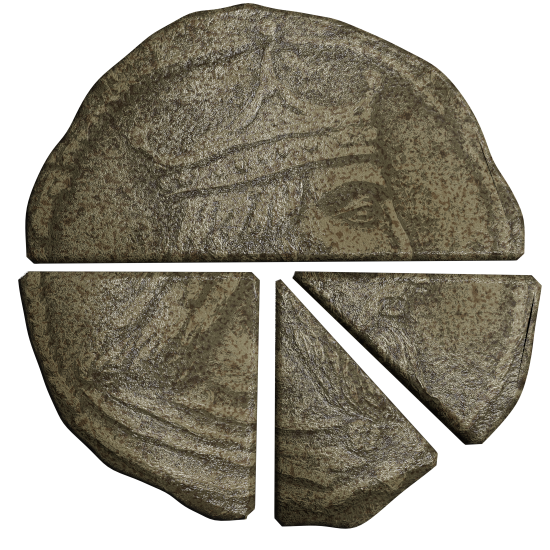
An old gold coin (Cut into half, fourth, and eighth pieces) from the late 16th century. The coin shows an image of the Ninth Vernador King of Cassel, who ruled from 1492 I.A. to 1620 I.A.
By the year 1200, the Kingdom had grown to most of it's current size, and magic crystals were becoming quite valuable. All the easy to find ones above ground were used and no longer had a supply of Aether. People started to use the Berilli for magical purposes as well, taking them out of circulation. Since people were hoarding crystals and not spending them, which greatly inflated the value of the currency. Cassel had no choice but to starting minting gold coins like surrounding kingdoms.
The first gold coins were simple, usually consisting of the face of the currently reigning king inside a raised rim, on both sides. Coins were made by hammering an ingot into a flat slab, which did result in coins that has inconsistent thicknesses. Using a special chisel with a sharpened circular head, coins were cut into circular shapes. In these older times, the coins measured roughly 33mm across though there were many inconsistencies across centuries.
The blank coins were then heated until they turned a dull orange color, and became somewhat soft. This coin was then placed on an anvil and a steel die was placed on top of it. These steel dies were carefully carved to show the appearance of the Vernador King. With a violent strike of a hammer, the image from the die is transferred to the coin. The coin is then reheated and flipped over, and then struck again.
It would be several centuries until coin artisans started to use two dies to strike a coin at the same time. Before this, one side of the coin was always flatter and had less detail due to the process. When they switched to using two dies, the reverse of the coin was usually struck with an image of the world tree while the obverse of the coin maintained the face of the king.
In current times, the minting process is vastly different but uses the same principle. Where ancient peoples had to do everything by hand, the modern process uses steam technology and is mostly automated. There are three mints in the Kingdoms of Cassel, one in the Kingdom of Verdina in the City of Lornar, one in the Kingdom of Aluvian in the City of Wrethilin, and one in the Kingdom of Baileon in the city of Tesiadem. Each mint produces millions of different coins each year.
Alloyed ingots of metal are put through large steel rollers that crushed the metal into sheets with a precise thickness. These sheets are then fed into machines that cut rounded or shaped coins, creating thousands of blanks every day. Before striking, the blank coins are heated and bathed in an acid solution to remove any oxides.
For the striking process, blank coins were put through a sorting machine that filtered out suitable coins with imperfect ones, which were sent back to be melted down and the process repeated. The suitable coins then slide into a steel ring to be held. From above and below, steam presses cause the obverse and reverse dies to strike at the same time in one dramatic strike, creating a perfectly struck coin. For coins made of multiple layers like the single and ten beryl coins, the process is slightly different and required additional heating and sorting steps but also results in perfectly struck coins every time.
The coins are finished by putting them in fine sand and then tumbled until they are polished smooth. Inspectors go through the finished coins, looking for imperfections, though when looking at thousands of coins a day, imperfections often slip by. The coins are then boxed up and shipped across the Kingdoms.
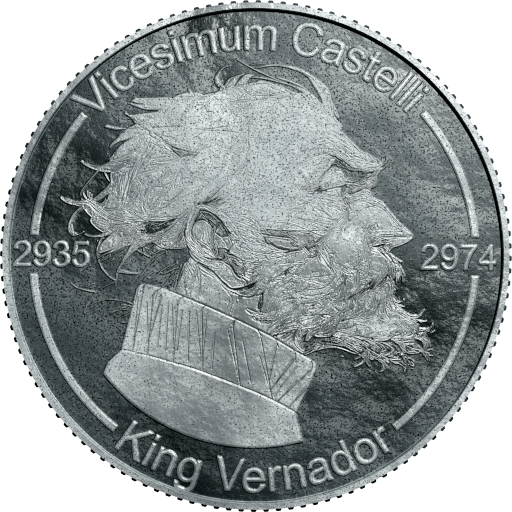
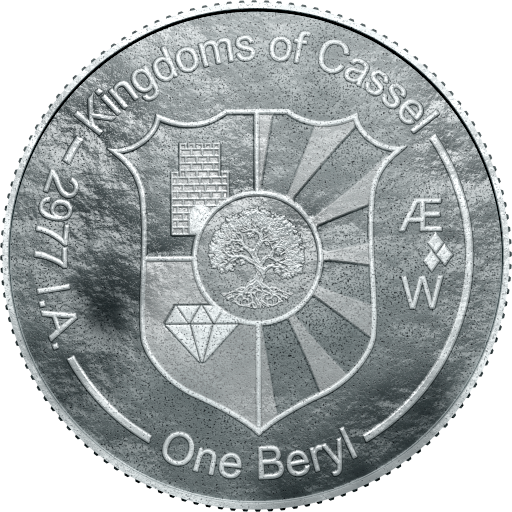
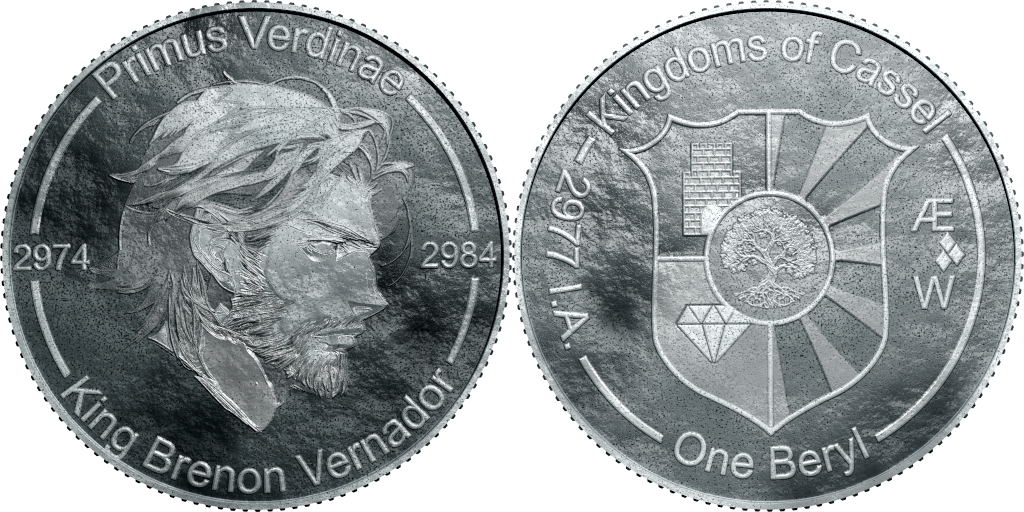
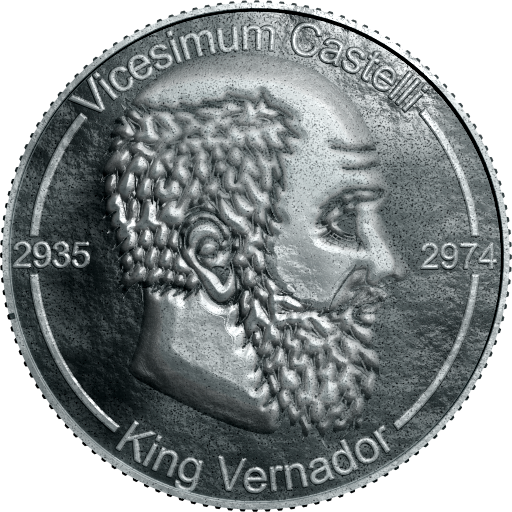
A modern One beryl Coin, minted in the year 2977. The coin shows an image of the Twentieth Vernador King of Cassel who reigned from 2935 I.A. to 2974 I.A.
Modern Beryl Coins
Quick Reference Table
((Author's Note: Red Text indicates the common name I will use the most while worldbuilding here.))| Image | Info | Physical Characteristics |
|---|---|---|
 |
Name: Ten Beryl Alternate Name(s): Saint Coin Year First Minted (Modern): 2880 |
Diameter: 40mm Thickness: 4mm Weight: 64.5 grams Ridges: 256 Material Composition: 30% Gold, 50% Silver, 20% copper |
|
Name: One Beryl Alternate Name(s): - None - Year First Minted (Modern): 2708 |
Diameter: 30mm Thickness: 2.5mm Weight: 19 grams Ridges: 128 Material Composition: 85% Silver, 10% Copper, 5% Gold |
 |
Name: Half Beryl Alternate Name(s): Elf Coin, Rose Coin, Crescent Year First Minted (Modern): 2920 |
Diameter: 30mm Thickness: 2.5mm Weight: 13.4 grams Ridges: 100 Material Composition: 75% Silver, 20% Copper, 10% Nickel |
 |
Name: Quarter Beryl Alternate Name(s): Mark, Quarter Year First Minted (Modern): 2925 |
Diameter: 25mm Thickness: 2mm Weight: 9.3 grams Ridges: 150 Material Composition (Outer): 80% Copper, 10% Zinc, 10% Nickel |
 |
Name: Eighth Beryl Alternate Name(s): Bit, Chip, Leaf Year First Minted (Modern): 2850 |
Diameter: 25mm Thickness: 2mm Weight: 5.7 grams Ridges: 20 Material Composition: 70% Copper, 20% Silver, 10% Tin |
 |
Name: Sixteenth Beryl Alternate Name(s): Half-Bit, Hound, Pup/Puppy, Perry, Green Year First Minted (Modern): 2650 |
Diameter: 18mm Thickness: 3mm Weight: 6 grams Ridges: - None - Material Composition: 40% Copper, 35% Tin, 25% Zinc |
 |
Name: Thirty-second Beryl Alternate Name(s): Quarter-bit, Cat, Colby, Blue, Fairy Coin Year First Minted (Modern): 2900 |
Diameter: 15mm Thickness: 1.8mm Weight: 2.5 grams Ridges: - None - Material Composition: 45% Zinc, 30% Copper, 25% Tin |
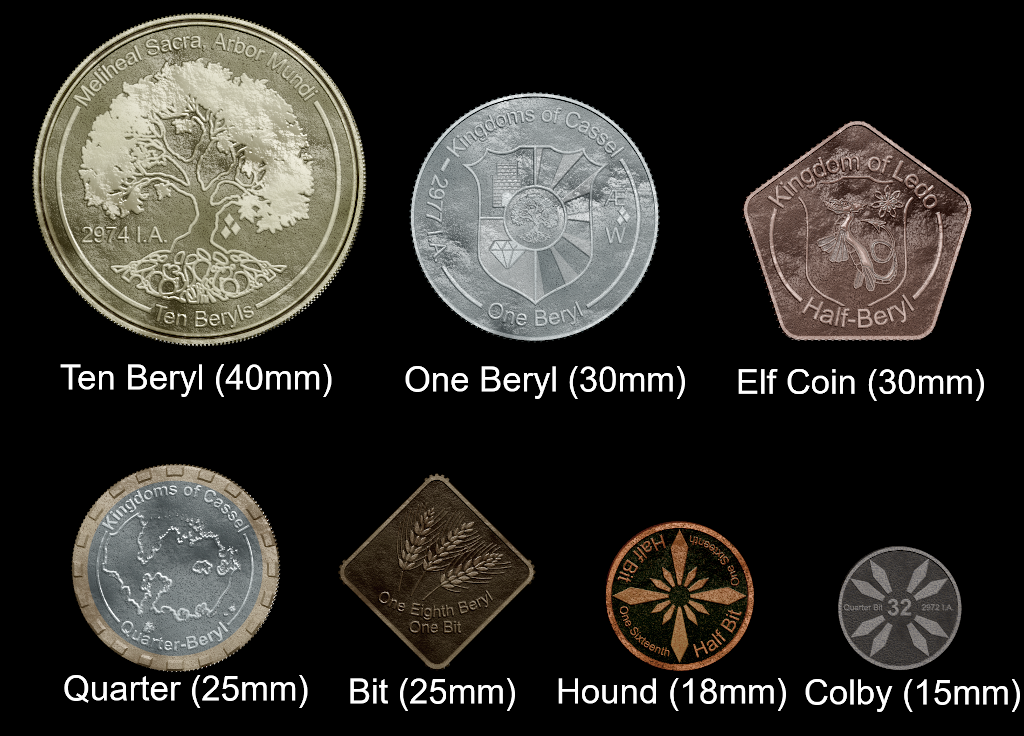
Size Comparison
Common trade items and values
| Image | Item | Cost | Conversion |
|---|---|---|---|
 |
Large apple 2 Smaller Apples Bushel of Apples Baked Pie |
1 Colby 1 Colby 1 Beryl 3 Bits |
1/32 B 1/32 B 1 B 3/8 B |
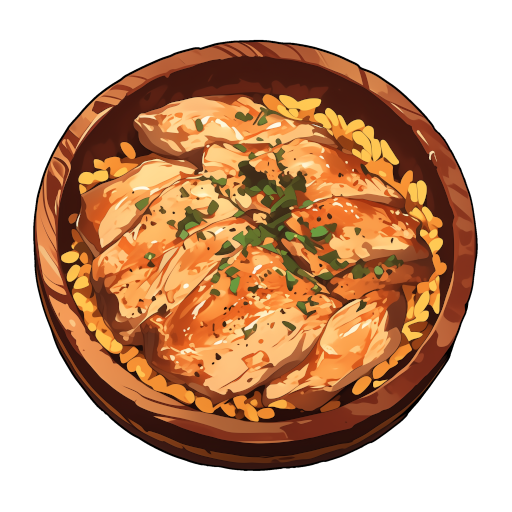 |
Rice and Meat Broth Tavern Stew Simple Meal Premium meal Luxury Dinner |
3 hounds 1 Bit 1 Quarter 1 Elf Coin 3 Beryl |
3/16 B 1/8 B 1/4 B 1/2 B 1 B |
 |
Orange Drink Healing Potion Resist Fire Potion Aether Charge Awareness Tonic |
3 Colbies 1 Bit 1 Beryl 3 Beryls 20 Beryls |
3/32 B 1/8 B 1 B 3 B 20 B |
| Image | Item | Cost | Conversion |
|---|---|---|---|
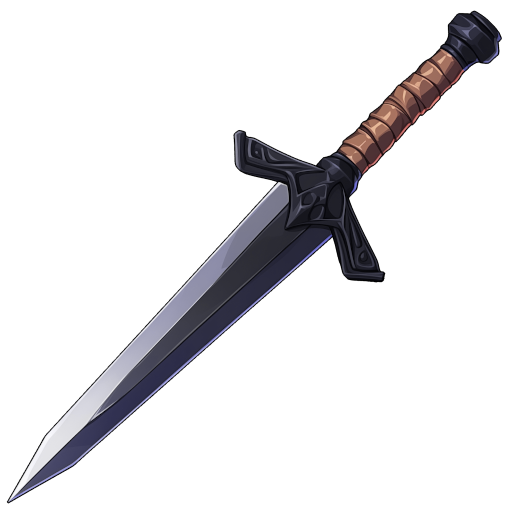 |
Basic Knife Quality Dagger Steel Longsword Percussion Musket Gem Steel Weapon |
1 Elf Coin 2 Beryls 10 Beryls 23 Beryls 100 Beryls |
1/2 B 2 B 10 B 23 B 100 B |
 |
Chainmail Shirt Steel Helmet Steel Curiass Gem Steel Armor Elven Mages Armor |
2 Beryls 4 Beryls 8 Beryls 210 Beryls 350 Beryls |
2 B 4 B 8 B 210 B 350 B |
 |
Acre of Land (Desert) Acre of Land (Fertile) Acre of Land (Urban) Small Cottage Mansion Castle |
1 Hound 1 Elf Coin 10 Beryls 20 Beryls 750 Beryls 2500 Beryls |
1/16 B 1/2 B 10 B 20 B 750 B 2500 B |
Occupations and Wages
| Job Title | Description | Wages | Conversion |
|---|---|---|---|
| Unskilled Laborer | Does whatever brainless job is available. | 2 Quarters per day | 1/2 B |
| Skilled Farmhand | mill worker, ploughman, harvester, etc. | 1 Beryl per day | 1 B |
| Baker | Operates Ovens and bakes food. | 3 Elf Coins per day | 1.5 B |
| Blacksmith | Produces everyday metal goods. | 2 Beryls per day | 2 B |
| Apothecary | Makes potions and medicines. | 3 Beryls per day | 3 B |
| Farm Mage | Inglorious but extremely necessary job to ensure crop yields stay high and famine is prevented. | 2 Beryls per day | 2 B |
| Healing Mage | Life and Death magic is extremely complex and dangerous on Vreathe, so skilled mages are necessary. | 5 Beryls per day | 5 B |
| Combat Mage | Dedicated battle mage in the King's armies. | 4 Beryls per day. | 4 B |
| Town Guard | Polices the town to keep everything lawful. | 3 Elf Coins per day | 1.5 B |
| Professional Soldier | Full time soldier in the King's armies. | 2 Beryls per day. | 2 B |
| Personal Guard | Personal guard for a Noble or City Official | 3 Beryls per day | 3 B |
| Military Captain | Manages and trains soldiers. Leads troops into War. | 10 Beryls per day. | 10 B |
Ten Beryl
Diameter: 40mm
Ridges: 256
Ridges: 256
Thickness: 4mm
Alternate Names: Saint Coin
Year first Minted (Modern): 2880
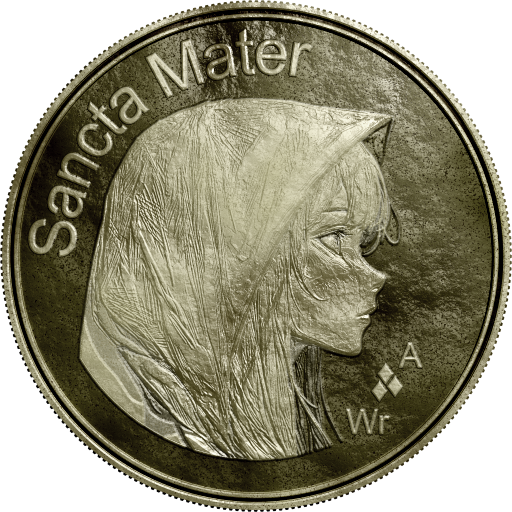
Obverse Side: Portrait of the Holy Mother Saint Nora, wearing a plain hooded cloak. The words "Sancta Mater" (Holy Mother) are on the top left of the coin. On the lower right side is the mint mark, as well as the Country and City the mint is located.
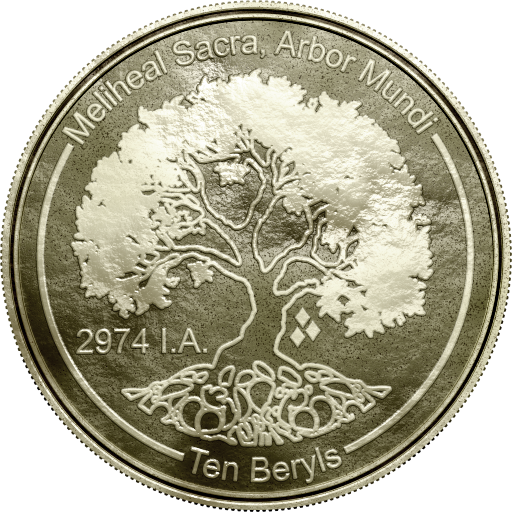
Reverse Side: Image of Meliheal the World Tree. The Words "Meliheal Sacra, Arbor Mundi" (Sacred Meliheal, the World Tree) are written across the top. The Value of the currency, Ten Beryls, is written on the bottom. The date the coin was minted is located on the bottom left. A second mint mark can be seen in the lower center, just to the right of the world tree.
Other Characteristics: Coin uniquely has two rims. The Center of the ridges on the side are sunken in slightly. A strip of silver runs through the middle of the coin, visible when looking at the side.

Side View showing the edge shape
Obverse
Reverse
The Ten Beryl Coin was introduced in the year 2880 after industrialized mining and greatly increased metal supplies started to devalue the silver based Beryl coins. The Ten Beryl Coin is made mostly of gold with Silver and Copper added for hardness.
Every few years the Royal Mint will change the silver and copper content slightly so that at any time the actual metal value of a Ten Beryl coin is between 9.25 and 10.75 times that of the One Beryl coin, which hasn't changed it's alloy composition in well over two hundred years. This can make certain years of the coin worth quite a bit more than usual.
This also makes coins from certain years rather difficult to find as they have been melted down and reminted, making them very rare and valuable among coin collectors. A Ten Beryl coin from the year 2923, when the value of gold was hyper inflated, can fetch 250 Beryls at auction.
Beryl
Diameter: 30mm
Ridges: 128
Ridges: 128
Thickness: 2.5mm
Alternate Names: — None —
Year first Minted (Modern): 2708
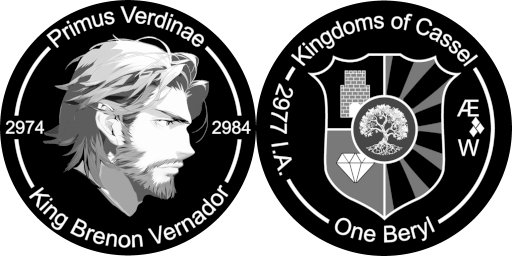
Obverse Side: Portrait of the previous ruling monarch of Cassel. In this case, that is Eldon Vernador XX. The numbers on the left and the right are the years that the monarch reigned. On the top the words "Vicesimum Castelli" is written for the Twentieth of Cassel. On the bottom is written "King Vernador". Usually the first name is omitted with few exceptions as most of the Vernador Kings were named Eldon.
The previous monarch's face is minted on new coins for a period of twenty five years, then even earlier monarchs are shown, rotated out every other year. The current ruling monarch's face is never shown on a coin, compared to surrounding nations which usually only show their current leader's face.
Reverse Side: The Casselian Coat of Arms, with motifs from each of the three major kingdoms that originally and currently make it up, including the Fortress of Lornar, the Diamond of Tesiadem, and the Radiant Rays of Wrethilin. In the center of the shield is the Emblem of the World Tree. On the left side the date the coin was minted is written, and on the right side, the mint mark, country, and city of origin are shown. Across the top "Kingdoms of Cassel" is written, and along the bottom, the coins value "One Beryl" is written.
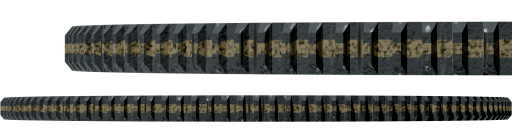
Other Characteristics: A Thin Strip of Gold is pressed between the Obverse and Reverse. It is visible when looking at the coin ridges on the side. When charged with magic, this specific Alloy of Silver/Gold/Copper will glow a pale blue, giving it a similar appearance to the Aquamarine beryls used in ancient times.
Obverse
Reverse
Side View
Usually a Beryl is just called "Beryl", though regons surrounding Cassel will call it a Silver Coin instead. The modern version of the One Beryl Coin was introduced in the year 2708. While the faces of the monarch change all the time the reverse side of the coin has changed little in 280 years.
Some years rarer than others as Cassel's three mints do not produce an equal number of these coins each year. The rarest version of this coin is a 2846 Issia Vernador coin. Despite having the longest reign of any Vernador of the last thousand years (over 300 years from 2456 - 2784), she was depicted on a coin only on the years 2785 - 2790, and 2846. One of her coins is worth as much to collectors as a 2923 saint coin.
Brenon's Coin
First minted in the year 2985, as ordered by Queen Marla Vernador of Verdina (or North Cassel), this version of the One Beryl Coin depicts the face of the late King Brenon. He was king of Verdina for a brief decade after Vernador XX split the Human kingdom into three smaller ones. The reverse of the coin depicts the Verdinian Coat of Arms, the Fortress Tower, and has "Kingdom of Verdina" scrawled across the top.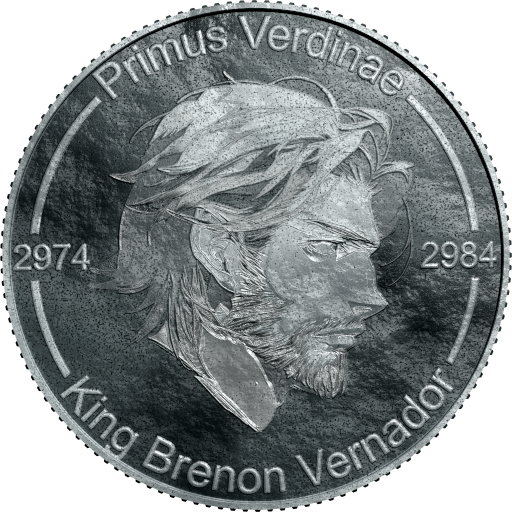
Marla's Coin
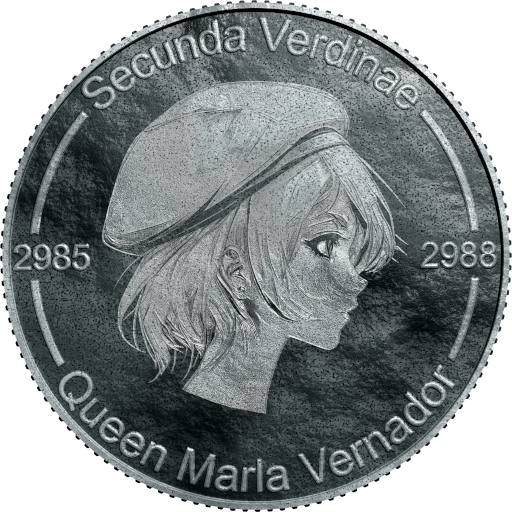
First Minted in the year 2988, as ordered by King Eldon Vernador XXI of Aluviane (or South Cassel). This version of the One Beryl Coin depicts the face of Marla Vernador, who was just 12 years old at the time of her passing and ruled for just three years after her father Brenon passed. Many in the North think Eldon was responsible for her death, as Eldon annexed all of the North after her passing. Marla's face has become a rallying point for many in Cassel who are tired of being ruled by the Vernadors, to the point that many Ferretor controlled Baronies refuse to accept Beryl coins with any other monarch on it.Vandalized Beryls
So hated is the current power structure in some parts of Cassel that coins are scraped against sand paper until the images on the coins are faded or completely obscured. It is still legal currency across the kingdoms as banks will usually send the coins to the mints to be melted down for replacement coins. In the last year or so however, as the Ferretors have started declaring themselves independent and with Cassel slipping into a Civil War, more and more vandalized coins can be found circulating around.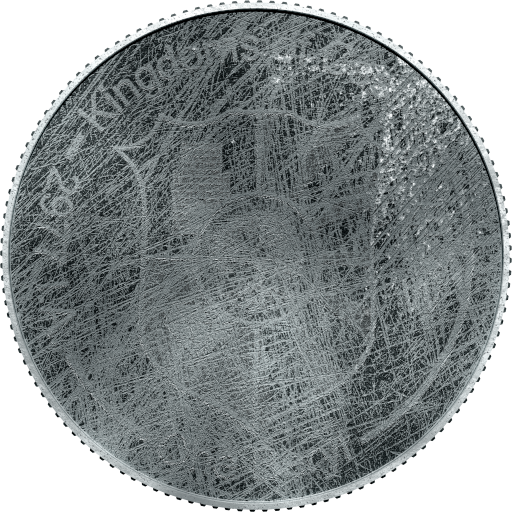
Half Beryl
Diameter: 30mm
Ridges: 100
Ridges: 100
Thickness: 2.5mm
Alternate Names: Elf Coin, Rose Coin, Crescent
Year first Minted (Modern): 2920
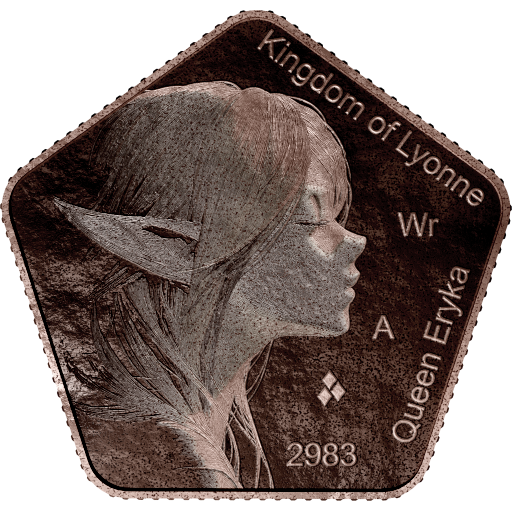
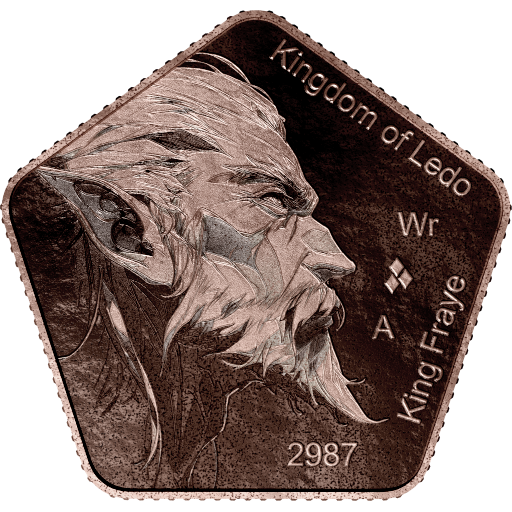
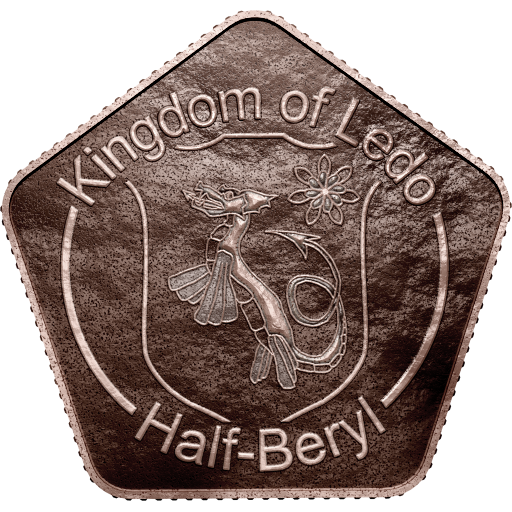
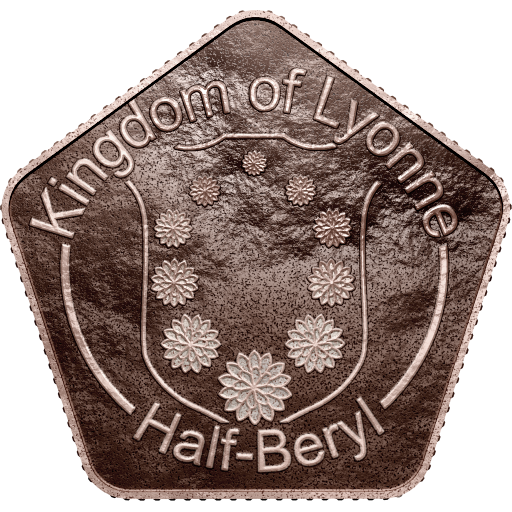
Obverse Side: Contains a portrait of the ruling family of an elven Kingdom of Cassel, either that of Ledo (Currently ruled by Old King Fraye), or that or Lyonne (Currently ruled by Queen Eryka). In diagonal lettering on the top right is the name of the elven Kingdom the monarch rules. On the bottom right is the name of the monarch. Between this and the face of the monarch is the mint mark and letters representing which country and city the coins were minted in.
Reverse Side: The Coat of arms for each Elven Kingdom of Cassel is represented. For Ledo, this is a depiction of the Water Serpent and a rounded Silver Flower on the top right. For Lyonne, ten depictions of the same flower are shown with the largest depiction on the bottom and the smallest depiction on the top. Both versions of the coin contain lettering across the top saying which kingdom the coins are representing. The value of the currency, Half Beryl, is written along the bottom.
Other Characteristics: Traditionally Elven Coins were minted in various shapes. When the two Elven Kingdoms of Cassel signed a treaty with the Human kingdom and unified their coinage standards in the year 2920, the Half Beryl coin was made into a Pentagon shape and always depicts an elven monarch. Before this, half beryl equivalent coins from elven kingdoms were crescent shaped.

Side View
Ledo Coin - Obverse
Ledo Coin - Reverse
Lyonne Coin - Obverse
Lyonne Coin - Reverse
Since Old King Fraye has ruled the Elf-Kingdom of Ledo for literally tens of thousands of years, his face is depicted on thousands of different coins going back to ages when Gods still walked the world. Half Beryl coins with his depiction are considered worthless among collectors. Queen Eryka's coin however (elected Queen of Lyonne in 2977) is prized by collectors for her exceptional beauty depicted on the coin. While equal numbers of both coins are minted every other year, there are only about half as many Eryka coins in circulation compared to Fraye coins.
Quarter Beryl
Diameter: 25mm
Ridges: 150.
Ridges: 150.
Thickness: 2mm
Materials (Inner): 85% Silver, 10% Copper, 5% Nickel
Alternate Names: Mark, Quarter
Year first Minted (Modern): 2925
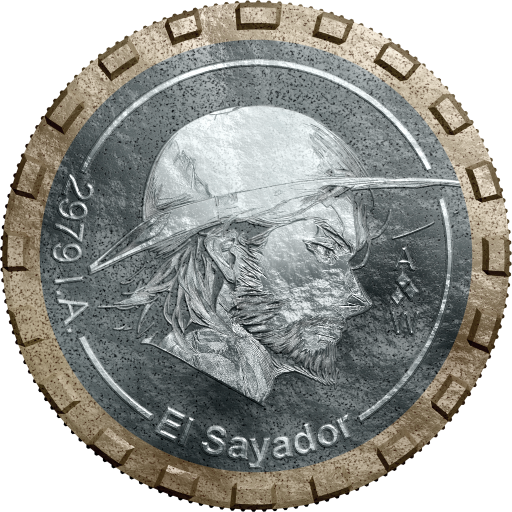
Obverse Side: Portrait of various heroes and historical figures from Cassel's history. The current version of the coin depicts Sayador, an ancient hero that fought for and against Cassel during the Teyand wars of 1400 I.A. On the left side of the coin is the date the coin was minted. On the right is the mint mark, as well as the country and city of origin. The name of the historical figure are written along the bottom. In this case "El Sayador" is written.
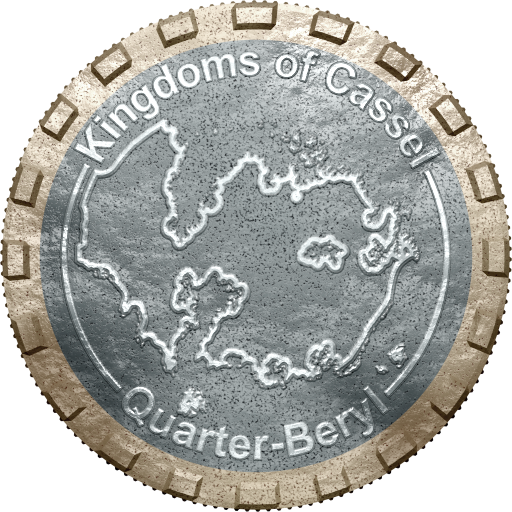
Reverse Side: The Reverse of the coin has an outline of a map of Cassel. The Entirety of the Kingdoms are represented except for one of the missing Aelurus Islands on the bottom right. The Isle of Rosika was moved on the bottom of left so it would be visible on this map. Along the top of the coin, the words "Kingdoms of Cassel" are written. Along the bottom of the coin, the coin's value, "Quarter Beryl", is written.
Other Characteristics: The 150 Ridges of the Coin's edge represents the 150 Baronies of Cassel. This addition is recent (as of 2970) and previous versions of the coin has smooth edges. A much older feature of the coin are twenty raised ridges on the coin's gold ring. Many say this represents the twenty counties of Cassel, but this wasn't considered then the coin was designed. This feature instead makes stacking the coin easier.

Side View
Obverse
Reverse
Also called a Mark or just Quarter, a quarter beryl is one of the most widely circulated coins in Cassel. The coin version was introduced in the year 2650. Before that Beryls were cut into quarter pieces. The original coin version was made entirely of copper-tin bronze. The version with a copper-zinc bronze outer ring wasn't introduced until the year 2925.
The design of the coin changes every year and there are many dozens of historical figures from across Cassel's history depicted on the coins. Some heroes from previous ages like Jushur are also depicted occasionally. Sayador is the face most often seen on the coin though, appearing roughly once every twelve years.
the rarest and most valuable verion of this coin would be that of Lady Cecilia. Her likeness was only depicted on a coin once in 2880. She was a healer in Cassel's Royal Army during a war against the Empire of Irrelith. Imperial forces managed to launch a Singularity Bomb into the center of the battlefield. The resulting singularity explosion would have killed tens of thousands of people, but Lady Cecilia used her bloodline ability to negate the power of the explosion before she turns to dust. Her sacrifice rallies Cassel's forces and they overran the Empire, decisively ending the war. Quarters from the year 2880 are worth thousands of beryls and are easily the most valuable coins Cassel has ever minted.
Eighth Beryl (Bit)
Diameter: 25mm
Ridges: 20
Ridges: 20
Thickness: 2mm
Alternate Names: Bit, Chip, Leaf
Year First Minted (Modern): 2850
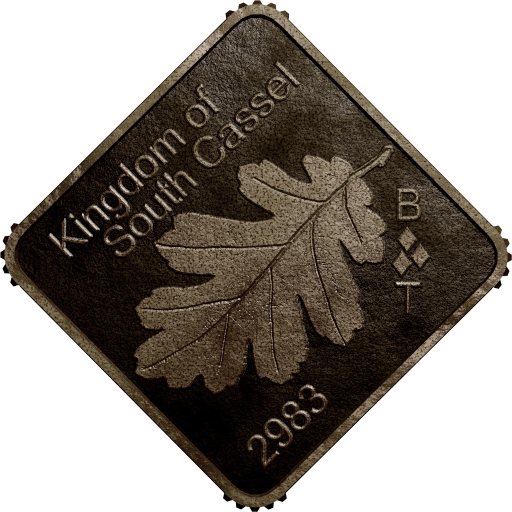
Obverse Side: Depiction of a Leaf from a species of tree native to Cassel. Every year there are three distinct variations of an eighth coin, with each mint making a unique coin. The example shown is a leaf from an Oak tree native to foothill regions across Cassel.
The top left of the Coin says "Kingdom of South Cassel" because the kingdom of Baileon was independent during this time (2974-2984). On the bottom right is the year this coin was minted. On the right is the mint mark as well as the country and city the coin was minted.
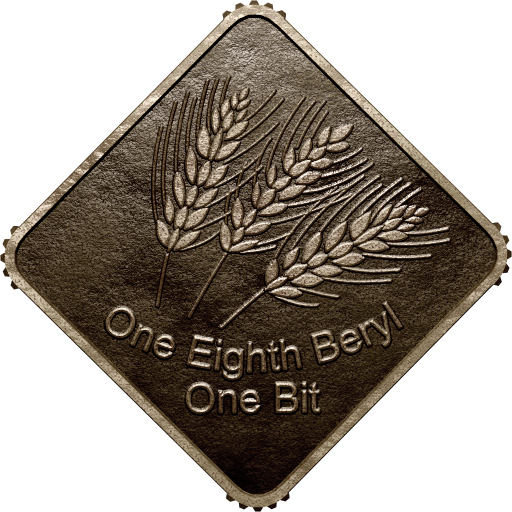
Reverse Side: Depiction of Wheat Stalks. This design has never changed. Below this, the words "One Eighth Beryl" are written, and below this "One Bit" is written, referring to the common name.
Other Characteristics: This coin takes on a unique diamond shape with rounded edges. Along each corner are five raised ridges, the sides of the rest of the coin are smooth.

Side View
Obverse
Reverse
The coin version of a Bit was introduced in the year 2650 along with the Quarter. It was originally made entirely of soft copper. It was intended for this coin to be clipped into two or four pieces for half and quarter bits for even smaller value denominations, which up to this point did not exist. In the year 2850, when dedicated half and quarter bits were introduced, the Bit's composition was changed slightly to increase hardness and discourage clipping.
Every twelve years, each of the three mints rotate between various leaves from various species of trees, ranging from Oak and Chestnut to Rowan, Yew, Pine, Olive, and Cypress. The most valuable Leaf coins are those that depict Olive Leaves, though their value among collectors might reach a Beryl. There was a decade in the 2980's when the Mint of Verdina depicted various flowers instead of leaves. These Flower Coins are quite valuable, with the rarest among these being a depiction of a Nivemian Iris, a violet flower that bloom only once every 120 years in the highland regions circling the Sands of Nessa, making it as rare as the coin is.
Sixteenth Beryl
Diameter: 18mm
Ridges: - None -
Ridges: - None -
Thickness: 3mm
Alternate Names: Half-Bit, Hound, Pup/Puppy, Perry, Green
Year first Minted (Modern): 2650
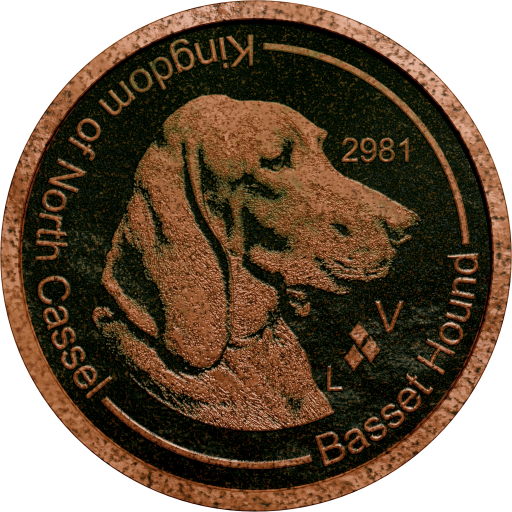
Obverse Side: Depicts a portrait of a dog breed native to Cassel. Every year, each of the three mints make a different variation of the coin with a different breed. In this Case a Basset Hound, bred from a monastery in Verdina, is shown.
On the top left is the region the dog breed originated, in this case the "Kingdom of North Cassel". On the lower right is the dog breed's name, "Basset Hound". On the top right of the coin is the year it was minted. On the lower right of the coin is the mint mark, as well as the nation and city it was made.
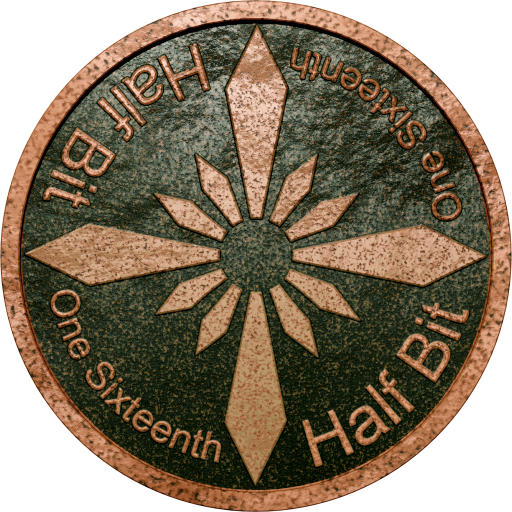
Reverse Side: The "Radiant Rays", A depiction of the Sun itself. This version of the Radiant Rays is often found on the Flag of Aluviane. Along the outside of the coin, the words "Half Bit" and "One Sixteenth" alternate, indicating the value of the coin.
Other Characteristics: The non-raised areas of the coin changes quickly after minting, creating a dark greenish hue after around ten years. Older coins are dark all over and coins left in the elements for a few months can develop a bright greenish-blue or even purple patina.

Side View
Obverse
Reverse
While coinage with this value was also made simply by clipping a Bit in half, Cassel did actually mint Sixteenth Beryls which were introduced at the same time as Bits were. Originally the obverse of the coin featured an Aluvian Shepherd that was owned by the King at the time. After the dog passed away the king ordered that Aluvian shepherds never be placed on a coin again, so the mints started to put the faces of other dogs on the coins instead, almost always a dog breed that originated in Cassel.
Dogs were always featured on these coins except for one year in 2786 when a Drake was shown instead. The coins were always referred to as Hound coins because of this. They are sometimes called "Greens" due to the darkened appearance the coins take on after a decadeor two in circulation.
Collectors prize certain years of this coin, with the oldest Aluvian Shepherd and the 2786 Drake Coin being the most valuable versions. Children love these puppy coins and often collect them. They call the different versions of the coins by whatever dog breed is represented on them and they claim that carrying certain hound coins with them will give them protection, as if a guardian dog is watching over them.
These coins are commonly turned into charms or tags for dog collars. The reverse of the coin is often filled with tin solder and has the pet's name and owner's information engraved. This is much more common in large towns and cities than the countryside. People try to match the coins with the breed of dog they own, but many non-Casselian breeds were never represented on a hound coin.
Many hound coins in circulation have a small hole drilled in the top as they were once used as a tag for a pet. The reverse of these coins usually have a silvery appearance because the tin solder couldn't be fully removed. While these coins are considered vandalized, banks don't send them back to the mint for replacements because the value of the coin isn't enough to matter.

Thirtysecond Beryl
Diameter:15mm
Ridges: - None -
Ridges: - None -
Thickness: 1.8mm
Materials (alternates): - Various -
Alternate Names: Quarter-bit, Cat, Colby, Blue, Fairy Coin
Year first Minted (Modern): 2900
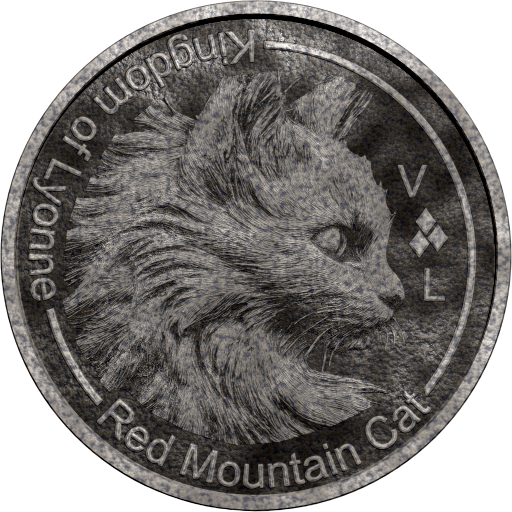
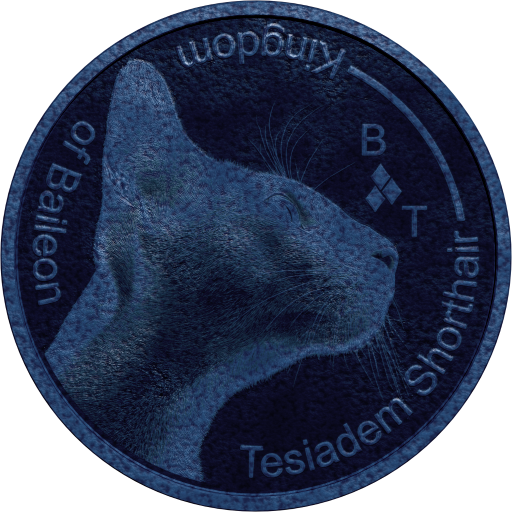
Obverse Side: Depicts an image of a breed of cat native to Cassel. Every year, each of the three mints make a different variation of the coin with a different breed. In this case, a Red Mountain Cat is shown on a coin minted in Verdina. On some years, instead of cats, different animals like fish, rabbits, pigs, drakes, and others are shown, usually on alternate versions of the coin.
On the top left is the region of Cassel the breed came from, in this case the "Kingdom of Lyonne". Along the bottom, the breed of the cat, "Red Mountain Cat", is written. On the right side is the mint mark and the country and city it was made.
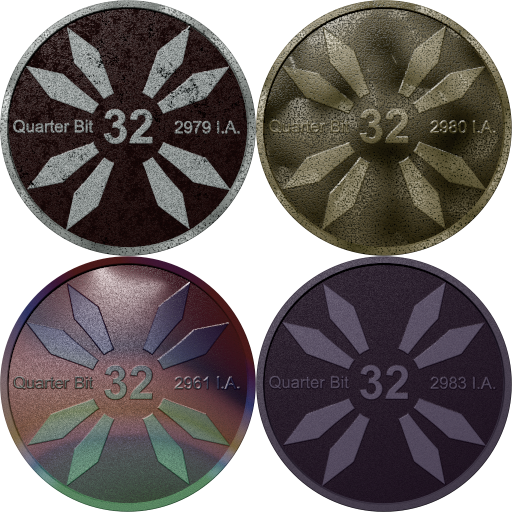
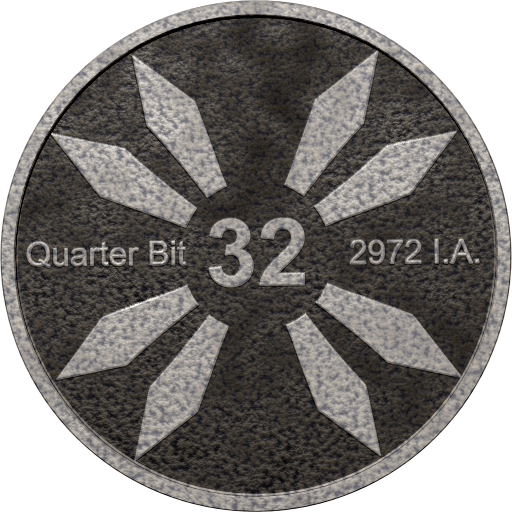
Reverse Side: A simplified version of the "Radiant Rays" are shown. In the center, the number "32" is written, indicating that this small coin is worth one thirty-second that of a Beryl. On the left side the value of the coin, "Quarter Bit", is written. On the right side, the date the coin was minted is shown.
Other Characteristics: The three mints of Cassel experiment on different alloys and heat treatments each year. This causes large batches of the coins to be released with wildly different colors and hardness levels. Corrosion resistance is also different.

Side View
More Variations
Normal Obverse
Blue Obverse
Normal Reverse
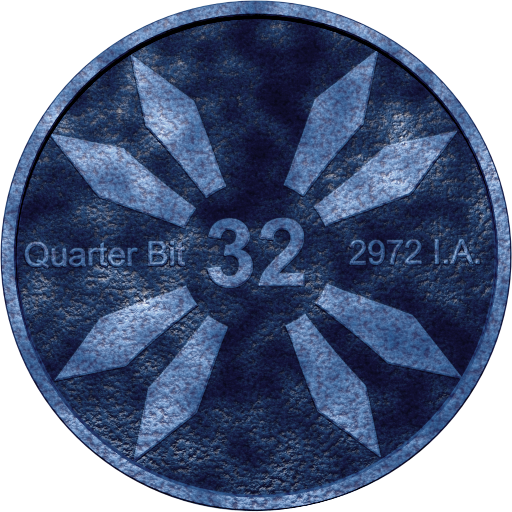
Blue Reverse
When the first Quarter-Bits were introduced in the year 2850, they were made of a copper-cobalt alloy that was prone to corrosion, which gave it a blue appearance after just a few years in circulation. In the year 2900, the coins were changed to their modern composition, were much less prone to corrosion, and took on a strictly warm silver appearance.
In the year 2933, the Mint of Verdina developed a gem forging method for Aluminum alloys, which changed their color to a deep blue in appearance. They temporarily minted these blue coins for a year, which were immensely popular. In the year 2943, the same mint experimented with creating different colored variations of the coin, creating violets and reds. Every year after this, the three mints of Cassel rotate between minting different variations of the coin, with two minting normal versions and one minting an experimental version with a different alloy, heat treatment, or color.
These coins are quite popular with children who are attracted to the different bright colors and the different animals that can appear on the coins. Because of this, numerous local tales about these coins have appeared. One popular tale involved the the claim that the radiant rays are actually fairy wings and if you are lost in the woods, you can say "Fairy Guide Me!" and throw the coin straight up in the air, where it lands is the direction of home.
Adult collectors tend to avoid these coins except for specific years. The most valuable coins are the original Colbies that were minted between 2850 and 2900, though nearly all of them are so corroded that it's impossible to tell that they were Quarter-Bits to begin with.
Just like with Half Bits and dogs, Quarter Bits often have a small hole drilled into the top because there might have previously been made into a charm and attached to a cat collar, with the pet name and the family that owns it engraved on the back. It also isn't uncommon to see girls in the cities wearing bracelets made of several dozen of these coins. The value of these coins is so low that it is almost never a target for thieves.



All things in due time. Its still impressive to see. Very wonderful beefy article!