

Ahmad Al-Zahir
⚠️ Content Warning
This article may contain mature themes, including homoerotic content, complex power dynamics, sexual encounters with vampires and anthropomorphic beings, as well as other adult material.
Reader discretion is advised.
Senior Inquisitor (SINQ) Ahmad Al-Zahir, formerly His Royal Highness Prince of Al-Zahira
Physical Description
General Physical Condition
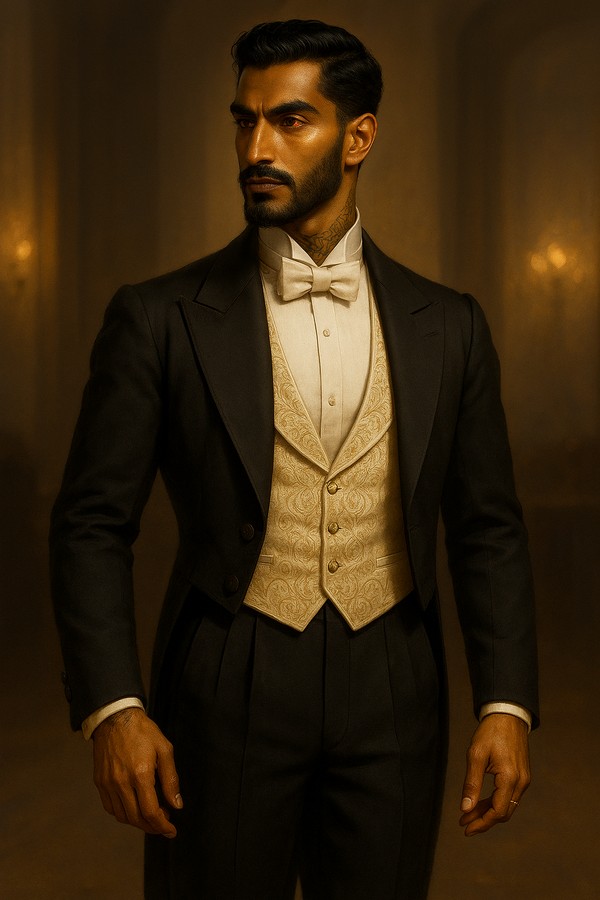
Exceptionally fit and disciplined: 206 cm, ~109 kg, broad-shouldered V-shape; strong endurance, precise agility from years of saddle, sabre, and bow.
Health: no chronic ailments or aids; steady nerves, steady sleep lightly kept.
Notables: Djinn-Touched (fire) — slight natural warmth and controlled heat-emanation; black sigil-tattoos as arcane conductors; gold nipple piercings.
Body Features
Tall, broad-shouldered V-shape (206 cm, ~109 kg) with dense, trained muscle and long, economical reach. Warm golden-olive skin with a faint heat-sheen; movement is controlled, feline, and quiet. Hands are strong and steady, palms lightly calloused from blade and bow; stance naturally upright, weight centred.
Facial Features
Symmetrical, patrician lines; straight nose, clean jaw, and a neatly kept short beard. Almond eyes, amber with gold flecks, a level, unhurried gaze beneath firm brows. Black hair, slightly wavy, worn short with a side part; expression composed, voice low and even.
Identifying Characteristics
Flowing black flame-tattoos across shoulders, chest, back, and flanks (arcane conductors/seals). Gold nipple piercings set with small gemstones. A subtle, constant warmth at close range; the faintest trace of attar. Gait measured, almost silent; presence that reads as contained power rather than display.
Apparel & Accessories
On duty he wears the prescribed OFB uniform in black-and-gold with the radiance insignia of the Order of the Black Sun (rank: Senior Inquisitor). The cut is severe, posture-correcting; cap, greatcoat, and gloves per regulation, insignia kept immaculate. Off duty he prefers bespoke dark suits and a long black greatcoat; signet ring, precise pocket-watch, and a trace of desert attar. Gold nipple piercings remain unseen beneath linen—private vow, not display.
Specialized Equipment
Standard OFB field satchel packed to regulation: warrant case and Chapter House keys; heat-safe gloves; etched glass vials, wax-sealed envelopes, tags and string; sigil chalks (white/red/black), iron pins, blessed salt; compact brass ward-frame; folding lens and slate for rapid diagrams; numbered evidence ledger and stubby rain-proof pencil. As inquisitorial sidearm, a plain sabre in a discreet scabbard—kept sharp, seldom drawn. All items conform to OFB doctrine and ceremonial-rational practice.
Mental characteristics
Personal history
Prince Ahmad Al-Zahir was born in Al-Zahira on the eastern rim of the Mediterranean, the tenth son of a long-reigning Sultan and the favoured consort who bore him. His earliest years were steeped in courtly ritual and the unforgiving clarity of desert light: tutors before dawn, scripture and statecraft by noon, and in the cooler hours the rider’s seat, the bow, and the blade. When the signs of Djinn-touch first surfaced—heat that steadied lamps, a shimmer that clung to skin like noon on a copper dish—priest-scholars marked him for discipline rather than spectacle.
At twelve he entered formal training to master the fire-aspect that ran like an ember under his skin. The first ink was laid then: flowing black sigils across shoulder and chest to route excess charge, seals as much as ornament. He took to control as other boys take to mischief; what he could not tame, he learned to outwait. In public he was dutiful and precise; in private he argued late into the night with his mother’s poets about mercy, law, and the uses of power.
Court life, however, turned harsher under his father’s rule. To preserve imperial favour abroad, the Sultan enforced prohibitions at home with pitiless zeal. The palace that had taught him logic taught him fear: men whispered, doors closed more softly, and the first bodies fell to make an example. Ahmad’s nature—unapologetically and exclusively drawn to men—could not be made to bend. When it was finally dragged into the light, the punishment was not subtle. Lovers were killed. Three of his elder brothers, who shared his truth, were exiled alongside him. Ahmad was sixteen.
London received him not with trumpets but with soot and fog—yet also with letters sealed by his mother’s kin. From that side of the family came a fortune discreetly placed at the brothers’ disposal: accounts that accrued interest while the city slept, the kind of comfort that could have kept them idle for life. Ahmad learned to live well without living soft. The formal geometry of the desert translated into London as a private discipline: mornings at the salle, afternoons in libraries, and evenings walking the narrow arithmetic of streets simply to feel the city think.
It was still the work that saved him—by giving the day a temperature and the night a purpose. The Occult Felony Bureau did not demand fealty; it demanded results. Evidence first, then judgement. Ahmad brought heat-sense to cold scenes, a soldier’s patience to panicked witnesses, and a prince’s courtesy to the dead. He treated procedure as a craft and refined his fire until it left no fingerprints. He does not wear the badge because he must, but because idleness would corrode him; and so, in time, he grew from the exotic junior no one knew how to brief into the steady hand other detectives quietly requested.
His circle widened—to include informants in Witch’s Hollow, scholars who argued sigils over tea, and the Fae-Touched investigator Tristan Poll, with whom he built an unspoken compact: no needless risks, no dishonest reports, no leaving a man behind. Ahmad’s manner remained cool, even sardonic; his loyalties did not. In interviews he preferred silence to theatre. In rooms thick with grief he let the warmth around him rise a fraction, just enough to steady breath and pen.
His circle widened—to include informants in Londons underbelly, scholars who argued sigils over tea, and the Fae-Touched investigator Tristan Poll, with whom he built an unspoken compact: no needless risks, no dishonest reports, no leaving a man behind. Ahmad’s manner remained cool, even sardonic; his loyalties did not. In interviews he preferred silence to theatre. In rooms thick with grief he let the warmth around him rise a fraction, just enough to steady breath and pen.
Today, at thirty-two, Ahmad is what the city has tempered: an exiled prince who refuses pity, a disciplined vessel for a dangerous light, and an OFB detective who treats power as a trust. He will joke that he does not grant wishes. What he grants, when the facts allow, is something rarer—closure, safety, and an honest account of what the night has done.
Gender Identity
Ahmad counts himself a man in the old sense: a matter of bearing, oath, and conduct rather than ornament or rule over others. Manhood, to his mind, is steadiness under heat, courtesy in strength, and the keeping of one’s word when it grows costly. He trims his beard, wears gold without apology, and sees no contradiction between adornment and gravity.
From Al-Zahira he inherits a simpler doctrine. The Djinn, whose spark runs in his blood, knew nothing of man or woman as a boundary; they took shapes as they pleased and loved as they willed. That indifference settled into his people as custom: trade, command, craft, and the rearing of children belong to aptitude, not to sex. In a household, the one most fit leads; in the field, the one most able.
Thus Ahmad measures persons by discipline and honour. He neither boasts of being a man nor asks leave to be one. He permits others the same ease: let a soul declare itself by its work, its care, and its courage, and he is satisfied. If London frets over roles, he does not. Fire has no patience for such fretting.
Sexuality
Ahmad’s desire is plain and untroubled: he is drawn to men, and only to men. In temper he favours the leading place, not for cruelty but for order. He holds that the bedchamber, like the duelling ground, must be ruled by honour—nothing taken that is not freely given, nothing promised that is not kept.
He treats intimacy as a covenant. Bounds are set beforehand; the stronger hand carries the heavier duty of care; the end is not conquest but steadiness of heart. Severity may have its hour—he is no stranger to rope, command, or the measured sting—but it is discipline, not spite. He reads his partner as he would a battlefield: breath, flinch, and mettle; and he will rather call a halt than trespass.
London’s fashions require discretion, which he observes without shame. He is courteous with refusals, exact with consent, and meticulous in the “after” as in the act itself: warmth restored, wounds—if any—salved, words set right. To him, desire is a matter of trust kept under heat; power given and received cleanly; and the body’s truth spoken without apology.
Education
Royal Schooling (Al-Zahira)
Raised to a prince’s measure, Ahmad was taught early by master tutors in history, letters, law, mathematics and the tongues of neighbours. Mornings belonged to scripture, statecraft, and the art of speaking plainly; afternoons to geometry, astronomy, and accounts; evenings to diplomacy at his mother’s salon, where he learned to listen as carefully as he spoke.
Martial Discipline
From boyhood he was shaped for saddle and field: seat and rein, the bow at speed, and the sabre’s plain economy. Campaign logic, desert craft, and the ordering of men were drilled until they lived in his hands.
Djinn Governance
At twelve he entered formal rule over the fire in his blood. High ranking Saff al-Mutahhayyibīn al-Nār and priest-scholars taught breath and stillness, the laying of seals, the movements of the warrior dances, and the reading of heat as sign rather than temptation. His black sigils were set as conductors—ornament in appearance, restraint in truth. Lessons in Za’hareen, the Djinn tongue, fixed the rites and formulae.
London Studies
Exile widened rather than narrowed his course. He took private instruction and read like a penitent: natural philosophy, comparative religion, antiquities, and the harsher branches of medicine a detective must stomach. He observed courts, learned the city’s customs, and made a habit of museums and lectures, taking from each what would sharpen his judgement.
OFB Craft
Within the Bureau he learned the trade as the Bureau keeps it: the securing of scenes, the keeping of evidence, the writing of reports that stand up under oath. He studied warding, sigil-work for containment, and the plain rules of testimony. Procedure became second nature; his fire, a tool that serves rather than stains.
Employment
Private Study & Unpaid Service (London, from age 16)
Exiled but amply provided for by his mother’s kin, Ahmad had no need to seek wages. He set himself a regimen instead: mornings in the salle and libraries together with his teachers, who followed him and his brothers into exile, afternoons walking London’s rougher wards to learn their tempers, evenings in quiet salons where scholars argued symbols and law. He lent his eyes and steadiness to seedy traders when trouble brushed their doors—always discreet, always without fee.
Entry to the Bureau — Detecting Occult Constable (DOC)
When the OFB required a cool head for high-magic scenes, Ahmad accepted a constabulary appointment not from want but from principle. As a Detecting Occult Constable, he specialised in arsonry of an unearthly sort, heat-phase reconstruction, and containment protocols. Procedure took root in his hands; his fire left no traces where evidence must speak.
Middle Command — Crown & High Crown Constable
Promotion followed steady work rather than noise. As Crown Constable, then High Crown Constable, he led field teams and coordinated district investigations where sorcery and politics rubbed dangerously close. His manner—spare words, exact reports—won him the sort of witnesses who dislike policemen but respect fairness.
Inquisitorial Tier — Inquisitor
Advanced to Inquisitor, he gained charge of restricted rites and doctrine cases, taking on matters too delicate for ordinary command: sealed necromantic warrants, church liaison, and inquiries likely to rattle Parliament if mishandled. The post demanded judgement under heat; he proved difficult to rattle.
Senior Inquisitor (Present)
Ahmad now serves as Senior Inquisitor — district command within the Inquisitorial Tier, set beneath the Tribunal Inquisitors and above Inquisitors, with oversight of inquisitorial squads and Necromantic Services. In Bureau parlance it is the second chair of the Inquisition, answerable upward to the Tribunal and outward to the Chapter House. He reviews doctrine-sensitive cases before they reach the Inner Tribunal, signs off on warding deployments, and is the name other detectives request when a scene needs both fire and restraint.
Why he works
Wealth keeps him comfortable; work keeps him clean. He does not wear the badge for coin. He wears it because idleness corrodes, because law can be honed into shelter, and because London is safer when someone patient is willing to hold the hotter end of the iron.
Accomplishments & Achievements
The Nine-Bell Arson Dossier
Unwound a chain of ritual fires staged to mimic accidents across dockside chapels. Reconstructed the heat-phase, trapped the instigator with his own timings, and delivered a report that stood unshaken under oath. Outcome: Established him as the Bureau’s quiet expert on fire-sorcery; earned discretionary command of inquisitorial teams.
The Gilt Pier Murders
Refused to accept a fashionable suspect and followed a dull trail of accounts ledgers instead. The true culprit proved to be a benefactor of several Members. Outcome: Case cleared with minimal spectacle; reputation for steel under pressure.
Mentor in the Field
Known for turning nervous recruits into steady investigators: insists on clean scenes, clean reports, and clean exits. Outcome: A cadre of younger detectives who request his oversight when doctrine and danger tangle.
Failures & Embarrassments
The Executions at Court (Unprevented)
As a boy he lacked the reach to save the lover condemned under his father’s edicts. Mark left: A private oath: never to let power grind the unprotected unchallenged.
The Scholar’s Affair (Broken Off)
Ended a tender attachment with an university man when inquisitorial work drew blood near the fellow’s door. No scandal followed, but the silence after did. Cost: Loneliness he does not advertise; stricter boundaries around his private life.
The Lantern Street Witness (Lost)
Trusted a frightened runner to return for protection; the man fled the city and later turned up dead on the Kent road. Lesson: Fear bends truth; he now keeps a tighter hold on witnesses and sends escort rather than promises.
The Chapter House Rebuke
Once delivered a report with barbed asides about a superior’s delay. Accurate, unwise, and quoted back to him in full. Lesson: Let the facts carry their own blade; keep the temper sheathed in writing.
The Strand Demonstration (Minor Scorch)
A public warding display—meant to calm nerves—ended with singed bunting and an alderman’s ruined hat. He apologised on the spot and bought the man a better one. Embarrassment: A tale colleagues still enjoy retelling; he bears it with dry humour and sharper preparation.
Mental Trauma
He carries the desert’s heat and the cold of a throne-room floor. The killings at court left a seam that never quite closes: the sound of iron drawn for show, the stillness after a scream swallowed by marble. Exile at sixteen taught him another quiet—doors closing softly, letters sealed with the wrong crest, the knowledge that mercy was not for the likes of his lover. London has added its own marks: a ward set too tight; a witness who ran and did not live to come back; the way smoke can smell like judgement when a scene is too fresh.
He does not name these things as ailments. He treats them as debts to be kept in order. Sleep is guarded and light; he prefers a wall to his back and an exit he has already measured. Bells at odd hours make his shoulders square before his mind has caught up. The scent of hot iron, singed linen, or certain court attars can turn his breath shallow; he answers with drill—slow count, even draw, heat folded inward until it is only warmth. He keeps unopened letters from Al-Zahira in a locked drawer and touches none of them by fire.
How he manages
- Discipline before dawn: breathwork, blade forms, copywork of sigils—quiet labour that steadies the hand.
- Rituals of control: wards laid for practice, seals set and broken until his mind obeys the slower pace.
- Company with measure: evenings with his brothers; occasional plain talk with Tristan Poll when the night’s work was foul.
- Mercy for the living: careful aftercare in the field and in the bedchamber; order restored where heat has run high.
- Boundaries kept: no spectacles, no needless crowds, no public shows of power unless duty demands it.
He will not call himself wounded. He will say only that some fires are banked, not spent—and that a man is known by how he keeps watch over the ones that remain.
Morality & Philosophy
First Principles
Power is a trust; law is a tool; mercy is a virtue only when yoked to judgement. Ahmad holds that a man is measured by the weight he is willing to carry without complaint and by how cleanly he lays that weight down.
On Justice
Justice begins with proof. Feeling may start an inquiry, but evidence must finish it. He would rather let a guilty man go than hang him on a pretty speech. Oath and report are sacred things; if they crack, the house falls.
On Power
The Djinn in his blood teaches indifference to rank and fashion. Power does not make truth; it only makes noise. A prince who cannot master himself is unfit to guide others. Thus he keeps his fire under bit and bridle: force used late, used cleanly, and only as much as the work demands.
On Mercy
He gives mercy as a craftsman, not a sentimentalist—where it will mend, not where it will rot. He will ease a first offender, shield a witness, and spare a frightened lad his pride; he will not spare a man who preys upon the unguarded.
On Truth
Truth is not a banner but a ledger. He distrusts grand declarations and prefers small, provable statements stacked one upon another until they hold a man’s weight. When he is wrong, he repairs the record and pays the cost.
On Duty and Consent
Duty is chosen, not imposed. He serves the Bureau because it lets him make shelter out of law. In the field and the bedchamber alike, consent is the cornerstone: nothing taken that is not offered, nothing promised that is not kept. The stronger hand bears the heavier charge.
On Work and Wealth
Fortune frees him from want; it does not excuse idleness. Labour keeps a man from rust. He takes no coin he has not earned and refuses favours that would tangle his judgement.
On Faith & The Unseen
He honours scripture, but his piety is quiet—kept in clean work, kept in restraint. Of spirits and rites he is neither credulous nor scornful: test, record, confirm; name the thing and bind it, or let it go.
On Rank & Household
From Al-Zahira he holds that aptitude outranks sex. In house or field, the fit hand leads. He respects offices but bows to competence; obedience is owed to wisdom, not merely to a chair.
Private Rule
“Control without mercy is tyranny; mercy without control is waste.” He repeats it until it lives in his fingers. If there is a choice between spectacle and safety, he will choose safety and let others have the applause.
Taboos
Oath-breaking
A word given is iron. He will not swear lightly, and he will not break what he has sworn.
Coercion in the bedchamber
Desire without consent is theft. No force, no tricks, no drunken promises.
Spectacle-magic
Power for show, fear, or applause—never. Fire is for work, ward, or rescue, not for crowds.
Falsifying the record
No cooked reports, no shaded testimony, no “useful” lies. If the facts wound, let them.
Wasting the weak
Preying on the unguarded—urchins, servants, the poor—is rot. He will not stomach it, nor those who do.
Buying outcomes
He will not spend family gold to tilt the scales of justice, nor take coin to soften his hand.
Public loss of temper
He keeps heat under bit and bridle. Shouting matches, thrown objects, or visible flare are beneath him.
Slander as sport
He will argue a man’s acts, never soil a man’s name for pleasure or convenience.
Treachery to his own
He will not sell a colleague for favour, nor abandon a brother to save face.
Desecration of the dead
The dead are to be handled cleanly and spoken of plain. No rifling, no mockery, no needless rites.
Burning home with home-fire
He will not use his Djinn heat upon family letters, heirlooms, or household altars; some things are to be kept from the flame.
Social
Family Ties
Father — The Sultan of Al-Zahira
Blood, not refuge. Ahmad respects the office and grieves the man it made: edicts that killed lovers; exile for three sons. Correspondence arrives under royal seal; most letters remain unopened in a locked drawer.
Brothers in Exile (London Household)
Khalid (45): The Merchant. Pragmatic, smooth-handed with accounts; manages joint investments and keeps the household’s books square. Ahmad leans on his steadiness in money matters.
Faris (42): The Socialite & Philanthropist. Chivalric, charming, useful in salons and charities; opens doors Ahmad would rather not knock upon.
Samir (38): The Painter. Night-minded, keen-eyed; the brother who reads Ahmad’s silences best.
The four share a quiet pact: no lies within the house, no man left to face trouble alone.
Maternal Kin
Uncles and cousins abroad administer the trust that shields the brothers from court reprisals. Their aid is discreet and unsentimental: funds arrive on time; advice arrives only when asked.
Keepsakes & Boundaries
A small box of childhood tokens; his mother’s signet (worn only at home royal letters unburned but unread. He will defend the family name in public, rebuke it in private, and protect his brothers above rank, pride, or return.
Relationships
Arabic (native)
English (fluent)
French (fluent)
Turkish (conversational)
Za’hareen (ritual/operational).

Comments