

Bayt al-Rashid
⚠️ Content Warning
This article may contain mature themes, including homoerotic content, complex power dynamics, sexual encounters with vampires and anthropomorphic beings, as well as other adult material.
Reader discretion is advised.
TABLE OF CONTENTS is in the World Navigation
Alterations
Hardly had the Al-Zahir brothers moved in when Bayt al-Rashid began to evolve.
In the early 1880s a glazed winter garden of iron and glass was added behind the dining room so that citrus, jasmine and pomegranate could thrive despite the London climate. A few years later a small hammam was installed on the lower ground floor—a sequence of warm room, steam chamber and cold plunge—its walls lined with turquoise and cobalt tiles brought in through the Suez Canal.
The 1890s brought discreet modern comforts: a hydraulic lift tucked into the service stair, electric wiring whose glow, filtered through pierced brass lanterns, still read as candlelight, and a hot-water heating system to spare the inlaid woodwork from coal soot. Each change served continuity rather than fashion—a steady negotiation between homeland and exile.
Architecture
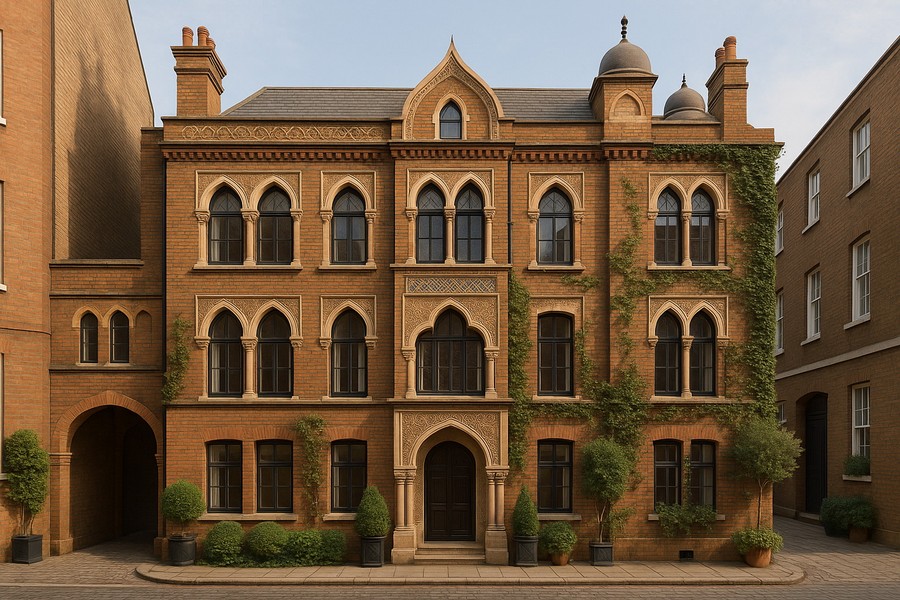
Outwardly, Bayt al-Rashid speaks Mayfair’s idiom; inwardly, it sings the poetry of the East. The street façade is laid in warm London stock brick with Portland-stone dressings, a restrained Italianate cornice typical of late-Victorian town palaces.
Beyond this cultivated reserve the plan turns inward around a top-lit hall, where a coloured lantern roof draws daylight down to a marble vestibule paved in greys and honey tones. Walls and ceilings of the principal rooms are panelled in walnut and cedar with intarsia of ebony, mother-of-pearl and bone; frieze zones carry calligraphic bands and stylised palm motifs. Heavy yet hushed doors in teak conceal small ventilating sashes, while mashrabiyya screens throw lace-like shadows across Minton encaustic tiles. Fireplaces keep Victorian proportion but are framed in veined marble and geometric tile fields; the plasterwork softens into honeycomb coffering—a gentle, muqarnas-inspired echo—picked out in gilt on warm ivory. Textiles—silks, Kerman carpets and deep velvet portières—temper the city’s noise, and pierced copper and brass luminaires scatter light in a thousand facets. The result is a true synthesis: Victorian discipline married to Levantine domestic grace.
History
The story of Bayt al-Rashid begins with a decision made in exile. In 1875 the four banished brothers of the Al-Zahir line secured a narrow yet prestigious Mayfair plot. Plans were developed between a London architect and a Cairene master-builder who conceived the interiors as a continuous sequence—vestibule, hall, reception, private chambers—centred on light rather than frontage. Ground was broken in spring 1876; within a year the structure was roofed and weather-tight. In 1877–78 the house filled with crates arriving via the Suez Canal and rail: carved panels, tiles, lanterns and carpets. Fitting them required invention—hidden air flues to tame London damp, careful placing of radiators so neither plaster nor inlay would suffer—so that move-in followed in spring 1878 after roughly two years on site and a further season of interior finishing.
Thereafter the house wrote its own building chronicle. The 1880s set the tone with the winter garden and hammam; the 1890s layered modern utilities without disturbing the illusion of lantern-light. Each intervention sharpened, rather than blurred, the original character—until Bayt al-Rashid was no longer merely a London house with oriental rooms, but a place where two worlds learned to live together.

Comments
Author's Notes
The image in this article was found via Pinterest and is used here for illustrative, non-commercial purposes. I was unable to trace the original artist - BlackBuildz - neither on Pinterest nor on Instergram. If you are the creator and wish the image to be removed or credited properly, please contact me immediately. No copyright infringement intended.