
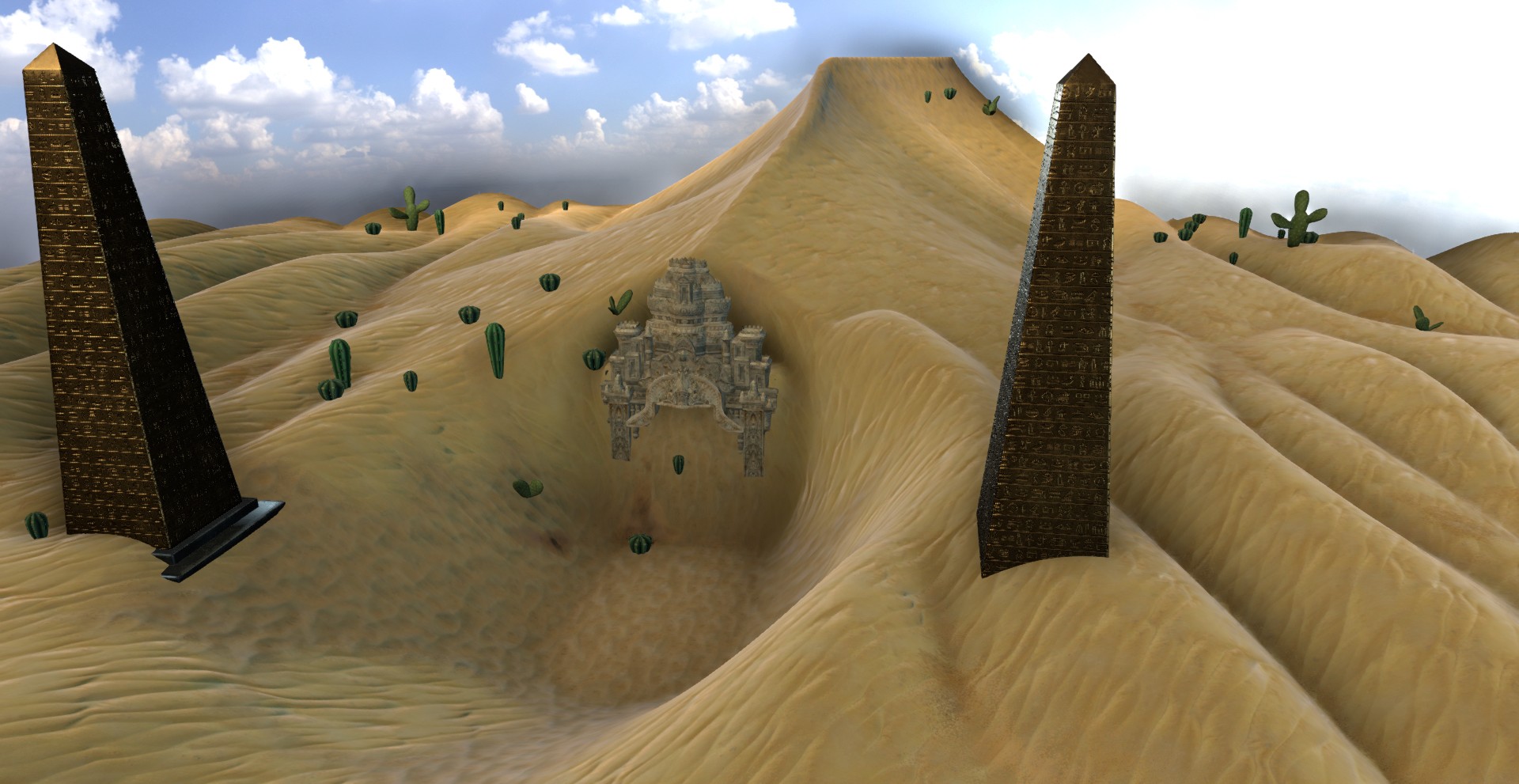
Desert Travel
Traveling in the desert presents a set of challenges that are relentless and immutable. The sun has no mercy in the deep desert; there is no shade to comfort the skin nor water to slake the thirst. It is a desperately dry landscape of deep sand broken up by vast, flat expanses of salt. Patches of quicksand dot the land, and it is often a death sentence to be without a camel, or other safe conveyance, while traversing the grassless plains.
Daily Needs
Per medium creatureWater:Under normal circumstances and normal activity, characters will need to consume two gallons of water per day. Heavy activity, such as marching, or prolonged combat, doubles that to four gallons per day. A gallon of water weighs eight pounds.
Food: A standard diet of two-thousand five-hundred to three-thousand calories weighs about a pound per day.
Dehydration
Exhaustion from lack of waterIf a creature consumes less water than required, they will start to suffer the effects of Exhaustion. Half of the necessary water per day necessitates a DC 15 Con save or gain 1 level of exhaustion. No water in a given day automatically bestows one level of exhaustion. Exhaustion is cumulative and deadly. At level 6, the character dies.
Heat Exposure
Exhaustion from extreme heatDaytime temperatures can top 100°F (38°C) in the Sunrathe Wastes, and as such, Extreme Heat rules apply. Each hour of travel without adequate protection, such as a cloak, shade, or etc., elicits a DC 5 + 1 per hour CON save, or gain 1 level of exhaustion. The character has disadvantage on the save if they are wearing heavy armor, or exerting themselves.
Navigation Hazards
Getting LostIf there are no clear landmarks, make a DC 12 Wisdom (Survival) check every 6 hours. On a fail, the party veers off course. Mirages, sandstorms, quicksand, or hostile wildlife may also cause distractions, requiring random encounter checks or saving throws.
Foraging for Supplies
Bushcraft in the wastelandFinding food and water in the desert requires a very specialized skill set. A DC 20 Wisdom (Survival, Desert) check to scrounge up 1d6 + Wis modifier pounds of food, and gallons of water. Otherwise, the characters will have to depend on supplies.
Foraging is impossible in barren terrain, unless near oases or rare plants and insects.
Resting in the Desert
Making campMost people in the Sunrathe Wastes travel and live their lives during the much more tolerable hours of the evening, while the sun is down and the moons are up. They make camp during the day, finding shelter and shade if they are able, otherwise depending on their gear to protect them from the roasting sun.
Quicksand: If a character enters the space of a quicksand pit without a proper conveyance - such as a camel, or a sand sled - they will need to make a DC12 Dexterity Saving Throw to avoid becoming trapped in the slowly grasping pit. Once trapped, they can escape by rolling a DC12 Strength Saving Throw; if they fail this throw, things become complicated. They can try again, but the Difficulty Class of the attempt goes up by two each time, to reflect how movement within the quicksand is what causes one to sink into it. If a stuck character were to remain stock still, their companions could easily pull them out with a length of rope and a DC8 Strength Check. This check is made at advantage if two or more people are hauling on the rope to rescue the imperiled player character.
Suffocation: Should the worst happen, and a character is completely covered in sand, they begin to suffocate. A character can hold their breath for a number of minutes equal to their Constitution Modifier; after that, the character drops to 0HP, and cannot regain HP or be stabilized until they are able to breathe again.
Exposure: If a trapped character were to cease all actions, they would not sink. But the sun will eventually get them if they are not rescued somehow. After one hour exposed to sun without protection, take 1d4 radiant damage. For each hour thereafter, double the damage die. For example, after the second hour exposed to the sun the damage die would be 2d4 , the third hour, 3d4 , and etc. It is a grim prospect.
Camels: Dromedaries, and purpose-built conveyances such as the sand-sled, do not sink in desert quicksand, and can traverse it as if it were normal terrain.
Weather in the Desert
Atmospheric HazardsNot only is the desert itself immensely dangerous, the weather is crafty and treacherous. Dust-devils can pop up out of nowhere, and full blown cyclones will paints great swathes of destruction throughout the deep desert. But sandstorms are the stuff of legend, and for good reason. They happen often enough that they are a real threat to anyone planning on traveling anywhere, and if one is unprepared they are just as deadly as a cyclone.
It takes a DC12 Wisdom (Survival) check to get through a sandstorm unscathed. This check is made at advantage if one of the characters is proficient in Survival(Desert). On a failed save, take 2d6 bludgeoning damage, and suffer one level of Exhaustion.
Desert Aetherflames
Atmospheric MagicOn very rare occassions, an aurora sends streaks of brilliant purple and blue writhing and twisting across the skies. These maelstroms of magical energy are very high up, but powerful enough to affect the Weave of Magic around them. Spellcasters feel energized and invigorated when they behold the dancing ribbons of light. Called the Sunrathe Aetherflames, they are considered incredibly lucky and auspicious for magic users.
Spellcasters lucky enough to behold the Aetherflames gain an additional Level One Spell Slot for twenty four hours.
Desert Moonbows
Prismatic MoonbowIn very rare occasions around select oases, the brilliance of the desert moons refracts through atmospheric moisture at just the right time of night to cause lunar rainbows. Called "Moonbows", these are considered extremely lucky for rogues and martial classes, who feel empowered and emboldened when they behold this incredibly rare phenomenon.
Rogues and purely martial classes that bask in the brilliance of a Moonbow for ten minutes gain a Luck Die for twenty-four hours.
Desert Conveyances
Traveling through the desert, even at night, requires one to pack and carry all of the supplies needed for the trip. Victuals and water are heavy; far beyond the carrying capacity of a human on a week-long excursion, for instance. This necessitates some way of carrying all of the necessary equipment, gear, accoutrements, and luxuries people are apt to haul around with them.
Camels: The Ships of the Sands, these dromedaries can walk unimpeded through the hottest part of the deepest desert. Their splayed feet keep them atop the shifting sands, rather than sinking into it, and their bodies are perfectly adapted to life in a water-scarce environment. Camels can carry up to 240 pounds, and can drag up to five hundred. They can go up to a week without water, losing up to twenty five percent of their bodyweight as they do.
Sand Skids: A common option for hauling gear is a sand skid. These simple vehicles can carry up to five hundred pounds, and are engineered to stay level while sliding through the sands of the deep desert. They are made to be hauled, or pushed, by Camels
Comments