
New Singapore
New Singapore is the largest settlement by far and the only city relative to old world standards of what constitutes a city. Created and completely controlled by Parker, Goto, and Kochmann Inc. during the fall of the old world, New Singapore reflects much of the same technology and living conditions that many cities had in the old world. With such amenities as a modern banking and communication system available for all who can afford it, many travel to New Singapore to try and find an opportunity for a better life, with varying degrees of success.
Etymology
Originally New Singapore was named "Project Acropolis", taking its name not from the Acropolis of Athens as is commonly misunderstood, but the ancient concept of creating an important cultural or religious center on a high hill or mountain of a city. PGK thought of Project Acropolis as a sort of city on a hill, away from all the chaos that was occurring during the fall of old world to keep their interests alive.
Years after Project Acropolis reopened their borders, Singapore, a nearby abandoned megalopolis of the world, was looted of its technology and resources and was used to fuel the growth of Project Acropolis. Seeing themselves the spiritual successors to Singapore and reasoning with a bit of humor that much of Project Acropolis was made from Singapore's ruins, the decision to rename the city to New Singapore was put into motion.
History
Early Years
Project Acropolis
The beginnings of New Singapore started with Project Acropolis, PGK's largest and most ambitious project at the time. During the fall of the old world, PGK analysts projected that a decentralized network of international organizations was no longer going to be profitable for the corporation. While PGK had made significant expansions and profits during the chaos of the fall, the board of directors decided to move on the projections of the analysts and took the bold and rather expensive choice to create a large centralized location as a headquarters.
Careful surveying was conducted world wide for a safe location to stage this proposed project, until eventually an area in the South China Sea off the coasts of Malaysia, Singapore, and Brunei was chosen. While rights to this area also came with incredible costs, the relatively shallow sea, isolation from dangerous political hotspots, and high winds and sun that would provide power, made it a perfect location for perceived longevity.
The construction and terraforming involved with the project was monumental and took years to complete, starting at one point and radiating out from it. At the same time, 500,000 PGK employees from around the world were moved into housing projects upon the initial site that was created. When it was finally completed, Project Acropolis already consisted of a burgeoning city center and a large commercialized farming district to support the population. Plenty of unused land was also available for future expansion of the city.
Start of Isolation
The initial goals of Project Acropolis were to create a centralized headquarters for PGK's interests were largely fulfilled once the island was finished and the initial group settled, the true necessity of the project was yet to expose itself. While Project Acropolis lingered on and was seen as a deficit to the conglomerate's revenue, the slow collapse of the world economy along with the closing of PGK's overseas assets began to show that Project Acropolis's centralized economy was going to keep the conglomerate alive.
In one fateful move, PGK shocked the world by instead of inviting immigration to Project Acropolis, they quietly moved the remainder of their staff and families to the island and then closed off its ports and communication networks to the outside world. Switching to an isolated and internal economy, PGK cut off all contact with the rest of the world, and physically kept anyone from their ports, their sea walls raising to keep people both out and in.
100 Years of Solitude
While the world crumbled around them, Project Acropolis was able to sustain itself without any outside interference. For over 100 years, they continued on, forgetting the troubles of the outside world. However, with the safety of solitude, was over 100 years of little to no innovation or growth. The initial population that had joined Project Acropolis had enjoyed top of the line housing, healthcare, and jobs, not to mention fresh food grown locally.
A growing population that oversaturated the job market left many unemployed and led to a start of poverty. While the food and water purification plants were able to keep them alive and happy for many years, over time the lack of resources to serve their mechanical and electronic infrastructure started to dwindle. Still a corporate entity at heart, PGK's board of directors decided that keeping up consumerism and corporate growth was impossible without renewing these needed resources. So, they made the monumental decision to lower their walls.
Rebirth and Expansion
End of Isolation
Project Acropolis saw an massive increase in population, resources, and technology with the reopening of its border and the start of PGK's @World Expansion Initiative. Thanks to the initiative, the old world Singapore ruins were exploited and brought a rebirth to the city, ending unemployment and refreshing the city's infrastructure and eventually expanding it with a flood of innovation. Since Singapore had been such a boon to Project Acropolis, the board of directors decided to rename Project Acropolis to "New Singapore" in honor of the city.
The Last of the Great Cities
For the next few decades, New Singapore grew until it reached the edges of its own borders, thanks to the open border policy under the watch of @the refuge and immigration system. The once expansive farmland was now long gone, replaced with houses and factories, switching to outside food sources and large hydroponic farms. Technology of the new world was replicated, allowing residents to live with much of the same amenities as in the old world. New Singapore had become the megacity that it had always dreamed it would be, but once again it felt restrained by its own borders. Soon enough, whispers of the board considering large expansions into the world have surfaced, though no plans yet have been put into motion.
Geography
Location
New Singapore is located in the Sea of New Singapore, around what was known in the old world as the South China Sea, around the area of old world Malaysia, Brunei, Indonesia, and Singapore. Located in a relatively shallow area, the New Singapore island mass actually sits fixed to the sea bed with large struts holding the land together and certain areas kept solid with sea grade concrete to keep everything together. Historically the out parts of the sea walls have been able to rise and kept the island isolated for over 100 years. However, the seawall inner mechanics have long since rusted, and most, once lowered, broke ancient rusted mechanisms that would never allow them to raise again.
A single grand canal lies along the western part of the island, originally working as irrigation, pulling water up from massive pumps connected to the ocean, purifying it, and distributing most to the city before depositing the rest into the canal via a facade made to look like a large mountain cave. While most of the water is pumped to the city rather than the canal in contemporary times, the canal still holds a decent amount of water, though much of it is now saline, it still has a bit of a pleasant look to residents as a water feature.
Climate
New Singapore is equatorial and keeps a similar climate all year round of an average temperature of 30°C/86°F and high humidity levels. New Singapore has heavy rainfall and thunderstorms all year round, but also has heavier rainfall during monsoon seasons (December - March) and sporadic bouts of slightly drier weather.
In the larger commercial districts, limited weather control devices are dispatched and many of the larger parks and plazas have a slightly cooler temperature via outside air conditioning.
Districts of New Singapore
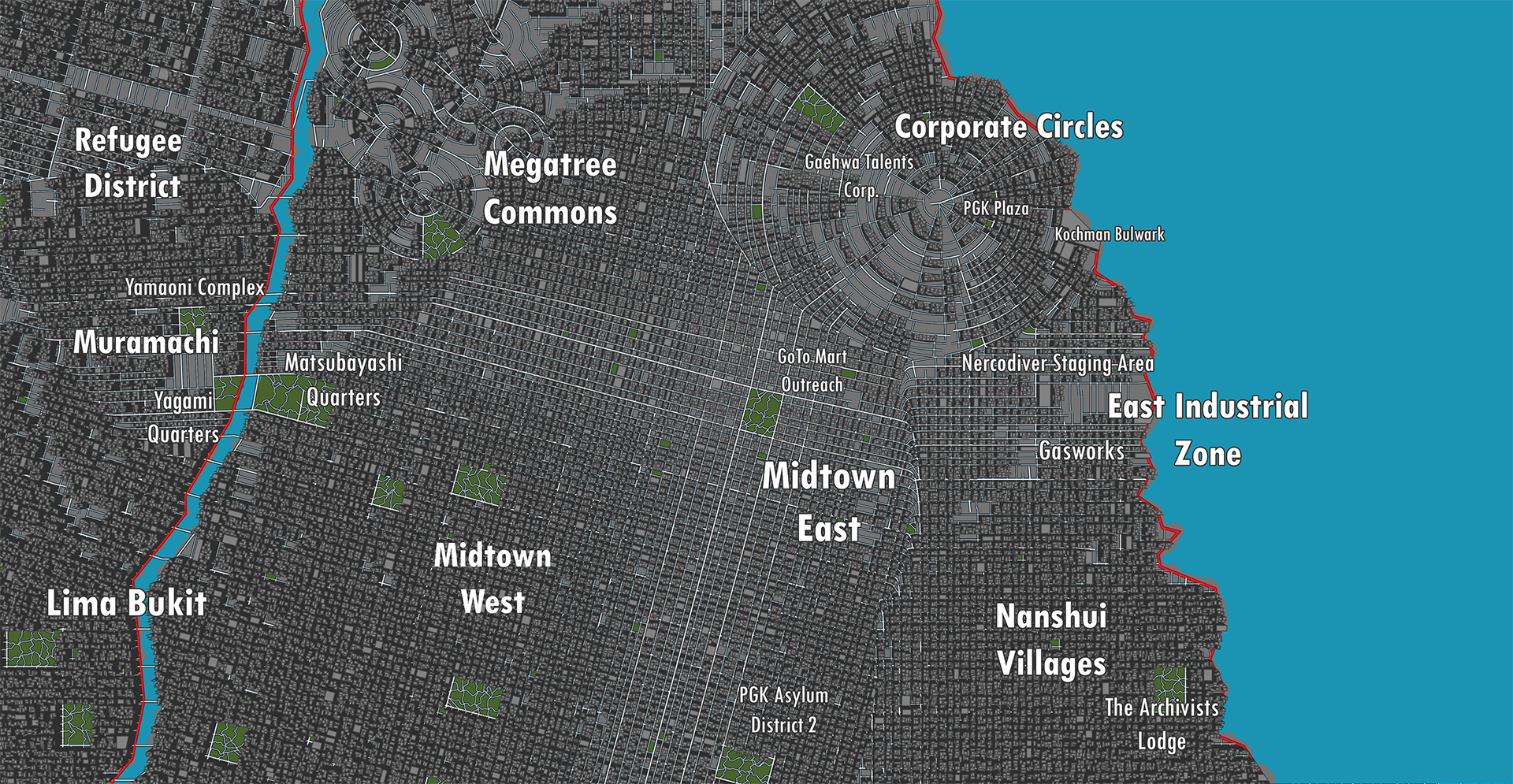
Corporate Circles
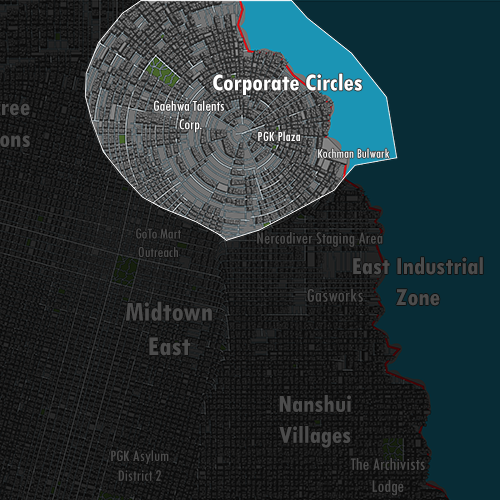
The site of the original Project Acropolis's corporate headquarters and settlement, the original area has grown to a large city center consisting of concentric circles of numerous skyscrapers which house the corporate headquarters of Parker, Goto, and Kochmann Inc., their subsidiaries, and other smaller corporate entities. Considered the crown jewel of PGK and New Singapore, the Corporate Circles are the safest and most technologically advanced area in the entire world, a true shadow of The Old World.
The PGK Plaza lies in the center of the circles and is considered the most beautiful and comfortable leisure area in the city, drawing thousands a day and artificially cooled through cool air pumped across the plaza by numerous high pressured vents. Surrounding this plaza are the main offices of PGK, @Parker Pharmaceuticals, and @GoTo Holdings. @Kochmann Private Security does not have an office represented in the plaza, but occupies a huge bulwark in the east side of the circles.
East Industrial Zone
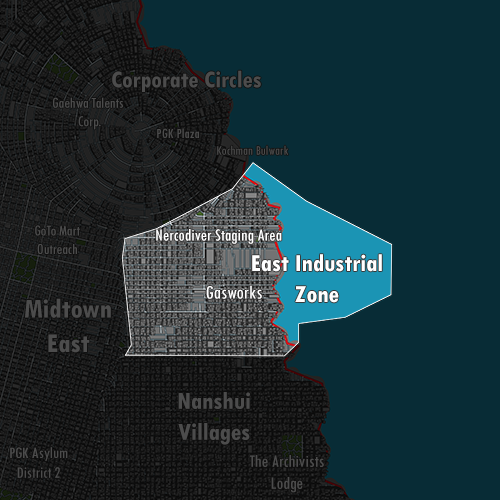
Though called the "East" Industrial Zone, there exists no other industrial zone in any other cardinal direction, with the only other zone repurposed as the refugee district. All heavy industry originating in New Singapore lays within the western side of the district, with the eastern seafront side filled with warehouses of various sizes and ownership. PGK owns the largest share of the factories, a large area known as the "Gasworks" now a nick name for the entire industrial area. Deliveries are done via VTOL (Vertical Take-off and Landing) vehicles, so the actually alleys and streets of the Gasworks are notoriously known for being very unsafe and unregulated and the company tends not to use it. Those who struggle to live in the refugee district tend to get lost here and never return.
In more recent times, @Marshers have moored on the seaside of the industrial zone, fishing the near seas and salvaging items from the industrial zone's refuse pipers. Friendly to outsiders, yet very protective of their own people, they've created a semblance of a safe area around their camps.
At the North end of the district is the Necrodiver Staging Area, operated by the Necrodivers Union as a staging point for Necrodiver operations in what they call the East Asian and SEA Theaters. While mostly covered in tarmac where drill rigs are stationed alongside their VTOL Frames, apartments and bars are also around the area as well to support members.
Lima Bukit
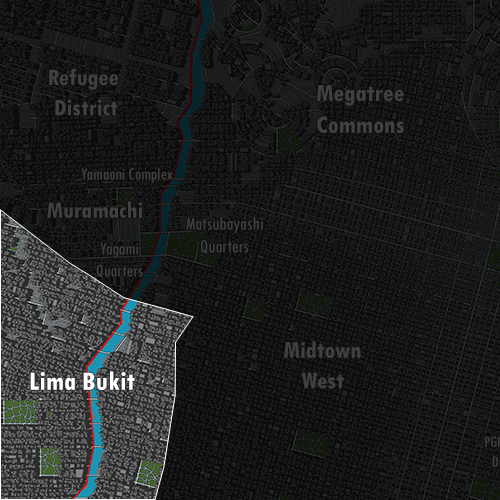
The name "Lima Bukit" refers to the Five Hills that jut out of the north side of the district. Not natural for obvious reasons, the Five Hills are actually the excess materials that were left over from the original forming of the island. Left alone for many years, they gained their more natural look from the accumulation of plants and grasses across the surface. Not just the namesake, the Five Hills also act as the physical and cultural boundary between Lima Bukit and Muramachi.
Lima Bukit's population originally derived from those who moved to Muramachi in the early post isolation days. Like Nanshui, the area that would become Muramachi and Lima Bukit was first settled when housing was at a shortage in Midtown. When the clans came and requested permission to develop the area, it seemed that they would fare better than Nanshui. However the clear superiority that the clans set over the district was not something every person in the district wanted.
The clans would not have insubordination and a large amount of the population went willingly, and in many cases, unwillingly, south of the Five Hills. Nestled in a corner of the city and not protected by @Kochmann Public Security, Lima Bukkit became heavy with crime and especially smuggling and gang violence. Surprisingly, after decades of fighting, the gangs came together to protect their community, ending the bloodshed and bringing peace to Lima Bukkit.
Though Lima Bukkit itself became more peaceful, the gangs had merely decided to focus themselves elsewhere. Their peace had come to a bloody end and their consolidation was done to gain power, not for peace. Part of realizing that the only way would be to expand into other districts, and soon they were causing problems in surrounding areas. This has left Lima Bukkit an oddly peaceful, but very infamous district.
Megatree Commons
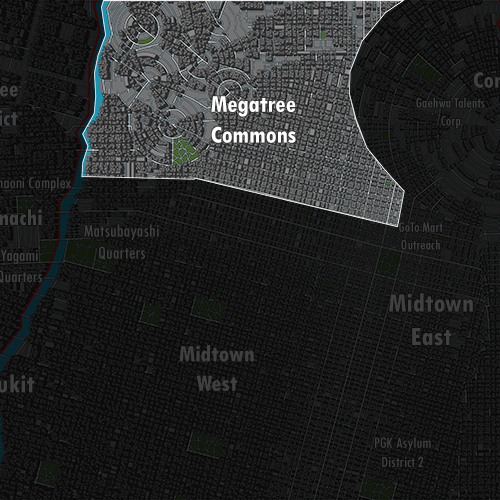
The Megatree Commons are a mostly residential area, but bisected by an ambitious project by PGK to create experimental arcologies like the few that had been made The Old World. However, a more practical use for them besides residential use was focused on instead and limit residences to large, but not arcology size apartments on the bottom levels of the trees. Modeled after the Supertrees of Singapore, but at a much larger scale, the Megatrees tower into the sky, collecting vast amounts of power from branch like solar panels and massive wind generators in their trunks. Large atmospheric collectors at the top collect water from rain and incipient moisture in the wind, filtering it and feeding it into the water system of New Singapore, providing more water than the pump system for the canal.
Beneath the Megatrees lies the agricultural sector of New Singapore, with large vertical hydroponic farms fed by the fresh water and artificial light to grow food on a large scale, with less room than farmland.
The residents of the Megatree commons are a bit more insular than other areas of New Singapore. They exist almost entirely as employees of the Megatree project or as employees of services in the area of the Megatree. The exception to this are some mid level employees working for corporate entities. The Megatree commons have a slightly more high class feel to them in places, and the common areas and slightly cleaner air from the lower level farms make it a bit more pleasant to live in.
Midtown
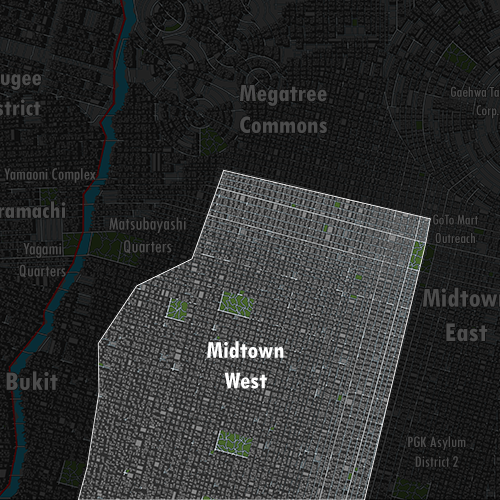
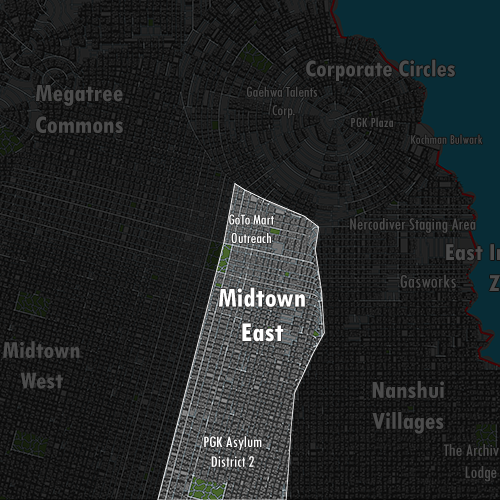
Midtown was the first location outside of the original settlement area that was created to be the residential and commercial zones for the quickly growing population after PGK ended isolation of Project Acropolis. Midtown continues to be not only the largest district in New Singapore, but is also the most populated of all the other districts. Typically Midtown is split into an East and West section, with the West and Newest side populated almost entirely by registered citizens of New Singapore.
Midtown Wast was first created to support the new population of immigrants during the first population rush. Notoriously it filled vacancies more quickly than construction could finish buildings, therefore leaving many without having a home and having to live in makeshift housing. Midtown West has finally overcome that stigma and is now quite well populated and housing is well established, with a decent amount of vacancies for new citizens. These vacancies however, are from heavy gatekeeping, with local ordinances, high fees, and discrimination by land lords making residency in Midtown west quite difficult, especially to those who can't navigate the difficult path to becoming a citizen.
Midtown East in contrast has a smaller, but more diverse population. Vacancies, however, are a bit less common, with most being in large smaller roomed high rises. Still, Midtown East keeps a decent standard of living almost comparable to Midtown West and has a smaller barrier to entry, limited only by space. About half the district contains PGK Asylum housing as part of the @Refuge and Immigration System in place. Asylum Seekers, a paid status of immigrant, are given one year of free housing and introduction into the job market. After that year, the Asylum Seekers must find sponsorship for a path towards citizenship, or face Refugee status and are almost completely regulated to the Refugee district. Many companies who take the risk of these short time residents have offices in Midtown East's north side's plaza, with GoTo Mart establishing an Outreach center to promote training and schooling to Asylum seekers.
Muramachi
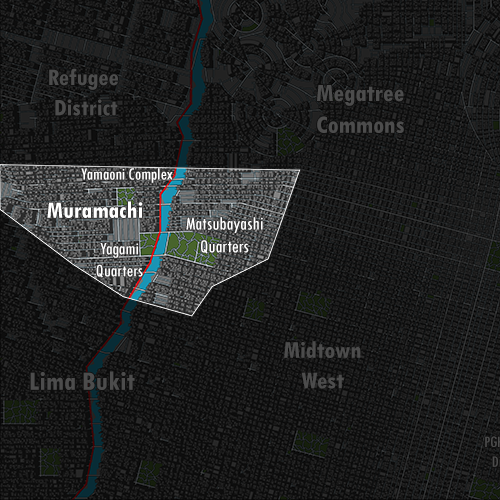
Muramachi was the first area in area in New Singapore that was built privately, but with the permission of PGK. Settled by families that could afford a generous contribution of resources into the New Singapore economy, Muramachi is characterized by the sprawling estates built by these families and surrounded by smaller buildings and tenements, not unlike Nanshui, but with a more organized structure. The three largest of these estates, are owned by the Matsubayashi Clan, Yagami Clan, and @Yamaoni Clan, with the first two contributing to both large public and private gardens, beautifying the canal area at its center.
While Muramachi is considered one of the safest areas in terms of personal crime, only really from fear of the Clans retaliation. As a trade off, Muramachi has the largest amount of Organized crime in the entire city. The worst kept secret is the secret war between the Matsubayashi and Yagami clans that have roots in a conflict that started in The Old World. Though a truce has kept any large scale conflicts from happening, personal battles have claimed the lives of many on both sides of the conflict.
Nanshui Villages
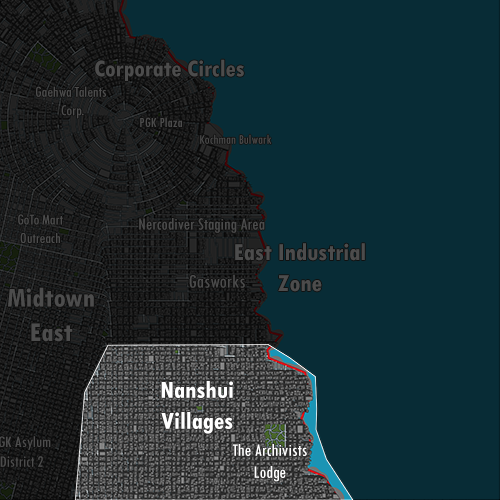
The Nanshui Villages district is distinct that it is the largest area of New Singapore that was not planned or created by PGK, but rather was built from local means. Originally Nansgui consisted scattered camps and make do housing for early immigrants who either didn't like the large projects that PGK were creating in what would become Midtown, or were stuck without a home because they had arrived before PGK could create housing for them. Over time these communities decided to band together to create their own permanent residence and commercial areas.
The result of the multitude of villages coming together and private constructions, makes Nanshui rather maze like and following no city planning or balanced construction style, often examples as 10 story apartment complexes next door to a single family house. Not regulated by @Kochmann or having a lot of the public infrastructure that the other districts have, Nanshui has its own local culture and has attracted those who wish to not attract attention.
Many old beliefs have weaved their way into Nanshui life and the streets themselves are said to be bewitched so out of district travelers often get lost. True confirmed magic has made its way to Nanshui however, as @The Archivists have made their home in Nanshui, collecting as many Old World Magics as they can in their protected archives.
Refugee District
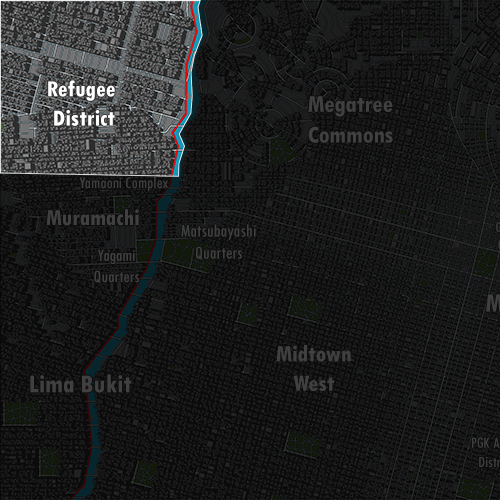
Originally a vast commercial farmland meant for supporting the original population of Project Acropolis, the farming area was demolished as food production changed to hydroponics in deep underground structures that could sustain the growing population much more efficiently. Redistricted as the Refugee district and incorporating the decommissioned West Industrial Zone, the district served to house those who were labeled as "Refugees" under the @Refuge and Immigration System.
In truth, the Refugee label has a broad spectrum, covering those who could not pay the cost to enter as an Asylum Seeker, those who could not find sponsorship after their trial period, and those who simply could not fit into society elsewhere. At odds with both the clans of Muramachi to the south and kept across the canal by @Kochmann security, the Refugee district remains a mostly lawless area. Small pockets communities have formed within the district to support and protect themselves, carving whatever home they can within the edge of the more prosperous areas.
For many, their life and death in New Singapore will occur completely in the confines of the Refugee district, with little chance of escaping it. Those who do make it out, rarely ever look back at the ruined and collapsing buildings that they once called home, nor the people who still live there.
Infrastructure
Land
Roads
New Singapore was planned with a vast population in mind, so well kept roadways are maintained in the Majorly PGK ran areas. Most districts have some sort of roadways, usually created through private ways, or even by short term contracts with PGK, but the quality of these roads can vary drastically by district. Two large highways cross over each other just below the Corporate Circles, connecting the main districts together, while a secondary highway runs along the canal to serve the western districts.
Vehicles
Fossil fuel is basically non-existant, as large scale drilling operations would be rather dangerous in any part of the world and not worth it. Bio-fuel is used, but is almost exclusively used by VTOLs to power their jet engines.
| A Series on PGK |
|---|
| Organization: Parker, Goto, and Kochmann Inc. |
| Senior Partners @Parker Pharmaceuticals @GoTo Holdings @Kochmann Private Security |
| Projects New Singapore @World Expansion Initiative @The Refuge and Immigration System |

Comments