
Watari (wah-tah-ree)
A nomadic group that roves up and down the west coast of North America. They are unique among those who dwell on the continent since they arrived by boat from the lost island nation formerly known as Japan. With no way of contacting any faction of their people that likely ended up on other continents in the decimated world, the group forms a clan, wandering up and down the coast with their eyes to the oceanic horizon where they know their sunken home and lost comrades to be.
Willowmoor's scouts will eventually run into them while exploring the post-apocalyptic world, opening trading opportunities for both communities.
With the passage of time and no plausible way of reuniting with their lost comrades across the ocean, the Watari will be faced with a tough decision: break into a diaspora and assimilate with other settlements to survive, or slowly die out because their nomadic life is not fit for the long term.
Naming Traditions
Family names
As was traditional with the culture they inherited, surnames are placed ahead of given names for introductions, during formal occasions, and on paperwork. Unless you are close or familial with someone, you are only supposed to address them by their family name as well.
Many outsiders will struggle with this concept, though most will also try in good faith to understand and adapt when with the Watari.
Culture
Major language groups and dialects
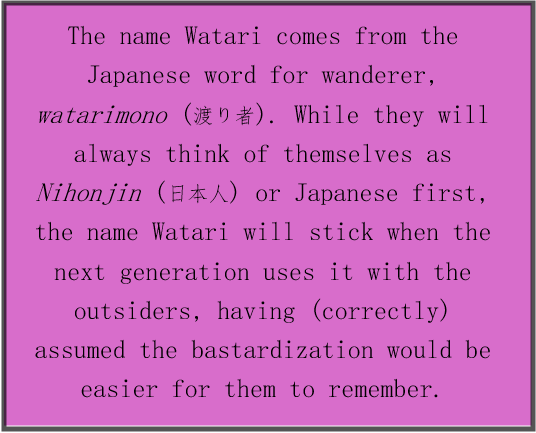
Their primary language is that of their destroyed homeland. For several years into the new world, the Watari themselves will call their language Nihongo (日本語), which most outsiders in their vicinity will know as Japanese; the further south they go along the coast, there will eventually be many who know it as Japonés (pronounced hah-poh-nehs).
In the future, the mostly-unchanged language will earn a new name on the inspirations of the rising generation and its newfangled ideas...
Culture and cultural heritage
The Watari are one faction of survivors from the destruction of the nation island, Japan. They feel certain that if they survived all the way out to the North American west coast that there must be other factions who washed ashore on China, the Koreas, or other places much nearer where Japan used to be.
The survivors will be keen to keep as much of their old culture as they can; not just the stalwart elderly, but even the youth will find pride and comfort in remembering their heritage. Collectively, they will continue the traditions and customs of their homeland, which they will be largely secretive about with outsiders - for many years, at least.
Since the survivors escaped via boats, and most at short notice, the majority wore only the clothes on their backs and what they might have carried in a bags, purses or pockets. The few who were able to prepare or owned the boats grabbed what they could, and almost all of them remembered something of sentimental value. While this was only a framed picture of loved ones for some, others were able to take heirlooms from their kamidana (神棚), a home altar and the center of daily worship in a typical Japanese household at the time of the world's modern end; it's one known tradition they will bring with them as well as they can.
Average technological level
They are straddled without the use of modern electronics just like everyone else. They find ways to make do with what they have, a list of which includes gasoline, batteries, solar panels, and anything they can use from the boats that got them to shore, which turns out to be a lot. They recreate navigational instruments, devise tools like the Hanabi Signal, and come up with an offshore fishing system to keep their bellies full while they're traveling along the coast.
One thing they originally lacked for was weaponry. Gunowners were few and far between in their home nation, so they only had two that essentially came from a couple of the boats. There are a variety of useful tools they use from the boats as well, but they also start teaching themselves how to make weapons as soon as they find the right materials. At first, they make do with spears with sharpened stone attached to the end or knives made in a similar fashion.
They will only get the opportunity to upgrade their weaponry to real knives, swords, and a few more guns when the warrior unit of their group leaves to find a city or town with supplies they're in desperate need of, such as insulin, antibiotics, and other medical necessities.
Art & Architecture
Since the Watari are a nomadic people, they don't have architecture in the form of buildings, and they lack art that can easily hang on the wall. They arrived on boats, but most were barely seaworthy by that point, and the rest wouldn't last much longer. Rather than leave them or set them adrift, they decided to break them down, turning the parts into the truck-like vehicles that they move about in when they're on the move.
When they stop to camp, the trucks providing both a boundary to outsiders and their quick getaway if they need it, their camp takes on the feel of a small village since they tend to stay put for roughly a season at a time.
In the early days, the camp was spread over one broad area, nothing but the stars up above and only their rudimentary vehicles surrounding them. Though they liked living below the stars, they were wary of being so exposed for so long, considering they tended to make camp for two to two and a half months. With time, they got various cloths they'd taken from the boats or scrounged from other shipwrecks when they came upon them, and they made tents.
By the time Willowmoor Scouts stumble upon the Watari, they have reached a point where each family unit has their own tent, and they hang various decorations made from whatever's available: tree branches, flowers, berries, moss, among other things.
The more artistic make paintings on flat driftwood from natural materials, limiting the colors they can use. Even so, they don't shy away from sharing these with outsiders, who have spied everything from various colors spread inanely around canvas to brilliant landscapes reminiscent of an ancient woodcutter's style who was well-known in their homeland to universally recognizable drawings and characters of anime design.
Foods & Cuisine
They eat similarly to how they did in their homeland when they're traveling along the coast, feasting on the plentiful seafood. They have a limited amount of vegetables, rice, and other grains, so most of what they eat is whatever they find along the coast, the other foods saved for those who need them and only in measured portions, like medicine. The seafood is served in a variety of ways, sometimes even uncooked.
When they stop to camp for a season, they move away from the coast to the most sheltered spot they can find that's as close to the ocean as possible. Sometimes they get lucky and the ocean is still in sight, so they send a fishing party out every day and continue eating fresh seafood if that's to their tastes. There are those who welcome the break, and hunting parties are born to go into the woods or fields or even ascend a mountain footpath to find whatever wildlife can be brought down to feast on. Those who are good with wild plants find herbs and produce along the way to add some variety, and the liminal supply of grains are measured out to those who need them most.
The food is all cooked together by those with the talent for it, the results shared equally with the community.
Funerary and Memorial customs
In the homeland they came from, most people held funeral ceremonies the same way, and they do their best to keep those traditions in place as best as they can. Due to the nature of their circumstances, they become acquainted with death quickly and often in the earliest months of their nomadic lifestyle, cementing these customs early in the subculture's formation.
Preparing for the death is the first custom if the death is expected. There is a ritual performed, though outsiders are forbidden from seeing.
When the person has died, friends and family are gathered and a death certificate is written; for the Watari, this is done by the Shuyou (主要) or chief on whatever paper they have available to them. The body is cleaned up and dressed for an informal wake. Since many participants have only a few items of clothing, not everyone can wear black, and those who can't aren't shamed for it. This alters an old tradition, but they have no choice; they must adapt with their circumstances.
Another ritual is performed at the wake, though outsiders aren't permitted to attend and bear witness.
The funeral is skipped - another tradition lost. It's too much pomp for them in their current state, though, so they go from the wake to the cremation - now done on a pyre either on the beach or within sight of the ocean. This is a new tradition that's formed since the ocean they see and often travel beside is the same one that swallowed their homeland.
When the cremation is done, the family of the deceased holds another ritual that outsiders aren't permitted to see, though they can infer it involves the gathering of the ashes since the relatives return with those; urns are hard to come by in their current situation, so the ashes are placed into whatever's available, from empty wine bottles to jars that once carried food of some kind. Even so, they are clearly treated with as much respect and care as they had been in the Before Times.
For those who have no family - also due to the circumstances - a friend or lover will typically take possession of the ashes. In the rare event there is no one who volunteers, the duty falls to the chief.
Another tradition they must leave behind is the grave where anyone could mourn the dead. They do their best with handmade altars that can be easily set up in the family tent when they stop to camp; while they're traveling, they'll set up the altar with the ashes on the beach if an important day happens to fall during a time of commute. It's not private enough for those who would rather mourn away from the public eye, though there are others who gain a preference for being in the arms of nature as they remember a lost loved one.
Ideals
Relationship Ideals
The Watari are monogamous, and the relationships are few and private among the small clan. When young adults and teens get together, they tend to keep it quiet until they reach a point of making it permanent. All new relationships are formed within and among members of the clan...at least for a few years.
Due to the Watari's small number, this will become untenable, and it will be the spark that ignites the next generation's inevitable rebellion.
Comments
Author's Notes
As I am a white girl who has always lived in America, I'm being mindful of treating this subculture with respect. A lot of their most treasured traditions and customs will be left unknown intentionally for this reason. Hence, their article is meant to be written by one of the "outsiders" who meets them (likely a Willowmooran, of course!).