
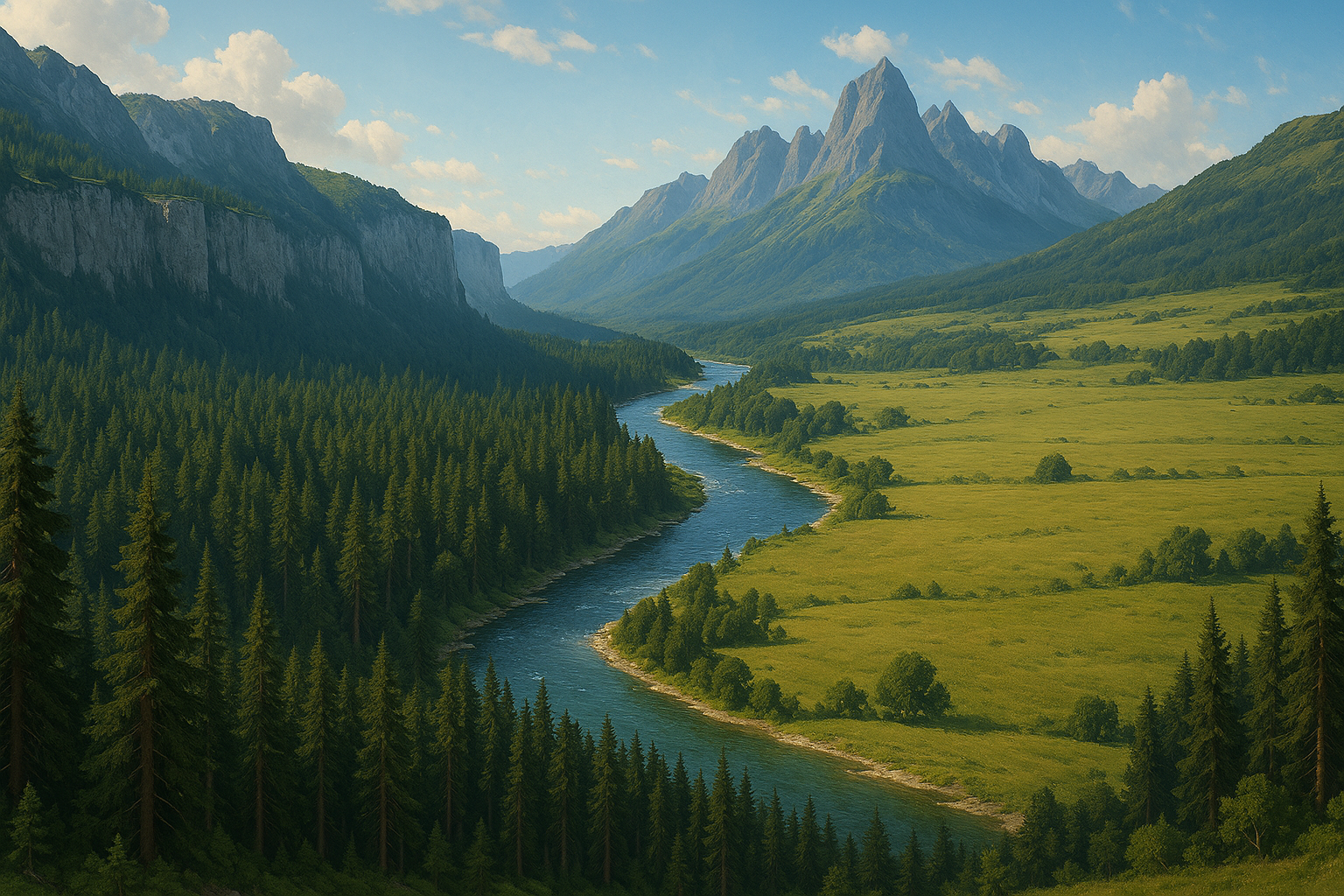
Mountain Range
Geography
The Mountain Range is exactly how it sounds; geographically speaking, it is a long mountain range that spans across the northern section of the central continent. Starting from the coast to the north of Maiden's Enclave and moving roughly northeast across the landmass. There are several rivers and lakes that naturally populate the mountain range, both above and below ground. This has helped create a diverse range of mountains, some of them barren and frozen, some of them boreal and full of life.
Through the geography of the mountain range, there are mythical locations such as Rillan Aur, the world spring where life began, and Krouin's Forge located in the heart of a Super-Volcano. Between mythological locations and a vast supply of natural resources, there is plenty to explore in this region of the world.
Ecosystem
Like any ecosystem, the system of the Mountain Range is governed by the interplay between the abiotic and biotic components, with the elevation of the mountains being a key actor in this interchange. The litany of variations in temperature, sunlight, and moisture creates distinctive life zones.
Abiotic Factors and Their Influence
Elevation
This is the most crucial abiotic factor. As you ascend, temperature and air pressure drop, while wind speed and solar radiation increase. This creates a series of vertical climate zones, each with its own specific conditions. This change is why you can find lush forests at the base and barren, polar-like environments at the summit of a single peak.
Topography
The shape of the land—steep slopes, valleys, and ridges—determines microclimates. South-facing slopes receive more direct sunlight and are generally drier and warmer, while north-facing slopes are shadier, colder, and retain more moisture. Valleys can experience temperature inversions, trapping cold air and fog, which affects where plants can grow.
Water Availability
Precipitation, whether rain or snow, is essential. The orographic effect dictates where moisture falls, making the western, windward slopes wet and forested, while the eastern, leeward slopes are in a dry rain shadow. The seasonal melting of snow and glaciers provides a critical water source for the entire ecosystem, affecting everything from plant growth to river flow.
Soil
Mountain soils are often young, thin, and poor in nutrients due to erosion, steep slopes, and the slow decomposition of organic matter in the cold. The lack of fertile soil limits the type of plant life that can thrive, favoring shallow-rooted, hardy species.
Biotic Dynamics and Interactions
Vertical Zonation
Plant and animal life follow the vertical climate zones. You'd see a progression from temperate and taiga forests at lower elevations, to alpine meadows with wildflowers and grasses above the treeline, and finally to sparse lichens and mosses in the high-altitude tundra.
Adaptation
Organisms have specialized adaptations to survive. Plants in the alpine tundra grow close to the ground to protect themselves from wind and cold. Animals, like mountain goats, have specialized hooves for climbing, while many others, like bears, hibernate to survive the harsh winters.
Predator-Prey Relationships
The food web is highly interdependent. Herbivores like elk and moose are a food source for predators such as wolves and bears. The population of predators is directly tied to the availability of their prey. The abundance of water also supports aquatic life, such as salmon, which are a key food source for bears and other carnivores.
Localized Phenomena
Atmospheric and Weather Phenomena
Lenticular Clouds
These are stationary, lens-shaped clouds that form when stable, moist air flows over the peaks. As the air rises and cools, it condenses into a cloud, but as it descends on the other side, it warms and the cloud evaporates. This creates a "standing wave" that appears to be motionless, even with high winds, leading to their famous "flying saucer" appearance. They are often a sign of powerful turbulence and are a common sight on the leeward side of major peaks.
Banner Clouds
A specific type of cloud that forms over pointy mountain summits. High winds hitting the mountain are compressed on the upwind side, creating an area of low pressure on the downwind side where the air cools and forms a "banner" of cloud streaming off the peak, showing the wind direction like a flag.
Temperature Inversions
In valleys and basins, especially during clear, calm nights, the air near the ground cools more rapidly than the air above it. This cold, dense air sinks and gets trapped in the lowlands, while warmer air sits on top. This phenomenon reverses the normal atmospheric temperature gradient, which can create a distinct layer of cold, stagnant air in the valleys, often with warmer conditions on the slopes above.
Valley Fog
A direct result of temperature inversions, valley fog forms when the trapped cold air in a valley cools to its dew point. This creates thick, persistent banks of fog that can fill an entire valley for days at a time, especially during winter. The mountaintops will often be in bright sunshine, while the valleys below are shrouded in a dense, cold mist.
Cinook Winds
On the eastern, leeward side of the range, as the mountain winds descend, they warm up dramatically and become very dry. This creates sudden, rapid temperature increases and can melt snow very quickly. These "snow-eaters" can have a significant effect on the local ecosystems.
Geological and Biological Phenomena
Geothermal Features
The supervolcano, even in its dormant state, can create localized hot spots. This can manifest as hot springs, geysers, or fumaroles (steam vents). These areas would have unique microclimates, melting snow and supporting life that wouldn't normally survive in such a cold, high-altitude environment.
Bog and Fen Ecosystems
The mountain range has areas of poor drainage in flat valley bottoms. Unlike bogs in glaciated regions, these would be fed by seepage and would be highly acidic. They would be home to unique, specialized flora and fauna adapted to waterlogged, nutrient-poor conditions.
Vertical Microbiomes
This is a key phenomenon of your range. The sheer change in elevation creates distinct vertical life zones. As you ascend, you would pass through different biomes, from temperate forests at the base to alpine meadows, and finally to barren, polar environments with permanent snow and ice at the highest peaks.
Climate
General
The climate of this region is incredibly diverse, changing dramatically based on the latitude and elevation. The orographic effect on the western coast and the continental climate extremes of the east and the north define it. The overall climate is temperate in the south, becoming subarctic and then outright polar as you reach the northern portions.
Western Section (40°N to 60°N)
This area is heavily impacted by the adjacent Maiden's Enclave and its proximity to the ocean.
- Temperature: The temperatures are moderate for the latitude, with distinct seasons. Winters are cold and snowy, but not severe. Summers are cool to mild.
- Precipitation: Moist air from the ocean, traveling over the coastal taiga, hits the western slopes and causes significant orographic precipitation in the form of heavy rain and snow. This creates a lush, wet environment on the windward side. The eastern slopes of this section are in a pronounced rain shadow, making them much drier.
- Super Volcano Impact: The dormant Krouin's Forge introduces a minor localized warming effect from the geothermal activity, and may release a constant, low level of sulfur dioxide in some areas. This can have a subtle cooling influence.
Central Section (0° to 30°E)
This section faces The Great Plains biomes, giving it a more extreme continental climate.
- Temperature: Without a major body of water, this region experiences a much wider range between seasons. Winters are severely cold, and summers are hot, particularly in the lower elevations and valleys.
- Precipitation: This area is generally much drier than the western section. The Great Plans are already semi-arid, and the eastern side of the mountains is in a rain shadow cast by the higher western peaks.
Eastern Section (30°E to 75°N)
This area experiences a progressive shift from a temperate forest climate to polar conditions.
- Temperature: The southern parts of this region have a four-season climate due to the adjacent temperate deciduous forests. However, as the range curves north, it becomes a winter taiga and a tundra. Here, the winters are extremely long, dark, and frigid, while the summers are short and cool. The northern portion is a source of consistently cold, dry air.
- Precipitation: The precipitation in this region is primarily in the form of snow, especially in the winter taiga and tundra areas. The presence of glaciers indicates a high level of annual snowfall at the highest elevations.
Elevation and Overall Climate
The entire mountain range experiences the effects of altitude on climate, with every rise in elevation bringing a drop in temperature and a change in conditions. The three prominent areas with peaks over 15,000ft act as "polar islands" within the broader climate zones, with permanent snowfields and glaciers. This creates a vertical zonation of climate, with distinct bands of different ecosystems as you ascend from the base to the summit.
Fauna & Flora
The types of plants and animals that can be found are highly dependent on the elevation.
Lower to Mid Flora
This region is dominated by coniferous trees, like pine, spruce, fir, and larch. It is also possible to find deciduous trees like birch and poplar in the warmer southern areas that are near water.
The forest floor is often covered in mosses, ferns, and low-lying shrubs that produce berries.
Mid to High Flora
At this elevation, flora is smaller and more resilient. This includes hardy, low-lying plants like cushion plants that hug the ground to escape the wind, as well as a variety of wildflowers, grasses, and sedges. Trees in this zone, known as krummholz, are often stunted and twisted due to the harsh winds and the cold.
Fauna
Large Mammals
This biome is home to large herbivores such as moose, elk, caribou, and mountain goats, all of which are well adapted to forage in the snowy terrain. These animals also support a population of large predators, including grizzly bears, wolves, and lynx.
Small Mammals
Arctic foxes are quite common, as are wolverines, and burrowing animals like marmots and lemmings.
Birds
Ducks, Geese, and Songbirds are common during the short summer months. Snowy Owl and Ptarmigan are common year-round.
Fish
Salmon is particularly common in this region, but there are a diverse set of fish that can be found both above and below ground.
Natural Resources
Timber and Wood Products
These are plentiful resources, particularly in the western coastal section. Its high precipitation and taiga biome are rich in dense coniferous forests. The eastern sides also provide lumber from a variety of deciduous and coniferous trees.
Water
Several prominent bodies of water, such as the Envalcir River, find their sources in the Mountain Ranges, providing several massive sources of freshwater.
Minerals and Metals
There are several significant mineral deposits throughout the Range; this is the primary reason that the Dwarves have made their homes in this region of the world. Mithril , Adamantine , Orichalcum, Gold, Silver, Copper, Iron, Coal, Rubies, Sapphires, Diamonds, and a litany of other minerals can be found throughout the region.

Comments