
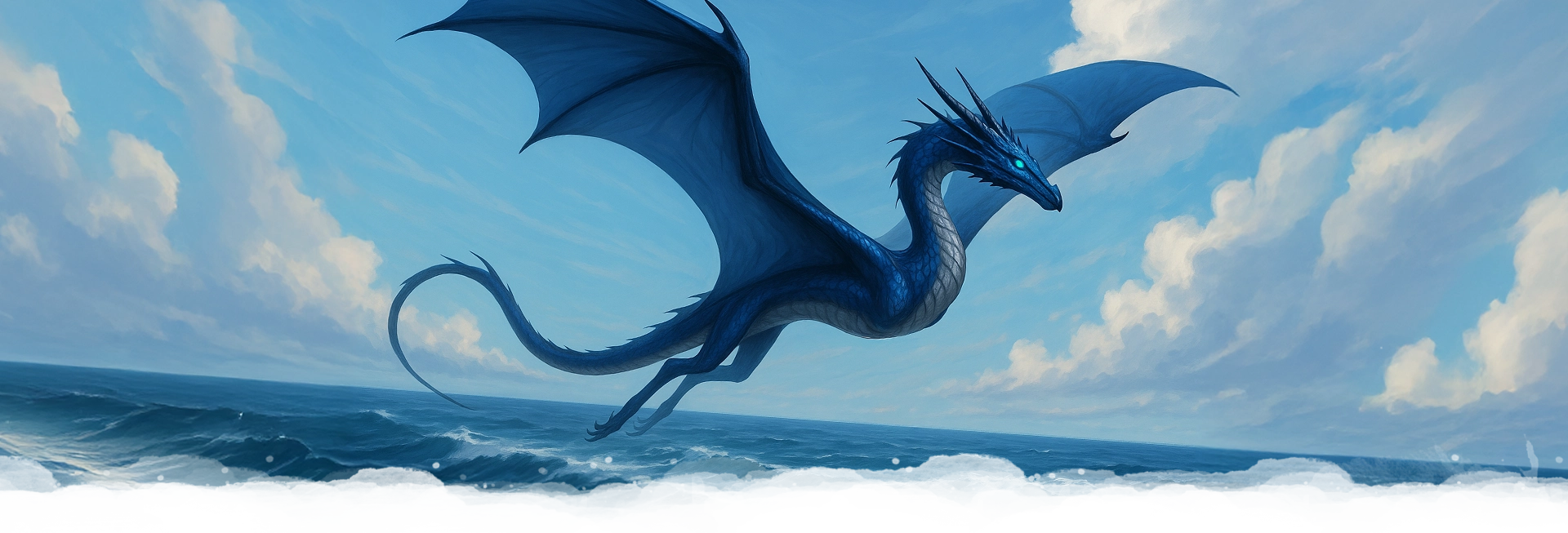
Sapphire Dragon
Among the prismatic flights, sapphire Dragons stand apart as creatures of the shoreline, dwelling where sea and sky converge. They are serpentine in shape and crystalline in nature, beings as much attuned to tides and currents as they are to Magic and lore. Legends describe them as patient watchers of coastlines, guardians of coral reefs and sunken ruins, and enigmatic stewards who value knowledge over dominion. To encounter one is to feel the weight of the sea and the clarity of refracted light—beautiful, inscrutable, and perilously sharp.
Unlike the greed of chromatics or the soaring ideals of metallics, sapphire dragons define themselves by curiosity and balance. They shape their lairs within caverns washed by the tide or grottoes carved into cliffs, where the crash of surf and the hum of arcane currents intermingle. To mortals, they appear both peril and promise: aloof predators that may suddenly bare their fangs, yet just as often subtle allies who test sailors with riddles, barter with scholars, and guard the fragile equilibrium of the coasts they claim as home.
Sapphire dragons build their lairs along rugged shorelines, often in caves carved into cliffs or in grottoes only accessible at low tide. Some dig deeper into the rock until their caverns open into vast flooded halls where they can swim and fly freely. Others build lairs around sunken shipwrecks, carefully arranging the remains into treasure vaults or even nesting chambers.
They choose lairs that offer seclusion but also vantage points. From a high cliff they can scan the sea for miles, while underwater tunnels let them vanish from view at a moment’s notice. The lairs are decorated with coral, shells, and relics taken from wrecks, serving both as ornamentation and protection for their eggs and hoards.
Biology
Sapphire dragons are among the most elegant and mysterious of the prismatic flight. Their bodies are perfectly adapted to life on both land and sea, and their unique crystalline organs make them natural vessels of arcane power. Every stage of their lives is marked not just by growth in size, but by deepening magical resonance, as their bodies and spirits refract the world’s energies like light through a prism.Anatomy & Morphology
Sapphire dragons have long, serpent-like bodies built for both swimming and flying. Their wings are narrow and flexible, able to fold flat against the body when diving underwater. Their tails act like rudders, giving them great speed and control in the sea, while still letting them twist sharply in the Air. Their heads are narrow and angular, with crystalline horns that sweep backward and become more faceted with age. Frilled crests line their necks and shimmer like rippling Water. Hatchlings begin with dull turquoise scales, but these darken into a deep ocean blue as they mature, finally becoming glasslike in their elder years. The oldest lose their pupils entirely, their eyes glowing like smooth orbs of sky-blue light. Beneath the scales, their skeletons are reinforced but partially hollow, similar to seabirds. This makes them lighter than most dragons, giving them agility without sacrificing strength. Unique to sapphires is a crystalline gland behind the heart, which refracts magical energy through their bodies and fuels their powerful spellcasting.Perception & Sensory Capabilities
Sapphire dragons see with incredible clarity both above and below the water. Their eyes can shift focus to pierce distortion, giving them perfect vision where most creatures see blur. Ancient sapphires are even said to “see” magic itself, reading magical currents as glowing streams of light. Their hearing is equally sharp. They can pick out the scrape of an oar across water miles away or track the hum of coral shifting in a reef. Underwater, they use a low-frequency echolocation — pulses that bounce through the sea, allowing them to map caves, wrecks, or prey even in total darkness. On top of their physical senses, the crystalline gland heightens their awareness. They can feel disturbances in magic, sense the presence of enchanted items, and sometimes catch impressions of a spellcaster’s intent. Many also develop a mild telepathy, letting them communicate directly with other intelligent beings.Genetics & Reproduction
Sapphire dragons reproduce sexually, but courtship is slow and deliberate. Instead of brute force, mates test each other with riddles, magical displays, and feats of creativity. A partner is expected to be an equal mind as well as a match in blood. After fertilization, the female carries the eggs internally for nearly two years before laying a clutch of two or three. The eggs are smooth, translucent, and faintly glow when exposed to moonlight or magic. Parents usually place them in enchanted saline pools lined with coral and pearl, which both protect the eggs and strengthen their magical potential. Hatchlings emerge small but alert, their scales soft and pale. They cannot speak yet, relying on hisses, body language, and faint psychic impressions to communicate. True Draconic speech only comes in adolescence, when their crystalline gland matures.Growth & Life Stages
Sapphire dragons grow slowly, with each stage marked by magical development as well as size.- Hatchling (0–20 years): Small, vulnerable, and curious. Scales are soft turquoise. Focused on survival instincts and magical sensitivity, but cannot yet form speech.
- Adolescent (50–200 years): Crystalline gland matures. They gain true speech, their scales harden into vibrant indigo, and they begin claiming small territories under parental watch.
- Adult (200–500 years): At full strength in body and magic, they establish independent lairs, expand their hoards, and may seek a mate. By five centuries, they are physically mature.
- Ancient (800+ years): Radiant, glasslike scales and glowing eyes. Rare survivors who become living oracles of arcane history, feared and revered in equal measure.
Biological Cycle & Longevity
Sapphire dragons are deeply tied to seasonal rhythms. In spring and summer, they grow more active, feeding heavily and adding to their hoards. In colder months, especially in the north, their metabolism slows, and they retreat into their lairs to rest and study. Their scales even reflect these changes — bright and refractive in summer, muted and storm-like in winter. They do not hibernate, but their long lives are marked by slow transformations. Their horns sharpen into crystalline spires, their eyes lose their pupils, and their scales shed less often, each fallen fragment becoming a flawless sapphire prized by mortals. Most live around 800–1,000 years if not slain. The very oldest, rare ancients who survive past a millennium, are said to carry centuries of memories and the wisdom of the sea itself, their very presence shaping the flow of magic around them.Habitat & Ecology
Sapphire dragons make their homes where land and sea meet, preferring places where waves crash against cliffs and the magic of the ocean feels strongest. They are masters of both water and sky, and their presence shapes the coasts they claim. To those who live nearby, they are both feared predators and hidden guardians, watching from a distance and deciding when to intervene.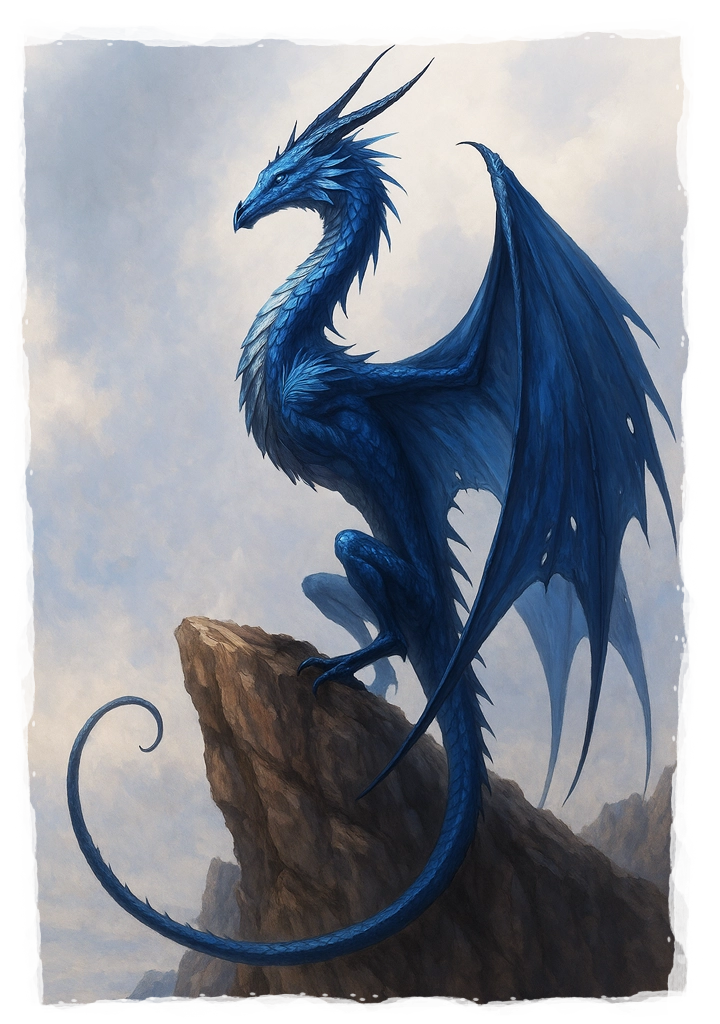 Habitats
Sapphire dragons build their lairs along rugged shorelines, often in caves carved into cliffs or in grottoes only accessible at low tide. Some dig deeper into the rock until their caverns open into vast flooded halls where they can swim and fly freely. Others build lairs around sunken shipwrecks, carefully arranging the remains into treasure vaults or even nesting chambers.
They choose lairs that offer seclusion but also vantage points. From a high cliff they can scan the sea for miles, while underwater tunnels let them vanish from view at a moment’s notice. The lairs are decorated with coral, shells, and relics taken from wrecks, serving both as ornamentation and protection for their eggs and hoards.
Dietary Needs & Habits
Sapphire dragons feed mostly on fish, squid, and other sea life, hunting with incredible speed and precision. They are skilled at driving schools of fish into coves where they can pick them off at will, and some are clever enough to “farm” these coves to ensure a steady supply of food. They also eat larger prey, such as whales or sea serpents, though only when necessary. Unlike the reckless hunting of chromatic dragons, sapphires cull carefully, often targeting the weak or diseased to keep populations healthy. Within their lairs, they sometimes cultivate coral gardens and shellfish beds, treating them as both food stores and ornaments. On rare occasions, they sample the foods of mortals while in disguise. Some develop unusual tastes — a fondness for wine, salted meats, or spiced dishes — and may demand these delicacies as tribute alongside books or artifacts.Environmental Impact
The presence of a sapphire dragon transforms its surroundings. Their careful hunting prevents overpopulation of predators and keeps fish stocks abundant. The waters near their lairs often teem with life, creating reefs that are richer and more colorful than elsewhere along the coast. Sailors tell stories of “dragon seas,” places where fish leap into nets and corals blaze with unnatural vibrancy. At the same time, their magical aura seeps into the land. Coral near their lairs may glow faintly, and the water may shimmer as if filled with refracted light. Local villagers sometimes see these changes as blessings — a sign their coast is protected by a hidden guardian.Territoriality
Though not needlessly violent, sapphire dragons are fiercely protective of their chosen range. They claim stretches of coast and sea as their own and do not tolerate other dragons encroaching without challenge. Conflicts are usually settled through displays of power — booming roars, crashing waves, or dazzling magical illusions — but can escalate into deadly battles if a rival refuses to yield. With mortals, they are more measured. Settlements near their territory may be allowed so long as the people show respect for the sea and its balance. Tributes of knowledge, artifacts, or fine food may be expected in exchange for protection. But if a village pollutes the waters or defiles the reefs, the dragon will not hesitate to sweep it away in a storm of wrath.Social Behaviour & Culture
Sapphire dragons are known less for brute strength than for their sharp minds and disciplined tempers. Where other dragons may be quick to anger, a sapphire often prefers to watch, weigh, and act only when sure of its choice. They prize cleverness, memory, and wisdom above raw power, and this shapes how they treat rivals, mates, offspring, and even mortals.Psychology & Temperament
At their core, sapphire dragons are defined by curiosity and restraint. They enjoy observing rather than dominating, often disguising themselves as seabirds, dolphins, or even humanoids to slip unnoticed into mortal cultures. To outsiders they may seem aloof or enigmatic, but this is a conscious choice: they prefer to gather knowledge quietly before deciding whether to engage. While slow to anger, once a sapphire dragon’s patience is broken, their fury is swift and overwhelming. They are not reckless destroyers, but when provoked, they strike decisively to eliminate threats to their domain. This balance of patience and controlled aggression makes them both respected and feared.Social Structure & Rivalries
Sapphire dragons are mostly solitary, each one ruling its own stretch of coast. However, they are less hostile to one another than many dragon species. Rivalries are common, but these are usually contests of wit or magical skill rather than violent clashes. A duel of illusions or a battle of riddles might decide which dragon claims a disputed cove, with the loser conceding before blood is spilled. Still, pride runs deep. If neither will yield, territorial disputes can erupt into spectacular battles, shaking the sea and sky. Once resolved, though, the victor rarely presses for dominance — sapphires value independence and mutual recognition more than hierarchy.Mating & Courtship
Courtship among sapphire dragons is long and elaborate. Rather than displays of physical might, suitors win favor with demonstrations of intellect and artistry: weaving illusions, presenting rare relics of knowledge, or posing riddles that only the most cunning can solve. Some even compose songs or works of magical craft to impress a potential mate. A pair that finds true compatibility may remain bonded for centuries, producing only one or two clutches across their lives. For sapphires, the bond is less about romance and more about intellectual partnership — a joining of minds that makes both stronger.Parental Care & Rearing
Unlike many dragons who abandon their young, sapphire dragons show remarkable devotion to their offspring. Both parents often guard the eggs and lair until the wyrmlings hatch, and then remain for decades afterward. Hatchlings are guided patiently, not just in survival but in curiosity. Parents encourage them to explore reefs, observe other creatures, and test their magical senses. Speech comes only in adolescence, but long before that, parents celebrate their hatchlings’ first psychic impressions or successful hunts as major milestones. A young sapphire raised well becomes not just a survivor, but a seeker of knowledge.Hoarding Tendencies
Like all dragons, sapphires keep hoards, but what they value most is not gold or gems. Their true treasures are knowledge and magic. They collect spellbooks, scrolls, enchanted relics, and even intelligent items with stories to tell. Sunken ships and coastal ruins are favorite sources of such prizes. They also arrange their hoards with unusual care. Tomes are kept dry on salvaged decks, pearls sorted into patterns, relics displayed like museum pieces. Some sapphires allow trusted mortals to study from their collections, though never without exacting a price in return.Relations with Humanoids
Mortals living near sapphire dragon territory often find themselves under silent watch. The dragon may appear in disguise among them, studying their culture and deciding whether they are worthy of aid. Villages that respect the sea and honor balance may find themselves protected — storms scattered, reefs guarded, or raiders driven off. In return, they may be asked for tribute in knowledge, relics, or fine food. Those who pollute the waters, plunder recklessly, or show disrespect quickly learn the dragon’s wrath. Entire fleets have been sunk by tempests raised in anger, and settlements washed away by waves. To mortals, sapphire dragons are both patron and threat — guardians when honored, destroyers when defied.Cultural & Mythic Role
Sailors and coastal folk tell countless stories of sapphire dragons. Some speak of glowing reefs that mark a dragon’s blessing, others of entire crews saved from storms by a shimmering blue shape in the waves. Offerings of pearls, shells, or written prayers are sometimes cast into the sea in hopes of earning a dragon’s favor. In lore, sapphires are symbols of wisdom, patience, and the ever-shifting sea. They are sometimes worshipped as living oracles of magic, consulted by wizards or kings seeking hidden truths. Their shed scales, horns, and even eggshell fragments are treasured as holy relics, believed to carry fragments of their insight.
Genetic Ancestor(s)
Scientific Name
Draconus Magus
Lifespan
800-1000 years
Geographic Distribution

Comments