

Emerald Dragon
Among the prismatic flights, emerald Dragons embody patience and quiet guardianship. Where sapphires rule the sea and rubies fight tyranny, emeralds root themselves in the green heart of the world. They are the wardens of forests and jungles, beings who nurture life as much as they protect it. Legends speak of them as gardeners of paradise groves, adopting lost children, sheltering animals, and cultivating flora thought extinct elsewhere.
Emerald dragons see themselves less as rulers than caretakers. They defend their domains fiercely from corruption, particularly from green dragons who twist the same wilds for selfish ends. To mortals, they can seem like distant spirits of nature, appearing in disguise as hermits, gardeners, or kindly wanderers. Those who stumble into their groves may find gentle guidance, fierce protection, or a living god among the trees.
Emerald dragons choose lairs deep within remote forests, far from mortal settlements. These lairs often take the form of hidden groves, valleys, or hollows beneath colossal trees. Some carve chambers beneath root networks or shape caverns into vaulted gardens filled with glowing flora. Others transform natural clearings into paradises of cultivated plants and enchanted pools, where wildlife thrives under their careful balance.
Their lairs are unmistakable to the keen-eyed traveler. Vines grow thick, flowers bloom out of season, and rare plants appear that exist nowhere else. It is said an emerald dragon can spend centuries cultivating a single grove, shaping it into what they see as a living masterpiece. Some ancients dedicate their entire lives to nurturing one towering tree, which becomes both their home and their legacy.
Biology
Emerald dragons are among the most nurturing and contemplative of the prismatic flight. Their bodies are finely tuned to life beneath the canopy, where filtered light, shifting foliage, and hidden groves define their world. Every stage of their growth reflects the cycles of nature—germination, growth, decay, and renewal—and their Magic is bound to the flourishing of life around them.Anatomy & Morphology
Emerald dragons are tall, slender, and serpentine, their long necks and bodies reminiscent of climbing vines winding toward the sun. Their wings are broad and leaflike, patterned with subtle veining that resembles foliage, and fringed at times with trailing moss or vines. Their horns sweep gracefully backward in branching arcs, sometimes splitting into multiple prongs like antlers, and their eyes shine with a soft, luminous green. Young emeralds hatch with scales the color of deep forest shadows flecked with bright emerald. As they age, those flecks spread until the dragon’s entire body gleams like cut gemstones, glittering even in low light. Some ancients adorn themselves with living plants woven into their scales—flowers, mosses, or entire creeping vines—that thrive as if nourished by the dragon’s very presence.Perception & Sensory Capabilities
Emerald dragons are creatures of the shade, and their vision is adapted to life beneath the canopy. They see clearly in dim light and can pierce the dense foliage of a forest with ease. Their sense of smell rivals that of wolves, able to identify individuals by their unique scents and detect subtle changes in plant life. Their hearing isolates even the quietest movement—footsteps on leaf litter, or the distant crack of a branch. More than physical senses, emeralds possess a subtle extrasensory awareness of life itself. They can sense the health of plants and creatures in their domain, detecting disease, corruption, or imbalance. Some ancients develop empathic abilities that let them feel the emotions of beings within their groves, an awareness they use to guide or protect those under their care.Genetics & Reproduction
Emerald dragons reproduce sexually, though courtship is slow and marked by patience. Suitors often spend decades tending gardens or cultivating rare flora together, proving compatibility not through dominance but shared stewardship. Bonds formed this way can last for centuries. Females carry eggs internally for nearly two years before laying them in hidden groves, often at the roots of colossal trees or in clearings steeped in natural magic. The eggs resemble polished emerald stones shot through with veins of gold and faintly glow when nourished by rainwater or moonlight. Clutches are small, usually one or two, but each egg is carefully guarded and sustained by the ambient magic of the chosen grove.Growth & Life Stages
Emerald dragons grow slowly, with each stage marked by magical development as well as size.- Hatchling (0–30 years): Small and cautious, with dark green scales and bright flecks. Protected closely by their parents, they learn to hunt small prey and nurture plants.
- Adolescent (30–150 years): Scales take on a brighter gemstone gleam. They gain speech and begin cultivating small gardens or caring for animals, encouraged by their parents.
- Adult (150–500 years): At full strength, they establish their own groves, fiercely protecting them while expanding their hoards of rare flora. Adults may take on humanoid forms to guide mortals.
- Ancient (700+ years): Their scales shimmer like flawless emeralds, and their bodies may be partly cloaked in living greenery. Their mere presence can cause forests to bloom unnaturally vibrant, making them living spirits of the wood.
Biological Cycle & Longevity
Emerald dragons live in harmony with the seasons. In spring, they sow and nurture, filling their groves with new life. Summer brings vitality and active defense of their domains. Autumn is a time of harvest and reflection, where they gather seeds and prepare for rest. Winter sees them contemplative and still, often slipping into disguised lives among mortals or retreating deep into meditation. Their lives span 800–1,000 years, with ancients embodying the forests they inhabit. Their horns may branch like trees, their scales gleam with radiant depth, and plants flourish wherever they tread. To mortals, such dragons are indistinguishable from gods of the wild, guardians whose long memories carry the weight of centuries.Habitat & Ecology
Emerald dragons thrive in the heart of forests and jungles, choosing domains where the wild is lushest and least touched by civilization. They are natural wardens of green places, their presence tied to the vitality of the land. To those who wander into their realms, the world feels subtly different—streams run clearer, the Air smells sharper, and plants seem unnaturally vibrant.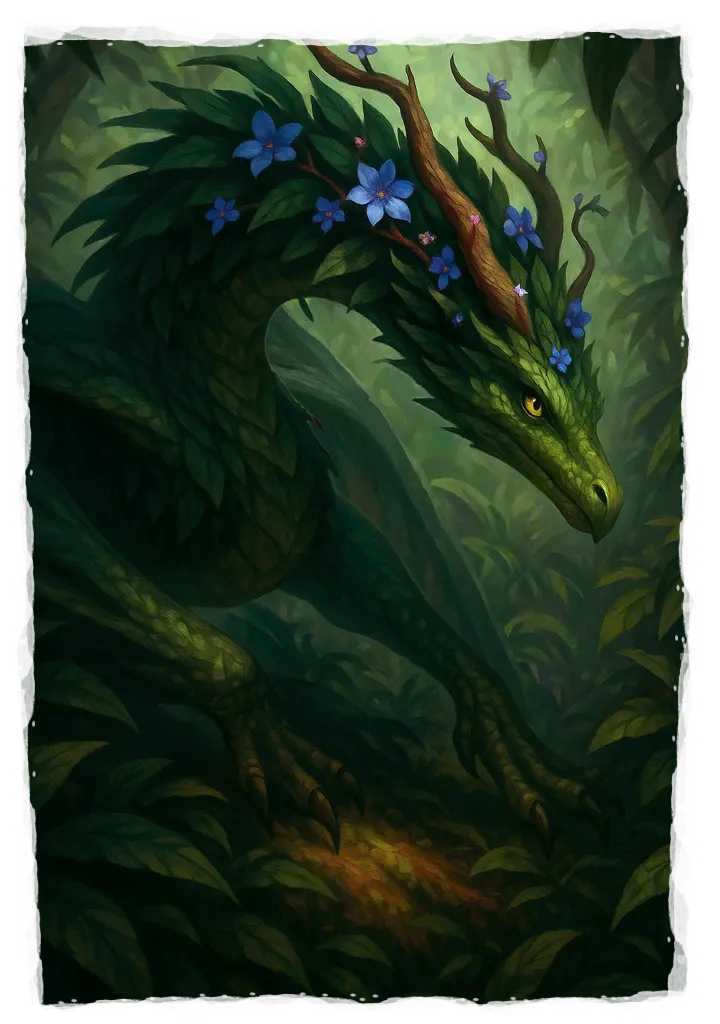 Habitats
Emerald dragons choose lairs deep within remote forests, far from mortal settlements. These lairs often take the form of hidden groves, valleys, or hollows beneath colossal trees. Some carve chambers beneath root networks or shape caverns into vaulted gardens filled with glowing flora. Others transform natural clearings into paradises of cultivated plants and enchanted pools, where wildlife thrives under their careful balance.
Their lairs are unmistakable to the keen-eyed traveler. Vines grow thick, flowers bloom out of season, and rare plants appear that exist nowhere else. It is said an emerald dragon can spend centuries cultivating a single grove, shaping it into what they see as a living masterpiece. Some ancients dedicate their entire lives to nurturing one towering tree, which becomes both their home and their legacy.
Dietary Needs & Habits
Emerald dragons are omnivores with a strong preference for balance in their diet. They hunt deer, boar, and other forest animals, but with restraint—never enough to upset local populations. Just as often, they eat fruits, roots, and herbs, many of which they cultivate themselves. Their gardens are not only treasures but also carefully tended food stores, filled with edible flora unknown outside their groves. They are also curious about mortal cuisine. In humanoid guise, some emeralds enjoy baked breads, spiced stews, or herbal teas, collecting recipes as if they were treasures. These tastes rarely override their natural diet, but they sometimes demand such dishes as tribute from nearby mortals, alongside seeds, rare plants, or medicinal herbs.Environmental Impact
The presence of an emerald dragon reshapes entire ecosystems. Their magic encourages plants to grow taller, rivers to run purer, and animals to thrive. Forests under their guardianship may expand rapidly, creating havens of life that outsiders describe as “enchanted.” Endangered plants and creatures can survive within these domains long after they vanish elsewhere, turning the dragon’s grove into a living sanctuary. This power can also be destructive when turned to wrath. Should a grove be defiled, an emerald dragon may unleash its magic in reverse—causing forests to wither, vines to choke invaders, and beasts to turn violent. The health of the land is directly tied to their mood, and their fury can scar woodlands for centuries.Territoriality
Emerald dragons are patient but fiercely protective of their chosen domains. They allow mortals to pass through so long as they show respect for the land, but those who cut trees carelessly, pollute rivers, or poach animals quickly earn their wrath. Intruders may first be warned by illusions or whispers in the trees, but if warnings are ignored, the dragon defends its grove with unyielding ferocity. Their greatest rivals are green dragons, who corrupt the same forests emeralds seek to protect. The battles between them are legendary—living storms of poison and growth clashing in struggles that reshape the wilderness. Though emeralds prefer peace, they will never yield to a green, seeing their very existence as a violation of the wild order.Social Behaviour & Culture
Emerald dragons are the caretakers of the prismatic flight. They see themselves not as rulers but as guardians of growth, patience, and balance. Their personalities reflect the forests they inhabit—slow to change, deeply rooted, yet capable of sudden and overwhelming force when threatened. To mortals, they often seem like distant spirits of the wild, offering guidance from the shadows rather than direct intervention.Psychology & Temperament
Emerald dragons are calm and empathetic, often more approachable than other dragon species. They value patience, nurturing, and the steady rhythms of growth, though their gentleness should never be mistaken for weakness. When pushed, they respond with sharp decisiveness, defending their groves and dependents with unwavering resolve. They are curious about the “short-lived” races and often study them in disguise, sometimes living as gardeners, herbalists, or kindly wanderers. Where a Sapphire Dragon might test mortals with riddles, an emerald prefers to guide them—gently shaping their growth much as they would a seedling in their gardens.Social Structure & Rivalries
Emerald dragons are solitary, but their solitude is less isolation than stewardship. They do not compete for dominance with their kin, preferring mutual respect and distance. Still, rivalries exist, especially with green dragons who seek to corrupt and dominate the same forests emeralds nurture. These conflicts are among the most destructive in dragonkind, leaving scars upon the land that last centuries. On rare occasions, emeralds form bonds with druids, fey, or other beings tied to nature. These alliances are subtle but enduring, built on shared respect for the wild.Mating & Courtship
Courtship among emerald dragons is less a spectacle than a process of quiet devotion. Suitors prove themselves with cultivation—raising gardens, protecting animals, or restoring blighted land to health. A pair may spend decades tending the same grove together before deciding to mate, ensuring compatibility in both temperament and purpose. These bonds are usually lifelong, producing only one or two clutches across centuries. For emeralds, a mate is a partner in stewardship, chosen as much for their patience and care as for their strength.Parental Care & Rearing
Emerald dragons are deeply devoted parents, among the most protective of their kind. Both parents often remain with their young well into adolescence, teaching wyrmlings the principles of balance, patience, and respect for the living world. Lessons are as much about nurturing as survival—raising plants, tending animals, and sensing the rhythms of the seasons. They encourage wyrmlings to form bonds with companion animals or mortals, fostering empathy and responsibility from an early age. To emeralds, raising offspring is not merely survival—it is the passing down of stewardship.Hoarding Tendencies
An emerald dragon’s hoard is unlike any other. They treasure living things—rare plants, flowering trees, and unique herbs cultivated in their groves. Some of these exist nowhere else in the world, thriving only under the dragon’s care. Their gardens may contain ingredients capable of brewing the most powerful potions, giving their hoards both beauty and practical worth. Older emeralds often flaunt their mastery of cultivation by weaving plants into their scales, creating living adornments that both protect and display their treasures. To them, their hoard is not a pile of wealth but a living masterpiece.Relations with Humanoids
Emerald dragons often interact with mortals more directly than other prismatic dragons, though usually in disguise. They take roles as healers, gardeners, or hermits, guiding individuals who interest them. Many tales speak of lost children or wounded animals rescued and raised by emerald dragons in Human guise. They do not demand tribute as sapphires do, but may quietly encourage offerings of seeds, rare herbs, or written lore. Mortals who respect the land may find themselves under the dragon’s protection; those who despoil it quickly face their wrath.Cultural & Mythic Role
In mortal folklore, emerald dragons are guardians of the lost and spirits of the green. Forest villagers tell stories of kindly strangers who vanished into the trees, later revealed to be emeralds in disguise. Druids revere them as wardens of the balance, and their groves are sometimes treated as sacred places. Legends even claim that some of the world’s greatest trees—the canopy Giants that pierce the sky—were nurtured by emerald ancients. To many cultures, they symbolize patience, renewal, and the quiet strength of nature.
Genetic Ancestor(s)
Scientific Name
Draconus Vitae
Lifespan
800-1000 years
Geographic Distribution

Comments