

Blazennian Empire
The Blazennian Empire is the strongest power in Telgren, but is hampered by a devastating recent civil war. The Empire consists of numerous semi-autonomous states of wildly varying sizes. Slowly growing since its establishment, the Blazennian Empire has risen to greatness in almost every category, and is a true juggernaunt. However, mired in political strife despite their massive latent power (or perhaps because of it), the Empire has struggled to truly leverage this immense strength
Structure
The Blazennian Empire is composed of numerous semi-independent countries, each with a corresponding title. All constituents are nominally subjects of the emperor, and many have their own subjects. Only countries that are direct vassals of the Empire are considered in this list. Each title has its corresponding name in the Blazennian language, with the name in English following in parenthesis. If a particular state uses a local but equivalent title, this will be in parenthesis after its name.
Kingdom Rank (4)
Royauren (Kingdoms):
- Mäzgyrazrfold (Kyálsága)
Grozduchets (Grand Duchies):
- Bahran
- Sochvalar
Hörtemples (High Temples):
- Cayunth
Duchy Rank (30)
Landgraviates (Land-Counts*):
- Fluencia
- Linoren
- Sofmargand
- Wurdalia
Fremgraviates (Friend-Counts*):
- Alianem (Ami Propriet)
- Impiruava (Varägna)
- Liradsromn (Faituo)
Margraviates (March-Counts*):
- Aldmarck
- Dvönmark
- Fenmark
- Feumarck
- Nordmark
Impirgraviates (Imperial-Counts*):
- Karrunhall
- Paslantye
- Hohenlönd
Prinztemples (Princely Temples):
- Margratium
- Neuthrower
Duchets (Duchies):
- Alenzibar
- Krinschtal-Souwenstein
- Quastrain
- Rhinfeldt
- Rothen
- Staussau
- Sulduhn
- Talquon
- Turselessen
Blazeologer Orden (Blazeological Orders):
- Audorden
- Orakorden
- Orden Frewauler
Grozfreizones (Greater Free Zones):
- Eldritch Isle
County Rank (23)
Impirtemples (Imperial Temples):
- Caminburg
- Nurtemple
- Pharum
- Usturn
Magisteriums:
- Onondatia
- Oplacademi
- Rheium
Komtes (Counties):
- Caysil
- Danzurg
- Eussum-Durein
- Eussum-Ordun
- Foidoneur (Comte)
- Hauvil (Comte)
- Heinwrain
- Kerunda
- Krischofer
- Mezdona
- Mogliriem (Comte)
- Nodoneur (Comte)
- Ornstund
- Runkarth
- Salenlönd
- Waldor
- Yarevier
Barony Rank (21)
Baronies:
- Alune-Warschein
- Alune-Dras
- Arcuron
- Barden
- Cycladelest
- Diffendorn
- Dnujyow
- Dungarth
- Eileinschwerth
- Feuseliche
- Filiupol
- Hesendorf
- Judunor
- Kurnia
- Lediag
- Rötheim
- Sarrein
- Soessen
- Thardon
- Wälschone
- Zonduzein
Lordship Rank (45)
Seignöriate (Lordships):
- Aulwein
- Bayesar
- Dexun
- Grunwell
- Heidelönd
- Hilenalönd
- Ingailönd
- Ixwin
- Khuryun (Seigneuria)
- Lauleturn
- Ruhenlönd
- Siedar
- Suenlönd
- Umunrand
- Wässelönd
- Wodurlönd
Burgherzones (Merchant Zones):
- Desstein
- Dresdofor
- Embonn
- Heivapf
- Hyparpol
- Hoschflusz
- Kyzalim
- Nylarsis
- Rhutmmer
- Schluhant
- Turiun
- Valienbaie (Marchant Zone)
- Yonna
Freizones (Free Zones):
- Alben
- Ilrunship
- Skoldan
- Vonor
- Wellebrecht
Kommanduris (Commanderies):
- Farholt
- Feirward
- Muthwick
Impirshrines (Imperial Shrines):
- Allenon
- Danuz
- Haxburry
- Mazen
- Murein
- Rilun
- Stornbud
- Tym
*Important etymology note: The Blazennian word for count, Komte, comes from the Fremedhian one (Comte). Any titles ending in graviate technically do not translate to count as graviate and komte are distinct, but rather (roughly) to "owner" which refers to their lands being de jure irrevocable by the Emperor, unlike other titles which are merely de facto irrevocable (excluding events such as the Blazennian civil war)
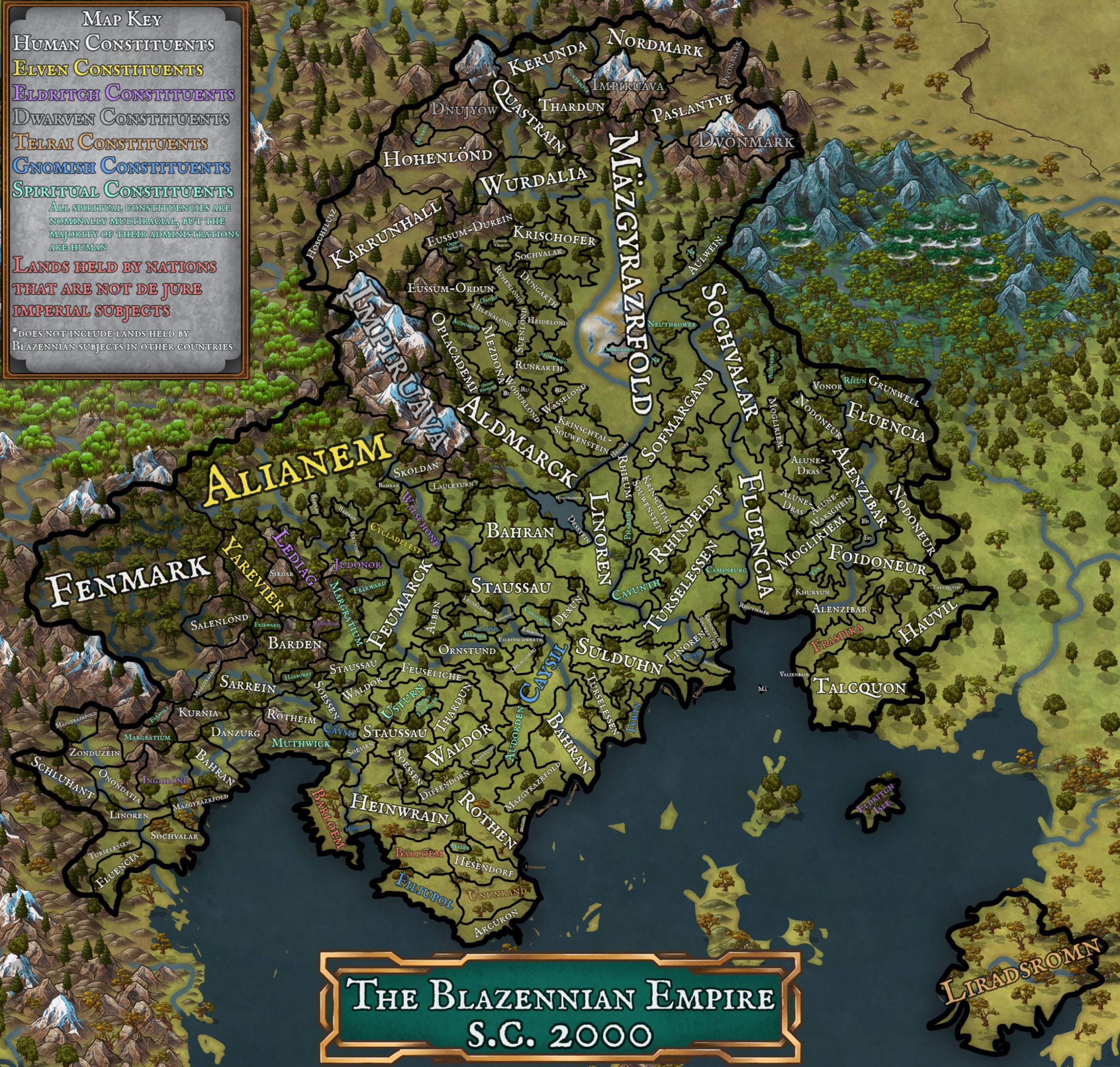
Imperial Rank Gazetteer
Royauren (Kyálsága, Kingdom): These ranks are illegitimate titles within the Empire, with the only known kingdoms to be formed in the Empire done by rebels as well as the usurper Csömbor I's Kyálsága. However, the imperial provinces can be considered something similar to kingdoms in their own right, and any state which was able to come into control of the entirety of one of these provinces might legitimately be granted the rank of king.
Grozduchet (Grand Duchy): The rank of Grozduchet is another illegal title, with the term itself having been invented in order for it to bestow on the Grand Duchy of Barloem who was not supposed to be a part of the Empire. Thus, the elevation of Csömbor's closest allies to Grand Dukes makes a mockery of the Imperial rule of law and indeed the treaty of First Treaty of Lorrelais itself.
Hörtemple (High Temple): The role of High Temple is that of the foremost authority in religious matters. The history of the title dates back to Emperor Alezar I, who was convinced to elevate Cayunth as the center for the Blazennian religion in order to balance power between mage and priest. As a unique title, there is absoluetely no way to claim this title without also holding Cayunth. Before Csömbor's mockeries, the title of Hörtemple was the highest temporal title (sans Emperor) in the lands, ruled by the High Priest, the highest spiritual title, though limited in its reach over Recognized Imperial minorities.
Landgraviate (Land-Count): The title of Landgraviate was originally bestowed upon some of the oldest states in the Empire and those who supported it during its formation, though the ranks were expanded in the wake of the Blazennian Civil War. Landgraviates are not divisible by title revocation from the Emperor, though their lands can be split be inheritance or war. However, the title of Landgraviate is bestowed upon the center of that constituent's power, and cannot be revoked by war or writ, nor passed to more than one constituent. Besides this, Landgraves are recognized as equal to duchies.
Fremgraviate (Friend-Count, Ami Propriet, Varägna, Faituo): A Fremgraviate is similar to a landgraviate except that it is created as a special title to a tract of land reserved to be ruled by a specific Recognized Minority. These Fremgraviates, like Landgraviates, cannot be modified, but they also cannot legally be ruled by anyone not from that minority. Fremgraviates, like Landgraviates, are recognized as equal to duchies.
Margraviate (March Count): Margraviates are tracts of land specifically granted at the behest of the Emperor for the mustering of armies, in lieu of formal taxes. Unlike other -graviates, Margraviates can be dissolved by writ of the Emperor, though this has only happened a few times in history. They however cannot be split into multiple states as this would then mean a drop in the amount of levies they are able to provide. This has resulted in the Margraviates becoming some of the most stable and developed constituencies, and their rank equal to duke makes them highly coveted as well.
Impirgraviate (Imperial Count): Impirgraviates are rare organizations of land which are designated as autonomous parts of the Empire while also being of lesser status. Unlike most other constituencies within the Empire, Impirgraviates do not have dynastic rule, and are governed by a noble for the term of his life, upon which they are bequeathed back to the Empire. The lands are then ruled in trust by the Emperor until such a time that the Imperial Council selects a new count to rule the region. Because they are not tied to any specific constituent but rather the Empire as a whole, they often suffer from inconsistent authority, making them good places to escape justice. Although there have been Impirgraviate established in other regions in the past, all current ones have been established on formerly Erleting lands as a compromise of some sort. (Note for their lore later: Paslantye- after the centaur wars, was for minor nobility, especially those whose lands were given to Maz, nobody could agree on who would rule it; Karrunhall- after the Dennonian War, a 'self-ruled' Erleting experiment but not made hereditary since how can we really trust them racism; Hohenlönd, post civil war, made from nobles who received land in the Alcedina region over the usurpers, who undid these grants when they won and sent the minor nobles to this region, previously annexed by Emberkeep)
Prinztemple (Princely Temple): A Princely Temple is a territory with both temporal and spiritual authority, granting wide powers and equal status to a duke. This gives them legal authority to lead armies, control lands, and other privileges of rank.
Duchet (Duchy): A duchy is tract of land extending the high nobility title of duke upon the owner. Because duchies have less protections than the various -graviates, they are always being created and destroyed, as regional lords sezie lands and become recongized as dukes. In the same manner, old duchies have tended to split into many lines as their territory is subdivided amongst children, whereupon they may lose their title of duke in poverty.
Blazeologer Orden (Blazeological Order): Unlike mot other titles in this list, that of Blazeologer Orden is not a landed title, but rather denotes a swathe of land under the direct control of one of the Blazelogical Orders. Due to ranking equal to duke, this title often takes precedence over others the Order Head may possess.
Grozfreizone (Greater Free Zone): The Greater Free Zone of The Eldritch Isle is a unique title for a unique constituent. This title grants the ruler of that island high status, as well as autonomy. It is the highest non-clerical and non-hereditary title attached to land within the Empire.
Impirtemple (Imperial Temple): An Imperial Temple is technically a title locked to a building, as one of the primary centers of Blazeology. However, the Imperial Temples often hold tithes from a number of different territories, often left to them by pious peoples who died heriless, and they have been be given imperial permission to govern lands on behalf of the Emperor. Essentially, they are lower level temples granted imperial immediacy in order to manage lands more effectively, but with lesser authority and prestige than a Prinztemple, since the Prinztemples are historically important titles and increasing their number would imbalance the religious hierarchy of the Empire.
Magisterium: A magisterium is a special title, defined as the land held by a magical order in common, as opposed to the lands personally held by the Grand Magister, or leader of a magisterium. These lands are therefore not tied to the dynastic conflicts throughout the land. However, neither are magisteriums legally allowed to seize land themselves, only purchase it, and therefore the wealth of magisteriums are usually in their members and small but profitable property.
Komte (County, Comte): Komtes are the domains of a count, who ranks just below a duke. Counties are the particularly common due to the dissolution of past duchies into various dynastic counts, wherupon the senior title of duke is often lost, leaving small counties of limited power.
Barony: A barony is a lowlevel title within the Empire, and baronies are created and destroyed yearly as new ones gain imperial immediatcy and onld ones are easily conquered by more powerful states or lose their immediacy.
Seignöriate (Lordship, Seigneuria): A Seignöriate is the lowest landed title one can have in the Blazennian Empire, and there are many of unlanded Seignörs within the Empire. Often small, economically backwater regions, those Seignöriates with imperial immediacy have little to no protection from more powerful neighbors. Many of the hereditary once-tribal lands of Blazennia bear this title because their leaders resisted imperial expansion.
Burgherzone (Merchant Zone, Marchant Zone): A burgherzone is essentially a city-state granted the authority to maintain itself and its own tax and trade in place of the Emperor. Often granted to powerful urban centers, burgherzones are trusted deputies of the emperor and one of the few titles to be able to ruled by a lowborn man or woman.
Freizone (Free Zone): A Freizone is a community of free peasants who are not subject to the rule of a lord. They are essentially the rural equivalent of Burgherzones, but have much less power due to their economic weakness. Most Freizones are located in poor regions where the Emperor has historically found uneconomical to personally control the defense or development of, and which do not have any local lords, and thus given autonomy to locals to do it for him. Many of these stick around after the Emperor is changed, having been removed from the domain of the old Emperor's constituent.
Kommanduri (Commandery): A commandery is an independently landed chapter of one of the Blazennian Orders, typically placed in order to guard critical places. They can also be created specifically to solve internal disputes in the various orders about which part of the order controls a certain tract of land. These territories are legally subject to their wider order in most matters, but crucially possess imperial immediacy and pay taxes which only may be used for their community or granted to the emperor.
Impirshrine (Imperial Shrine): An imperial shrine is a shrine granted temporary or permanent control over certain lands, as opposed to regular shrines which can only own land under the church hierarchy. Like commanderies, Impirshrines are usually created when the emperor wants lands granted to the church in a specific region and only used for that region's betterment. It may also be granted to powerful and influential shrines suffering from attacks by landed neighbors, or who have entered a dispute with them, so they can manage their own defense and pay taxes to the Emperor from the lay peoples of their land more effectively.
History
The Blazennian Empire was founded in 1240 SC, around a decade after the end of the Clesentian Wars. The Empire was primarily formed thanks to the efforts of Varimar "Fireblood", whose charisma and honor were well known throughout the land. Varimar, because of his status as a person of mixed Blazennian and Fremedhian lines, was able to command the respect of both the Blazennians and Fremedhians in the confederation. Ruling over a relatively strong member of the confederation in Rhionion, he also had the military might to back up his alliance. Of course, negotiating the formation of an Empire from a confederation is no easy task, but by 1240 it was formally established after several internal factions came to an accord.
Blazennia would undergo a flurry of expansions shortly after it was founded. After a series of negotiation with the elves of Alianem in order to resolve the convoluted mess of the borders in Feulönd, the first Fremgraviate was formed, beginning a lasting legacy of compromise. Revisiting these negotiation tactics when dealing with non-Blazennian groups allowed the Empire to incorporate other ethnic minorities. These efforts culminated in 1252 SC and the Imperial Treaty. This treaty promised that Telrai in the Empire would be granted lands for them to rule, and the Blazennian Empire would cede all islands in the gulf to a nation of Telrai who are not beholden to them. In return, Telrai will not obstruct The Blazennian Empire and will defend the coasts. Varimar would use this treaty as an excuse to intervene in the conflict between the reborn Kingdom of Fraspika and Telrai settlers, starting the Blazennian-Fraspikan War. The war would last for 7 years, but in the end Fraspika was defeated by the Blazennian Empire. Fraspikan troops would have quickly been overwhelmed, but the Blazennian forces had to deal with the complicated political situation in Fraspika, which had a number of dukes clamoring for independence. The war was also prolonged by the Fraspikan ruler's refusal to capitulate. Once the king was deposed and a new one elected, Liradsromn, carved from Fraspika, was established as the home for Telrai in the Empire. This new Duchy was to be ruled by Telrai in perpetuity, and though they have long been granted rights to settle elsewhere they are not guaranteed any power there. With this, Varimar secured Telrai loyalty and established them as a buffer state between the Blazefollk and their main rival while weakening this rival at the same time.
Besides the success in securing an alliance with the Telrai, the end of the war brought many new duchies into the Blazennian Empire thanks to the Treaty of Lorrelais. This treaty legalized the secession of the dukes which had defected from Fraspika during the war on the condition they join the Blazennian Empire. However, it left the status of the Duchy of Barloem, which had never acknowledged Fraspika's restoration but didn't formally defect, in question. Because the other Dukes of the Blazennian Empire wanted to keep their own status by not expanding the number of dukes, but formally since Barloem didn't border the Empire, Varimar was heavily lobbied to allow Barloem to remain independent, which its populace also wanted. In the end, the two would manage to agree on a treaty in 1261 granting Barloem its request, which led to the two states becoming close partners. Fraspika was infuriated by this, as their two strongest neighbors working together was a great threat, but there was nothing they could do because of their recent defeat. In 1263, the Eldritch isle, another small remnant of Fraspika, would join the Blazennian Empire under similar conditions as that of the Treaty of Lorrelais.
During the three decades which followed this, mostly during the reign of Sendion I, almost all of the remaining Blazennian tribes were also incorporated into the Empire, whether it be through peace or war. The modern regions of Stamarlönd, Luisalönd, and Enctörlönd were later carved from these tribes. Combined with the Aldimpirheit, whose tribes joined willingly, the former two would be molded into Nordprovinz, while the small Impirwood province was expanded by nearly 50% thanks to the addition of what would later become Enctörlönd. This led to the reorganization of several other provinces until their lands were more balanced, giving the various constituents a more reasonable allocation of de jure lands. The Dwarven state of Impiruava would join the empire in 1285, becoming the final Fremgraviate. By 1290, the Empire's border stretched from the Great Gulf to northern passes. Bounded by the several rivers, and the Urzomarth and Dennonian highlands and mountain ranges, the northern lands had poor agricultural potential, were sparsely populated, and were subject to Trollish raids, which was a major reason their tribes swore fealty. Operations to root out the trolls were undertaken, but would not come to fruition for some time.
In 1294, Emperor Albubite the Great, elected in 1291, launched the conquest of what would become the Fenmark. Much like operations in the Nordprovinz, Albubite utilized a mixture of warfare and diplomacy to force the states to submit. Most of these were organized as subjects of the new Fenmarch, which Albubite equipped with a marvelous magical fortress, still standing today. The edge of this marsh would serve as the border for his conquests, and of the new march. However, eventually, Salenlönd, composed of the more fertile regions in the northeast of the Fenmarch was broken off a separate state. The conquest of the Fenmarch would be the last major expansion of Blazennia for several centuries, as the states increasingly turned to internal schemes and machinations.
The years from 1336 to 1502 is generally known as the "first" or "greater" Fragmentation Period. Tembodar I Ollomar, son of Albubite the Great, ruled for eight years before he died young and heirless in 1344, which caused a crisis. This is because the council reforms of Albubite, while effective, had devolved after his death into electoral cliques. Although the swift election of Bäude I Schwerinzern briefly united the factions, in the end the Schwerinzern dynasty's universal support degenerated into its own clique, which lost the support of the others rather quickly. During his reign, the cliques solidified into the Rhinfeldt clique, led by the Schwerinzern dynasty and their allies against the Leonian-led clique centered around Linoren. The Contus family typically balanced between the two as a distant third option. These cliques, reminiscent of the confederation's politics in the pre-imperial era, had simmered under the surface and Bäude's election had stirred the pot once more. As the two cliques battled for dominance, their dynasties variously elected, typically using their power to weaken the other, the empire began to fall into smaller and smaller pieces as succession became increasingly complicated. Tensions increased from events such as the assassination of Albubite III, and even the election of Varimar II of house Contus failed to solve the situation. Things came to a head when Varimar the Fourth of house Schwerinzern rebelled and killed the Leonian emperor, seizing the throne for himself. He was the worst emperor of this period, and was eventually overthrown in a revolt against his tyranny. Alezar III of house Agridar, from the Aldmarck, was selected as the new emperor after his leadership in the rebellion was the deciding factor, and his ascention marked the end of the diarchy. Alezar III and his son Albubite IV, ruling for over 50 years combined, led a renaissance of sorts which saw Blazennia stabilized once more.
Despite the strife of the Greater Fragmentation Period, Blazennia did see a major increase in population between 1336 and 1502, primarily driven by the relative peace between the smaller states not involved in the politics of the diarchy or the council. Conflct being settled in the realm of intrigue, murder, and diplomacy alongside settling of the various tribes which still remained migratory drove a large increase in birth rate and the Blazennian population, especially in the Emberäire and Gräiun Kugest provinces, began to rise. Though not exponential due to deaths from disease and unsanitary conditions still being high, the steady growth provided Blazennia with many more farmers and thus more of a surplus of grain. This, in turn, allowed economic diversification, which accelerated during the golden years. The trollish issue in the northern lands was finally dealt with, and contact with the Rodłowi in the north was finally established, allowing for a flow of migrants, trade, and, later, religion.
Although the golden years under Alezar and Albubite would prove critical to the survival of the empire, the lack of actual reforms meant that after the two strong emperors died, things began to crumble once more. Though the Agrider dynasty kept the throne for a few years with Varimar V Agridar, he was a sickly monarch with a short reign. Even before his death the machinations of the nobility began again. Aldar I Welsen, of Bahran, was elected instead of Varimar's son, and proved to be a decent ruler, but was unable to stop the crumbling of the empire. Though the Agridar and Welsen dynasties both had other chances at the throne, by the 1620s they were passed over for the Hohrichar dynasty, who were building powerful a base for themselves out of the Duchy of Staussau. Alas, the assassination of Varimar VII, who had been the second successive Hohrichar, proved the deciding factor in ending their rise. Disputes over succession continued for the next few emperors as well, and the empire seemed doomed to crumble forever.
The throne would eventually pass to Bäude II, who also made concessions to have his daughter Selussa take the throne after him. Selussa, the only woman to rule the empire, proved a divisive figure. She clashed with the clergy who considered her too improper, and annuled her marriage on grounds of infertility shortly after her father's death. This angered the nobility as they felt she had reneged on her father's promises (he'd promised to marry her to a noble as part of the deal to make her Empress). Remarrying to the Grand Duke of Barloem, she utilized her new husband's military to pacify restless dukes, fragmenting their lands into counties and baronies. Under Selussa, most of the nobility's powers were at their lowest, and it was a time remembered for its large number of knights and lesser nobility, with chivalric values reaching an all time high. This decentralized model, although good for those who wished to live in peace, was harming the economic continuity and modern statebuilding and required reform. Selussa, hamstrung by concessions made by both her and her father, did not have the political clout for these reforms. Instead she focused on the cultural sphere, which blossomed. Many of the most famous works of literature and art to date stem from this period.
After 1700 the emperor transitioned into the Strongman period. Named after the succession of Emperors who ruled through the projection of military might, it was dominated by those who strongarmed the lesser electorates, those who had lost most of their lands during the fragmentation of the Empire, but still held council seats. In order to keep larger states from consuming them as vassals, they sold their votes or bargained to keep immediacy. Many of the smaller states without this privilege would be subsumed, leading to strife and hard times for many lesser houses, who saw their possessions gobbled up. Many of the more powerful states financed their dominance through investments in the colonization of Ifyrial or sale of materials to the colonies, especially during the reigns of the later emperors in this period. The first of the strongman emperors was Albubite VI Schwerinzern, who reclaimed the throne for his family for the first time in 200 years. A cruel man, Schwerinzern began the process of centralizing the empire by reforming succession laws and instituting harsh penalties for corruption. His policies, while unpopular, halted the disintegration of the empire, but also raised taxes and tributes, leading to great unrest. After his death, nobody wanted another Schwerinzern, the dynasty that had tained the throne not once but twice, so emperorship instead went to Varimar VIII Gehrimar, of Krischofer, a rising state during this period. Gehrimar spend great amounts of time and money to keep the empire together through force. This proved successful from his election in 1748 through 1775.
In 1775 S.C., the geopolitical situation would change, and the rising Second Centaur Khanate crushed the Enctör tribes to the north of Blazennia. Though separated by mountains from Blazennia, many Enctör fled into the Empire through mountain passes. This created a refugee problem that Gehrimar tried to solve, though he proved unable to manage it in the end. His efforts were in vain, and almost all the work he had enforced was undone as factionalism erupted over the Enctör issue. He died a broken man of a broken constituent, its coffers empty from all his meddling. Harsh policies had failed to make any lasting changes, much as the Golden Years did. Luckily, the next emperor was Eberhald I Lumiäire. When Emperor Eberhald I ascended the throne in 1784, he decided to create a small duchy for the Enctör to rule over within the empire in the sparsely populated north of the country, which was where most of them had settled. Eberhald would also lead the nation against the Second Centaur Khanate and crush them after a seven-year conflict. By destroying them before they could gain too much power, he ensured the existential threat of the centaurs would not threaten Blazennia as they had in the 1200s. During this war, Eberhald also carved out lands from the Erleting tribes, bringing new regions into the fold. He formed the Nordmarck to protect these new lands, and granted it to worthy knights who had lost their ancestral lands. Not just a great tactician and excellent warrior, Eberhald also helped to reform the administration, using war as a distraction to force through laws, threatening to invade constituents if necessary. Eberhald's reforms made the emperor position respected again, at least for a time. His reforms, though effective, rejuvinated the Strongman period after the failure of Varimar VIII, proving that the authority of the Emperor could indeed force change on reluctant constituents. Imperial power was reinforced at the expense of the powerful constituents who constantly threatened imperial authority. Eberhald would later (in 1810) get the nation involved in the Barloemer succession war, but after six years of minor progress he would die and be replaced by Lionel I Tuvoren. Tuvoren immediately negotiated peace with Fraspika, expanding the Empire's borders slightly, but leaving Barloem to be taken by the Fraspikans. This ensured that consituents such as Talquon, that held lands in Fraspika and allied Barloem, would lose their estates in Fraspika, causing some resentment in the west. When Varimar IX Oallbrith and a coalition against tyranny captured the throne in a bloodless revolution from Alezar VI Hohrichar, who had killed his predecessor Tembodar II in battle, it was proven that even in strife the strong could keep factionalism from spreading. For a time. Tembodar II was a powerful mage, but not a very effective tactician, and got the Blazennian Empire involved in the draining Fraspikan League War, thus losing control of border areas previously conquered by Lionel I and resulting in unrest. On his way back to Vindaun (his base of power) after signing the treaty of cession in 1885, he was ambushed by Alezar, who killed him via magic during a pitched battle. Alezar then seized the crown and proceeded to rule the Empire through force for four years before he was finally overthrown.
The empire's most prominent dynasties had centralized powerful states once more, and now were locked in succession crisis once more. When Varimar IX Oallbrith died in 1913, the Empire hadn't seen an election in 62 years, and the nobility refused to elect his son. The powerful constituents, while not as disruptive in the time of the Eberhaldian reforms, had crawled their way back to near-parity with that period in the years since his reign. And so, instead of electing an emperor who could enforce his own power, the most powerful states agreed to keep the gridlock going and to consolidate further. Although eventually the bargain was ended, it came too late. Blazennia was a failing state, with various small constituents in uproar or even active revolt, and nobody could agree on how to fix it, which led to a total of 8 emperors in just 25 years. First in line was Silas I Leonian-Augellion, from Linoren. Dead after just a year, the imperial title jumped dynasty after dynasty after each squandered their opportunity. Several were murdered during this time, and the electors became desperate enough to elect Eboolandin I Crytaloon, a gnome. He, much like the others, didn't last long and couldn't fix the issues. In time, desperation forced the electors to turn to Varfehrn II Oallbrith, “The Old”, son of Varimar IX and spurned for the imperial throne back in 1913. By the time of his elevation, he was 80 years old, and died within months of election, after finally achieving his lifelone goal. Perhaps learning from past mistakes, the noblity turned to his son, who ruled decently for a few years before his eccentrecies turned to madness. Deposed for his own safety, the nobility turned to the Lumiäire. If the dynasty, which was seen as near-holy, could save the state once, they could surely do so again. Following the crowning of Alezar VIII, it seemed the Empire's troubles were over. Alezar would unite the nation in the Dennonian Wars, conquering most of Dennonia by 1974 alongside the Kingdom of Spólństawo, and who projected the power of the church, leading to foreign conversions rising for the first time in many years. However, the issues that had seemingly been dealt with by Alezar continued to simmer under the surface, and the nation would break out into civil war in 1988.
The civil war pit the ruling emperor Alezar VIII against the usurper Csömbor of Mäzgyrazrfold, who rallied a group of powerful constituents angry about what they saw as the unfair distribution of land gained in Dennonia. The empire was split between which one to support, leading to a massive war with numerous constituencies being invaded and annexed by their neighbors. After 6 years of bloody warfare, Csömbor's army sat just outside the Imperial seat of Emberkeep. The siege dragged on for some time, before Alezar's forces attacked in a sortie. At that moment, he Csömbor used his magic to obliterate Alezar and this sortie by opening a chasm and dropping them inside before closing it. This move essentially ended the war by allowing Csömbor to take control of Emberkeep and from there destroy the rest of Emberkeep's forces. Only a few knights and loyalists, along with the king's son, prince Valien, would escape, having been on a scouting mission. Valien would flee to the Fenmarch with these troops and was able to make use of the antimagic towers at Lastkeep in order to stave off Csömbor's attempt to seize this last bastion of resistance. For five years, Valien's army has held out, making occasional raids and cautiously recruiting spies and soldiers. However, to all but this loyalist group, the Civil War ended five years and Csömbor is emperor.
Blazennian Emperors
- Name, “nickname if applicable” (country) reign (lifespan if relevant)
- All dates are in SC
- Emperors in purple ruled during the Early Period (1240-1336)
- Emperors in yellow ruled during the Golden Years (1502-1559)
- Emperors in orange ruled during the Greater or Lesser Fragmentation Periods (1336-1502, 1559-1703)
- Emperors in blue ruled during the Strongman Period (1703-1913)
- Emperors in red ruled during the Time of Troubles
1. Varimar I5 Ashtullion, “Fireblood” (Rhionian) 1240-1267
2. Sendion I Contus (Fluencia) 1267-1291
3. Albubite I2&5 Ollomar, “The Great” (Ornstund) 1291-1336
4. Tembodar I Ollomar (Ornstund) 1336-1344
5. Bäude I Schwerinzern (Rhinfeldt) 1344-1361
6. Albubite II Leonian (Linoren) 1361-1371
No Emperor selected for 2 years
7. Albubite III3 Leonian (Linoren) 1373-1376
8. Jägenmann I Schwerinzern (Rhinfeldt) 1376-1392
9. Varimar II2 Contus (Fluencia) 1392-1418
No Emperor selected for 13 years
10. Varimar III2 Leonian (Linoren) 1431-1447
11. Alezar I Leonian (Linoren) 1447-1469
No Emperor selected for 6 years
12. Alezar II3 Leonian (Linoren) 1475-1484
13. Varimar IV3 Schwerinzern (Rhinfeldt) 1484-1502
14. Alezar III5 Agridar “Slayer of Foes” (Aldmarck) 1502-1531
15. Albubite IV Agridar (Aldmarck) 1531-1559
16. Varimar V Agridar (Aldmarck) 1559-1562
17. Aldar I2 Welsen (Bahran) 1562-1588
18. Varfehrn I Agridar (Aldmarck) 1588-1593
No Emperor selected for 1 year
19. Varimar VI2 Welsen (Bahran) 1594-1628
20. Alezar IV Hohrichar (Staussau) 1628-1636
21. Varimar VII3 Hohrichar (Staussau) 1636-1636
No Emperor selected for 2 years
22. Jägenmann II Tuvoren (Sochvalar) 1638-1644
23. Bäude II Leonian (Linoren) 1644-1658
24. Selussa I1 Leonian (Linoren) 1658-1682
No Emperor selected for 3 years
25. Albubite V Alens (Alenzibar) 1685-1703
26. Albubite VI Schwerinzern (Rhinfeldt) 1703-1748
27. Varimar VIII Gehrimar (Krischofer) 1748-1784
28. Eberhald I5 Lumiäire, “Soldier-king” (Emberkeep) 1784-1816 (1750-1816)
29. Lionel I Tuvoren (Sochvalar) 1816-1844 (1772-1844)
30. Alezar V Alens (Alenzibar) 1844-1851
31. Tembodar II2&3 Kyrains (Vindaun) 1851-1885
32. Alezar VI2&4 Hohrichar (Staussau) 1885-1889
33. Varimar IX Oallbrith (Bahran) 1889-1913 (1851-1913)
No Emperor selected for 13 years
34. Bäude III Schoselburg (Turselessen) 1932-1939
35. Albubite VII3 Alens (Alenzibar) 1939-1940
36. Eboolandin I Crytaloon, “Gnome Emperor” (Caysil) 1940-1943
37. Alezar VII Agridar (Aldmarck) 1943-1948
38. Eberhald II3 Kyrains (Vindaun) 1948-1950
39. Varfehrn II Oallbrith, “The Old” (Bahran) 1950-1950 (1872-1950)
40. Jägenmann III4 Oallbrith, “The Mad” (Bahran) 1950-1956 (1898-1967)
41. Alezar VIII3 Lumiäire (Emberkeep) 1956-1994 (1929-1994)
42. Csömbor I2 Kunremád, “The Black Hand” (Mäzgyrazyrfold) 1994- (1930-)
- the only women to ever rule the Empire
- mage-emperor. Although many emperors have had some magical ability, those marked as such are powerful enough to have been trained in their own right, before of during emperorship
- death by assassination or in battle to rebellious constituents
- bloodless coup leading to removal of the emperor
- emperors recognized as the best to date
Imperial Dynasties by Years Ruled
- Leonian (99/100*)
- Schwerinzern (96)
- Agridar & Lumiäire (70)
- Welsen (60)
- Ollomar (53)
- Contus (50)
- Gehrimar & Kyrains (36)
- Tuvoren (34)
- Oallbrith (30)
- Ashtullion (27)
- Alens (26)
- Hohrichar (12)
- Schoselburg (7)
- Kunremád (6**)
- Crytaloon (3)
*depending on if the Leonian-Augellion cadet branch is counted
**active
Succession
In 1248, the first Emperor, Varimar I, would formalize its unqiue succession laws due to his lack of an heir and the federal approach of the Empire's structure. When Varimar the Great passed his original succession draft by the nobility of the realm, many of whom had been independent just a few years earlier, he knew he had to make sure the succession would be secure, but also that the nobility had great say; he did not want the nation he built to fall apart after his death. He knew he also could not give the nobility too much power on their own, as then they would be able to tear the nation to pieces, so they would have to somehow be balanced. This, he would try to weave with his characteristic love for the art of fighting. And so were born the Blazennian Succession Laws. The new succession system would supersede the old Fraspikan one which tended to split countries into awkward new states. Instead, after the death of each emperor, the nobility would convene and pronounce a successor to the previous emperor. There would be three candidates, one of whom had to be the heir to the previous monarch. All three had to be from different regions of the empire, and each had to be from a unique family. The great nobility would hold an election and the winner would become the Emperor in Waiting. Any noble family who cast their vote for a different candidate would then be allowed to dissent. If there were any such dissenters, a grand tournament would be held where any member of the nobility who dissented could compete against the Emperor in Waiting. The winner of the tournament would then be able to place whoever they chose on the throne. From this original vision, the laws have changed somewhat. The council has been shrunk somewhat, as assembling the whole nobility at one time was deemed both unsafe and unpractical. Only those holding the titles of one of the original non-republican, non-march members of the Empire are allowed into the succession council, with some exceptions. Marked with * are the members which, respectively, represented the Blazeological church, as well as Blazeological Paladins, who are certainly not monarchies. In time the council had come to be solidified as the following countries, though the old council was completely overwritten following Csömbor's recent ascension.
The Old Council
- Emberkeep
- Mäzgyrazrfold
- Bahran
- Sochvalar
- Cayunth*
- Liradsromn
- Impiruava
- Alianem
- Linoren
- Fluencia
- Sofmargand
- Wurdalia
- Audorden*
The New Council
- Mäzgyrazrfold
- Bahran
- Sochvalar
- Liradsromn
- Impiruava
- Alianem
- Linoren
- Fluencia
- Turselessen
The results of the council reorganization are quite clear. Csömbor removed the majority of members who fought alongside Alezar VIII, as well as those who were neutral but who clearly favored Alezar. In their place, he elevated those who fought alongside him, though he made sure that the racial minorities were represented. While most were neutral or fought for Alezar, Csömbor did not want a full scale racial uprising, which would surely occur should he strip the office holders of their dignity. He also removed Cayunth and Audorden from the council, officially because he wished to "protect the religious minorities". In reality, however, Csömbor simply does not want the church or the paladins interfering with his plans. While Csömbor may think the council is secure, he has not banked on his allies turning against him should it be profitable for their nations- after all, they helped him overthrow the righteous emperor, and what's one more sin in the pile.
The Empire now stands split between Prince Valien, seeking to return the Empire to its original form, Csömbor, who seeks centralization around himself, and those constituents who look to the chaos and see opportunity. Whatever happens, the succession is certainly murky at best, neither Valien or Csömbor having an heir, and many of the old nobility disgraced or dead. Succession reform may very well be necessary for the Blazennian Empire to march boldly forth once more.
Demography and Population
Total Population
- 36,000,000 Imperial
- 5,000,000 Mäzgyrazrfold
Racial/Ethnic Composition
- 21,230,000 Blazennian Humans (incl Eldritch)
- 5,000,000 Fremedhian Humans
- 2,620,000 Enctör Humans
- 2,550,000 Elves
- 1,640,000 Telrai
- 1,446,000 Erleting Humans
- 900,000 Dwarves
- 213,000 Gnomes
- 60,000 Goblins
- 40,000 Isilí Eldritch
- 25,000 Orcs
- 11,000 Halflings
- 4,000 Tritons
- 1,000 Centaurs
Regional Composition
- Gräiun Kugest: 8,530,000
- Feulönd: 7,050,000
- Emberäire: 5,570,000
- Aldzenterprovinz: 5,420,000
- Impirwood: 4,600,000
- Nordprovinz: 3,220,000
- Oaestlönd: 1,350,000
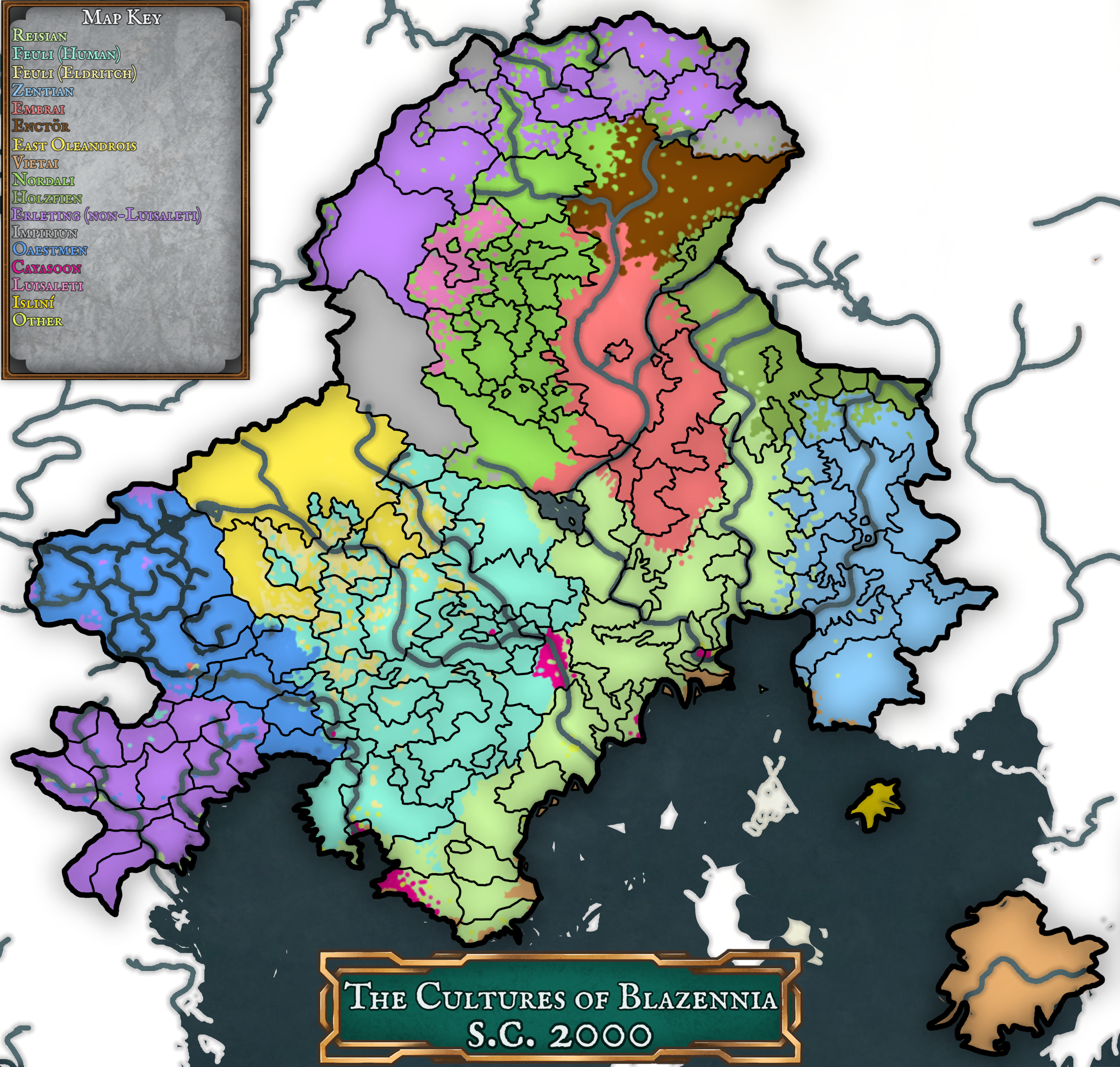
Territories
The Blazennian Empire is composed of the following provinces: Gräiun Kugest, Feulönd, Emberäire, Aldzenterprovinz, Impirwood, Nordprovinz, and Greatsfen. Each of these provinces is also broken up into several regions, whose only purpose in their current state is in regards to the Imperial Succession Laws. The provincial borders are also mostly arbitrary due to the autonomous nature of the majority of the Empire's constituents, many holding lands outside their basic region. However, unlike the regions, they are still used for organization purposes. Any constituent with imperial immediacy is considered to belong to all provinces they hold land in, with any one of these serving as their primary province. Any lands they hold in a province is subject to regional authority. For example, crimes committed in an Impirwood exclave of a constituent in Emberäire would fall under the purview of justices there, rather than in the Emberäire region where they hold the most sway. Of course, if they had local assembly privileges, this wouldn't apply.
Any lands not formally added to one of these provinces or whose status in unclear is considered de facto part of the primary province of the constituent controlling it. This situation lasts until such lands are formally assigned a province or a new province is created. This situation was used during the Dennonian wars, as newly controlled land in the regions of Neu Oaest and Wengardennonia was briefly under the direct control of the Emperor, whose capital in Emberäire meant that much of the now-Nordprovinz was considered part of Emberäire for administrative purposes. This was similarly evident in the Oaestlönd during its conquest, until the region was fully conquered and became its own province.
The Provinces
- Gräiun Kugest is the most populated province of the Empire, outstripping the next-largest by nearly a third. It dates back to the lands of West Fraspika, which controlled the entire region during its existence. It's the oldest Imperial province, as well as the most urbanized and developed. As the majority of the coastal regions are part of this province, the Gräiun Kugest can also count on being the single largest economic zone of Blazennia, with nearly all trade flowing through the region at one point or another, and most artisanal goods sourced from the region. The Gräiun Kugest has also emerged as a major producer of wines due to its drier but still temperate climate, especially in the hilly eastern coast. The region is also quite diverse, and though humans make up the vast majority of the population, one can also find large minorities of elves, eldritch, and gnomes, small communities of dwarves or halflings, and almost the entire goblinic and orcish population of Blazennia. Triton merchants are also a common sight, though they rarely actually live on the surface. With a mild and generally temperate climate, calm seas, and wide rivers, Gräiun Kugest is also a prominent source of agrarian crops, and its position closer to the equator makes it a prime location for growing different crops than in more northern regions.
- Feulönd, the Empire's second largest province is a blend of several different biomes. The south is generally drier, but still fertile lands interspersed with rivers and streams, and home to sparse woods. Its central reaches are more lush, but also forested with slightly denser woods, while the north is a lush woodland with little exploited agrarian land. Despite being named after elves, or feu in Blazennian, the Feulönd is still a human-majority province, though interspersed with elves, eldritch, and gnomes. Most of the region's 2,000,000 elves live within the northern sector, however. Due to the influence of the elves, the Feulönd is a common source of artisanal goods, and though the output is lower, quality is known as the best in Telgren. Feulönd has also long been known for its magical expertise, with most of the Empire's mages being from the region, and it hosts the headquarters of most magical orders, with the notable exclusion of Eldritch Isle.
- Emberäire is the agricultural heartland of the Empire, and home to some of the most historically important constituents. Mostly made up of temperate grasslands in the south, with this becoming cooler and drier as one moves north, Emberäire therefore hosts a variety of different crops. Although much of the region is lush farmland, the monotony is broken up in several places, most notable by Lake Linoren. Often considered the most beautiful place in the Empire, the lake is a source of pride for Emberäire's citizens as well as being the lynchpin of the region's trade and shipping routes. Emberäire is also home to the most sacred place in all of Blazeology; the Ember Springs. As a sacred site in the faith, it attracts a number of pilgrims each year and is also home to the famed Oracular Order, as well as its restorative hot springs. Emberäire's constituents have also been the source for much of the chivalric traditions of Blazennia, as their strong aristocratic tradition dates back to the founding of the Empire.
- Aldzenterprovinz is perhaps the most distinct province of the Empire. Not originally part of either West Fraspika or Blazennia at all, the province consists of the lands taken from the Kingdom of Fraspika in the Blazennian-Fraspikan war. Its name originates from its location between the 3 Fraspikas. The Aldzenterprovinz's terrain is mostly dominated by the Ouessewood, which fades into the Cianwood in the north, marking the boundary of the province. This makes for a stark transition, as the province's population is concentrated in the less forested and coastal south. Despite this coastal connection with, primarily, Gräiun Kugest, Aldzenterprovinz is relatively isolated from the rest of Blazennia, as the population is ethnically Fremedhian, not Blazennian. Though most are culturally similar to the Blazennians, their belief in the Kosmevair faith sets them apart from the rest of the Empire's humans. Aldzenterprovinz is also notable for containing the majority of Blazennia's 1.6 million resident Telrai, as well as the idyllic Eldritch Isle, the largest magical center of the Empire outside Feulönd.
- Impirwood, originally the Blazennian frontier, is a province often considered backwards by the elites of the southern provinces. Alongside the north of Emberäire, the north of Impirwood contained many tribes which did not submit to Blazennian rule easily, and was cycled through a variety of administrations before finally being granted to the Enctör, who have come to dominate the region over time. Besides the Enctör, the nation of Sochvalar as well as landlords from elsewhere in the empire have dominated the province, ensuring a flow of timber into the rest of the Empire. Impirwood is also the only province in which the majority of the population is not Blazennian, though there is a strong minority of 1.6 million throughout the province.
- Nordprovinz is the Empire's most northerly frontier, most of it recently conquered from the originally Erleting population. Its history dates back to the Second Centaur Khanate, which attempted to attack Blazennia through the highland passes, but failed and was eventually destroyed. Following this, Blazennia colonized the region of Nordarpasses, which became critical for the defense of the Empire. Eventually, the region was found to be rich in metals, and the mountains became an important Impirmine colony. It became a home for the rougher people of Blazennia, mostly those of the Impirwood, but also having admixture from the other provinces. Most of the original Erleting peoples of the region were pushed west as the best land was taken by these settlers, leaving it sparsely populated. Following the Dennonian wars, the province was greatly expanded, and more settlers rushed in to claim the lands. Nordprovince is not a particularly racially diverse, with 800,000 Dwarves making up the vast majority of non-human inhabitants. Besides dwarves, it's home to almost the entire Erleting minority of the Empire, and a small amount of Enctör, but much of the region remains ruled by ethnic Blazennians. Interestingly, Nordprovinz is also home to roughly 1000 centaurs, mostly those exiled or hailing from destroyed tribes. They are treated extremely poorly and typically keep to themselves, as they are greatly stigmatized by the Blazennian populace.
- Oaestlönd is a small, isolated, and lightly populated province which until recently was dominated by the Fenmarch. Home to a mix of Blazennian and Erleting tribes, the region was conquered and incorporated into the Empire by Albubite the Great, and most of its squabbling tribes eventually falling under the Fenmark. Even the lands outside of the fens, the Ald Oaest, have historically lightly populated and the entire province is poor and remote, with trade being limited to the riverine route. Its position as a buffer makes it an important military stronghold, but other than that it had no notability until the recent Dennonian Wars, when the province was greatly expanded into the river valleys and hills of the east at the expense of the local Erleting. This has injected some life into the province, but its turnover in rulers during the Blazennian civil war as well as the presence of the loyalist faction in the Fenmark have prevented the province from any reral prosperity.
Military
The Blazennian Empire has many different branches of the military. Most prominent of these is the imperial levy, composed of soldiers from most constituents. This typically makes up the bulk of the Blazennian army, but is usually only called up during wars and is not a professional fighting force. The emperor also has his own personal army which complements the levy and may be more or less important depending on the strength of the imperial core of that emperor. The empire also has several marches who provide military forces, swelling the army further. The forces from the marches are typically the best trained and most loyal. Depending on the campaigns, this national army may also be supplemented by local levies, knights, or other soldiers.
The Empire has no national navy, instead relying on the Kingdom on Hekahon. However, in recent years the idea of a national army based is Csaishavel has gained traction with coastal states, many of whom currently maintain their own navies but feel an imperial fleet would be beneficial.
Blazennia, unlike many other states, does not have a centralized battlemage system, instead relying on mage guilds and battlemages within the army. Noble battlemages can often find employment in the marches, but this is no surety due to its constant fluctuation. Because they do not compose a standing unit, most battlemages either fight as mercenaries or perform lesser tasks during times of peace.
Lastly, the Audorden, as the military branch of the religion of Blazeology, has its own force of soldiers. Since the church is tied to the Blazennian states, these warriors often fight in wars against heathens. They're a mix of paladins and regular, though devout, footsoldiers.
Technological Level
The Blazennian Empire had fairly standard technological development for Telgren, and possesses a reasonably modern military. The Blazennian Empire had developed and embraced technologies such as cast iron and organ guns, as well as utilizing cannons able to fire shells. Due to the lack of siege warfare undertaken by the Blazennian empire, cannons are not very common, however; often seeing use only in cases when magic is unavailable or unviable (such as with Magniferium). For example, cannons did not see any major combat during the Blazennian Civil War and what little use they had was limited to siege warfare, such as the unsuccessful siege of Lastkeep in the Fenmarch. Cannons that are of use in combat (through innovations such as limbers) are quite rare and limited to a few examples in the service of gnomish constituents, which were all neutral during the civil war, so their value has not spread. Although the arquebus has made its way to the Blazennian Empire, it has not spread far due to a lack of manufacturing expertise making production difficult. Most armies continue to use traditional weapons, with even the hand cannon limited to the tiny standing armies of the Empire; and even in these cases not being used by mounted forces.
Religion
Almost all citizens of the Blazennian Empire are followers of Blazeology. However, there are several minorities which do not follow the Blazeologic religion. The Telrai within the Empire are allowed to follow their traditional Sakablu Watchers faith, as are most other races, excluding slaves of course. Additionally, while the Empire has taken active efforts to convert the Erleting peoples to Blazeology, this has largely resulted in a bastardized version of Blazeology-Blazelukhó.
Foreign Relations
- Fenmark Situation: The Fenmark is de jure territory of the Blazennian Empire, and therefore is bound by its laws. However, with the refusal of that land to acknowledge the current emperor, they are in a strange situation diplomatically, where technically they remain part of the empire but in practice remain independent for the time being.
- Fraspikan Situation: Fraspika's control over de jure Imperial lands has led to increasing hostility between the two nations. Blazennia and Fraspika have come to blows before, and their relations are typically poor.
- The Unofficial Guarantor: Blazennia often aligns with Barloem in order to surround Fraspika. This doctrine lapsed for many years as Blazennia did not wish to enter full-scale war over skirmishes, and failed when Fraspika's king became ruler of Barleom diplomatically and via legal precedent. However, with Barloem independent, realtions improved once more, although Csömbor's ascension has strained them again. Still Barloem remains one of Blazennia's most powerful potential allies.
- Treaty of Eternal Friendship: The Kingdom of Hekahon is required to assist Blazennia in all naval matters, be it military, pirate-based, or smuggling. The Kingdom of Hekahon essentially acts as an extremely autonomous march, granted the protection of the Empire but also exemptions from all its laws and regulations. However, Hekahon recieves many of the benefits of the empire due to their longstanding alliance, such as lowered tariffs and preferential trade.
- Blazennian Converts: The Kingdom of Spólństawo's conversion to Blazeology has made firm allies of that state with Blazennia. However, the civil wars in both nations disrupted this alliance, which could blossom further once the two realms stabilize.
- The Alcediner City-States: The Alcediner city-states lies across the dangerous highlands of Alcedina from Blazennia. It has long been the ambition of Blazennian rulers to finall push into these lands and acquire a land border with the Aclediner, but these mountains are occupied by Erleting and trollish tribes who have fiercely resisted Blazennian expansionism. The Alcediner city-states are brothers in faith, and their merchant families have deep ties to Blazennia.
Laws
Legislature is generally left up to the various Blazennian constituencies (those with imperial immediacy) who also possess local assemblies. This, by default, extends to any state which has a position on the Imperial Council, any state established as a Privileged Minority (see below) and any one of the ecclesiastical constituencies. However, it can also be granted by special writ of the empire, if granted this way it cannot be revoked without the consent of the emperor and 2/3rds of the council. Such states have their own legislature, whose laws override any imperial law except in special cases such as extradition, tariffs, magic, and imperial levies. If laws are not clarified, it is assumed to be the same as the empire at-large. Any constituency which does not fall under these categories abides by the laws laid in place by the imperial council. More accurately, legal scholars from the council collaborate to write laws which the council will agree to.
The Magical constituents may also have special rules regarding the use and training of magic within their borders which override imperial laws. This privilege, known as Magis Autoretsreite, acknowledges the special and difficult position that training and certifying mages may be, and ensures that meddling is not carried out by the state. It allows for more or less regulation of mages based on their skills, rather than the general laws aimed to protect the public, allowing the most wise to push the boundaries of magic without harming the public. Much to the chagrin of peasants within magical constituencies, who often worry despite little cause for it.
In enforcement of laws, things become even more mired. Technically, the emperor is the supreme arbiter of justice, however, cases only reach him in instances of extreme gridlock, as the Most High Justice oversees most proceedings. The Most High Justice is an influential position as he determines how laws are defined and written for the future, and is in prime position to weaken any rivals he may have. In order to ensure this does not happen he must be a high-born noble whose character is attested to by multiple realms. The emperor may also revoke his interpretations if he feels them to be unfair, and the council may call an injunction to halt his operation and investigate misconduct with approval by the emperor. Naturally, the Most High Justice cannot attend to every cases, and most fall to the High Justices, of which there is one for each province of the Empire. Below the High Justices, regular justices administer local laws. Of course, the states with independent legal systems also have their own judicial systems, complicating the matter.
The emperor has several tools at his disposal to ensure the loyalty of the Blazennian Constituents. First, imperial levies given by most member states ensure that the imperial army cannot be matched by any one constituent. This loyal army is also strengthened by the marches, who provide further military service in exchange for exemptions from imperial taxes. He may also consider revoking an independent constituent's rights, including their immediacy. Of course, the emperor is not without checks. The imperial council holds a great amount of informal power, and can obstruct an emperor or force him to compromise if it suits them. This can usually only be wielded against an extremely corrupt or cruel emperor, as little else can unite the entire council against an emperor.
One of the most important Imperial laws is that of Privileged Minorities. Certain states, given their population consists of non-Blazennian subjects, granting them local assemblies. This allows them to try court cases within their own communities, as long as the case is not treason. This is in order to prevent racial or ethnic bias in the judicial scene, where, for example, a Blazennian man could kill a Fremedhian man and be tried in a court of only Blazennians, who it would be assumed are more favorable towards the Blazennian. Although in theory this practice is quite fair, in reality it means that the local minorities can leverage bias towards their subjects who are not a part of the minority. For example, in the above case, what if the Blazennian man was not guilty, but was used as a scapegoat and tried unfairly in a Fremedhian court? Such cases occasionally popped up in the early Empire, before reforms set in place ensured that an independent official from the imperial judicial side of things would oversee such court cases. These officials were granted powers which allowed them to halt a court case if things seemed suspicious, and even to order an investigation against the case. This could result in the loss of local assembly privileges, though usually a warning is enough- though bias does still occur it rarely reaches the level justifying this.
Agriculture & Industry
The Blazennian Empire is an agricultural powerhouse, with various constituents producing a variety of different crops and animal products, with grains alone including barley, millet, wheat, rye, and cereals. Other notable agricultural goods include wool, dairy products, beef, pork, mutton, beans, and fruits and nuts, which themselves count for almonds, grapes, olives, figs, pears, apples, plums, cherries, and walnuts. Besides these staple crops, the Blazennian Empire is also a major producer of flax, woad, madder, herbs such as rosemary.
In general, the agricultural production of Blazennia can be split into four distinct regions, which loosely line up with internal regions. The wetter parts of the west, especially the Greatsfen as well as Alianem and the hill counties of Fenschild are the main producers of goods which proliferate in cooler, wetter climate- barley is the main crop in these cooler regions, but wheat as well as some fruit production is also common. Most of the Empire's woad originate from these cooler climates as well, alongside a significant chunk of herbs, pork, mutton, and wool. To the west of this wetter region, the main heartland of the Empire is a huge center of farming, with wheat in particular taking central stage. This agrarian heartland covers most of Emberäire, excluding the north, as well as parts of northern Gräiun Kugest, central Feulönd, and the northern half of Aldzenterprovinz. Even part of the Greywood falls into this temperate belt, though it's less fertile. Besides wheat, the region is particularly notable for the wide variety of fruits- every single variety of fruit cultivated in the Blazennian Empire is grown to some in the agricultural heartland, particularly around Lake Linoren. Of course, dairy is a major industry in these regions as well, and cereals make up the majority of the grain market when excluding wheat. The agricultural belt is, if nothing else, diverse, and almost every crop grown in Blazennia is found in some capacity here. To the south of this belt, the rest of the Gräiun Kugest, plus the southern regions of Feulönd and Aldzenterprovinz make up the Blazennian Wine Country. Although there are a number of wines grown to the north, this southern sector of the Empire boasts the most famous and prestigious wines, alongside sprawling orchards of more heat-resistant fruits and a ton of olive farms. In drier regions away from the coast and major rivers, livestock is the main product. The whole regions benefits from the production of herbs and other luxuries such as the madder industry, with the western hills in particular being known for the herbal industry. Finally, the northern parts of the Blazennian Empire make up the least fertile and consequentially less agriculturally developed part of the Empire. Encompassing most of the Impirwood and Nordprovinz, plus northern Emberäire, the region is particularly reliant on riverine agriculture. Emberäire northwest, thanks to its large river systems, if the most fertile, with wheat production being highest there compared to other parts of the north, but millet, rye, and barley are the dominant crops in the region, and animal husbandry necessary to produce an effective surplus in a significant portion of the region. This is especially noticeable in the mountains and highlands of Nordprovinz, where the climate is not only cool but also dry- sheep and goats are the primary industry there. Nordprovinz also suffers from its late incorporation into the Empire, with little in the way of an agrarian tradition having developed among the native population.
Compared to the agrarian sectors, industry in the Blazennian Empire is limited. Although powerful guilds exist, focused around goods such as fine cloths, glassware, and metalworking, there is little concentration besides the largest urban centers. Blazennia is, however, a regional leader in the production of magical curiosities, weapons, and objects, with this industry thriving in Feulönd in particular. As one might expect, Alianem is a center of the trade, with the confluence of the Feuflar and Imperial rivers also being a major hub for the trade. Besides Alianem, states such as Eileinschwerth, Embonn, Casyil, and of course Oplacademi are major players in this trade, with the ports in Bahran's Sarschent region performing most of the export duties for goods exiting the Empire. Besides the Feulönd, in recent years Mäzgyrazrfold has emerged as a player in this market, in order to fulfill their ruler's demands for magical goods.
Trade & Transport
The Blazennian system of trade and transport is highly variable based on different regions, which is largely because of patchwork laws regarding trade itself. Rivers remain the most lucrative routes for trade, and the majority of goods, especially those headed for export, flow through them. Due to rivers making up a large portion of Blazennian internal borders, riverine trade also skirts numerous tariff points. Such internal tariffs represent a significant blockage of trade between smaller constituents, and less efficient routes must often be undertaken to avoid these tariffs, stalling commerce. Still, even rivers have their fair share of tariffs. For example, to transport goods from the Impirgraviate of Paslantye to the port of Csaishavel one would have to pay dues to Mäzgyrazrfold (3 times), Yonna, Linoren, and Turselessen, with most of those coming in the final few miles to the coastline. For this reason, goods can be annoyingly difficult to transport (if they're taxable) while movement without goods is often relatively free. Thanks to the tariff issue, many of the constituents to the north prefer trading with the Kingdom of Spólństawo, making Kerunda a major hub for such trade after its establishment following the Dennonian Wars. This trade situation heavily favors coastal nations, which can freely trade with one another and therefore lose less in tariffs. For this reason, the most powerful state inevitably seek control over the coastline, with states that lack this access (such as Sochvalar) forced to find alternate solutions.
Despite the Blazennian Empire being an agriculturally productive and manufacturing heavyweight by its competitors' standards, there remain a number of things that the Empire either does not produce at all or does not produce in sufficient quantities for to sustain its needs. Thanks to being an agricultural powerhouse, Blazennia does have a positive export of foodstuffs, not needing to import any. In contrast, many of the luxuries used within the Blazennian Empire, as well as the raw materials required to make them, must be imported. For example, although wine is produced in heavy quantities in the aptly named Wine Country, there is still a need to import wines from, for example, Fraspika, to make up the difference. Fraspika also provides many specialty alcoholic beverages, discounting basic wine and beer, which is desired by the nobility thanks to its exotic appeal.
Besides wine, cloth and metals are both imported to Blazennia despite being produced in the region, as the production of them is either insufficient or in lower quality than foreign imports. Cloth can usually be obtained from the Alcediner states, while the metal industry has shifted its source from the east to the remaining Ifyrialn colonies (and some of the important ones). Of particular importance are the reserves of Magniferium and Orichalcum which are easily accessible on the continent, as they are a major part of the Blazennian industry in finished magical products. What hasn't changed in imports from the east are spices, cotton, paper, and ink. Spices and cotton are luxury goods which are shipped from the southeast primarily by Gnomish companies and corporations, and disseminated from the gnomish territories of Ixwin, Yonna, Hyparpol, and Filiupol into the Empire. Not all trade from the east is performed by gnomes though, with paper and ink coming primarily from the Ægyian states, with exchanges usually happening in the colonies now, whereas before the whole process was much more lengthy. Paper and ink is naturally cirtical to both Blazennian bureaucracy for records and contracts, but also for education; religious, magical, and traditional training all relies on books. Mages also need to write down spells and notes for magic, making paper critical for their profession as well, though the clergy remains the largest importer of paper as a whole.
The last few goods which Blazennia imports are all from Telgren, including leather, furs, perfume, and amber. While leather and furs are both produced in Blazennia, it is generally easy to obtain foreign products of this kind, and they are often more reliable sources of them compared to internal producers. Along with furs from the north, amber is also sent south into the Empire, typically in exchange for either finished products or for metals. Finally, perfume, like cloths, is often produced in the Alcedina region, though elves also have a share in its production.
Blazennia is a massive exporter of goods, with agrarian goods naturally being the main export of the nation. Just about every type of grain, fruit, and animal product produced within the empire is exported to the wider world, with the agricultural belt producing the majority of exports. As Blazennia is also a regional leader in the production of magical curiosities, weapons, and objects, many of these are primed for export due to the high prices they can fetch on the outside market. Lastly, Blazennian glassware is generally renowned and a decent portion of the industry is primed for export.
Education
The Blazennian Empire's education system, although it could be considered poor by most standards, is relatively advanced for Telgren, carried by advanced schools in both magic and religion. Most citizens of the empire receive little to no education, with their limits being what one might learn in shrine schools, while the wealthy and powerful have become increasingly able to justify and support sending their children to prestigious universities, which are scattered throughout the lands. Due to the dominance of guilds for most trades, specialized education in regards to these skills are heavily regulated in a much more rigid way than even the universities. All of these fields overlap with the schools of magic and religion, which overlap in many ways with traditional university education and with the guilds, with various schools often working closely with local guilds to teach students specific skills.
Shrine Schools are the most basic bloc of education in the Blazennian Empire, and are the purview of the Blazeological Clergy. These schools are typically convened within whatever shrine may serve a community (if indeed there is one) and are therefore essentially impossible to reach for anyone living anywhere outside of the shrine's immediate surroundings. Additionally, not every shrine actually has a school, with very small shrines that run on just a few members typically being for less developed in this regard than a larger shrine in urban areas. Shrine schools exclusively teach pupils who have not come of age; they are not open to adults. They can be quite popular with the poor in urban areas because they usually provide a meal after school, which entices those who have issues feeding their children to send them to school for food. Although relatively worthless in raising literacy among the populace or teaching anything beyond basic concepts, the shrine schools are quite adept at noting intelligent young pupils who might qualify for a clerical or magical education.
The Blazennian Empire has many different religious schools, known as Robe Schools, after the Robe Division of the Blazelogical church. which are intended to teach clergymen specialized duties based on which deity they serve. These schools are much more in-depth than shrine schools, but vary in intensity. For example, the Oracular School of the Oracular Order is equivalent to a highly specialized course in magic combined with theology, so a solid base of education is required before a notivate even begins learning to scry. A similarly in depth school is that of the Order of Vestodrun, which manages clerical law and organization, thus requiring a deep understanding of the Blazelogical religious doctrine, a program that takes several years of study. This is in contrast to the larger clerical sects, such as the Sornic Daughters, whose job largely requires knowledge of childcare and similar duties, and consequentially has a much shorter training period. Each of the clerical schools also expects a donation to the church before one can be fully finished with their novitiate, which is to prevent 'lowlife' infiltration, so they require funds to attend.
Magical schools are very in depth institutions which focus on training those who attend in the magical arts. They may be paid for up front or via post-graduate labor, where a newly graduated student from a poor family serves the school for a specified amount of hours in a set discipline in order to pay for their education. This usually involves running spellwork for the university, such as providing power, teaching classes, or obtaining materials for use by the university. However, some schools require upfront payment, thus limiting students to the wealthy. Mages go through a process in which they spend about a year learning general, basic spells and principles, followed by a year in rigorous study in a chosen field, then a year focused on independent exploration. Finally, they are tested in what they've learned, and are required to pass a series of challenges involving theory, specific spells, and improvisation, before finally being presented with their qualifications for professional work as a mage. This three-year program was developed primarily by the Oplacademi, the only landed magic school in the Empire, but has gradually come into use by most other magical schools, excluding the magical school of Eldritch Isle which follows a different but equal framework.
As for regular universities, they tend to be only available for the wealthy. Typically, the only non-aristocrats who might be attending a university at any given time are clergy members trying to obtain a lay education, sponsored by their local shrine or temple, but the pseudo-aristocracy that runs the Burgherzones. This is most common with administrators or ambitious clergymen on the fast track to authority from the few Impirtemples. The various universities within the Blazennian Empire are scattered throughout the land, but there are a few notable regions where higher education is concentrated. The region around the confluence of the Feuflar and Imperial rivers is the single densest region for universities, with Caysil, Oplacademi, Embonn, Ornstund, and Eileinswerth all having at least one university within their nation. Of particular note is Oplacademi, which maintains a lay university for the purpose of educating students in non-magical pursuits that nonetheless are necessary for the constituent. Besides the confluence region, most parts of the Empire with a significant gnomish population, such as the Sudarkugest, tend to have extra universities because almost every Gnomish state desires one, while human and elven constituents are less likely to concern themselves with these things.
Velnie Á Blaze Quetals
- County of Salenlönd
- Duchy of Talquon
- Fremgraviate of Alianem
- Fremgraviate of Impiruava
- Fremgraviate of Liradsromn
- Grand Duchy of Bahran
- Grand Duchy of Sochvalar
- High Temple of Cayunth
- Kingdom of Mäzgyrazrfold
- Landgraviate of Fluencia
- Landgraviate of Linoren
- Landgraviate of Sofmargand
- Landgraviate of Wurdalia
- Margraviate of Fenmark
625,000 sq. mi (approx)

Comments