

Xinzhouren
"We keep what is ours: wisdom, leisure, and the right to live gently. If the world insists we harden, we answer with patience—and a very sharp nailgun."
Origins and Self-Image
Descended from Jovian colonists who fled hyper-corporatized culture, the Xinzhouren formed on Xīnzhuo in the Wolf System and later spread as a refugee diaspora. Their communities—often called Xinztowns—are intentionally insular, preserving language, aesthetics, and custom with stubborn pride. Outsiders who settle among them are labeled chù shēng (“born-outside”) and kept at arm’s length; Xinzhouren who fully assimilate into host cultures are derided as huài dàn (“spoiled eggs”). This gatekeeping is not incidental—it’s a cultural survival strategy born of exile and reinforced by a pervasive belief that Xinzhouren lifeways are simply better.
Physical Traits and Dress
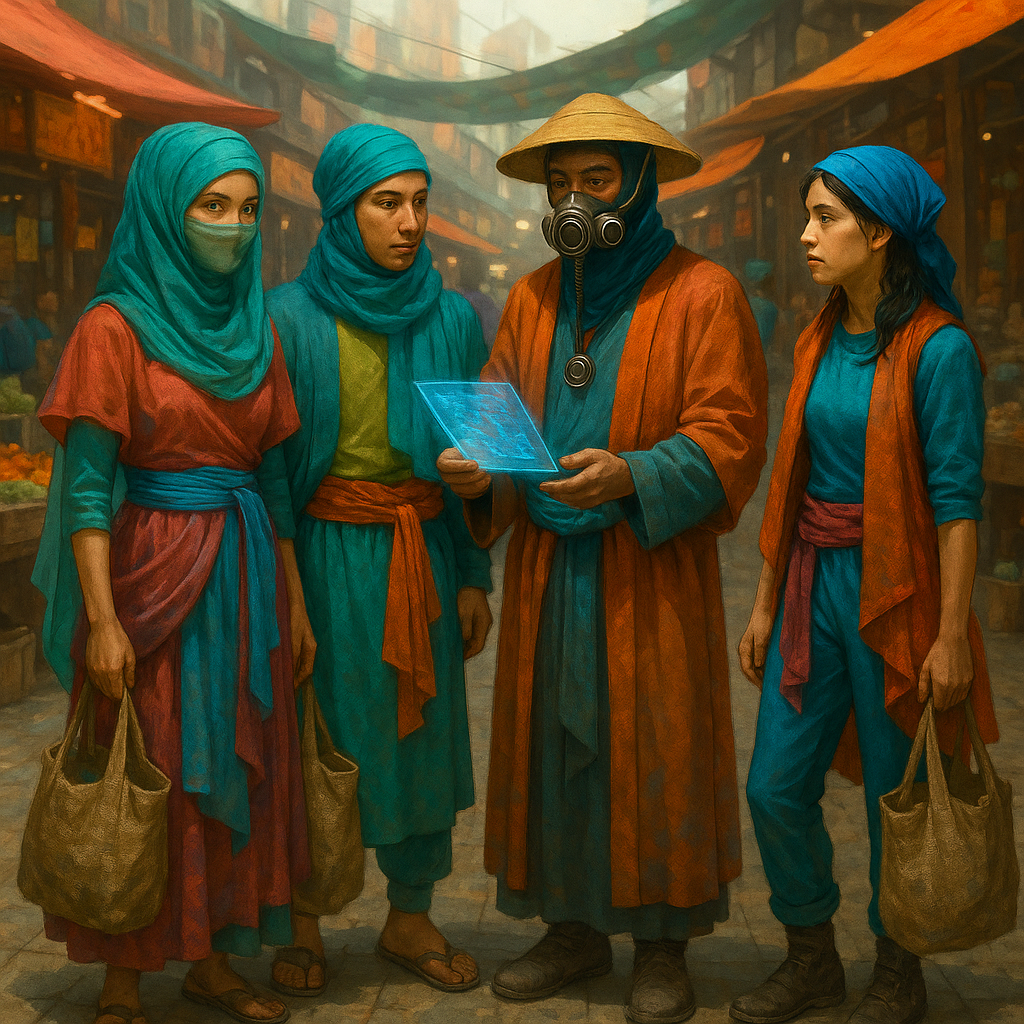
Stereotypically: high cheekbones, oval faces, olive skin; monolid or hooded eyes; distinctive complex jade-green irises; straight black hair; full lips; flatter noses; and a generally delicate, short build. Clothing favors layered polymer fabrics in bright colors, with headwraps and veils common for all genders. Rebreathers are fashionable as well as functional—worn even in safe atmospheres as a nod to heritage and urban air pragmatics.
Spirituality and Foodways
Under the Seekers of Wisdom umbrella, Xinzhouren pursue serenity through understanding, not devotion. They practice a negotiatory animism, seeking harmony with local shén (spirits of places, tools, and processes) as equals rather than gods.
Diet is hypervegan:
- “Gifts of the flora”—foods harvested without harming the plant (fruits, edible flowers, beans, saps, syrups).
- “Artifice”—fully synthetic foods, clean-manufactured from base inputs.
The absence of a supreme being, combined with scrupulous social ethics, gives their religiosity a pragmatic, civic tone.
Work, Wealth, and Anti-Corporate Ethos
Culturally anti-corporate, Xinzhouren prefer co-ops, microbusinesses, and shared responsibility over top-down management. Leisure outranks labor in identity: one is a fisher, poet, glass-etcher—not a job title. Synthetics (synths) perform heavy and menial work; a “farmer” typically manages a synth plantation rather than a payroll. This posture, first a rejection of Jupiter’s corporate org-culture, hardened in exile into a moral stance.
The Three Gifts (Synth Pedagogy)
A defining life-cycle tradition ensures deep fluency with robotics:
- The First Gift (birth): a monitor synth that handles infant care logistics so parents can focus on affection and guidance.
- The Second Gift (school age): a tutor synth—often in a compact body—guiding study, language, craft, and etiquette.
- The Third Gift (coming of age): a companion synth supporting adult independence, travel, and career.
Affluent families provide new platforms at each stage; others upgrade a single synth over time. Retired bodies become household “pets.” The tradition produces expert operators and sought-after synth artisans across Human Space.
Kinship, Marriage, and Elder Care
Arranged marriages remain common but loosely bonded. Parallel lovers are tolerated for all genders; the cardinal rule is children only with the arranged partner. In practice, “children-as-retirement-plan” means siblings pool funds to commission elder-care synthetics and maintain weekly calls. This yields stable eldercare without surrendering leisure or autonomy.
Death Rites and Legal Friction
Traditional funerary practice is open-air cremation by scavenger—placing the body on stone and letting nature return it. Most host polities ban this as a health risk, leading to clandestine adaptations that mimic Criminal disposal (e.g., bodies left in rat- or fish-rich locations, composted in worm farms). Authorities view it as double illegality; Xinzhouren view it as nonnegotiable reciprocity with local shén. The result is a repeating cycle of cultural offense vs. public health enforcement.
Politics of Peace (and its Edge)
Xinzhouren broadly reject militarism, policing, imperialism, and coercion—trusting tradition and moral certitude over the gun. They refuse conscription, object to mandatory service, and spurn “martial training,” which they deem premeditation of murder. When conflict is unavoidable, they reach for pitchforks, torches, nailguns, and tools—not formal arms.
This ethic regularly collides with Martian Militia policy. During Levie Hustings (annual mustering of 18-year-olds), Olympus Mons Xinztown often erupts. True to doctrine, their up-gunned work synths lack combat programming—yet the line blurs when a fruit-thrower becomes a riot-scattering platform. To soldiers, they’re obstructionists; to Xinzhouren, they’re protecting youth from dehumanization.
Aesthetics in Diaspora (and Bīnggē Yǒng Xī Influence)
Even as the anti-military Bīnggē Yǒng Xī recruit across many peoples, Xinzhouren aesthetics imprint the movement: bright layered polymers, veils, rebreathers, and tool-turned-weapon silhouettes—kitchen-pattern molecular-ceramic blades, MAW hammers and picks, rivetguns with stripped safeties. The look isn’t cosplay; it is philosophy made visible—a refusal to dignify professional soldiering, even when choosing violence.
External Perception
To neighbors, Xinzhouren are polite, principled, insular, and obstinate. To corporations, they’re hard to co-opt. To militaries, they’re conscientious objectors who sometimes become street-level Hazards. To themselves, they are keepers of wisdom in an age bewitched by efficiency and force. The diaspora’s compact is simple: preserve serenity, trade fairly, ritualize life—and never worship power.
Major organizations
Xinzhouren Racial Lens 0 or -5 points
(applied to standard Human template)
Attribute Modifiers:
- None (Xinzhouren are physically baseline humans, though stereotypically shorter and more delicate).
Secondary Characteristics:
- None.
Advantages:
- Cultural Familiarity (Xinzhouren) 1
- Cultural Adaptability (Synthetics) 2 – Due to the “Three Gifts” tradition, Xinzhouren are unusually comfortable with synths, treating them as companions, tools, and extensions of family. This provides +2 on any Savoir-Faire (Servant/Synth) rolls and +1 to Electronics Operation (Synthetics) or Electronics Repair (Synthetics).
- Fit 5 – Optional but common; their vegan and plant-based diet tends to produce relatively healthy metabolisms.
Perks:
- Polymer Fashion 1 – Xinzhouren are accustomed to wearing layered, breathable polymer fabrics, veils, and headwraps. They are rarely penalized for encumbrance or heat when dressed in this style, as long as it is appropriate to the climate.
- Religious Ritual Training (Seekers of Wisdom) 1 – Provides +1 to rolls for Meditation, Theology (Animism), or Philosophy when interacting within their own cultural context.
Disadvantages:
- Pacifism (Self-Defense Only) -15 – Xinzhouren reject militarism and refuse to initiate violence. Spontaneous violence may occur in desperation, but they avoid training and premeditation.
- Sense of Duty (Community/Xinzhouren Diaspora) -5 – Strong attachment to their people and traditions.
- Social Stigma (Minority Group) -5 – In many systems, Xinzhouren are considered “outsiders” or “troublemakers,” facing prejudice, especially on Mars (conflicts with conscription).
- Quirk-Level Traits:
- Hypervegan Diet (will not eat animal products; only “gifts of flora” and “artifice”) -1
- Arranged Marriage Tradition (culturally bound, but loose practice; taboo against children outside arranged pairings) -1
- Reject Corporate Authority -1
- Tradition of Open-Air Cremation (illegal in many polities; may secretly perform it) -1
- Values Leisure over Work (rarely defines identity by profession) -1
Skills:
- Meditation (Will/Easy) 1 – Spiritual practice.
- Philosophy (Seekers of Wisdom) (IQ/H) 2 – Cultural framework.
- Electronics Operation (Synthetics) (IQ/A) 1 – Due to the “Three Gifts.”
- Savoir-Faire (Servant/Synth) (IQ/E) 1

Comments