

Team Game: Löpenskold
General Information
2 teams with 9 active players each. Up to 4 substitute players (for injured players or role changes). Up to 3 sets (minimum of 4 rounds total).Objective of the Game
Protect the Runner or take the Runner’s cargo — depending on whether the team is in the Defender or Attacker position.Field Description
The playing field is circular and appears to be enclosed in ice. At its center lies a flat, geometrically shaped hexagon that slightly resembles a triangle. Inside this hexagon runs an isosceles, broad-edged triangle, whose lines form a path. At the three corners of this triangle are marked fields that visually stand out from the rest of the surface. From the top point of the triangle, a straight line leads to the center of the opposite base. There lies a single, enclosed field. The area between this connecting line and the base is a separate segment and stands out visually from the rest of the field. The overall structure is symmetrical and clearly organized, with a focus on circular and triangular shapes that interlock. Path length (Outpost → Tip): approx. 22 mField diameter: approx. 36 m
Team Roles
Attackers:
Attackers have no special roles. Their goal is to catch the Runner from the defending team and take the cargo.Defenders:
Defenders include one Runner and between 1 and 8 active defenders. The rest of the team remains in the reserve area.Setup
Attackers position themselves first. They may spread freely across the ice field. Often, the baseline is left completely empty, and attackers are placed along the legs of the running path. The Runner chooses one of the two outposts at the baseline of the path. From there, they start and attempt to reach the tip — and then continue to the base at the center of the field. Active defenders move into the combat zones along the side of the path the Runner will take. The reserve stands within the triangle marked by the path.Gameplay
Attackers
may enter the combat zone after the round begins and attempt to knock down, kick, strike, pin, wrestle, or drag defenders into the ice zone to reach the Runner. If an attacker manages to grab the Runner, they may try to pull them into the combat zone, where teammates will swarm the Runner and do everything they can to take the cargo. Attackers may also try to knock the cargo out of the Runner’s hand. Experienced players often manage to hurl the cargo into the combat zone. Thrown balls may be intercepted by attackers.The Runner
attempts to reach the base in the center of the field from the starting outpost. They may not fight, but may dodge — as long as they remain on the marked path. If both feet are in the reserve area, the game is briefly paused, and the Runner must restart from the base (with repositioning of all involved players, except those already eliminated). If both feet are in the combat zone, the Runner becomes a defender. They may throw the cargo to a reserve player, who then takes over the Runner role.Defenders
may only stay within the combat zone. They try to shield the Runner and stop the attackers. If the ball lands in the combat zone, a defender may attempt to throw it to a reserve player. The defenders surround the throwing player to protect them and create a clear throwing lane. If a defender is pushed into the outer field, they are considered “devoured” and are out for the round. If they step onto the path, they must immediately return to the combat zone. If they fail to do so within five seconds, the game is briefly paused and the player is sent back to the combat zone. If this happens a second time in the same round, they are also considered “devoured.”Reserve Players
remain in their zone and may throw snowballs. This has little effect but can occasionally confuse a defender. If a Runner is dragged into the combat zone (and thus becomes a defender), one or two reserve players may move into an outpost and wait to receive the cargo. They may then attempt to bring the cargo to the goal as the new Runner. Reserve players may also enter the combat zone and automatically become defenders.The Cargo
The cargo is a head-sized, tied bundle with no real contents. It is purely symbolic. Runners often carry it under their arm while running.Choosing the Starting Position
A coin toss decides which team begins as defenders or attackers.The Outposts
Runners at outposts may not be attacked. Starting outposts may be freely chosen. It is allowed to take the long route (via both starting outposts). Only one player may occupy an outpost at a time.Combat Zone
Players may move freely within the combat zone. Even if they started on the left side, they may cross to the right side through this zone.Set and Round
A set continues until one team scores two points. A round lasts a maximum of ten minutes. If no decision is reached within that time, the teams switch roles (attackers/defenders). It is possible for a set to end after just two rounds. If a round is won before the ten minutes are up, roles are switched and the next round begins. The team that wins two sets first wins the game.Winning a Round
Defenders:
They win the round if they bring the cargo to the base. If the defenders have no Runner left, they must defend the ball until the end of the round. In this special situation, it may be passed between defenders. They can no longer score, but may try to force a draw.Attackers:
They win if they manage to take the cargo and bring it into the outer field zone (not by throwing — the attacker must enter the outer zone with their entire body).Draw:
If neither team achieves its goal within the set time, no point is awarded.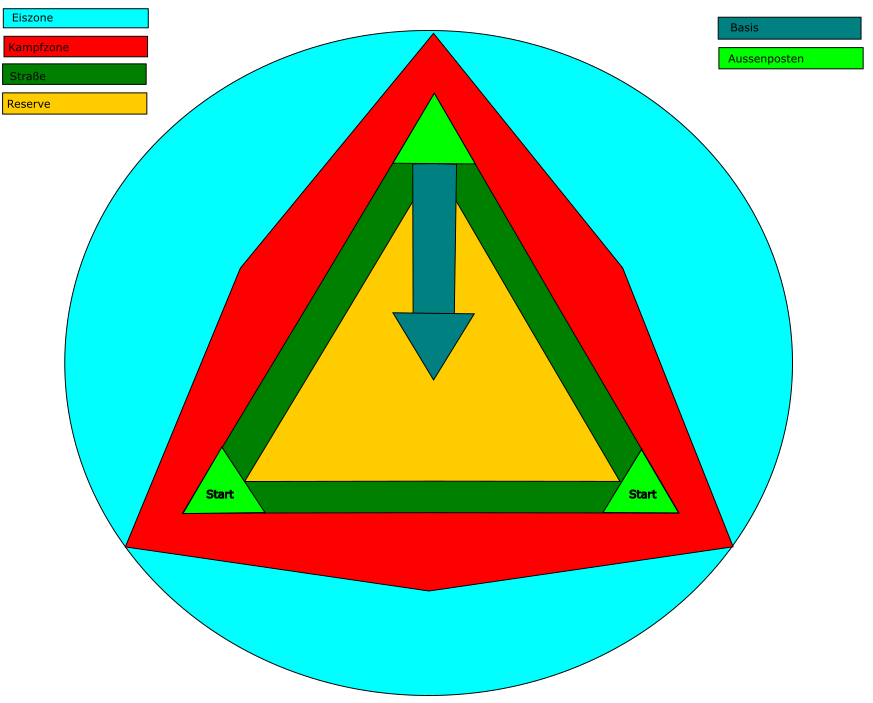
by Selibaque
Created by Selibaque 2025

Kommentare