
The Evergreen Vigil
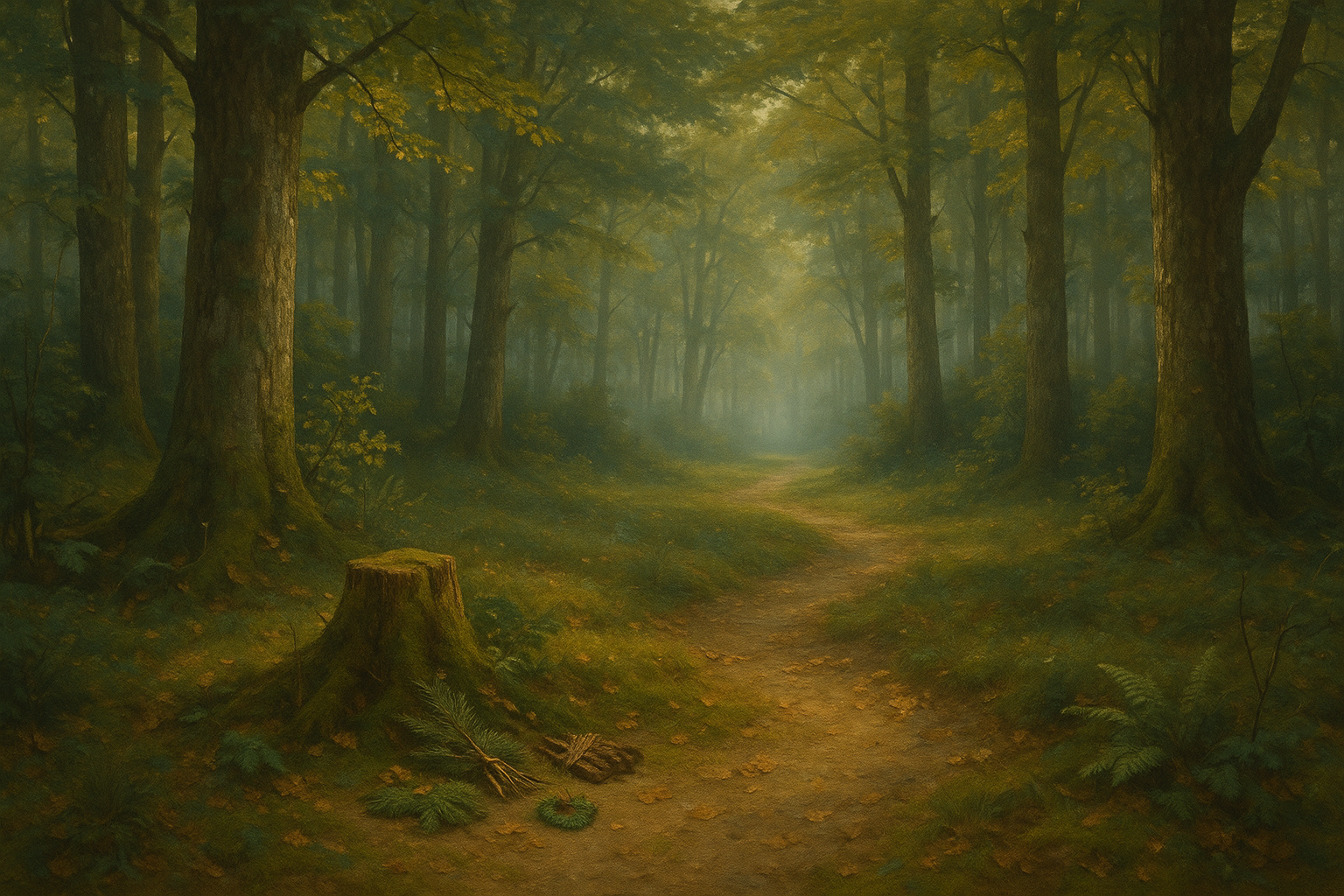
Every year on the first night of Zephyren, the villages surrounding Wren’s forest hold a quiet ritual known as the Evergreen Vigil. It is not a holiday so much as a communal act of respect for the woods and the unseen forces that protect it. Families gather at the edge of the tree line carrying small bundles of evergreen needles, pinecones, and bits of dried moss — nothing taken from living trees, only what the forest has willingly released.
At sunset, villagers place these bundles at the bases of old stumps or moss-covered stones, murmuring soft thanks for the year’s shelter, rainfall, game, and harvest. The offerings are intentionally humble; the tradition insists that “the forest asks for nothing more than acknowledgment.”
Children are encouraged to leave something personal:
a carved wooden animal, a painted pebble, a braid of grass, or a token of something they learned that year. Elders tell them this helps the Forest Keeper know they have grown well.
After placing the offerings, the villagers keep a shared hour of silence, no music, no prayer, just the settling of the woods and the whisper of branches. This is said to be the time when Wren walks closest to the boundary between Human land and wild, listening to what the people offer of themselves.
By morning, the offerings are always gone.
Some say Pine steals them.
Some say the forest reclaims them.
Some claim Wren himself decides which gifts are worthy. Regardless of belief, the Vigil remains a cherished tradition: a moment each year where the villagers pause to remember that the forest is not simply land, but a living partner in their survival, one that deserves gratitude, not fear.
Some say the forest reclaims them.
Some claim Wren himself decides which gifts are worthy. Regardless of belief, the Vigil remains a cherished tradition: a moment each year where the villagers pause to remember that the forest is not simply land, but a living partner in their survival, one that deserves gratitude, not fear.
History
The Evergreen Vigil began centuries ago, long before Wren himself became known to the villages. Its earliest form was a simple, practical custom practiced by the first settlers who built their homes near the forest’s edge. In those days, the woods were older, darker, and far less forgiving. Hunters spoke of eyes watching them from the undergrowth, of paths shifting beneath their feet, and of strange, protective forces that drove off threats but punished disrespect. To maintain peace, the early settlers left small offerings of gathered pine needles and shed branches each spring as a gesture of gratitude for safe passage through the woods.
At this time, the Vigil had no name, no formal structure, and no supernatural expectation. It was an act of coexistence, acknowledgment that humans lived at the mercy of the forest and the creatures within it.
The Age of Sightings
Generations later, as Wren began appearing near village borders, often glimpsed at dawn or dusk, the Vigil took on new meaning. Sightings of a tall, horned figure with ivy clinging to his skin reshaped local beliefs. The villagers, unable to fully understand what they saw, blended the unknown guardian with their existing customs. The offerings that were once simple tokens of gratitude gradually became gifts “for the Forest Keeper,” even though Wren himself neither encouraged nor acknowledged the practice. This shift occurred almost entirely through oral tradition — grandmothers whispering to children, hunters embellishing tales by firelight, and druids adding spiritual weight to the idea of a guardian spirit.The Era of Reverence and Fear
As villages grew and began to rely more heavily on lumber, farmland, and hunting, their relationship with the forest became strained. In years when harvests failed or predators became bold, superstition flared. Some villagers began treating the Vigil not as gratitude, but as appeasement. Whispers spread that if the Keeper was angered, he would withdraw his protection, an idea fueled by poor seasons, harsh winters, and natural imbalances the people did not understand. This era introduced rituals of fear, not respect. Offerings grew larger and more ceremonial, children were taught that misbehavior would “offend the Keeper.” Some villages added unnecessary embellishments, like painted symbols or ritual chants, to ensure they were “heard.” Ironically, this was the period when Wren was least present at the forest’s edge, leading to more speculation and distortion of the tradition.Modern Interpretation
In recent generations, the Evergreen Vigil has softened again. Thanks to a better understanding of nature cycles and more stable relations among villages, the tradition returned to its gentler roots. The elaborate offerings fell out of use, replaced once more by natural items, pinecones, moss, shed branches, and small handmade tokens. The Vigil is now seen less as a ritual of fear and more as a moment of reflection: a reminder to live in balance, take only what is needed, and respect the woods that sustain them.
Primary Related Location
Important Locations


The line between worship and appeasement in a polytheistic society is often blurred. I covered that idea in my article on the subject, or you can check the link I put in the Bibliography if you want to read a brilliant professor talk about the same thing.
How ordinary mortals worship the Nine
tent pole article summarizing common religious practices in Scarterra