
Hornhaven Forest
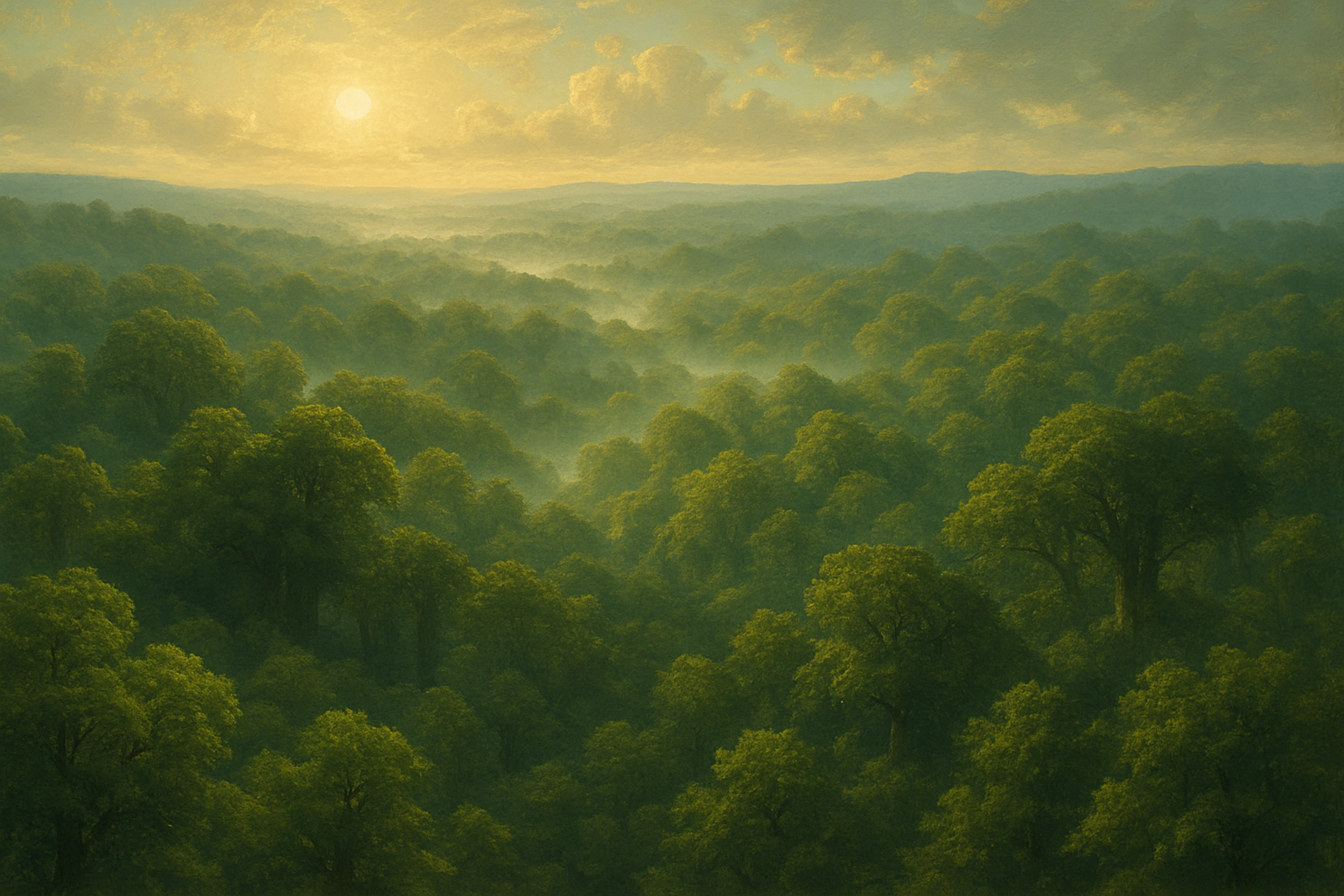
Hornhaven Forest stretches across the southern curve of Tharnis, where gentle hills roll into dense greenwood and mist gathers in the low valleys near the Mesowet coast. It is one of the oldest surviving woodlands of the region, a place where the temperate climate of Tharnis turns warm and humid as it drifts southward. Towering broadleaf trees dominate its canopy, elm, ash, oak, and hornbeam, interwoven with vast swaths of evergreen pine whose scent carries for miles.
Though beautiful, Hornhaven is far from tame. The forest is layered and deep, full of shadowed glades, rich undergrowth, and ancient root systems that twist into ravines and sinkholes hidden beneath ferns. Wildlife thrives here, deer, boar, wolves, bears, and countless smaller creatures, but they behave differently within Hornhaven’s borders, more alert and more attuned to the unseen rhythms that guide the wood. The land responds to disturbances with uncanny precision: storms break too quickly, streams divert themselves, and animals appear where logic says they shouldn’t.
The villages along Hornhaven’s outskirts depend on the forest for seasonal hunts, herbal medicines, and timber; yet they treat its border like a sacred threshold. Children are taught not to wander past familiar paths, and hunters pay quiet respect before each excursion. This reverence stems from an old belief that the forest is watched over by a guardian spirit, the being they call the Forest Keeper, unmistakably inspired by Wren. The myth is so old that even scholars debate where the folklore ends and truth begins.
Hornhaven’s atmosphere is one of living balance: neither hostile nor welcoming, but awake. It is a place where silence has weight, where wind carries meaning, and where those who step lightly are rewarded with safety and abundance. But when the land is out of harmony, Hornhaven grows restless. Predators become bold, crops wither in nearby fields, and even the air takes on a charged stillness, as if the forest itself is holding its breath.
Geography
Hornhaven occupies a broad stretch of southern Tharnis, where rolling uplands descend into deep, ancient woodland. Its geography is defined by a combination of elevation changes, dense tree cover, hidden waterways, and pockets of natural magic, creating a landscape both beautiful and unpredictable.
1. Rolling Uplands and Sloping Terrain
The northern boundary rises gently into low, rounded hills shaped by centuries of erosion. These uplands feed into the heart of the forest, creating natural ridges, shallow valleys, and winding paths that shift subtly with the seasons. Many of these slopes are covered with a mixture of old-growth oak, hornbeam, and elm.2. Dense Mixed Canopy
Hornhaven’s most defining feature is its thick, layered canopy. Towering hardwoods dominate the skyline, interspersed with evergreen pine and spruce that give the forest its year-round green hue. The mix of broadleaf and conifer species creates dramatic seasonal color shifts — from deep summer emerald to autumn gold.3. Moss-Draped Ravines and Root Chasms
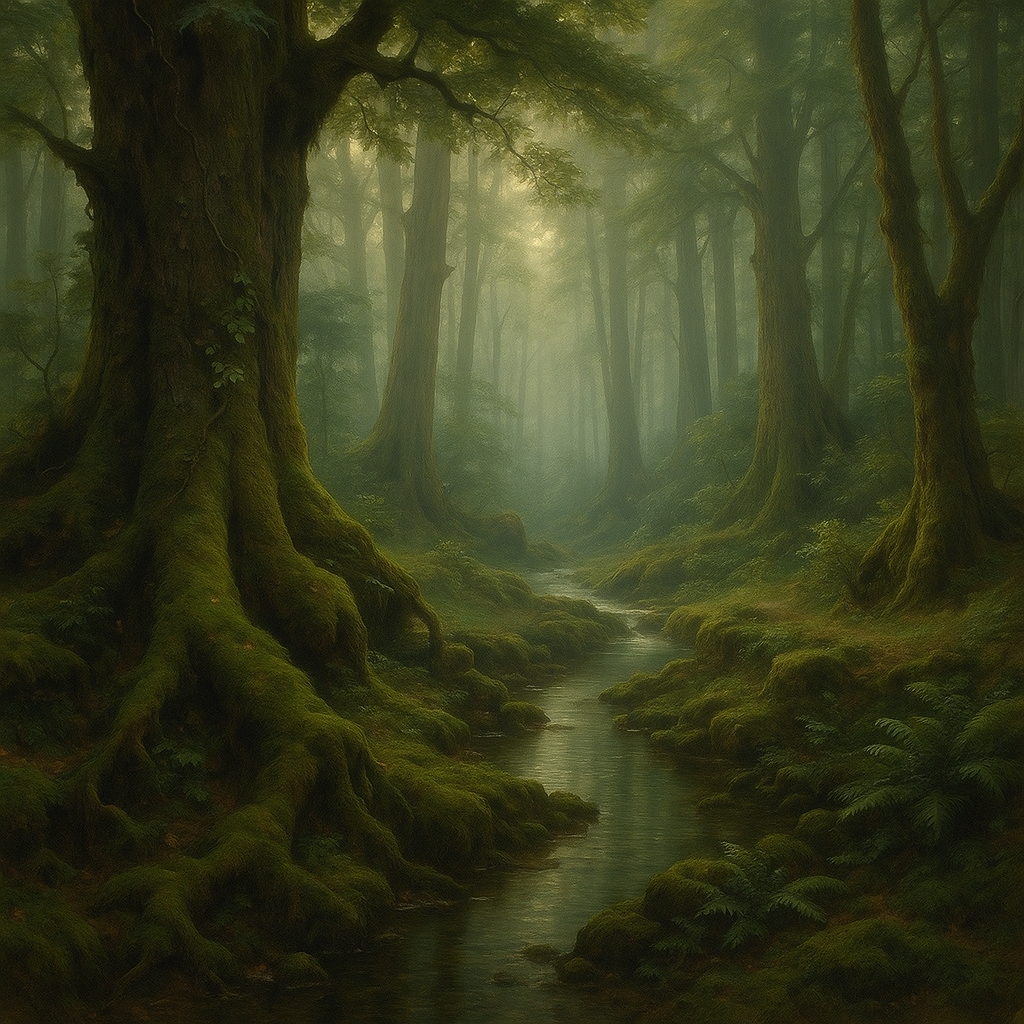
Beneath the canopy lie deep, shaded ravines formed by ancient streams. Tangled roots form natural bridges, while moss carpets every stone. These ravines remain cool even in summer, and many plunge into narrow, hidden chasms where daylight struggles to reach the ground.4. Freshwater Springs and Threading Creeks
Fed by underground reservoirs, Hornhaven contains numerous fresh springs that bubble up through rocks and feed thin, winding creeks. These waterways carve shallow channels through the forest floor, often disappearing beneath leaf litter only to resurface deeper in the woods.5. Fog-Heavy Lowlands
Toward the southern edge, closer to the Mesowet winds, moist air settles into shallow basins and flatland glades. Morning fog is common here, draping the forest in silver mist and muting all sound. These lowland pockets are lush with ferns, cattails, and thick undergrowth.6. Ancient Heartwoods
At the forest’s center lies the oldest region, where trees are impossibly massive and clustered tightly together. The air here feels heavier, quieter, and more aware. This part of Hornhaven sees little human activity and is where Wren spends most of his time. Even animals tread carefully in these groves.7. Hidden Clearings and Seasonal Meadows
Hornhaven contains scattered natural clearings created by old fallen giants or erosion. These meadows bloom explosively in spring—with wildflowers, herbs, and berry bushes—and become grazing sites for deer and elk. In summer, they’re dense with insects and birds. In autumn, they turn russet and gold.8. Natural Boundaries
Hornhaven’s edges are defined more by natural transitions than sharp borders. Fields become thicket. Path becomes shadow. Villagers mark the boundary by instinct more than sight. A certain hush, a deeper green, a sudden chill — these signs tell them when they’ve stepped onto the Keeper’s land.Ecosystem
Hornhaven is one of the most biologically rich forests in southern Tharnis, shaped by a warm, humid climate and dense, old-growth woodland. Its ecosystem is defined by towering heartwood trees, tangled understory thickets, and clear freshwater streams fed by underground springs. The forest is known for dramatic vertical stratification, with each layer supporting its own distinct network of life — from canopy gliders to burrowing root-dwellers.
Despite its peaceful appearance, Hornhaven is a place of constant natural tension. Predators stalk the underbrush, ancient trees silently compete for sunlight, and magical forces subtly alter the flow of life. The presence of Wren himself influences the forest, encouraging harmony but never suppressing its wildness. Balance is the rule of Hornhaven: every creature, from the smallest beetle to the largest elk, has a role in maintaining the forest’s rhythm.
Seasonal cycles, guided by Callista and Umbriel, can dramatically affect the forest’s behavior. During Umbriel-heavy nights, nocturnal predators become bolder, foliage shifts in subtle chromatic tones, and certain magical species awaken or migrate. Callista’s bright phases bring calmer nights, stronger growth, and increased animal activity. These lunar influences create a dynamic ecosystem that feels alive in more ways than one.
Climate
Hornhaven follows the same seasonal structure as the rest of the Northern Hemisphere, but its position in northern Tharnis gives it slightly cooler winters and gentler summers than the climates of central Arandor. The forest’s old-growth canopy, complex ravines, and proximity to the Mesowet Ocean help regulate temperature, giving Hornhaven a steady, living rhythm through the year.
Winter, spanning Sombriel 5 to Astralon 18, settles heavily over Hornhaven, though rarely with the severity seen further north. Snow blankets the uplands and dusts the canopy, muffling sound until the entire wood feels ancient and hushed. Streams crust with ice and the mornings are sharp and cold, but the deep heartwoods retain enough trapped warmth to resist deep freeze. Wildlife grows scarce in these months as many creatures migrate, hibernate, or move cautiously beneath the trees, leaving Hornhaven in a kind of breath-held stillness.
Spring, from Astralon 19 to Zephyren 29, arrives with force. Snowmelt rushes through the ravines, and the forest floor turns muddy before bursting into vibrant renewal. Ferns uncurl, moss thickens, wildflowers open in the brief early sun, and understory growth becomes almost aggressive in its speed. Birds return in great numbers, Pine becomes hyperactive, and Wren feels the forest’s pulse surge back to life as the canopy shifts from skeletal branches to a rising mass of green.
Summer, lasting from Zephyren 30 to Fyrden 14, is warm, humid, and full of energy. Though temperatures rise, Hornhaven’s dense canopy filters the sun, creating cool shaded corridors beneath the branches. Afternoon storms sweep in from the Mesowet Ocean with dramatic regularity, dumping rain that steams off warm earth. These months 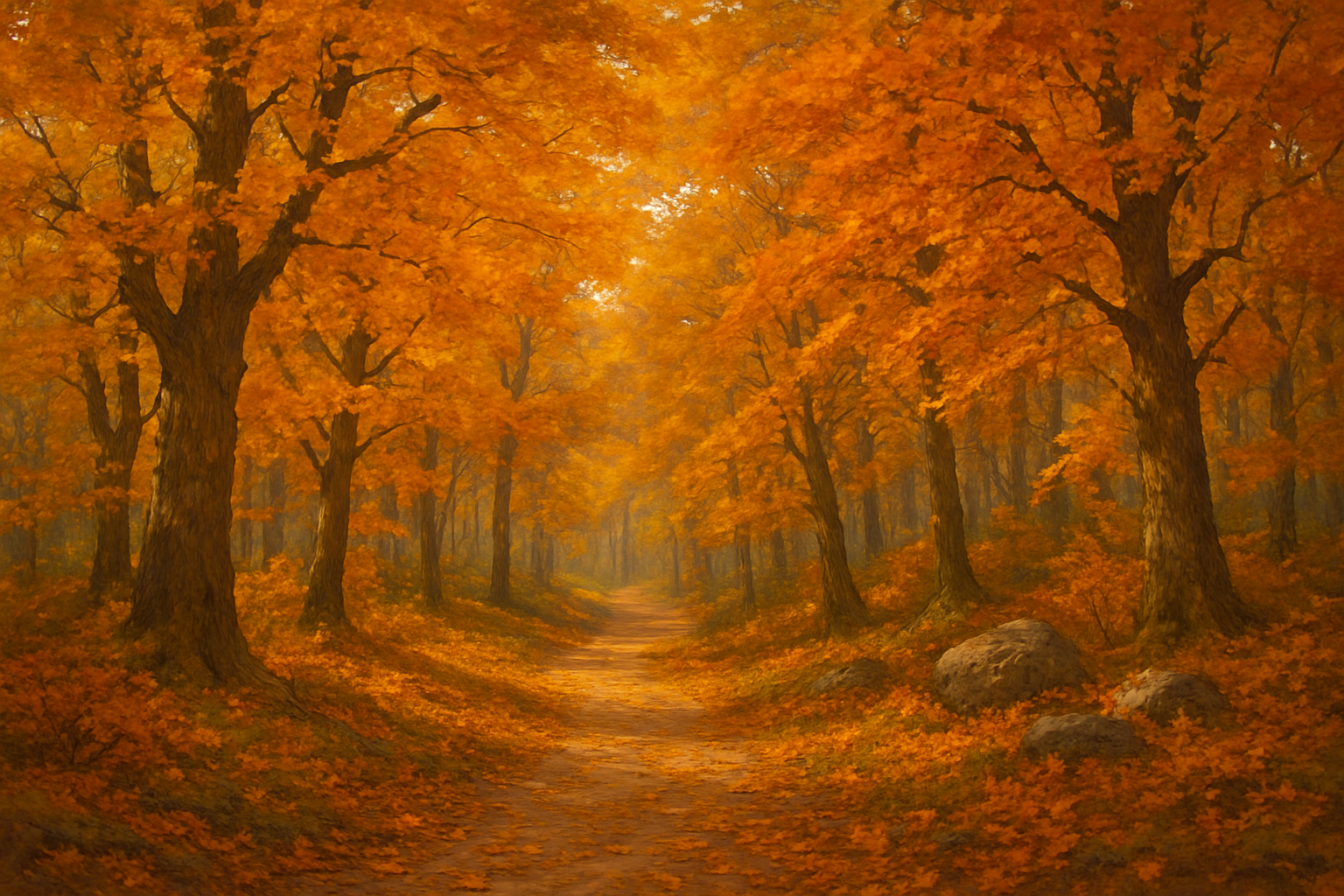 are the height of activity: animals roam freely, insects fill the air, and the forest feels awake and vibrant in a way bordering on restless.
Autumn, from Fyrden 15 to Sombriel 4, is long, rich, and quietly dramatic. The forest shifts into amber and copper hues as the hardwood leaves begin their slow fall. The air cools noticeably, nights deepen, and Hornhaven settles into a rhythmic calm. Foraging peaks as wildlife prepares for the coming cold, predators follow the shifting paths of prey, and the forest seems to take stock of itself. This is the reflective season — a time Wren calls Hornhaven’s “breathing,” when the land exudes a sense of balance before winter returns again.
are the height of activity: animals roam freely, insects fill the air, and the forest feels awake and vibrant in a way bordering on restless.
Autumn, from Fyrden 15 to Sombriel 4, is long, rich, and quietly dramatic. The forest shifts into amber and copper hues as the hardwood leaves begin their slow fall. The air cools noticeably, nights deepen, and Hornhaven settles into a rhythmic calm. Foraging peaks as wildlife prepares for the coming cold, predators follow the shifting paths of prey, and the forest seems to take stock of itself. This is the reflective season — a time Wren calls Hornhaven’s “breathing,” when the land exudes a sense of balance before winter returns again.
Natural Resources
Hornhaven’s resources are abundant but never excessive, the forest is generous only to those who treat it with respect. Its old-growth heartwood trees produce dense, resilient timber valued across Tharnis, but felling them is considered taboo except during sanctioned winter culls. More common are the straight, flexible bolewood pines and honeybark maples, whose sap is refined into a dark amber syrup used in local medicines and trade.
Edible resources shift with the seasons. Spring brings wild onions, fiddlehead ferns, and early berries, while summer floods the undergrowth with blackthorn fruit, golden hazelnuts, and clusters of sweet glyphberries known to glow faintly under Callista’s light. Autumn is the season of plenty, mushrooms, chestnuts, roots, and late-season fruits that sustain villages through the winter. Winter offerings are sparse but dependable: evergreen shoots, hardy mosses, and the prized frost-truffle that grows only beneath the oldest pines.
The rivers and streams cutting through Hornhaven teem with silverfin trout, star-scaled minnows, and freshwater mussels whose shells are used in charmwork. The forest floor yields useful herbs such as moonmint, redcap sage, and the rare weepshade, an herb that thrives only where the canopy is densest. Wildlife is equally valuable, though hunting is tightly controlled. Deer, boar, hares, and seasonal migratory birds provide meat and hides, while predators such as wolves and lynx maintain the balance Wren fiercely protects.
Perhaps Hornhaven’s most unusual resource is its ley-touched flora, plants shaped subtly by the quiet magical currents running beneath Tharnis. Some trees grow with spiral grain used in druidcraft, and certain flowers bloom in response to Umbriel’s darker phases. These resources are not harvested casually; they are taken only with ritual permission, and many believe Wren himself grants or denies access based on the forest’s health.
Alternative Name(s)
Wrenwood, Wren's Glade
Type
Forest, Temperate (Seasonal)
Location under
Owning Organization
Related Tradition (Primary)


Comments