

Kamulosian (KAH-mu-LOH-zee-un )
The people of Kamulos are as varied as the landscapes they inhabit. From the fertile plains and windswept hills to the deep dwarven mines beneath the Zandari Mountains, the kingdom’s population reflects a long history of cooperation, tension, resilience, and prosperity. Kamulos has grown into one of the most racially diverse realms in Tanaria, its identity shaped by the combined efforts of humans, elves, dwarves, halflings, and a wide range of other ancestries who have carved out homes within its borders.
Kamulosian are defined not by a single culture, but by the interplay of many. The “nature-attuned” peoples, elves, centaur, shifters, fey-blooded, find harmony in the lush forests and rolling fields, while the “industry-driven” peoples, dwarves, humans, orcs, thrive in the mines, workshops, and bustling trade centers that power the kingdom’s economy. This duality is seen everywhere in Kamulos: in its architecture, in its politics, in its class structure, and in the expectations placed upon different communities. Tensions and prejudices exist, but so does a shared understanding that Kamulos prospers only when each group contributes its strengths.
Kamulos’s wealth, born from both the earth and the plow, has attracted settlers from across Tanaria. Farmers, fishermen, artisans, mages, merchants, miners, scholars, and travelers all converge within its borders, creating a kingdom where no single race dominates entirely and where cultural blending is part of daily life. Despite this diversity, Kamulos struggles with a pronounced class divide, most visible in predominantly human cities where industrialization concentrates wealth unevenly. Even so, the kingdom’s long-standing stability, its monarchy, and its influential Council of Races work continuously to maintain unity and representation among its people.
Migration, trade routes, and the kingdom’s reputation for safety and opportunity keep Kamulos culturally dynamic. Whether born in the heartland farmlands, the dwarven tunnel-cities, the elven woodland holds, or coastal towns braced against the sea winds, Kamulosian share a common pride: they see their kingdom as the place where nature and industry do not merely coexist, they make each other stronger.
Kamulosian are defined not by a single culture, but by the interplay of many. The “nature-attuned” peoples, elves, centaur, shifters, fey-blooded, find harmony in the lush forests and rolling fields, while the “industry-driven” peoples, dwarves, humans, orcs, thrive in the mines, workshops, and bustling trade centers that power the kingdom’s economy. This duality is seen everywhere in Kamulos: in its architecture, in its politics, in its class structure, and in the expectations placed upon different communities. Tensions and prejudices exist, but so does a shared understanding that Kamulos prospers only when each group contributes its strengths.
Kamulos’s wealth, born from both the earth and the plow, has attracted settlers from across Tanaria. Farmers, fishermen, artisans, mages, merchants, miners, scholars, and travelers all converge within its borders, creating a kingdom where no single race dominates entirely and where cultural blending is part of daily life. Despite this diversity, Kamulos struggles with a pronounced class divide, most visible in predominantly human cities where industrialization concentrates wealth unevenly. Even so, the kingdom’s long-standing stability, its monarchy, and its influential Council of Races work continuously to maintain unity and representation among its people.
Migration, trade routes, and the kingdom’s reputation for safety and opportunity keep Kamulos culturally dynamic. Whether born in the heartland farmlands, the dwarven tunnel-cities, the elven woodland holds, or coastal towns braced against the sea winds, Kamulosian share a common pride: they see their kingdom as the place where nature and industry do not merely coexist, they make each other stronger.
Culture
Major language groups and dialects
Kamulos is linguistically diverse, reflecting its mixed population and long history of cooperation between nature-aligned and industry-driven peoples. While most Kamulosians are multilingual to some degree, several major languages dominate daily life, each with its own regional or cultural dialects.
Kamulosian Common carries a distinctive cadence shaped by the kingdom’s geography, multicultural history, and practical, straightforward worldview. Linguists across Tanaria describe it as a lilting, rounded dialect, pleasant to the ear, easy to follow, and well-suited to trade, storytelling, and everyday conversation.
Kamulosian speech tends to be smooth and melodic, with a gentle rise and fall that comes from generations of multilingual influence. Heartland farmers, hill-dwellers, miners, and riverfolk all contributed different rhythms, resulting in; a soft lilt at the end of many sentences, rounded vowels and less harsh consonants, a steady, deliberate pace in rural areas, a faster, and a more clipped delivery in river and market districts.
The result is a dialect that feels warm, approachable, and practical rather than formal or aristocratic.
Kamulosian Common
The primary trade and governmental language of the kingdom, spoken across cities, farmlands, and markets. It is derived from older Human dialects but has absorbed vocabulary from dwarven, elven, and Halfling tongues over centuries.Kamulosian Common carries a distinctive cadence shaped by the kingdom’s geography, multicultural history, and practical, straightforward worldview. Linguists across Tanaria describe it as a lilting, rounded dialect, pleasant to the ear, easy to follow, and well-suited to trade, storytelling, and everyday conversation.
"Fields’re lookin’ grand today. Best get the work done while the sun’s willin’."
Kamulosian speech tends to be smooth and melodic, with a gentle rise and fall that comes from generations of multilingual influence. Heartland farmers, hill-dwellers, miners, and riverfolk all contributed different rhythms, resulting in; a soft lilt at the end of many sentences, rounded vowels and less harsh consonants, a steady, deliberate pace in rural areas, a faster, and a more clipped delivery in river and market districts.
The result is a dialect that feels warm, approachable, and practical rather than formal or aristocratic.
"Ah, you’re not from ’round here, are ya? No bother. Come in out o’ the wind— heat’s free, an’ you look like you could use it."
Dwarven (Weldenkont Stone-Tongue)
Spoken in the deep tunnel-city of Weldenkont and mining communities throughout the Zandari Mountains. A more formal and archaic version of Dwarvish persists in ceremonial and guild contexts.Elven
Elves in Kamulos come from multiple lineages, leading to a patchwork of elven dialects used in forests, rural settlements, and arcane enclaves.Thrukkar
Although orcs are fewer in Kamulos than in Dhuma, their presence in mining crews, mercenary bands, and caravan routes has introduced pockets of Orcish across the region.Art & Architecture
Kamulosian art and architecture reflect the kingdom’s core values: practicality, harmony with nature, sturdy craftsmanship, and the blending of many cultural influences. Nothing in Kamulos is purely decorative; beauty is expected to serve function, and function is expected to be well-crafted. The result is a distinct aesthetic that bridges the gap between rustic tradition and quiet sophistication.
Kamulosian architecture varies across the kingdom, shaped by geography and local culture, but several unifying traits define the style:
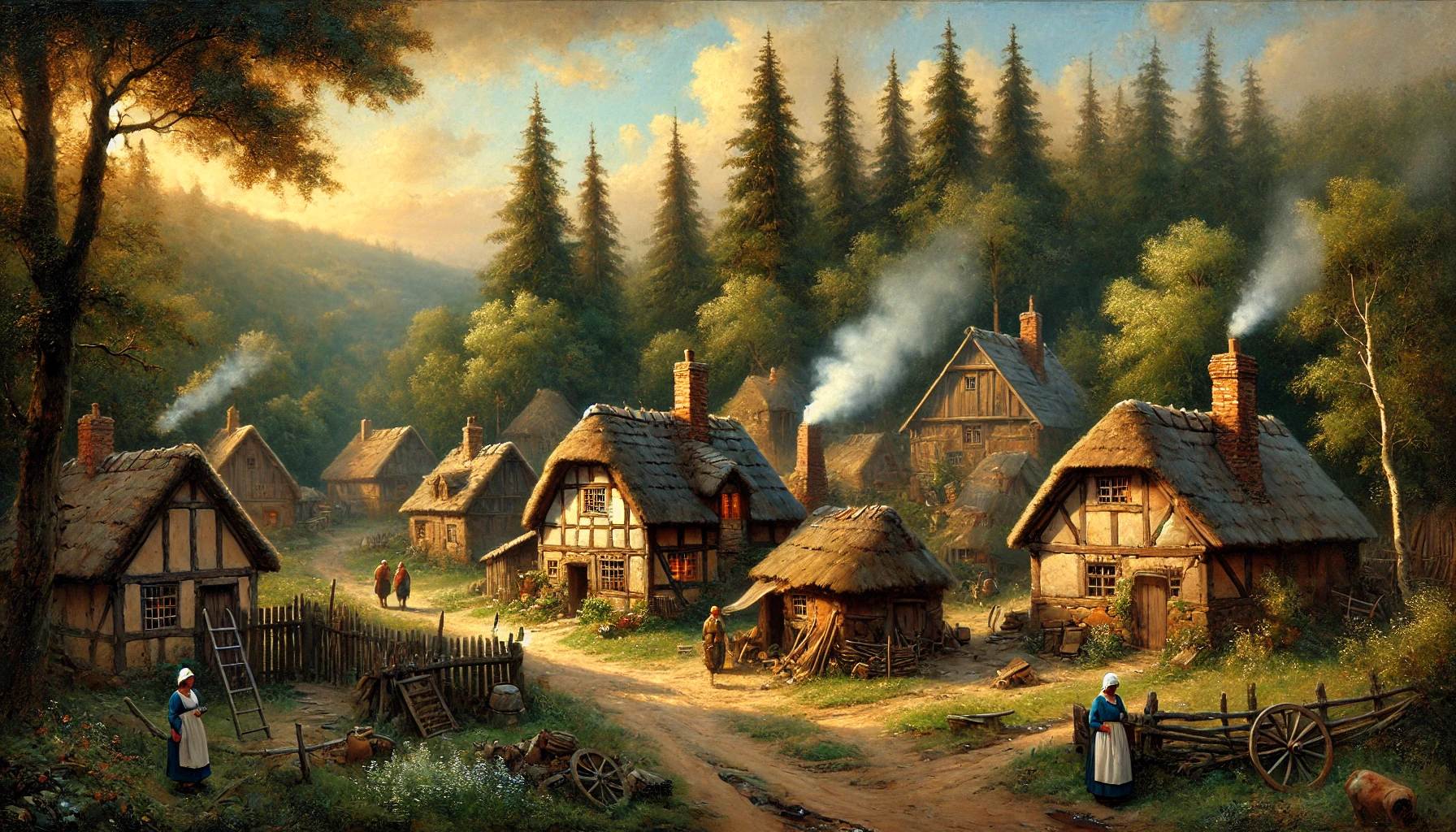 Buildings are designed to sit within the landscape, not dominate it. Instead of clearing forests or flattening hills, Kamulosians build around natural features. Tree lines become windbreaks, small rivers become millworks, and stone outcroppings are incorporated as foundations.
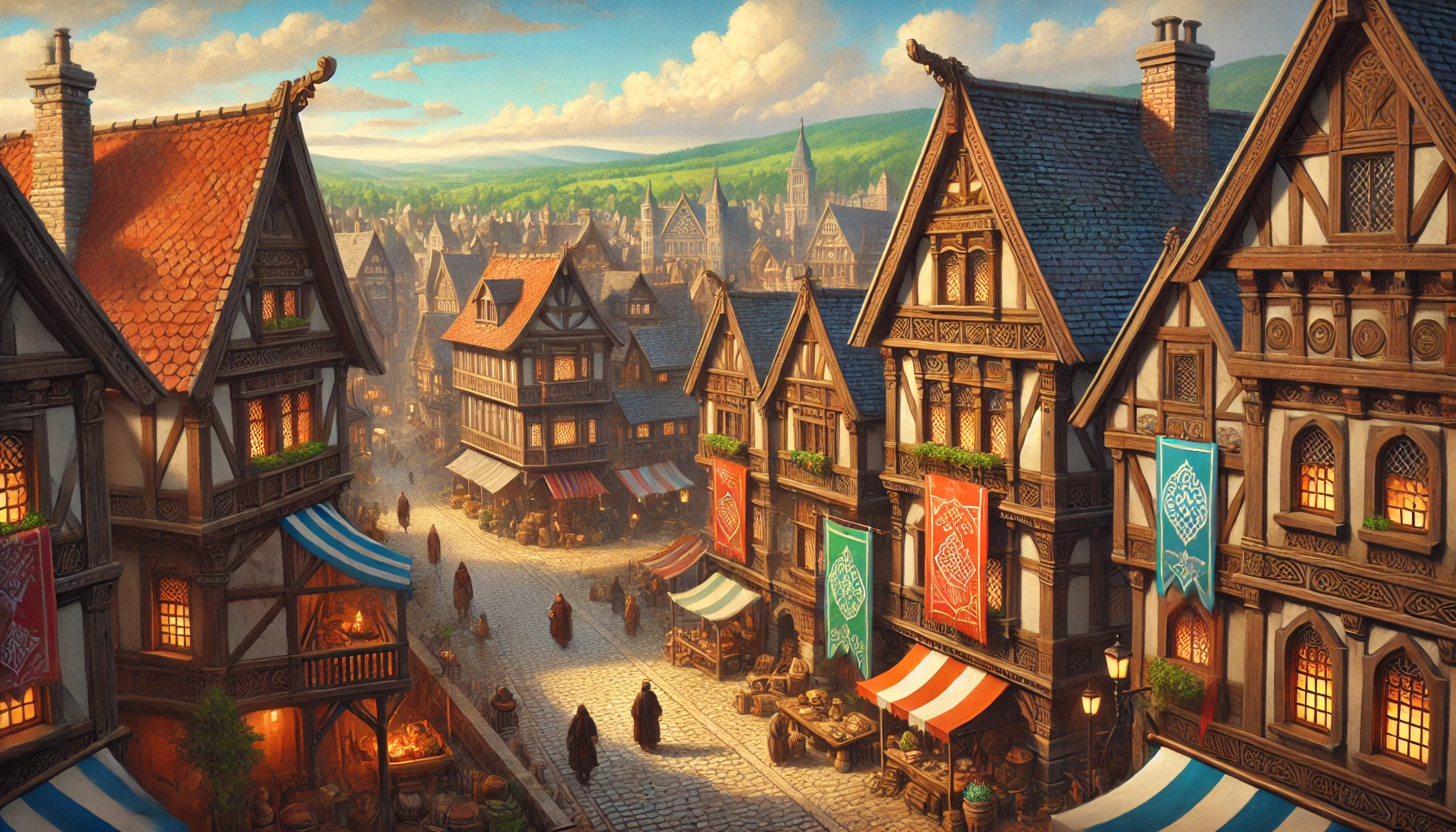 Cities in Kamulos are rarely chaotic. Streets are intentionally curved around terrain features, markets sit at natural crossroads, and civic buildings stand near rivers or central squares for easy access. Even larger cities maintain a sense of groundedness and open air, avoiding overcrowded vertical sprawl.
Architecture
Kamulosian architecture varies across the kingdom, shaped by geography and local culture, but several unifying traits define the style:
Nature-Focused Integration
Material-Driven Design
Common construction materials include:- Timber from local hardwoods
- River stones and field stones
- Dwarven-cut granite from Zandari
- Clay bricks and plaster in warmer southern regions
Warm, Practical Interiors
Homes emphasize:- wide hearths as gathering spaces
- built-in shelving and storage
- thick wooden beams
- woven tapestries that add insulation and color
Urban Layout
- Specialized Structures
- Dwarven-built stone districts feature vaulted ceilings, heavy pillars, and geometric motifs.
- Elven-influenced quarters use natural light, sweeping curves, and plant motifs.
- Riverway towns incorporate stilted platforms, wide docks, and canal bridges.
Common Customs, traditions and rituals
Kamulosian customs arise from the kingdom’s long history of cooperation between nature-bound peoples and industry-driven communities. While each race retains its own heritage, several shared traditions have become distinctly Kamulosian over the centuries.
Receiving a crafted item from another household or race is considered a mark of goodwill.
Seasonal Gatherings
Agricultural cycles shape much of Kamulosian life, and seasonal festivals are community events rather than guild-specific affairs.Craft Exchange
Because Kamulos values skill, communities often hold Craft Exchanges, where artisans trade tools, carvings, tapestries, or metalwork. These exchanges are not bartering for profit but symbolic acts reflecting respect for another’s craft.Receiving a crafted item from another household or race is considered a mark of goodwill.
Related Organizations
Related Locations


Comments