
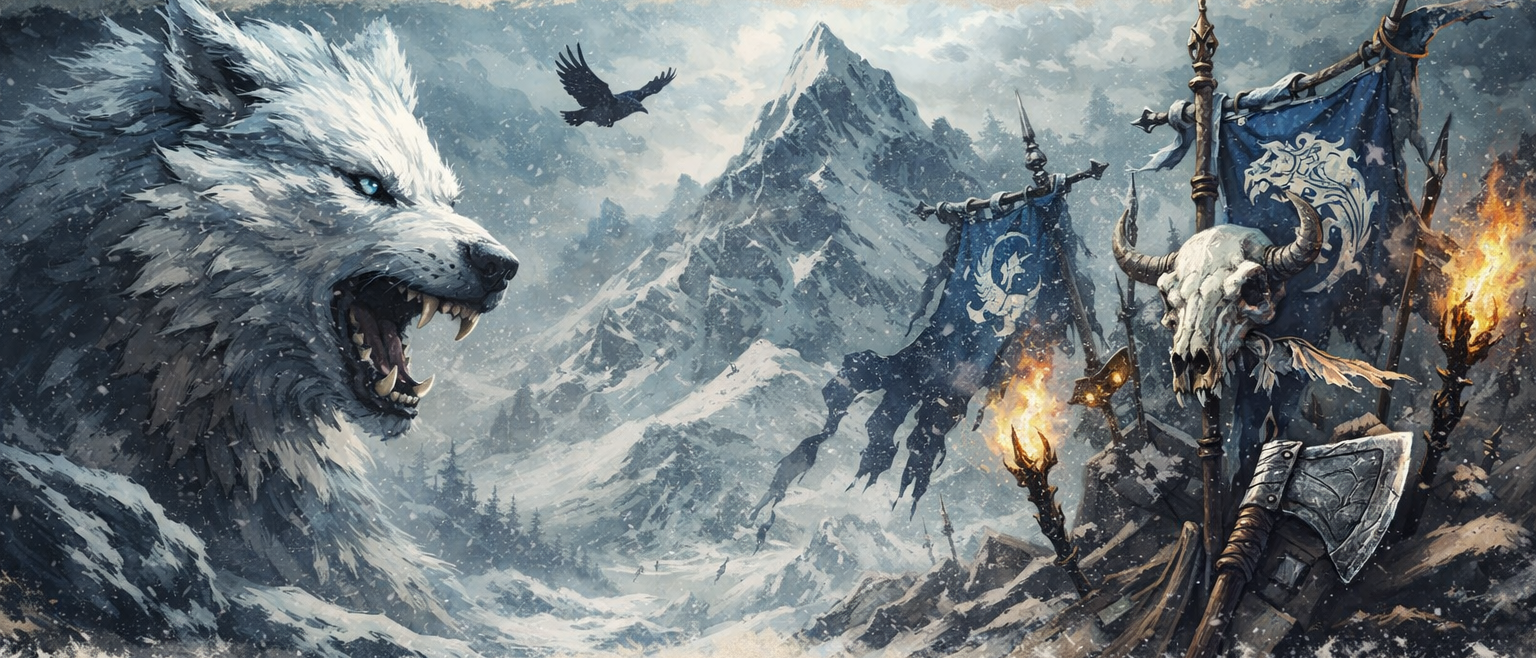
Kalros
Kalros is a southern geopolitical confederation defined less by fixed borders and more by shifting allegiance. It is not a unified kingdom in the traditional sense, but a coalition of clans, packs, and regional powers bound together by geography, shared history, and external pressure. Authority within Kalros is decentralized, fluid, and constantly renegotiated.
Rather than a crown or capital, Kalros functions through conditional unity. Each clan or people governs its own lands, customs, and internal laws. Matters that affect Kalros as a whole—defense, major trade routes, inter-clan conflict, or foreign diplomacy—are handled through councils, temporary alliances, or war moots convened as needed. No permanent central authority exists, and attempts to impose one have historically failed.
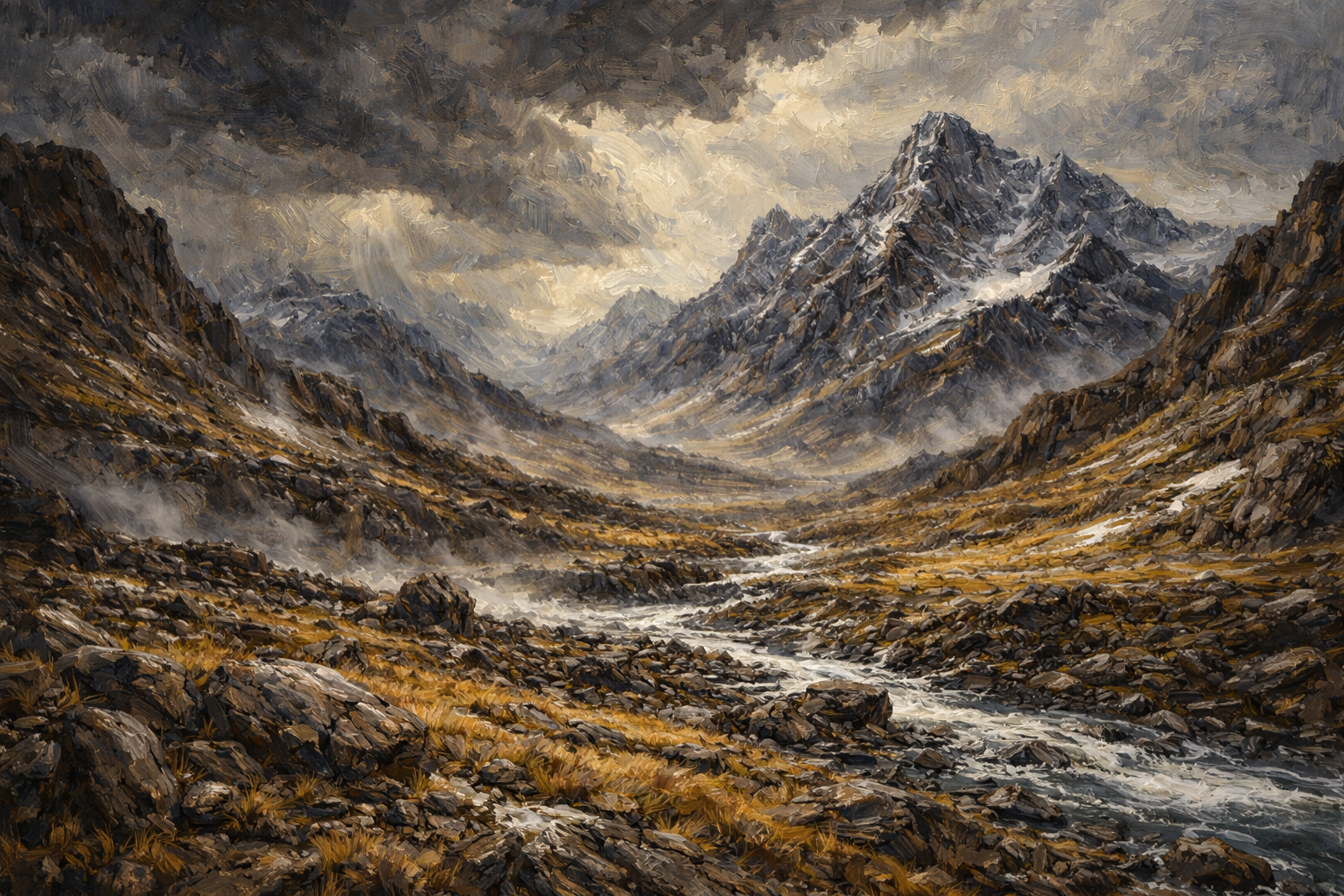
Geographically, Kalros occupies a broad and varied southern region, shaped by rugged mountains, cold highlands, wind-scoured plains, dense forests, and harsh coastal zones. While southern in latitude, much of Kalros remains cold or temperate due to elevation, prevailing winds, and proximity to frigid seas. The land is demanding, rewarding endurance and punishing weakness, and this reality underpins Kalros’s political culture.
Kalros is ethnically and culturally diverse, home to many distinct peoples who coexist through necessity rather than ideology. Orc clans, lycan and wolf-kin packs, human tribes adapted to tundra and coastal life, frost goliaths, snow elves, cervitaurs, and planetouched beings all claim parts of Kalros. These groups are not unified under a single identity. Each maintains its own traditions, leadership structures, and rivalries. Kalros does not assimilate its inhabitants; it contains them.
Politically, power in Kalros is earned, not inherited. Bloodlines carry weight only when backed by proven strength, leadership, and the ability to protect one’s people. Loyalty is personal and conditional, often tied to individuals rather than institutions. Councils may issue decrees, but no decision has authority unless clans choose to uphold it.
On the international stage, Kalros is regarded as dangerous but unreliable. When fractured, it is vulnerable to manipulation, internal conflict, and foreign interference. When unified, even briefly, Kalros becomes a formidable force capable of resisting larger, more centralized nations. Southern powers often misjudge Kalros, mistaking its lack of formal hierarchy for disorganization rather than deliberate independence.
Kalros currently exists in a state of political tension. The loss or disappearance of a once-dominant clan has left a vacuum no coalition has successfully filled. Old alliances strain, rival powers test boundaries, and foreign eyes watch closely. Whether Kalros will fracture further or be reforged into a more unified power remains uncertain, but its future will have lasting consequences for the southern balance of Tanaria.
Structure
Kalros operates as a confederated nation, structured around autonomous clans, packs, and peoples rather than a centralized government. There is no permanent capital, no standing monarch, and no unified bureaucracy. Authority exists at multiple levels and shifts depending on circumstance, necessity, and strength.
At the foundational level, clans and packs are the true governing bodies of Kalros. Each controls its own territory, resources, laws, and internal leadership. Leadership structures vary widely. Some clans are ruled by war-chiefs or elders, others by pack alphas, councils of proven warriors, spiritual leaders, or combinations thereof. Kalros recognizes these internal systems without interference, so long as they do not threaten the broader confederation.
Above the clan level exists the Confederated Council, sometimes referred to simply as the Gathering. This is not a standing body. It convenes only when a matter affects Kalros as a whole, such as large-scale war, border disputes, foreign treaties, or inter-clan conflicts that risk wider bloodshed. Attendance is voluntary in theory, but absence is remembered and often punished socially or militarily later.
Representation at the Gathering is not standardized. Each clan sends whoever they believe carries their authority, whether that is a chieftain, champion, elder, or emissary. Votes are rare and largely symbolic. Decisions are made through consensus, pressure, negotiation, and threat. Agreements reached at the Gathering carry weight only insofar as clans choose to honor them.
For matters of immediate defense, Kalros relies on War Moods or Call-Banners, temporary military coalitions formed in response to invasion or existential threat. When a Call-Banner is raised, clans choose whether to answer. Those who do are bound by oath for the duration of the conflict. Those who do not may face lasting consequences once the threat has passed. Leadership during a Call-Banner typically falls to the individual or clan with the greatest martial credibility, not necessarily seniority or lineage.
Dispute resolution between clans is handled through Sanctioned Challenges or mediated negotiations, depending on severity. These may take the form of ritual combat, trials by ordeal, negotiated compensation, or third-party arbitration by a mutually respected clan or neutral ground. Kalros law prioritizes containment of conflict over moral judgment. Justice is less about right and wrong and more about preventing cycles of retaliation.
Foreign relations are managed by Designated Envoys, appointed temporarily by the Gathering or by consensus among major clans. These envoys do not speak for Kalros indefinitely and can be recalled or ignored at any time. As a result, treaties with Kalros are often written with escape clauses, time limits, or contingent obligations, reflecting the unstable nature of its authority.
Religious and cultural influence exists parallel to political power but does not override it. Priests, shamans, and spiritual leaders may guide clans or advise councils, but they hold no formal authority unless backed by clan strength or widespread reverence. Kalros respects faith, but does not kneel to it.
In practice, Kalros functions because memory enforces structure. Oaths are remembered, betrayals recorded, and reputations carried forward across generations. There are no archives that matter more than oral history, no laws more binding than collective remembrance. This makes Kalros slow to forget, difficult to manipulate long-term, and nearly impossible to fully conquer.
Culture
Kalrosi culture is shaped by survival, memory, and autonomy. It is not unified, not gentle, and not concerned with appearing civilized by foreign standards. Identity in Kalros is earned through action rather than birth, and respect is granted only when reinforced by competence, strength, or reliability. Tradition matters, but tradition without purpose is discarded.
 Above all else, Kalros values self-sufficiency. Every individual is expected to contribute to the survival of their clan or community. Labor is not divided along rigid social lines. Hunters, herders, warriors, crafters, and spiritual leaders are all judged by effectiveness rather than title. Those who cannot contribute physically are expected to contribute in other ways, through knowledge, care, or strategy. Dependence without effort is one of the few universally condemned traits.
Loyalty in Kalros is layered, not absolute. Individuals are loyal first to their clan or pack, then to allies, and only distantly to Kalros as a whole. The concept of national identity exists, but it is secondary and often situational. During times of peace, Kalros is a name used by outsiders. During times of war, it becomes a shared banner under which old rivalries are temporarily set aside.
Honor in Kalros is practical rather than idealistic. Keeping one’s word matters, but so does knowing when an oath must be broken to prevent greater loss. Cowardice is despised, but reckless pride is treated with equal contempt. A leader who sacrifices their people for reputation will not remain a leader for long.
Conflict is expected and culturally normalized. Disputes between clans are common and not inherently shameful. What matters is containment. Violence that spreads beyond its cause, draws in uninvolved parties, or threatens the stability of the region is treated as failure rather than strength. Many conflicts are resolved through ritualized combat, mediation by neutral banners, or compensation agreements meant to prevent blood feuds.
Kalros is culturally diverse, but not permissive of cultural erasure. Orc clans, lycan packs, human tribes, frost goliaths, snow elves, cervitaurs, and planetouched peoples all maintain their own rites, dress, spiritual practices, and social structures. Cultural exchange happens through proximity and necessity, not through assimilation. Mixed communities exist, but identities remain distinct.
Religion in Kalros is personal and local. Primal deities, ancestral spirits, and forces tied to land, beast, and survival are commonly revered. Worship is rarely centralized. Shrines are more common than temples, and spiritual authority is earned through insight and service rather than hierarchy. Gods associated with rigid order or distant abstraction hold little influence unless they prove their relevance to survival.
Hospitality exists, but it is conditional. Guests are protected once welcomed, but trust is never immediate. Those who abuse hospitality are not forgiven, and stories of such betrayals travel far. Outsiders are judged harshly at first and fairly thereafter, provided they survive long enough to earn that fairness.
Kalros remembers. Deeds are carried forward through oral histories, scars, banners, and grudges. There are few written records that matter more than reputation. A clan’s past actions weigh heavily on its present standing, and forgiveness, while possible, is never cheap.
In Kalros, culture is not about comfort. It is about endurance.
Above all else, Kalros values self-sufficiency. Every individual is expected to contribute to the survival of their clan or community. Labor is not divided along rigid social lines. Hunters, herders, warriors, crafters, and spiritual leaders are all judged by effectiveness rather than title. Those who cannot contribute physically are expected to contribute in other ways, through knowledge, care, or strategy. Dependence without effort is one of the few universally condemned traits.
Loyalty in Kalros is layered, not absolute. Individuals are loyal first to their clan or pack, then to allies, and only distantly to Kalros as a whole. The concept of national identity exists, but it is secondary and often situational. During times of peace, Kalros is a name used by outsiders. During times of war, it becomes a shared banner under which old rivalries are temporarily set aside.
Honor in Kalros is practical rather than idealistic. Keeping one’s word matters, but so does knowing when an oath must be broken to prevent greater loss. Cowardice is despised, but reckless pride is treated with equal contempt. A leader who sacrifices their people for reputation will not remain a leader for long.
Conflict is expected and culturally normalized. Disputes between clans are common and not inherently shameful. What matters is containment. Violence that spreads beyond its cause, draws in uninvolved parties, or threatens the stability of the region is treated as failure rather than strength. Many conflicts are resolved through ritualized combat, mediation by neutral banners, or compensation agreements meant to prevent blood feuds.
Kalros is culturally diverse, but not permissive of cultural erasure. Orc clans, lycan packs, human tribes, frost goliaths, snow elves, cervitaurs, and planetouched peoples all maintain their own rites, dress, spiritual practices, and social structures. Cultural exchange happens through proximity and necessity, not through assimilation. Mixed communities exist, but identities remain distinct.
Religion in Kalros is personal and local. Primal deities, ancestral spirits, and forces tied to land, beast, and survival are commonly revered. Worship is rarely centralized. Shrines are more common than temples, and spiritual authority is earned through insight and service rather than hierarchy. Gods associated with rigid order or distant abstraction hold little influence unless they prove their relevance to survival.
Hospitality exists, but it is conditional. Guests are protected once welcomed, but trust is never immediate. Those who abuse hospitality are not forgiven, and stories of such betrayals travel far. Outsiders are judged harshly at first and fairly thereafter, provided they survive long enough to earn that fairness.
Kalros remembers. Deeds are carried forward through oral histories, scars, banners, and grudges. There are few written records that matter more than reputation. A clan’s past actions weigh heavily on its present standing, and forgiveness, while possible, is never cheap.
In Kalros, culture is not about comfort. It is about endurance.
History
Kalros is an ancient land whose people were never meant to be ruled as one. For most of its early existence, the region was divided among independent clans, each bound to its own territory, traditions, and leaders. These clans coexisted through shifting alliances, seasonal moots, and occasional conflict, but no single banner ruled them all.
This fractured state left Kalros vulnerable. During the height of Valoria’s expansionist era, the southern territories were invaded and absorbed into Valorian control. Clan lands were seized or redistributed, traditional leadership structures were undermined, and Valorian governors attempted to impose centralized law over a people who had never recognized such authority. While some clans bent under occupation to preserve their bloodlines, others resisted openly, retreating into forests, mountains, and borderlands where Valorian influence weakened.
The occupation proved unsustainable. Valoria’s rule inflamed old rivalries but also forged a shared resentment that Kalros had never known before. Over time, emissaries began moving between clans under truce, calling for unity not as a permanent crown, but as a necessary answer to foreign domination. These meetings culminated in the first true unification moot, where banners once raised against one another were planted side by side.
The resulting uprising was not a single war, but a series of coordinated rebellions, territorial purges, and strategic withdrawals that slowly bled Valoria’s hold on the region. Clan champions led the fighting, while elders and banner-bearers ensured no single clan claimed ownership of the victory. When the last Valorian strongholds fell, Kalros was reclaimed not as a kingdom, but as a confederation.
In the aftermath, the clans formally rejected the notion of a singular ruler. Instead, they established a shared governing body to prevent future subjugation and internal tyranny. This body would come to be known as the Circle of Banners, a living reminder that Kalros endures not through unity of blood, but unity of purpose.
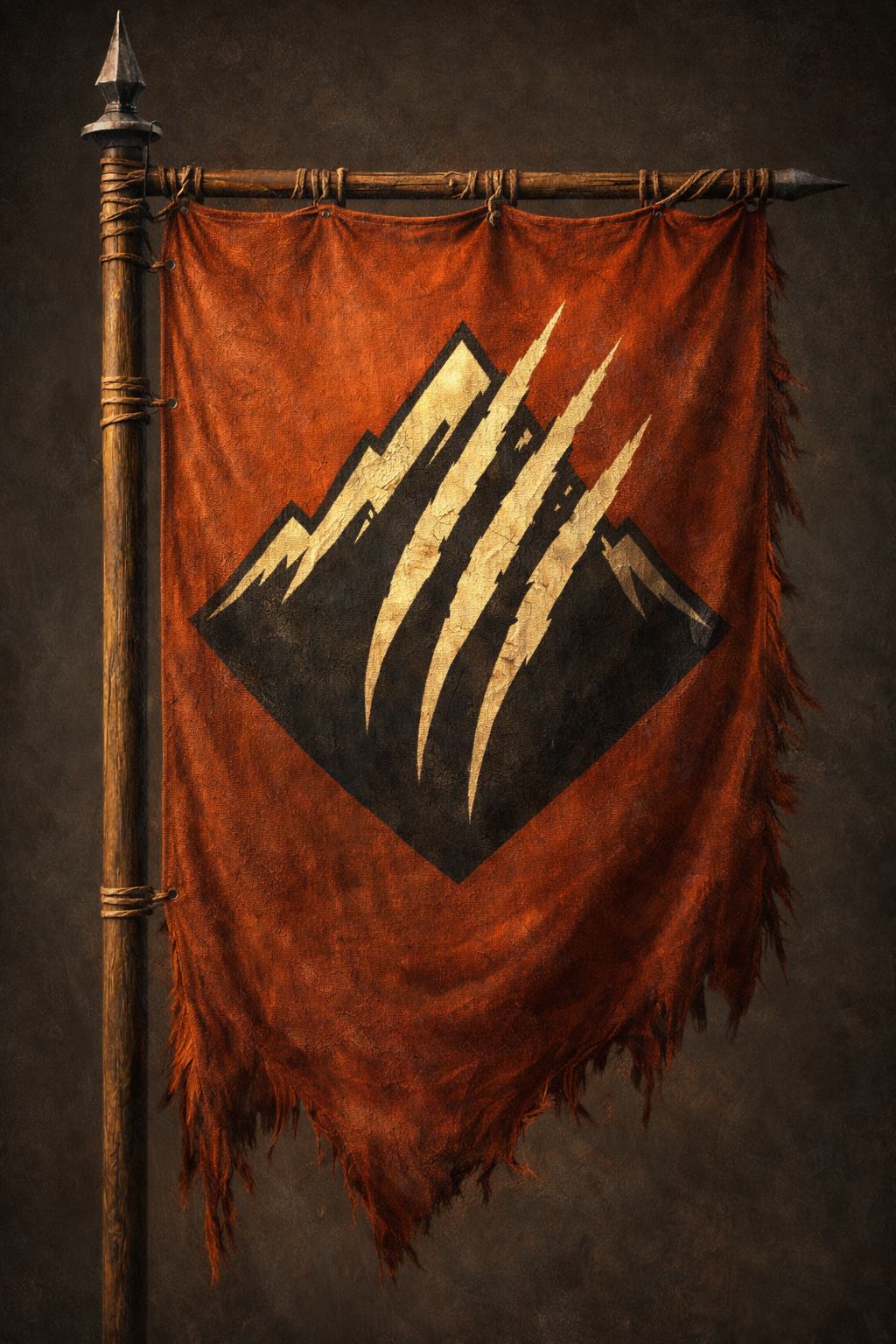
Kalros remains shaped by this history. Suspicion of centralized power runs deep, foreign rule is remembered as a wound rather than a chapter, and the right to bear one’s banner freely is treated as sacred. The nation exists not because the clans are the same, but because they chose, once, to stand together.
Demography and Population
Frost goliaths, snow elves, cervitaurs, and various planetouched peoples are fewer in number but hold culturally and strategically important territories. These groups often control difficult or resource-rich lands that discourage external settlement. Their lower population density is offset by strong territorial cohesion and long lifespans or physical resilience.
Kalros lacks large urban centers. Most of its population lives in small settlements, fortified villages, seasonal camps, or clan halls, rarely exceeding a few hundred individuals. Permanent towns are uncommon and usually located at trade crossroads, defensible passes, or coastal harbors. Population density fluctuates sharply throughout the year as clans migrate with herds, follow game, or retreat from inhospitable seasonal conditions.
Inter-clan mingling is common at borders, shared hunting grounds, and trade routes, but assimilation is rare. Mixed-heritage individuals exist throughout Kalros, particularly among long-standing border communities, yet cultural identity remains strongly tied to clan affiliation rather than ancestry alone.
Mortality rates in Kalros are higher than in more centralized nations, particularly due to climate, conflict, and limited access to centralized healing. Birth rates vary significantly by clan and species. As a result, population growth is slow and uneven, contributing to Kalros’ emphasis on endurance over expansion.
Despite its relatively low population, Kalros maintains a strong territorial presence. Its people are widely distributed, difficult to displace, and deeply rooted in their lands. Population strength in Kalros is measured not by numbers, but by the ability of its clans to endure hardship without collapse.
Estimated Demographics
Foreign Relations
Kalros maintains a cautious, guarded approach to foreign relations, shaped by memory of conquest and a deep distrust of centralized power. Diplomatic engagement is pragmatic rather than ideological. Kalros does not seek influence beyond its borders, nor does it attempt to export its way of life. Interaction with other nations is driven by necessity, threat mitigation, and limited economic exchange.
There is no permanent foreign ministry or diplomatic corps. External relations are handled through temporary envoys appointed by the Circle of Banners or, more commonly, by individual clans acting within their own interests. As a result, Kalros presents no single, consistent diplomatic voice. Treaties are often time-bound, narrowly scoped, and contingent on continued mutual benefit. Agreements made with one banner do not automatically bind another.
Relations with Valoria remain openly hostile despite the absence of active war. The legacy of occupation defines all interaction between the two powers. While a fragile non-aggression stance exists, trust is nonexistent. Border incidents, proxy conflicts, and covert interference are common, and both sides maintain readiness for renewed hostilities. Valorian diplomats are tolerated only under strict conditions and are rarely permitted to travel freely within Kalros.
Kalros’ relationships with other neighboring powers are uneven and highly situational. Some nations view Kalros as a useful buffer state or a source of mercenaries and raw materials. Others regard it as unstable, dangerous, or diplomatically unreliable. Kalros does little to correct these perceptions, valuing autonomy over reputation.
Trade with foreign nations is limited and conducted primarily through border settlements or neutral intermediaries. Kalros resists foreign economic dependence, particularly on centralized states, and clans are quick to sever trade relationships they perceive as exploitative or coercive. Long-term commercial agreements are rare and often collapse when political conditions shift.
Foreign military presence within Kalros is universally rejected. Even allied forces are viewed with suspicion, and any prolonged foreign deployment is likely to provoke armed resistance. Kalros’ tolerance for external influence ends where sovereignty begins.
In practice, Kalros survives internationally by being difficult to predict, costly to occupy, and resistant to long-term manipulation. Its foreign relations are defined less by alliances and more by deterrence, memory, and the understanding that Kalros answers only when it chooses to do so.
Founding Date
287 HE, marking the first recorded Gathering of Clans
Type
Geopolitical, Country
Alternative Names
The Clans of Kalros, Khal’Rhos, The Southern Marches
Demonym
Kalrosi
Ruling Organization
Government System
Tribalism
Power Structure
Confederation
Economic System
Barter system
Major Exports
- Furs & Hides – Thick pelts from tundra beasts, mountain predators, and herd animals. Highly valued for cold-weather gear, armor linings, and ceremonial cloaks.
- Hardened Timber – Slow-grown mountain and boreal forest wood, dense and resilient. Used for ship keels, longhouses, siege engines, and weapon hafts.
- Iron & Cold-Ores – Modest but reliable iron deposits and trace cold-infused ores extracted from foothills and highlands. Kalros iron is prized for durability over refinement.
- Stone & Granite – Quarried mountain stone used in fortifications, roads, and monumental construction. Frequently exported as cut blocks rather than finished works.
- Livestock & Draft Beasts – Hardy breeds adapted to cold, poor grazing, and long travel. Exported sparingly due to cultural value.
- Salted Meats & Preserved Foods – Jerky, smoked fish, cured game, and winter-stable rations produced for survival and long campaigns.
- Mercenary Contracts – Not an official trade good, but Kalros clans are known to export warriors, scouts, and survival experts through informal or clan-brokered agreements.
- Clan Craftworks – Practical, rugged goods such as tools, axes, shields, and winter gear. Functional rather than decorative, but respected for reliability.
Neighboring Nations
Related Plots


If they are so fiercely independent and don't inter-marry much, how do they avoid inbreeding issues? That seems to be their greatest long-term liability.
They don't assimilate as far as like... Orc clans vs human or werewolf packs, vs Zemanii tribes etc. There are various clans and tribes of different peoples of the same "type/species", and they will inter-marry to strengthen alliances and encourage diversity. A human from a mountain tribe might travel to a different human clan that lives and works coastal regions etc.
"Every story is a thread, and together we weave worlds."
The Origin of Tanaria