
Goliath
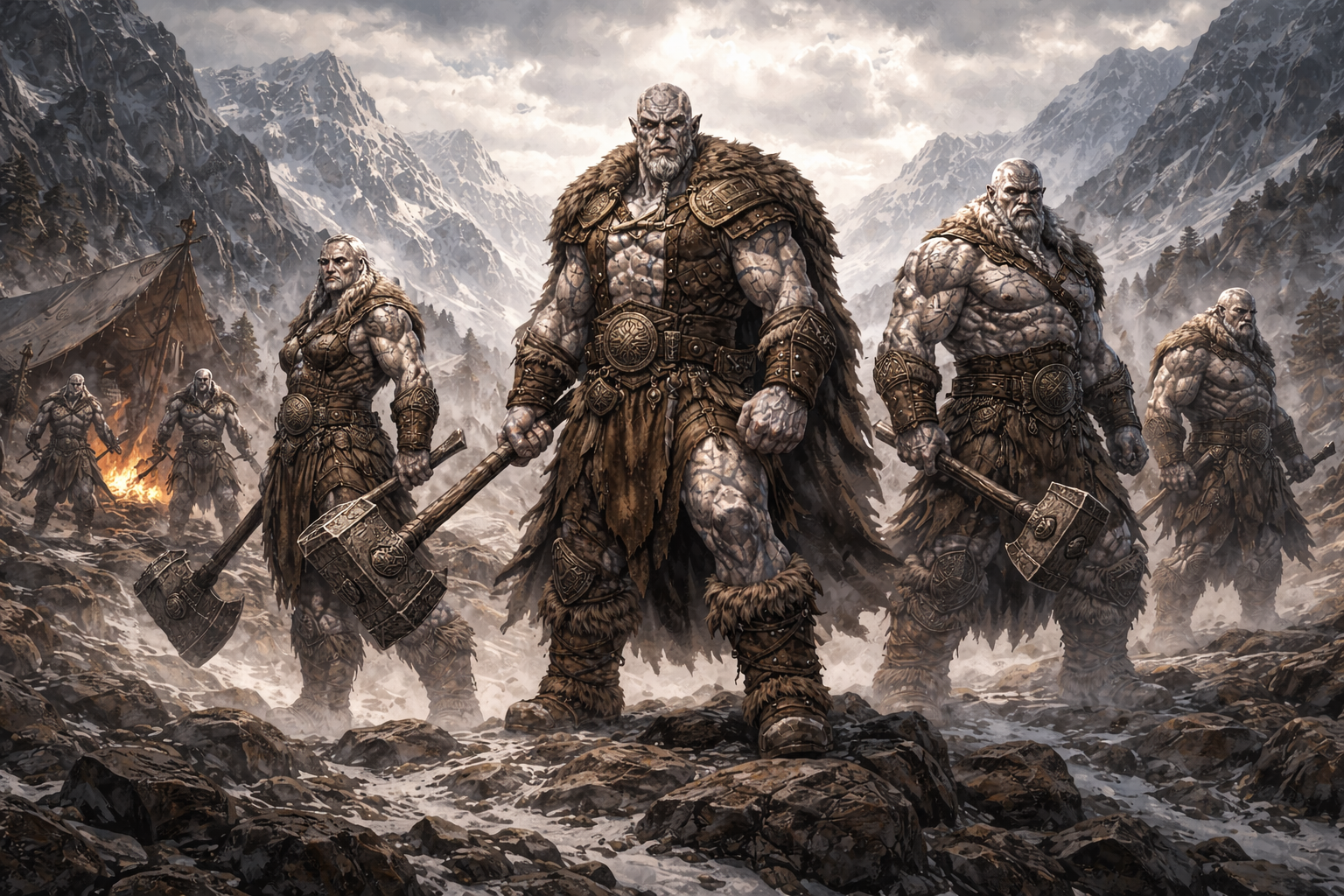
Tanarian Goliaths are not just big humanoids. They are a people shaped by altitude, isolation, and communal endurance. Size and strength matter, but what defines them culturally is reliability under pressure. A goliath is expected to endure, to hold, and to carry weight, literal or otherwise.
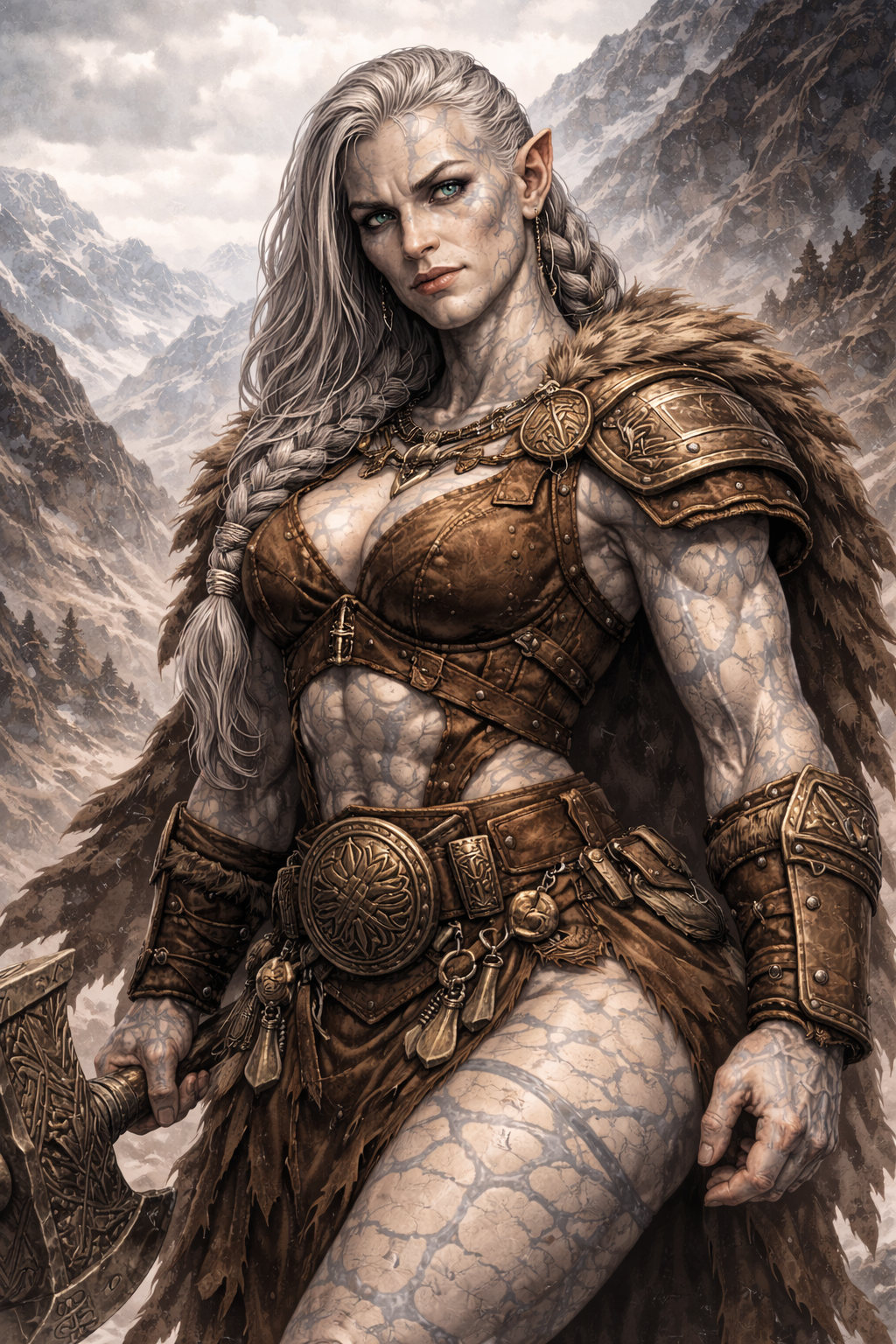
Physically, goliaths are towering humanoids with dense musculature, thick bone structure, and stone-like skin tones ranging from pale granite to deep slate, often marked by natural marbling or mineral veining. These markings are not tattoos; they are biological traits and are treated as identifiers of lineage, region, or personal history.
Goliaths mature slowly and live longer than most humanoid races, though not to elven extremes. Their societies value experience, repetition, and proven survival over innovation for its own sake.
Basic Information
Anatomy
Goliaths are massive humanoids, standing between 7 and 9 feet tall on average, with exceptionally dense musculature and skeletal structure. Their bones are thicker and heavier than those of most humanoids, granting them immense strength and resistance to blunt trauma but resulting in slower agility and reduced endurance in prolonged pursuits.
Their skin exhibits stone-like coloration and marbling, ranging from pale granite and ash-gray to deep slate and iron-dark hues. These markings are biological in nature, caused by mineral-rich dermal layers and pigment clustering, and often intensify with age. Scarring integrates seamlessly into these patterns, making age and battle history difficult for outsiders to distinguish.
Goliaths possess broad torsos, reinforced joints, and enlarged lung capacity, adaptations suited for thin air and extreme cold. Their cardiovascular systems are highly efficient, allowing sustained exertion at altitude where other humanoids would suffer hypoxia. Body hair is sparse but coarse, typically concentrated along the scalp, forearms, and jawline, with beards being common among males.
Sexual dimorphism is present but subtle compared to size variance within the species. Females are generally slightly shorter but no less robust, with comparable strength and endurance. Goliaths age slowly, reaching physical maturity later than humans but maintaining peak physical condition for a longer span before gradual decline.
Their physiology prioritizes resilience over speed. Goliaths are not built to chase prey, but to endure, to hold ground, and to carry burdens that would cripple other peoples.
Genetics and Reproduction
Goliaths are a sexually dimorphic, mammalian humanoid species with stable genetics adapted for extreme environments. Their physiology prioritizes durability, slow growth, and long-term survivability, which directly shapes their reproductive patterns and population dynamics.
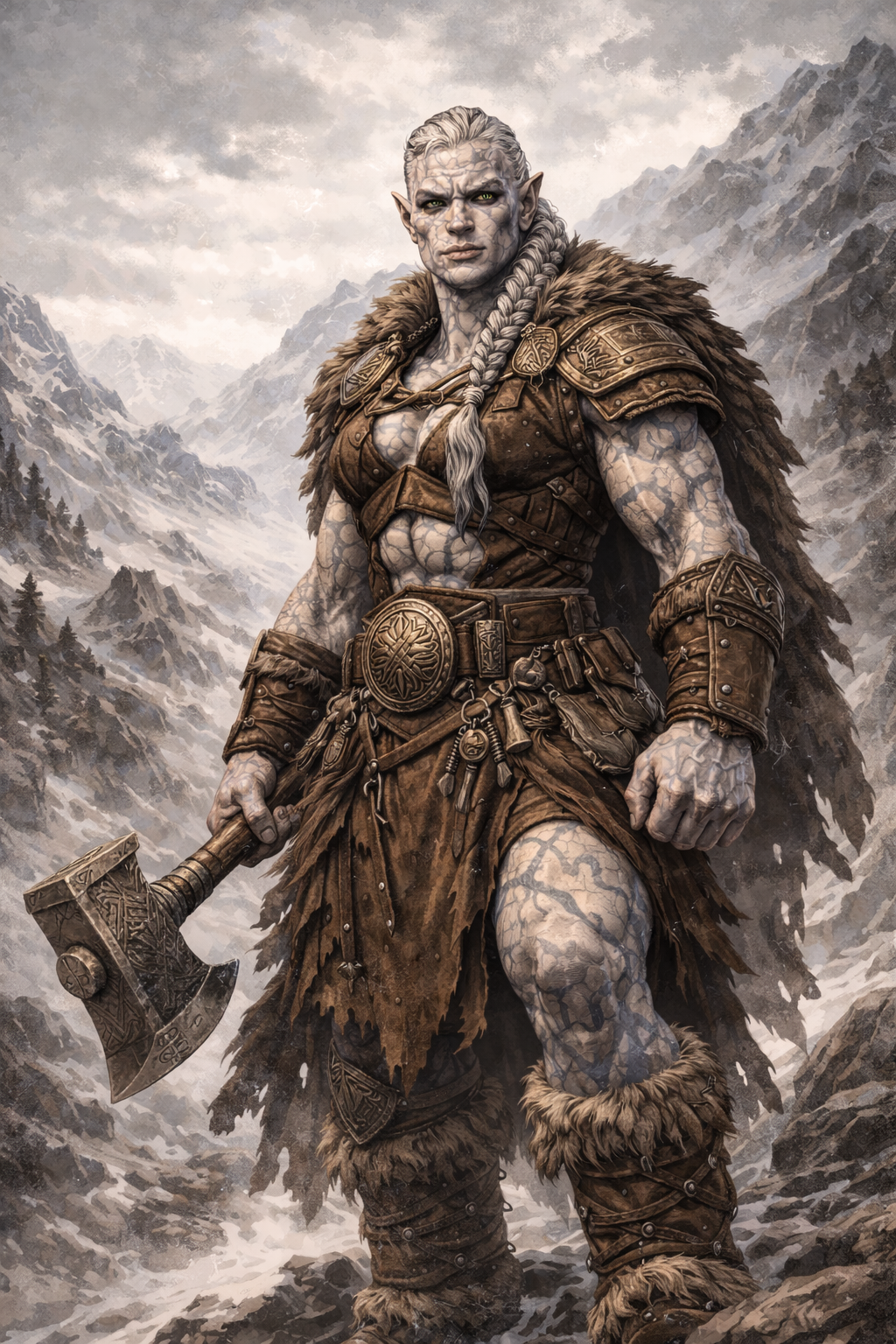 Goliath genetics are characterized by high skeletal density, reinforced connective tissue, and mineralized dermal layers. These traits are heritable and show relatively low variance across the species, suggesting long-term environmental pressure rather than recent magical alteration. Stone-like skin patterning is genetically encoded and influenced by both lineage and regional mineral composition, with coloration and veining often reflecting the dominant geology of ancestral homelands.
Hybridization with other humanoid species is biologically possible but rare. When it occurs, offspring tend to express diluted or unstable traits and often struggle with musculoskeletal development or environmental tolerance. As a result, most goliath cultures discourage interbreeding, not for ideological reasons, but due to the practical difficulties faced by mixed-heritage offspring.
Goliath genetics are characterized by high skeletal density, reinforced connective tissue, and mineralized dermal layers. These traits are heritable and show relatively low variance across the species, suggesting long-term environmental pressure rather than recent magical alteration. Stone-like skin patterning is genetically encoded and influenced by both lineage and regional mineral composition, with coloration and veining often reflecting the dominant geology of ancestral homelands.
Hybridization with other humanoid species is biologically possible but rare. When it occurs, offspring tend to express diluted or unstable traits and often struggle with musculoskeletal development or environmental tolerance. As a result, most goliath cultures discourage interbreeding, not for ideological reasons, but due to the practical difficulties faced by mixed-heritage offspring.
Reproductive Cycle
Goliaths have low fertility rates compared to humans. Gestation lasts approximately 11 to 12 months, reflecting the size and development needs of the fetus. Births are physically taxing but rarely fatal due to the robust physiology of goliath women and the presence of experienced midwives or elders trained in high-risk delivery. Pregnancy among goliaths is treated as a communal responsibility. Expectant mothers are temporarily relieved of the heaviest physical burdens but are not considered fragile. Light labor, training, and social duties continue well into gestation unless complications arise. Goliath children are born large and resilient but develop slowly. Early childhood is marked by rapid skeletal strengthening rather than motor refinement. Full physical maturity is not reached until the late twenties or early thirties by human reckoning. Cognitive development parallels this pace, with emphasis placed on observation, memory, and spatial awareness from an early age. Because of this slow maturation, goliaths place immense value on each child. Loss of offspring is rare but deeply impactful, and reckless endangerment of young goliaths is considered a grave cultural failing. Pair-bonding among goliaths is pragmatic rather than romanticized. Partnerships are formed based on compatibility, shared burdens, and mutual endurance. Long-term bonds are common but not universal, and dissolutions, while uncommon, are not taboo if both parties can no longer function effectively together. Children are typically raised within extended family units or clan groups rather than nuclear households. Biological parentage matters less than who bears responsibility for the child’s growth and survival.Population Control & Cultural Impact
Due to slow reproduction and low birth rates, goliath populations grow gradually and are highly sensitive to catastrophic loss. This has shaped their cultural emphasis on conflict containment, territorial stability, and long memory regarding wars or disasters that cost many lives. Goliaths do not expand rapidly, colonize aggressively, or replace lost populations quickly. When a goliath clan falls, it may take generations for its absence to fade from the land. In this way, goliath genetics reinforce their cultural philosophy: what is built must endure, because rebuilding is slow.Additional Information
Social Structure
Goliath society is organized around clans, each bound to specific territories, resources, and ancestral responsibilities. These clans are largely self-sufficient units, structured to survive prolonged isolation and extreme environmental pressure. Loyalty to one’s clan outweighs all other social bonds, including regional or national affiliations.
Leadership within a clan is functional rather than hereditary. While family lines carry weight, authority is granted to individuals who demonstrate reliability, physical endurance, and sound judgment over time. Leaders are expected to carry responsibility personally and visibly. A leader who avoids hardship or shifts burdens onto others quickly loses legitimacy.
Goliath clans are internally stratified by role rather than status. Hunters, wardens, builders, herders, warriors, and keepers of memory all hold essential positions. No role is considered lesser if it contributes meaningfully to survival. Physical inability does not strip status, provided the individual continues to serve the clan through teaching, planning, or caretaking.
Decision-making is typically collective and deliberate. Important matters are discussed among elders, experienced workers, and proven warriors rather than decided unilaterally.
Children are raised communally. Parentage is acknowledged, but responsibility for upbringing is shared among the clan. Training begins early and emphasizes endurance, observation, and repetition rather than formal instruction. Children who show weakness are not shamed but are guided toward roles suited to their capabilities.
Inter-clan relations among goliaths are cautious but stable. Alliances are long-term and rarely broken without significant cause. Feuds are uncommon, as the cost of prolonged conflict in hostile terrain is too high. When disputes arise, they are typically resolved through mediation, compensation, or controlled contests rather than open warfare.
Goliaths maintain minimal social hierarchy beyond functional necessity. There is little concept of nobility, wealth accumulation, or social climbing. Respect is earned through contribution and retained through consistency. Reputation is slow to build and slow to fade.
In essence, goliath society values endurance over ambition, stability over growth, and shared burden over individual success.
Geographic Origin and Distribution
Goliaths are primarily distributed across high-altitude and mountainous regions of Tanaria, where extreme terrain, thin air, and volatile weather limit the presence of most other humanoid peoples. Their settlements are typically found in places considered marginal or uninhabitable by lowland cultures, including alpine ranges, glacial valleys, wind-scoured plateaus, and high mountain passes.
The largest and most culturally influential goliath populations are found in southern Kalros, where Frost Goliath clans occupy the mountain chains and elevated highlands that form natural borders between clan territories. These regions serve as critical transit corridors and defensive strongholds, placing goliaths in long-standing roles as wardens of passes, neutral groundkeepers, and route guardians.
Smaller goliath enclaves exist beyond Kalros in other mountainous regions of Tanaria, particularly in areas with stable stone formations and long seasonal cycles. These populations are often isolated, maintaining limited contact with lowland nations and interacting primarily through trade caravans or seasonal migration routes. Such enclaves tend to develop localized cultural variations while retaining the core goliath emphasis on endurance and communal responsibility.
Goliaths are rarely found in lowland plains, dense urban centers, or tropical regions. Extended exposure to hot, humid environments places significant strain on their physiology, and their size and mass make densely populated settlements impractical. When goliaths do travel beyond their native ranges, it is usually for trade, warfare, or diplomatic obligations rather than permanent relocation.
Migration among goliaths is minimal. Clans are strongly tied to ancestral lands, and relocation is viewed as a last resort, undertaken only in response to environmental collapse, overwhelming threat, or formal invitation under oath. As a result, goliath populations remain geographically stable across generations, reinforcing their reputation as enduring fixtures of the regions they inhabit.
Average Intelligence
Goliaths possess below-average abstract intelligence compared to most humanoid peoples of Tanaria. They are slow to grasp complex theory, layered politics, and symbolic or academic systems of thought. This is widely attributed to their close evolutionary relationship with true giants, who are similarly known for limited intellectual flexibility.
Goliaths struggle with rapid problem-solving outside familiar contexts. Novel ideas, unfamiliar technologies, and intricate social maneuvering often require extended exposure before they are understood or trusted. As a result, goliaths are poorly suited to scholarly pursuits, arcane theory, or bureaucratic systems.
However, this does not render them incapable or foolish. Goliath intelligence is narrow but functional. They excel at concrete reasoning, repetition-based learning, and tasks with clear physical or environmental feedback. Memory for terrain, routine, and cause-and-effect outcomes is strong, while abstraction and speculation are weak.
Culturally, goliaths compensate for this limitation through collective decision-making and reliance on elders who have accumulated lived experience. They value certainty over cleverness and prefer proven methods to innovation. This makes them resistant to manipulation but slow to adapt when circumstances change rapidly.
Among other peoples, goliaths are often stereotyped as dull or slow-witted. While this perception is not entirely unfounded, it overlooks the fact that goliaths function effectively within the narrow parameters their environment demands. In places where survival hinges on endurance rather than intellect, intelligence beyond what is necessary is viewed as excess.
Perception and Sensory Capabilities
Goliath sensory perception is adapted for survival in extreme, open, and vertical environments. While their senses are not exceptionally acute by elven or predatory standards, they are highly reliable under stress, functioning consistently in conditions that degrade or overwhelm other humanoids.
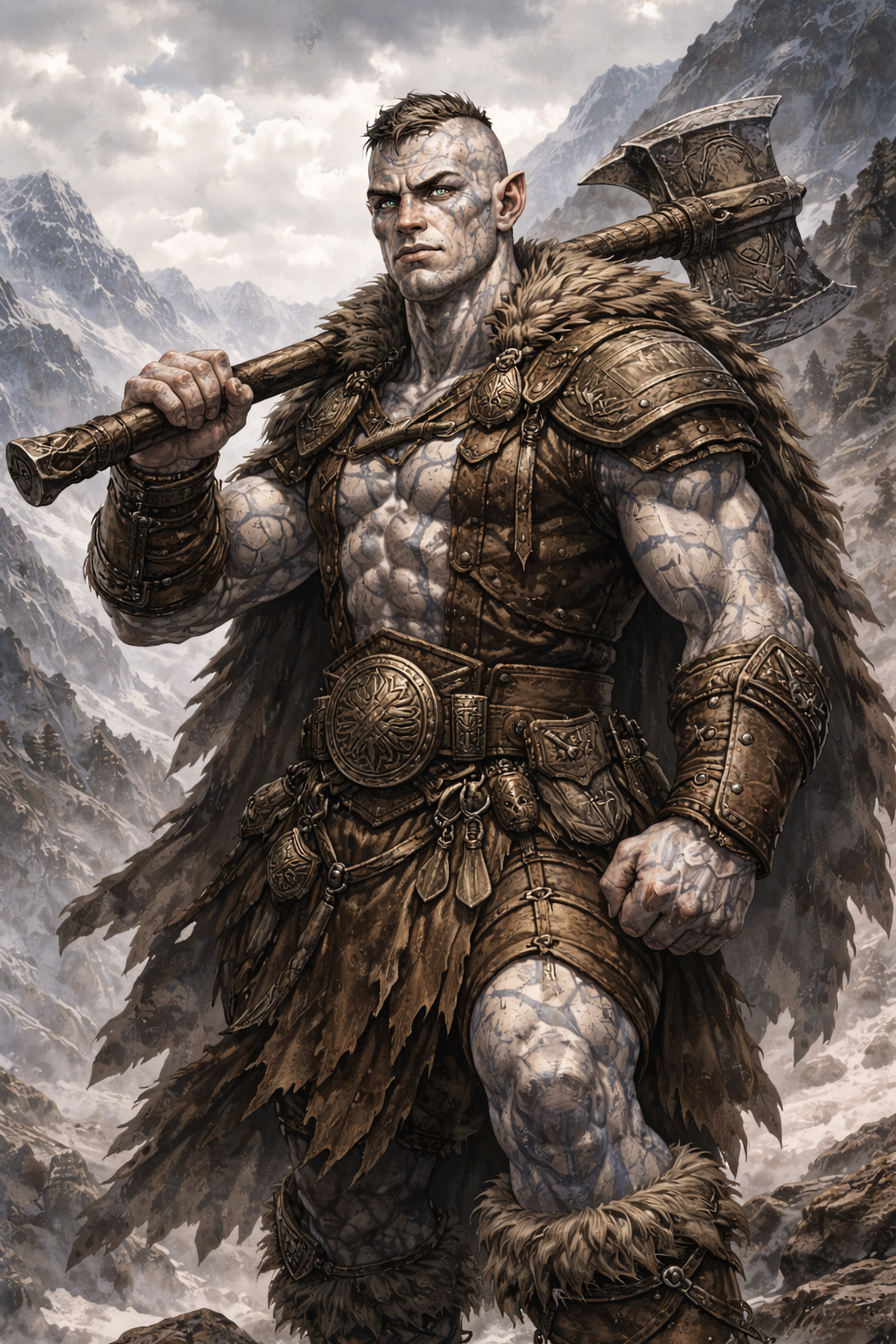 Vision in goliaths favors distance, contrast, and motion rather than fine detail. Their eyes are adapted to wide, high-altitude vistas, allowing them to track movement across long distances and distinguish shapes against snow, rock, and cloud cover. They perform well in low-light conditions common to mountain storms, overcast skies, and long twilight periods, but lack true darkvision. Instead, they rely on ambient light and silhouette recognition, making them effective sentries during dawn, dusk, and moonlit nights.
Hearing in goliaths is tuned toward low-frequency sound. They are particularly sensitive to deep vibrations such as rock shifts, avalanches, distant thunder, or the rhythmic footfalls of large creatures. This makes them adept at detecting environmental threats before they are visible. High-pitched or subtle sounds, such as whispered speech or small animal movement, are less easily perceived.
Olfactory capability is moderate. Goliaths can track strong or familiar scents over short distances, particularly in still air, but their sense of smell is not a primary survival tool. Cold, wind, and altitude significantly reduce scent reliability, and goliaths do not rely on it heavily.
Tactile sensitivity is heightened in the hands and feet. Dense nerve clusters allow goliaths to detect subtle changes in stone texture, ice stability, and structural stress through touch. This contributes to their reputation as skilled climbers and builders despite their size. They can often sense when a ledge, bridge, or structure is close to failure before visible signs appear.
In addition to conventional senses, many goliaths exhibit a low-level geosensory awareness, sometimes referred to by scholars as stone sense or ground memory. This is not true magic, nor does it grant active perception of thoughts or hidden beings. Rather, it manifests as an intuitive awareness of terrain stability, slope, and mass distribution. Goliaths instinctively know where footing is safest, when stone is under strain, or when a structure is poorly anchored.
This geosensory trait is believed to be a combination of evolved physiology and cultural conditioning rather than a supernatural gift. It does not function through solid barriers at distance, cannot locate creatures underground, and offers no advantage in non-terrestrial environments such as open water or air.
Goliaths do not possess innate extrasensory abilities such as telepathy, divination, or magical detection. Any individual displaying such capabilities does so through learned magic, divine blessing, or unique circumstance rather than racial inheritance.
Overall, goliath perception emphasizes awareness over acuity. They may not notice the smallest detail, but they are rarely surprised by large-scale change. Where others react, goliaths anticipate.
Vision in goliaths favors distance, contrast, and motion rather than fine detail. Their eyes are adapted to wide, high-altitude vistas, allowing them to track movement across long distances and distinguish shapes against snow, rock, and cloud cover. They perform well in low-light conditions common to mountain storms, overcast skies, and long twilight periods, but lack true darkvision. Instead, they rely on ambient light and silhouette recognition, making them effective sentries during dawn, dusk, and moonlit nights.
Hearing in goliaths is tuned toward low-frequency sound. They are particularly sensitive to deep vibrations such as rock shifts, avalanches, distant thunder, or the rhythmic footfalls of large creatures. This makes them adept at detecting environmental threats before they are visible. High-pitched or subtle sounds, such as whispered speech or small animal movement, are less easily perceived.
Olfactory capability is moderate. Goliaths can track strong or familiar scents over short distances, particularly in still air, but their sense of smell is not a primary survival tool. Cold, wind, and altitude significantly reduce scent reliability, and goliaths do not rely on it heavily.
Tactile sensitivity is heightened in the hands and feet. Dense nerve clusters allow goliaths to detect subtle changes in stone texture, ice stability, and structural stress through touch. This contributes to their reputation as skilled climbers and builders despite their size. They can often sense when a ledge, bridge, or structure is close to failure before visible signs appear.
In addition to conventional senses, many goliaths exhibit a low-level geosensory awareness, sometimes referred to by scholars as stone sense or ground memory. This is not true magic, nor does it grant active perception of thoughts or hidden beings. Rather, it manifests as an intuitive awareness of terrain stability, slope, and mass distribution. Goliaths instinctively know where footing is safest, when stone is under strain, or when a structure is poorly anchored.
This geosensory trait is believed to be a combination of evolved physiology and cultural conditioning rather than a supernatural gift. It does not function through solid barriers at distance, cannot locate creatures underground, and offers no advantage in non-terrestrial environments such as open water or air.
Goliaths do not possess innate extrasensory abilities such as telepathy, divination, or magical detection. Any individual displaying such capabilities does so through learned magic, divine blessing, or unique circumstance rather than racial inheritance.
Overall, goliath perception emphasizes awareness over acuity. They may not notice the smallest detail, but they are rarely surprised by large-scale change. Where others react, goliaths anticipate.
Civilization and Culture
Naming Traditions
Goliath names are functional identifiers rather than personal expressions. They are designed to be spoken clearly in harsh weather and over distance. Names favor hard consonants, simple syllables, and sounds that carry well across stone and open air.
A goliath’s full name is composed of three elements, though not all are used in daily speech.
Given Name
Given names are assigned shortly after birth by elders or caretakers and are intentionally simple. They often reference physical traits, natural phenomena, or qualities observed early in life. Reuse of names across generations is common and carries no stigma. Common given-name roots include:- Bor / Borr
- Krag / Kragg
- Tor / Torg
- Heth / Hadr
- Ulm / Ulmar
- Ska / Skarn
Clan Name
Clan names are inherited and immutable, tied to territory, ancestral duty, or defining historical events. In formal contexts, the clan name often precedes the given name. Examples of clan name meanings include:- Stoneward
- Frostbound
- Highmark
- Ironpass
- Gravepeak
Earned Names (By-Names)
Earned names are granted later in life to mark significant acts, enduring traits, or defining failures. They are never self-chosen and cannot be requested. Many goliaths never receive an earned name, and this carries no shame. Earned names may reference:- Survival of extreme hardship
- Long service to the clan
- A defining mistake or lesson
- A notable physical trait
- Stone-Shoulder
- Fellhold
- Lastwatch
- Cracked-Spear
- Winter-Kept
Naming Etiquette
Goliaths rarely use full names outside of formal gatherings or disputes. Outsiders are expected to use given names unless explicitly invited to use an earned name. Misuse or invention of earned names is considered a serious offense. Names are not gendered. Male and female goliaths draw from the same naming pool, with gender inferred by context rather than linguistic structure. In goliath culture, a name is not meant to impress. It is meant to endure.Gender Ideals
Goliath culture does not define worth, authority, or social role by gender. Survival in extreme environments demands capability over identity, and as a result, gender ideals among goliaths are functional rather than symbolic.
Strength, endurance, and reliability are valued traits in all goliaths, regardless of sex. While physical differences between male and female goliaths exist, they are not treated as indicators of social limitation. A goliath is judged by what they can carry, what they can endure, and whether they uphold their responsibilities to the clan.
Masculinity
Masculinity among goliaths is associated with bearing weight without complaint. Male goliaths are expected to contribute physically when able, to protect communal resources, and to accept responsibility without posturing. Aggression without purpose is discouraged, and dominance for its own sake is viewed as immaturity. Ideal masculine traits include:- Physical endurance and reliability
- Emotional restraint
- Willingness to shoulder long-term responsibility
- Protection of the vulnerable without expectation of praise
Femininity
Femininity in goliath culture is associated with stability, resilience, and continuity. Female goliaths are respected for their capacity to endure hardship, maintain communal bonds, and preserve knowledge through repetition and care. Physical strength is neither unexpected nor discouraged among women, and many serve as hunters, wardens, or warriors. Ideal feminine traits include:- Consistency and dependability
- Practical wisdom and memory
- Emotional steadiness under stress
- Commitment to communal survival
Gender Roles & Flexibility
Roles within goliath society are assigned by capability and need, not gender. Both men and women may lead clans, serve as elders, guard mountain passes, or act as mediators. Children are not raised with rigid expectations tied to gender, but are instead guided toward roles that suit their strengths. Goliaths place little emphasis on gender expression through clothing, ornamentation, or behavior. Dress is utilitarian, and social expectations prioritize function over presentation.Nonconformity & Social Response
Goliath culture has limited language for identity beyond physical sex, largely because personal identity is considered secondary to communal role. However, individuals who do not conform to typical expectations of masculinity or femininity are not stigmatized so long as they contribute meaningfully to the clan. What is condemned is not deviation, but refusal to carry one’s share of the burden. In goliath society, gender does not determine worth. Endurance does.History
The origins of the goliaths are closely tied to the ancient giantkin of Tanaria. Most scholars agree that goliaths descend from lesser Giant lineages that gradually adapted to life among the high mountains rather than the sprawling dominions once claimed by true giants. As giant civilizations fractured and declined, these smaller, hardier offshoots survived by abandoning conquest in favor of endurance.
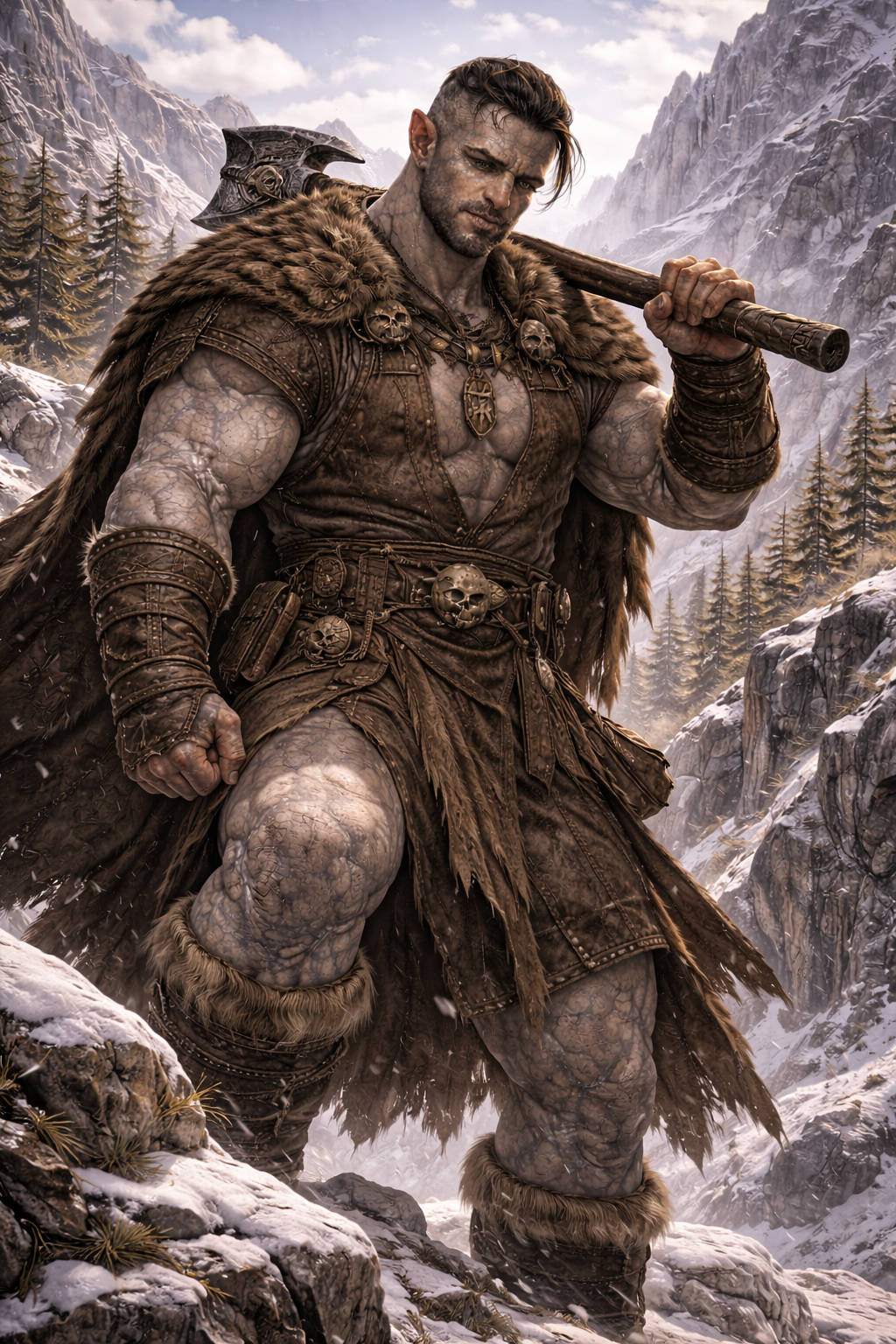 Early goliath communities formed in remote mountain ranges, where isolation and scarcity shaped their development. Cut off from fertile lands and major trade routes, they learned to survive through cooperation, repetition, and intimate knowledge of stone and weather. Over generations, these pressures favored physical resilience over intellectual or magical advancement, reinforcing the traits now characteristic of the race.
Unlike giants, goliaths never established empires or centralized realms. Their history is marked by absence rather than dominance. They endured where others failed, remaining in places that conquest-driven cultures found unprofitable or impossible to hold. As a result, goliaths were often overlooked or dismissed by expanding lowland nations, a circumstance that allowed their societies to persist largely unchanged.
Contact with other humanoid races increased as trade routes expanded into mountainous regions. Goliaths became known as wardens of passes, guides through dangerous terrain, and defenders of highland borders. While rarely aggressors, they proved devastatingly effective when threatened, earning a reputation as immovable and unforgiving opponents.
In Kalros, goliaths played a quiet but critical role during Valoria’s occupation. While not unified under a single banner, goliath clans resisted through attrition, denying safe passage, collapsing supply routes, and sheltering allied clans in terrain Valorian forces could not easily control. When the clans of Kalros united to reclaim their land, goliaths answered not with speeches or leadership, but with presence, holding ground until the war was decided.
In the modern era, goliaths remain largely unchanged. They do not seek expansion, cultural influence, or political power beyond what is necessary to protect their territories. Their history is not one of rise and fall, but of persistence. Where others measure time in dynasties and wars, goliaths measure it in stone, memory, and survival.
Early goliath communities formed in remote mountain ranges, where isolation and scarcity shaped their development. Cut off from fertile lands and major trade routes, they learned to survive through cooperation, repetition, and intimate knowledge of stone and weather. Over generations, these pressures favored physical resilience over intellectual or magical advancement, reinforcing the traits now characteristic of the race.
Unlike giants, goliaths never established empires or centralized realms. Their history is marked by absence rather than dominance. They endured where others failed, remaining in places that conquest-driven cultures found unprofitable or impossible to hold. As a result, goliaths were often overlooked or dismissed by expanding lowland nations, a circumstance that allowed their societies to persist largely unchanged.
Contact with other humanoid races increased as trade routes expanded into mountainous regions. Goliaths became known as wardens of passes, guides through dangerous terrain, and defenders of highland borders. While rarely aggressors, they proved devastatingly effective when threatened, earning a reputation as immovable and unforgiving opponents.
In Kalros, goliaths played a quiet but critical role during Valoria’s occupation. While not unified under a single banner, goliath clans resisted through attrition, denying safe passage, collapsing supply routes, and sheltering allied clans in terrain Valorian forces could not easily control. When the clans of Kalros united to reclaim their land, goliaths answered not with speeches or leadership, but with presence, holding ground until the war was decided.
In the modern era, goliaths remain largely unchanged. They do not seek expansion, cultural influence, or political power beyond what is necessary to protect their territories. Their history is not one of rise and fall, but of persistence. Where others measure time in dynasties and wars, goliaths measure it in stone, memory, and survival.
Interspecies Relations and Assumptions
Goliath interactions with other peoples of Tanaria are shaped by practicality rather than ideology. They neither seek dominance nor isolation for its own sake. Other races are judged by reliability, respect for territory, and behavior under hardship, not by lineage or reputation.
Humans
Relations with humans are cautious but functional. Goliaths recognize human adaptability and numbers as strengths, but view their short lifespans and rapid political shifts as liabilities. Human nations are often seen as unreliable long-term partners, prone to abandoning agreements once leadership changes. Individual humans who prove dependable, particularly guides, traders, or soldiers capable of enduring mountain conditions, are respected. Conversely, human authorities who attempt to impose law, taxation, or permanent settlement in goliath territory are met with firm resistance.Orcs
Goliaths share a mutual respect with orc clans, particularly those of Kalros. Both cultures value endurance, contribution, and strength proven through action rather than rhetoric. Conflicts do occur, usually over territory or resources, but are typically resolved through negotiation or controlled force rather than prolonged warfare. Orcs are regarded as volatile but honest. Goliaths find this preferable to subtlety or deception.Elves
Relations with elves are distant and strained. Goliaths find elven abstraction, long-term scheming, and emphasis on art or philosophy impractical. Elves, in turn, often view goliaths as unsophisticated or slow. However, mutual respect exists in matters of land stewardship. Snow elves and other cold-adapted elven groups maintain more amicable relations, particularly when shared territory requires cooperation rather than competition.Dwarves
Goliaths and dwarves maintain a relationship of measured respect. Both cultures understand stone, endurance, and generational responsibility, though they approach them differently. Dwarves favor mastery and refinement, while goliaths prioritize function and stability. Trade between the two is common, especially in tools, stonework, and infrastructure projects. Disagreements tend to arise over resource extraction, as goliaths are wary of over-mining and long-term damage to mountain stability.Other Peoples
Smaller or less physically imposing races are neither patronized nor underestimated. Goliaths are well aware that strength alone does not guarantee survival. Cleverness, magic, and numbers are treated as legitimate forms of power, though goliaths prefer to deal with those who wield such power openly. Those who respect goliath land, honor agreements, and understand the cost of mountain life are welcomed as allies. Those who exploit terrain, break oaths, or treat goliaths as obstacles rather than people are removed. In all cases, goliath interspecies relations are governed by a single principle: endure together, or do not stand at all.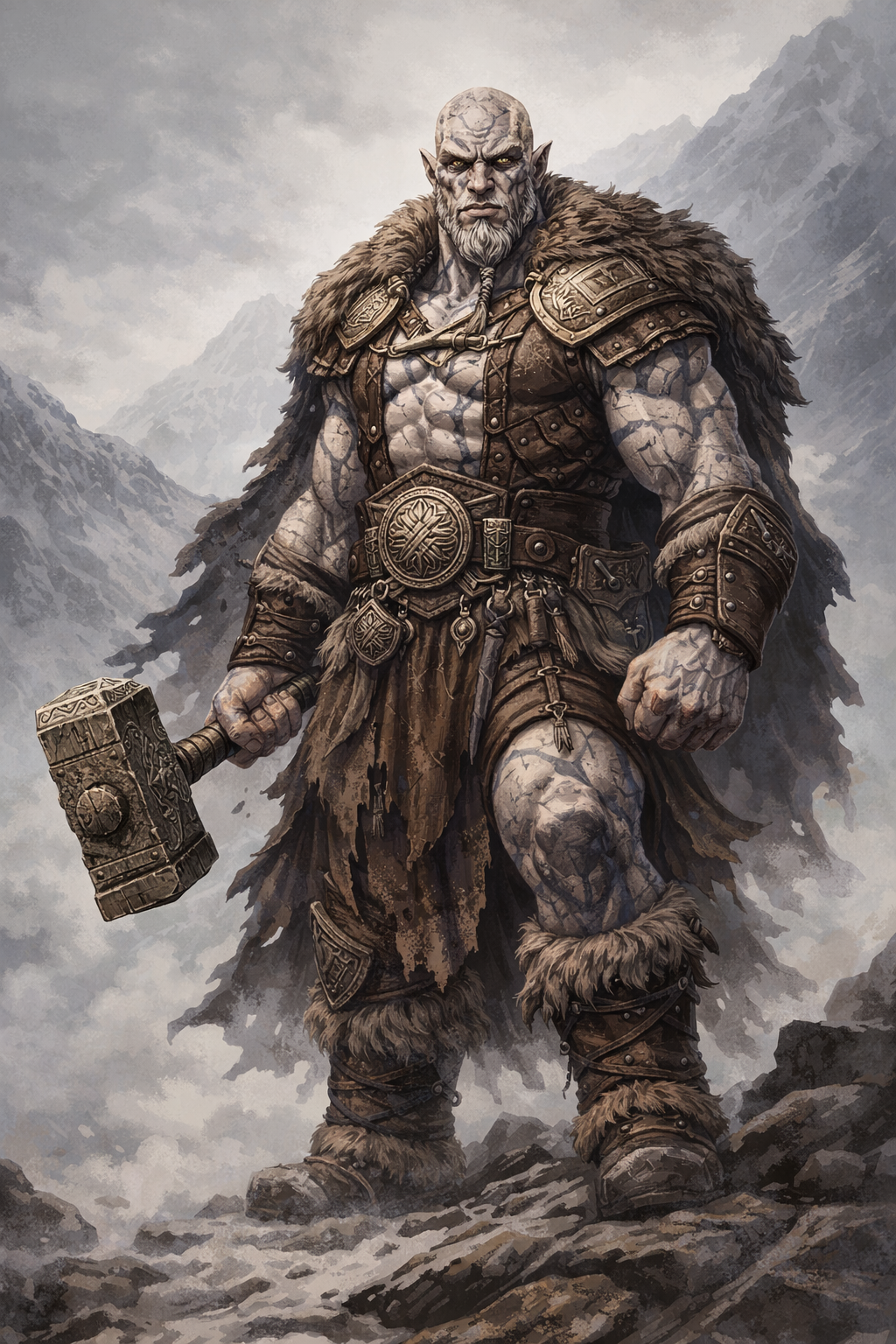
Genetic Ancestor(s)
Scientific Name
Gigantor montanus Sapiens
Lifespan
90 to 120 years
They mature slowly, reaching full physical adulthood later than humans, but maintain peak strength and endurance for a longer portion of their lives.
They mature slowly, reaching full physical adulthood later than humans, but maintain peak strength and endurance for a longer portion of their lives.
Conservation Status
Stable (Regionally Isolated)
Goliath populations are naturally low-density due to environmental constraints, long maturation periods, and limited habitable territory. However, their numbers are stable within their native ranges, and no evidence suggests a widespread population decline.
Goliath populations are naturally low-density due to environmental constraints, long maturation periods, and limited habitable territory. However, their numbers are stable within their native ranges, and no evidence suggests a widespread population decline.
Average Height
7 and 9 feet (2.1–2.7 m)
Average Weight
300 and 450 pounds (136–204 kg), with weight distributed through dense musculature and reinforced bone rather than bulk alone.
Average Physique
Goliaths possess an exceptionally robust and powerful physique, markedly exceeding that of most humanoid species. Their bodies are built for raw strength, load-bearing, and environmental endurance rather than agility or refinement. Broad shoulders, thick torsos, and heavily muscled limbs are universal traits, giving goliaths a naturally imposing silhouette even among other large races.
Musculature in goliaths is dense and efficient, favoring short-burst power and sustained exertion over speed or flexibility. They are capable of carrying immense weight for long periods, bracing structures, and performing repetitive physical labor without rapid fatigue. Fine motor coordination exists but is less precise than in smaller-framed species, particularly in tasks requiring delicate manipulation.
Bone density is significantly higher than in humans or orcs, contributing to both their great mass and their resistance to physical trauma. Joints are reinforced but somewhat inflexible, limiting extreme ranges of motion. As a result, goliaths are poor at evasive movement, acrobatics, or rapid directional changes.
Fat distribution is minimal, even in well-fed individuals. Goliaths maintain a naturally lean but heavily muscled build, with excess energy typically converted into muscle or stored for survival rather than visible fat. Physical condition declines slowly with age, and even elderly goliaths retain considerable strength relative to other species.
Overall, the average goliath physique is brutal, durable, and utilitarian. Their bodies are tools shaped by harsh environments, optimized to endure strain and punishment rather than elegance or speed.
Body Tint, Colouring and Marking
Goliaths display a narrow but distinct range of natural skin coloration and markings, shaped by genetics, environment, and lifelong physical stress. Their appearance is often described as stone-like, though goliaths are fully biological in nature.
Base skin tones range from pale granite and ash-white to slate gray and iron-dark hues, with regional variation reflecting local geology. Frost Goliaths tend toward lighter coloration, while those dwelling in mineral-rich or volcanic regions develop darker or warmer undertones.
Most goliaths develop dermal mineralization patterns, appearing as vein-like marbling or fractured lines across the skin. These markings are not tattoos, paint, or magical sigils. They are caused by trace mineral deposits absorbed over time through diet, water, and prolonged contact with stone, which settle within the outer dermal layers as the skin thickens and regenerates.
The expression of these markings is partially genetic and partially environmental. Lineage influences density and distribution, while terrain and lifestyle determine coloration and prominence. Patterns often follow muscle groups, joints, and areas of repeated strain or past injury, becoming more pronounced with age and physical labor. Young goliaths typically show faint or minimal marbling, while elders and seasoned warriors display complex, highly visible patterns.
Among goliaths, these markings are read as indicators of endurance and experience. Deep, well-defined marbling is considered a sign of resilience and is often regarded as attractive. Smooth or lightly marked skin is associated with youth or limited exposure to hardship rather than shame.
Artificial alteration of these markings is culturally taboo. Painting, carving, or magically enhancing mineral patterns is viewed as misrepresenting burdens not borne and is treated as a serious social offense.
In goliath culture, the body serves as a living record. Their skin carries the memory of the mountains they endure.
Geographic Distribution
“We do not conquer the mountain. We learn where it will hold us, and we build there. Those who rush break first.”


Comments