
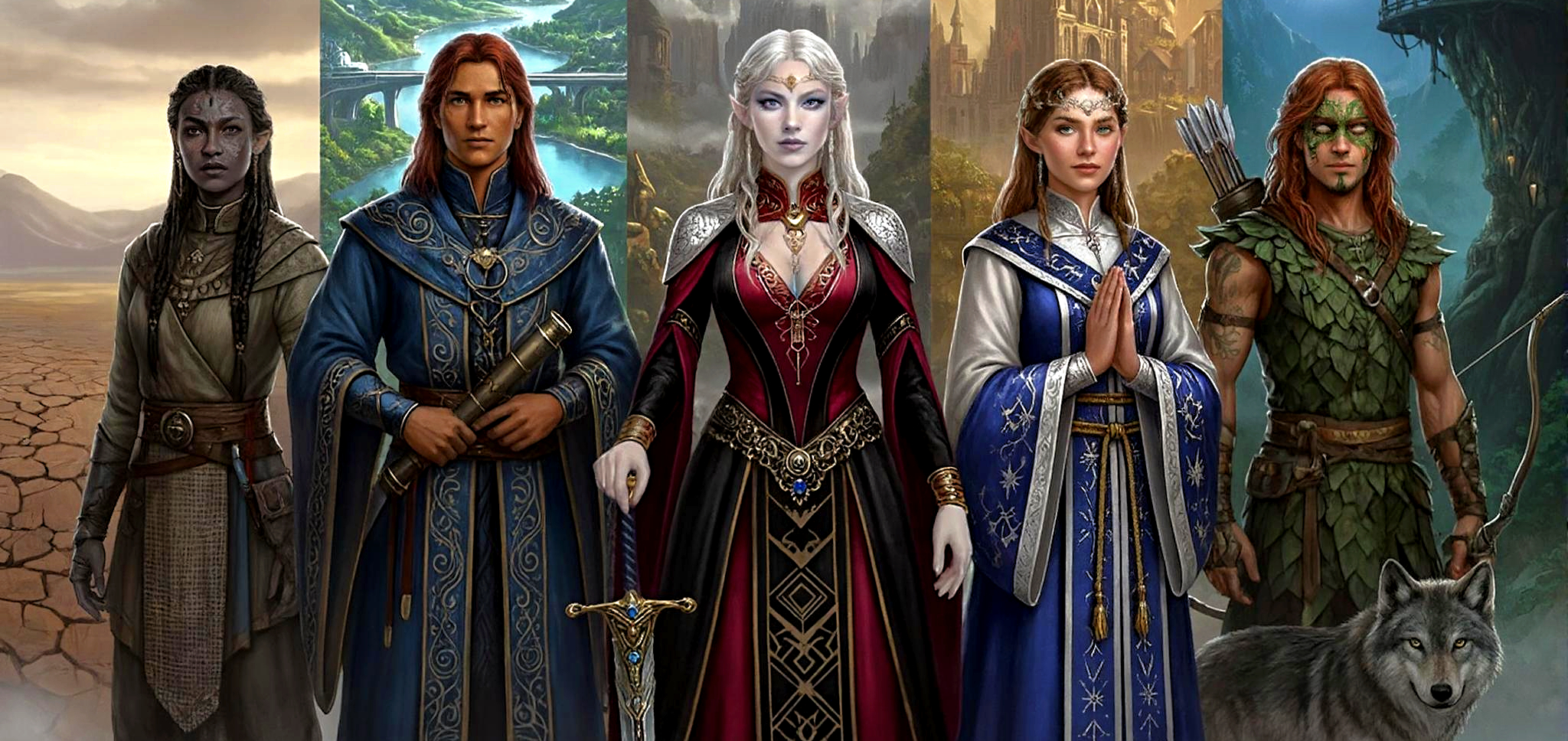
Shandaryn, the First Peoples (SHAN-drin)
The shandaryn are a race of sentients created by the Sisters to bridge the communication gap between the orfian and the Scales. They possess humanoid features, retain the sharp facial features and pointed helix of the orfian, and are said to have a lifespan longer than dragons.
They quickly evolved to become the foundational model for humanoid civilization across Aithyris. To delve into the intricate history, politics, timekeeping, and unique customs of their various societies, explore more of Shandaryn Civilization and Culture.
(The following article was written by the Chronicler of the Silver Blade)
The Blood and the Bond:
On the First Flowering
To speak of the shandaryn is to speak of time itself. Their history is a great, slow river, and those who live for a mere century or two are but leaves floating on its surface for a season.
From their very first "flowering"—as their own poets call that distant genesis—they have spread across the world, a patient people whose existence is woven into the very fabric of the Eternal Song. The oldest chronicles, those I studied long ago in the dusty silence of the Aula a'Vespri, tell us they first emerged in the lush woodlands of what would become the great kingdom of Sinda'lar.
It was there, near the banks of the Rhudira River, that the Firstborn opened their eyes to the light of the Father, and the long march of history began.
Basic Information
Biological Traits
On the Vessel and the Mask
In my long life as a chronicler, I have found that to truly understand a people, one must look beyond their grand histories and into the subtle truths of their very being. As one who carries their blood, I have had a unique vantage from which to observe the shandaryn, and there are certain physical truths that define them.
To a human eye, a shandaryn might at first seem familiar. They stand of a similar height, though they are creatures of air and wire where humans are of earth and brawn. Do not mistake their delicate, wispy builds for fragility. They are not built to hoard the heavy stores of flesh that burden the short-lived; they are efficient vessels for the Inner Light that sustains them, leaving no room for the accumulation of unnecessary weight.
Their features are etched with a sharper hand—angular and defined. Their hair and eye colors span our spectrum but burn with a richer, more vibrant intensity. Among the most ancient of their kind, the Elowyn. I have even seen their skin and hair take on the subtle green and blue hues of the forests and seas they call home.
Yet, the surest sign of their nature lies in the Mask—that subtle flush of color around the eyes that betrays the profound emotion they fight so hard to discipline. And while a shandaryn of five hundred years might wear the unlined face of a human of thirty, look to their eyes. There sits the weight of ages. It is a depth, a wisdom and sorrow that cannot be faked, a quiet testament to all they have seen in their long, slow walk through history.
Genetics and Reproduction
On the Sacred Geometry of Life
In my long life, I have learned that the greatest difference between humans and shandaryn is not the span of their years, but their relationship with the very act of creation. For humans, birth is a common and frequent joy, a seasonal rhythm of life. For the shandaryn, it is a rare, profound, and sacred expenditure of their inner Light—an event that shapes their families and their entire society in ways we can only begin to comprehend.
A shandaryn woman, I am told, will typically carry children only once in her long life. It is a blessed condition, but one of immense cost. From this rarity comes their most unique and mystical gift: the Birthbond.
It is the natural way of their people to conceive not one life, but two, in a single moment of union. Yet they are rarely born together. The first arrives, and the second waits, locked in a miraculous stasis within the mother until the season turns. Though they may be born years apart, they are twins in spirit, bound together in a way humans can only guess at. They are not merely siblings; they are two halves of a single whole, their very soul-songs tuned to the same key. It is an unspoken language, an instinctual connection that transcends distance.
While a single birth—what they call a Freebirth—is possible, it is seen as a rare and poignant exception to the natural order, a melody missing its harmony.
The first sign of this miracle is beautiful and mysterious. Soon after conception, an intricate pattern of lines, like a living tapestry, appears upon the mother's abdomen. They call it the Flowering. It begins as a faint blush of color that matches the mother’s Mask and slowly expands into a complex web of swirls and lines, a sacred map of the life growing within.
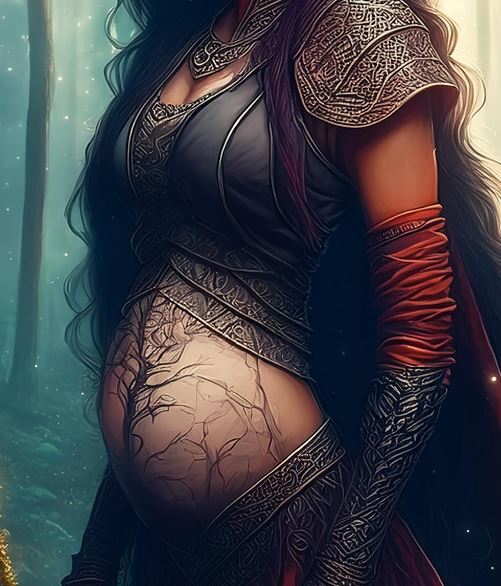
A shandaryn woman at about five months into a pregnancy.
The wisest among their healers can read these patterns as one reads a map, claiming to understand the nature, the health, and even the lineage of the unborn. A similar, smaller flower appears on the newborn, a mark of their heritage that only fades as they reach the threshold of puberty.
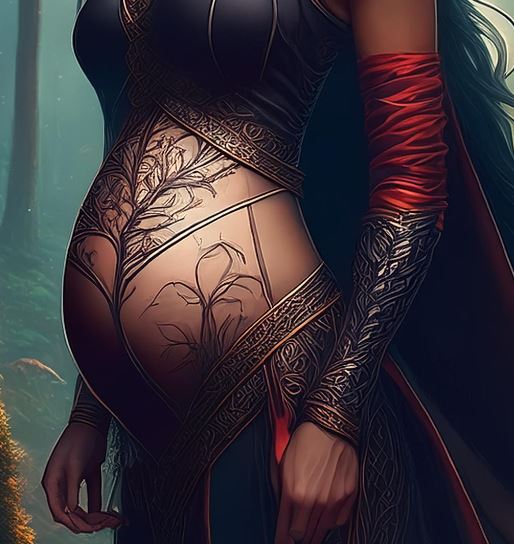
A shandaryn woman at about eight months into a pregnancy.
This beautiful process, however, takes a great toll. The strain of childbirth is immense for a shandaryn mother, taxing her inner Light to its limits. It is for this reason that their culture has embraced the shalarra.
Few mothers raise their children alone beyond the first Arc. Instead, the young are entrusted to these communal sanctuaries. It is not merely a custom, but a necessity. The shandaryn child grows in mind faster than in body; by thirty, they have the intellect of a scholar but the hormones of a child. The shalarra provides the discipline and peerage they need to survive this long, awkward twilight of youth.
It is an act of profound trust and collective love, born from a deep biological necessity—one that I, as a shin'misal who grew too fast for such a world, could only watch from the outside.
Biological Cycle
On the Rhythm of the Arc
Time does not hunt the shandaryn as it hunts us. For the races of men, life is a frantic, fleeting spark; for my mother's kin, it is a grand and patient clock, measured not in years, but in Arcs.
They mark their lives by this nine-year span, the time between each Sunless Passage—those rare, held-breath moments on the deepest winter solstice when the moon Selyne blots out the sun for hours on end. To live for seventy or eighty Arcs—nearly seven hundred of our solar years—is a full and common life for them. The few who endure to see their eighty-first Arc are granted the title Skaylar, "Venerable Soul," their hair turned to spun silver by the sheer weight of their wisdom.
This long view shapes their very nature. A shandaryn is not considered a true adult until they have seen nine full Arcs—eighty-one years. They call this threshold Ascension. Before this, despite their bodies growing strong, their spirits remain as reckless and emotional as any human youth. It is why their elders wisely guard them from the wider world, sequestering them in the shalarra until the storm of their long adolescence breaks.
After Ascension, they settle into a deep, contemplative patience that humans often mistake for aloofness. Their long lives grant them the time for a kind of perfectionism that is both a marvel and a burden; they are forever refining their work, be it a poem or a treaty. Yet, I have often seen them look with a strange envy at the quick, intuitive leaps of a sharp human mind, realizing that sometimes, a shorter candle burns brighter.
But it is in their end that their unique nature is most profoundly revealed. They do not fear the dark as we do. The Vesprian faith speaks of a gentle "Passing," a mystical departure where a soul is called home by the Sister Asharavae. Their funeral rites, the great pyres that burn so brightly at dusk, are not acts of destruction, but beacons—lit to guide the Sister of Flame as she carries the fallen across the Arc of Starlight.
Additional Information
Facial characteristics
On the Architecture of Truth
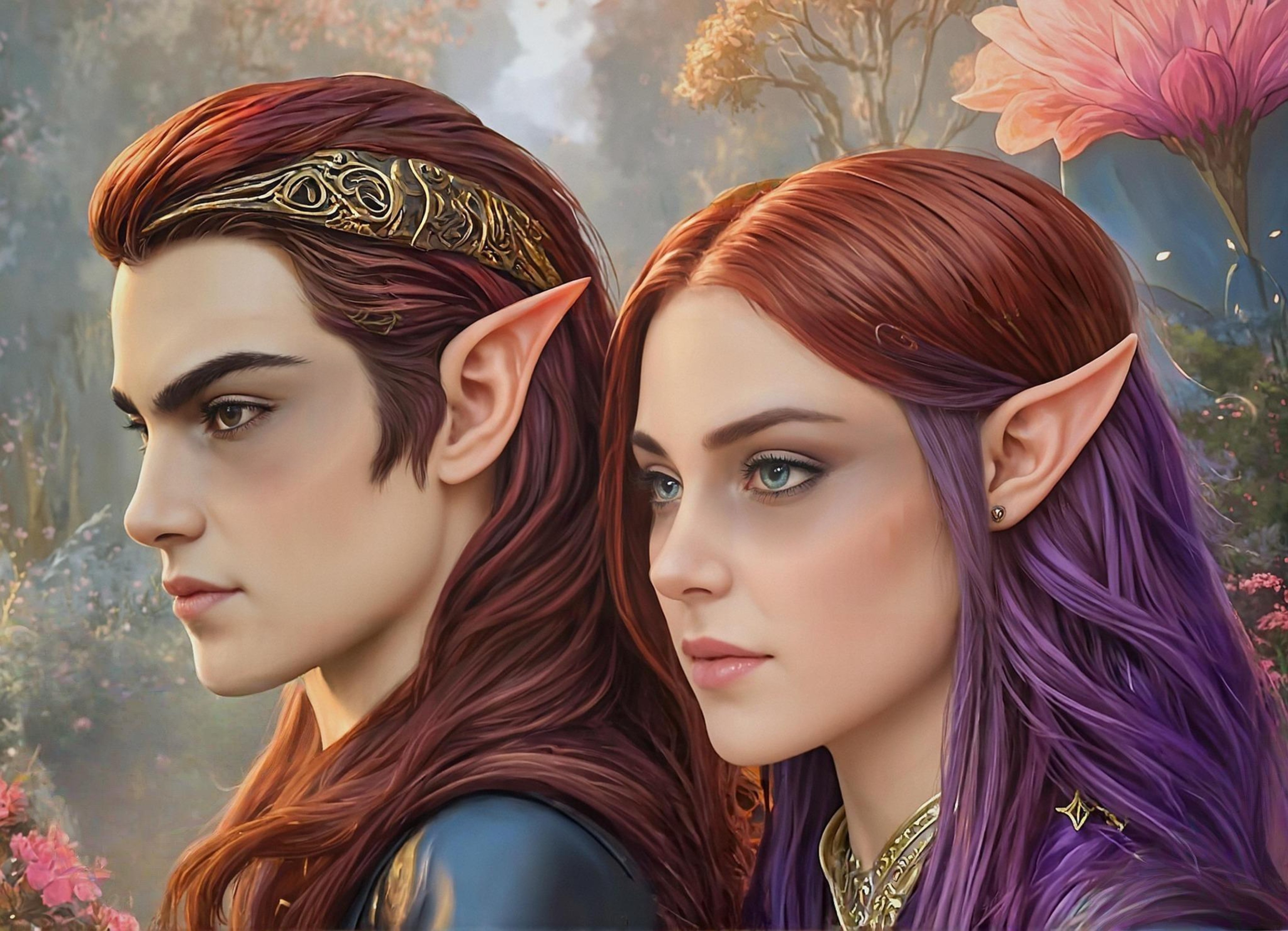
The most remarkable feature of the shandaryn is not their strength, but their absolute lack of privacy. Look closely at their faces, and you will see the Mask—a subtle shadowing of the complexion around their eyes and temples. This is no simple cosmetic difference; it is an involuntary window to their soul. Any profound emotion—from stress to deep affection, or even the flicker of a dishonest thought—causes the Mask to darken. They read these shifts as keenly as any body language, making true deception a difficult art. Indeed, hiding one's Mask is often a matter of survival, for the intensity it displays is a stark signal of the person's vulnerability.
And then there are their ears. Any who have studied the history of the Fey know a pointed helix is not unique, but the shandaryn’s is distinct. It is a mark of ancient lineage, attributed in myth to the touch of Learyth, Sister of Wind. It is not a simple, skyward spike, but a graceful curve that falls backward. This curve reveals a delicate, telling distinction between the sexes:
- The helix of a shandaryn male is typically bent back to a line nearly parallel with the ground—the Horizon Vector. It aligns with the eye's sightline, lending him an aerodynamic, vigilant profile.
- For a shandaryn female, the point carries a slighter, more pronounced upward angle—the Celestial Vector. This subtle sweep distinguishes her silhouette.
It is a cruel irony of history that this elegant, deliberate mark of their divine form has also been the very thing their bitter enemies have sought to claim as brutal trophies of war, reducing a sign of divine artistry to a crude, vile measure of victory.
The image below represents the stereotypical "perfect world" average of shandaryn helix morphology and the extent of a fully flushed mask. The subtle variation within each is as individual as fingerprints.
Perception and Sensory Capabilities
On the Heart’s Unlocking and the Price of Sensation
To understand the shandaryn is to understand that they are not merely in this world; they are of it, sustained by the very music of Aithyris. Their vitality comes not from the brute consumption of food, but from their Inner Light, drawn from the great Father in the sky and the living world around them.
This essence dictates their very form: their bodies are slight and willowy, built as efficient conduits for Light rather than vessels for muscle, granting them their characteristic resilience and the scornful, short-sighted human label of "wisps". This inner Light burns within them, granting a thermal layer that shields them from the cold and a subtle warmth they can share through a simple touch.
The Burden of Connection
Their senses are tuned to a finer key than any human. Their sight can drink in the soft radiance of a moonless night and see as if in midday brightness. But it is their Emotional Sensitivity that defines them. They feel the emotional state of others as keenly as we feel the wind on our skin. This constant influx of sorrow and joy is why they cultivate their famous aloofness; they must shield themselves, lest they be overwhelmed by the sheer, chaotic noise of the outside world. This sensitivity, however, grants them an uncanny wisdom, for they can reliably distinguish the very blood-signature of another soul, knowing at a glance if they are kin, half-kin, or utterly foreign.
The Lock and the Key
This deep connection to emotion finds its most profound expression in their most intimate bonds. It is a fundamental truth of their biology: a shandaryn union is an act of absolute physiological surrender.
Their bodies are a testament to this, for physical union is only possible when the female’s inner self is opened. This occurs in a moment of true, overwhelming desire—or a state of deep, consuming emotional vulnerability. This emotional cascade is outwardly reflected in the darkening of their facial Mask. A "full and deep Mask" is a cruel, biological billboard, a completely valid predictor of physical access.
This is why their culture is so rigid. To a shandaryn woman, a casual touch is a risk. Their emotional stability is the lock protecting their body. This truth forces their infamous stoicism; they must suppress their feelings not to be cold, but to keep their bodies sealed against the chaos and predation of the world.
The Season of Volatility
When a shandaryn enters the Bloom (at the fifth to seventh Arc), this intense emotionality is magnified. Their bodies are flooded with a demanding biological imperative to reproduce. They are not merely interested in the act; their heightened senses make sexual union an intense, almost narcotic experience—a sensation they cannot just walk away from until the act is completed.
This is why arranged political marriages often failed for our kin. Their hearts and their bodies are one, and they cannot give one without the other. It is a truth of their nature that is both beautiful and, in a cruel world, a terrible vulnerability.
The Saga of the Silver Blade begins!
Read Excerpts
Available now!
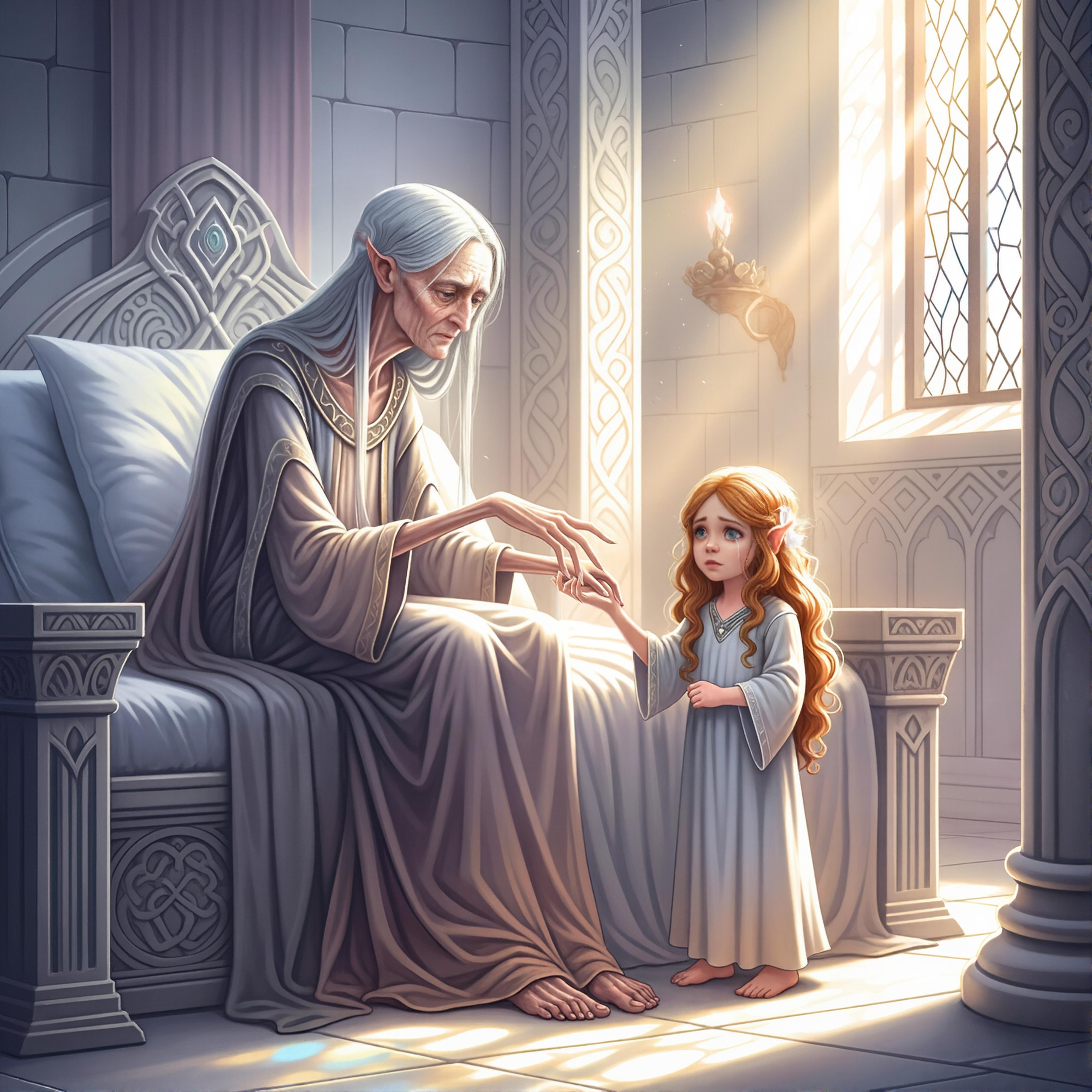
An artists conception of the ancient Qyen Carielyn of Vespria with the young Krysaalis a'Ciermanuinn.
Vital Characteristics
Longevity and Lifespan: They are long-lived, with their age traditionally measured in Arcs, a unit of time equating to nine solar years.
Physical Traits: They possess refined, humanoid features, often with a heart-shaped face, high cheekbones, and pointed helices (ears).
The Mask: Their skin displays a unique physiological response called the Mask, a temporary flush of color (from ashy grey to pearlescent) across the face that visually betrays their emotional state.
Empathy and Connection: They possess a natural empathic ability to fully sense the emotions of others upon physical contact.
Birth Structure: Shandaryn births often result in twins, with many sharing an unbreakable birthbond.
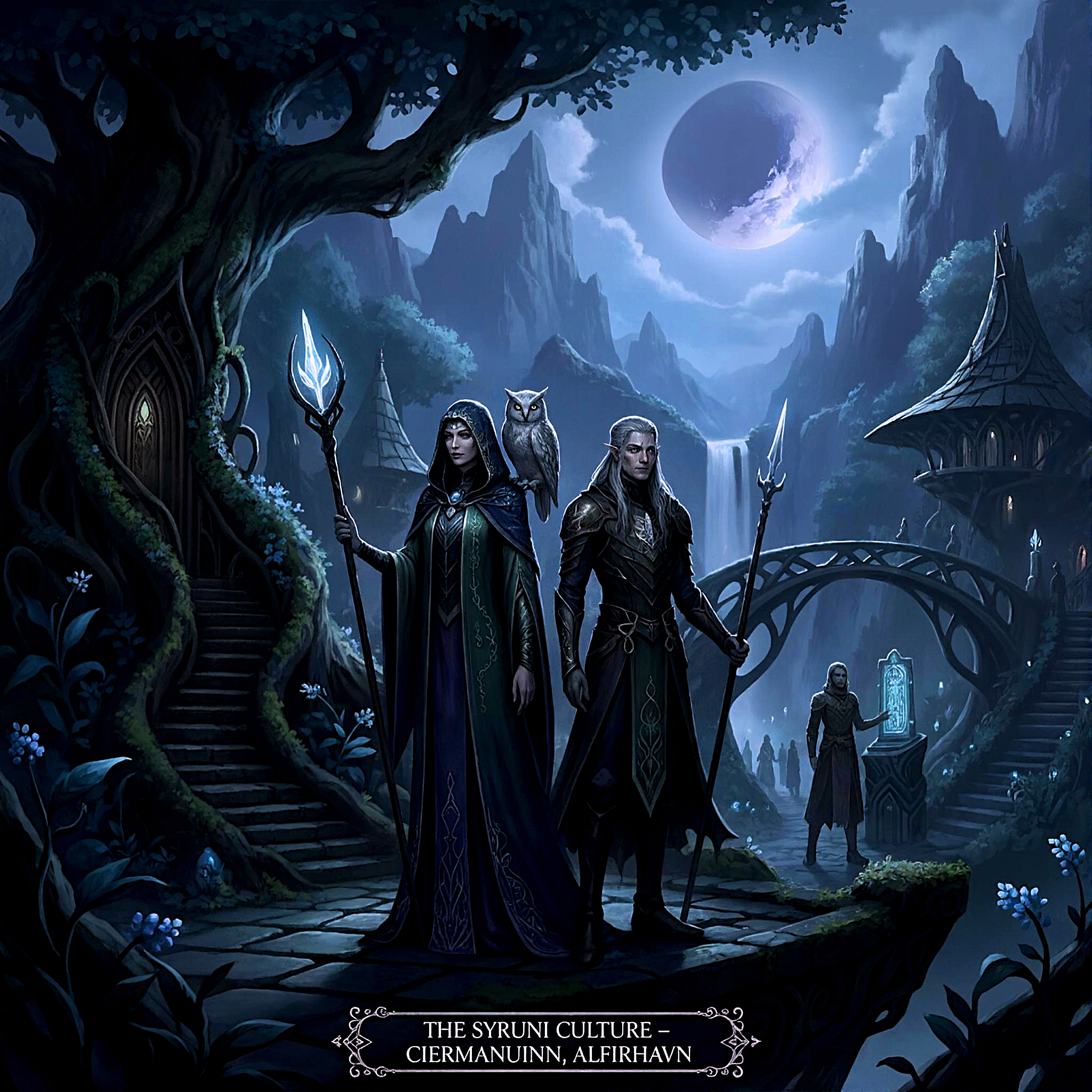
The shandaryn of Ciermanuinn are a rare example of a blended culture (Eleysian Elowyn/Vesprian, in this case).
Cultural Divide: The species is primarily divided between the ancient, nature-aligned Elowyn (who possess skills in stealth and nature Attunement) and the urban civilizations of the Elowyr.
Spiritual Core: Their primary faith centers on the Ashta Vespri (Eight Stars), reverence for the Seven Sisters, and a foundation in the magic known as the Grand Composition.
Glossary of Terms:
Birthbond: The profound, mystical connection shared between shandaryn twins born from a single conception event (paired ova fertilized by the same father).
Freebirth: A rare single shandaryn child born when one half of the paired ovum fails to develop.
Flowering: An intricate pattern of lines and swirls (also called the abdominal web) that appears on a pregnant shandaryn woman's abdomen within a month of conception.
Flower: The ritualistic marks that appear on a shandaryn mother’s abdomen (Flowering). Its fading on a child marks the onset of puberty, lending itself to crude slang terms for the loss of virginity, such as "deflowered".
Binding (Ceremony): A formal, symbolic ceremony practiced by most shandaryn cultures for a pair or circle (more than two members) wishing to commit to one another for a lifetime. A true Binding is a metaphysical harmonization of two Soul-songs into a new, shared "Conchord".
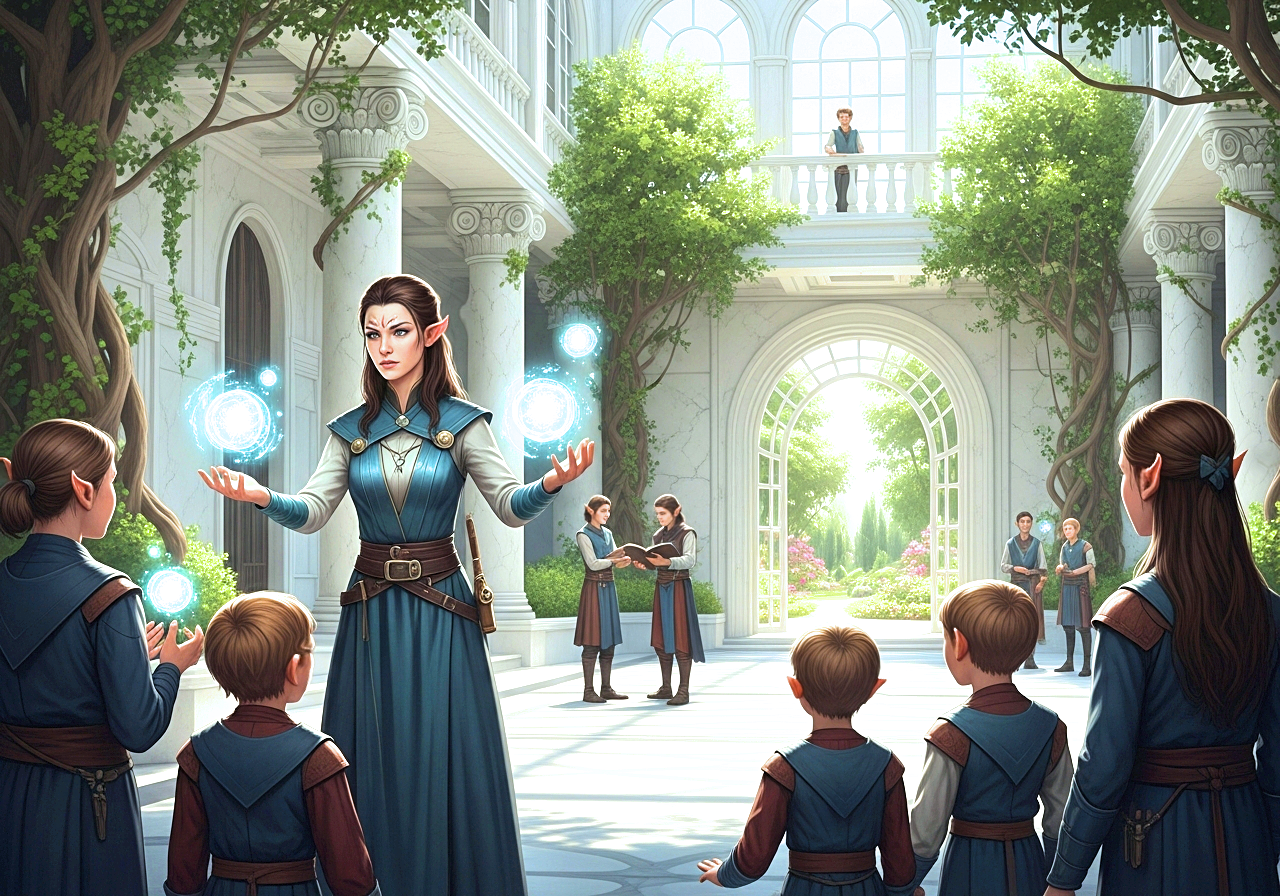
This is a stereotypical shalarra. It is far from the average, which are much less formalized.
Shalarra: A communal care system or facility for shandaryn children.
Wisps: A pejorative nickname for shandaryn, referencing their typically slender, willowy physiques caused by a hyper-metabolistic state.
Skaylar: A title of profound reverence accorded to a rare shandaryn individual who attains the venerable age of 81 Arcs (729 solar years).
Passing: An unwitnessed, mystical departure that occurs when a shandaryn deliberately chooses to cease living.
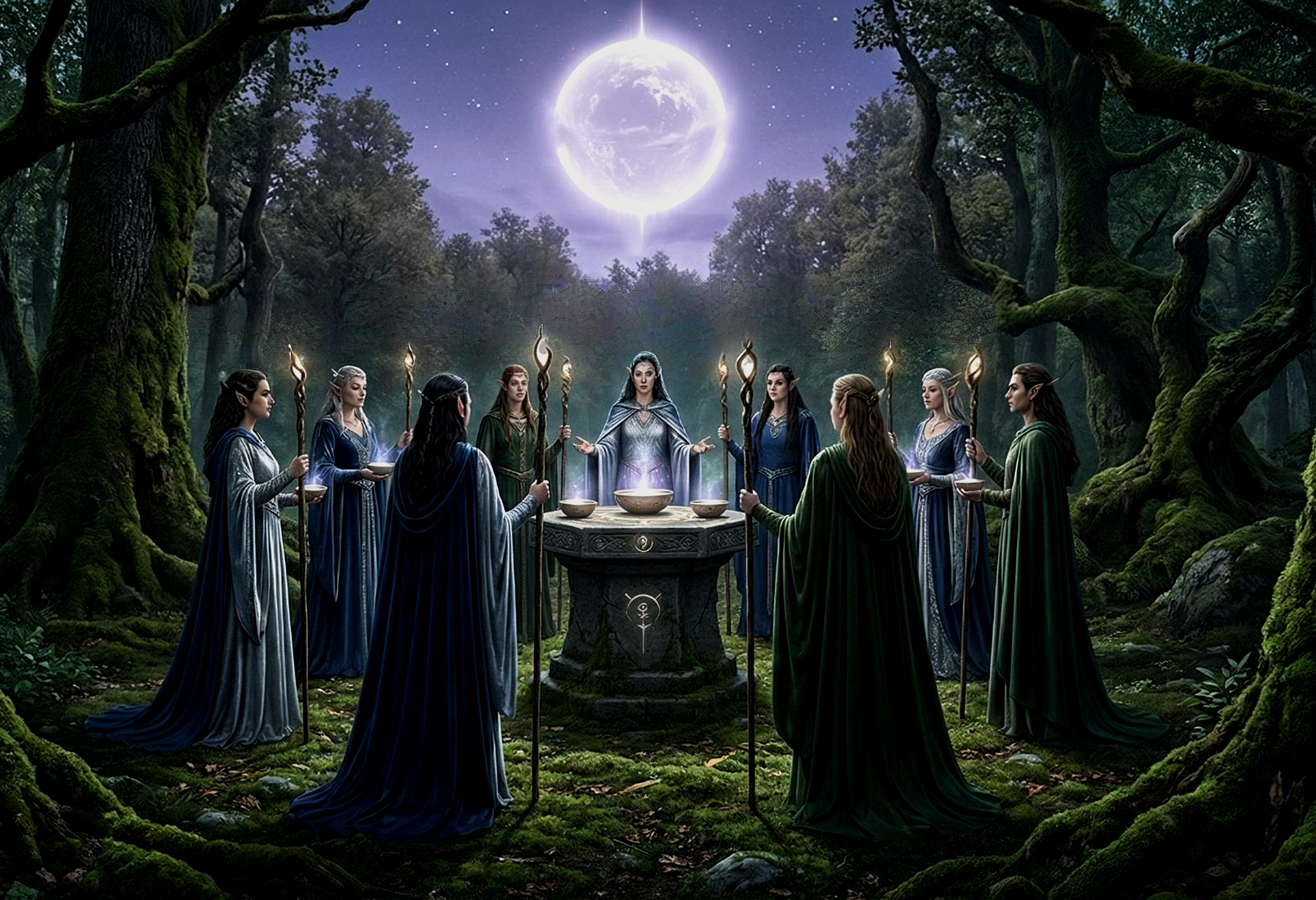
Unspecified shandaryn ritual.
Comments