
Shandaryn Civilization and Culture
(The following article was written by the Chronicler of the Silver Blade)
On the Price of Human Love
It is in their relationship with humans that the deepest sorrows of the shandaryn are found. It is a cruel irony that the original source of their prejudice against humanity was not hatred, but love.
They learned, early on, the profound and repeating heartbreak of forming attachments with the shorter-lived—of watching those they loved grow old and die while they, who measured their own lives in decades-long Arcs, remained virtually unchanged as a stone. This pain, over centuries, curdled into a protective caution, which lesser souls then twisted into manufactured reasons for scorn and rigid laws of blood purity.
Their heightened emotional sensitivity, while allowing for deep bonds, made them terribly vulnerable; they were susceptible to being overwhelmed by the volatility and sheer intensity of human emotions, which contributed to their eventual aloofness. The result is that the noble shandaryn, who abhorred emotional chaos, began viewing them as transient, unpredictable, short-sighted, and ultimately, a source of unavoidable grief.
I have seen the legacy of this pain. I have heard the whispers of "unclean" lesser races and witnessed the ancient ritual of "Cleansing" after a journey in human lands, though thankfully, most modern shandaryn see this tradition as little more than simple hygiene. The descendants of that sorrow—the shin'misal—face the greatest burden. They are often barred from ascending to leadership among the Torwyn. This prejudice is compounded by their biological reality: their rapid human-like maturation makes them incompatible with the shalarra system, structurally isolating them from shandaryn culture before they ever achieve Ascension.
It is a long and sorrowful shadow, but it is one that begins, slowly, to recede in places like Lithrys, where two peoples are finally learning to see each other not as a shandaryn or a human, but simply as a soul.
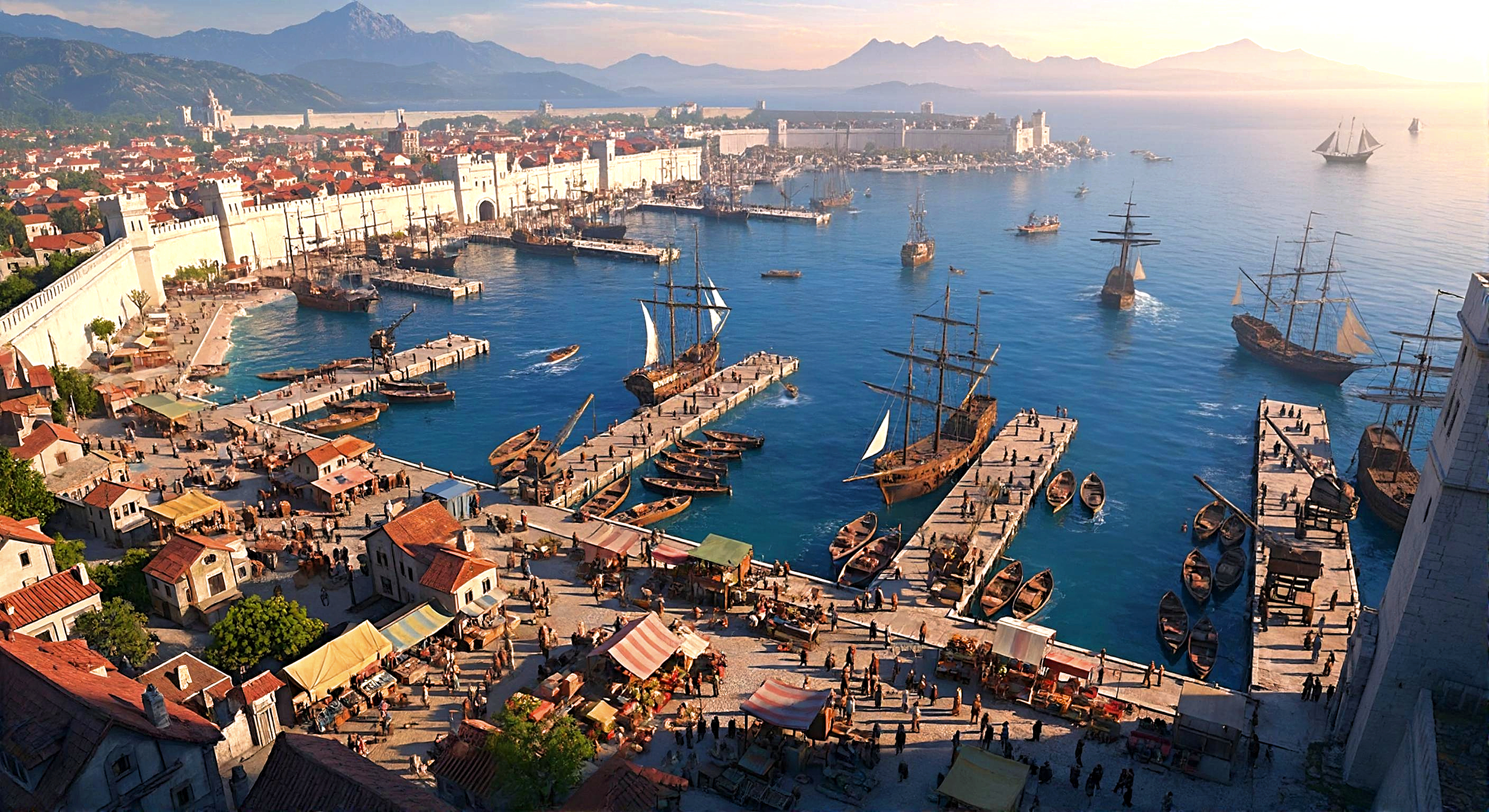
The bustling port of Lithrys, on the Isle of Eleys.
History
The Ancient Gift and the Cost of Form
The earliest history of the shandaryn is tied to forces more ancient than our world itself. Our beginning is inseparable from the orfian—a curious, ancient people who arose from the world itself, the very spirit of sentient life given form. The oldest Elowyn tales, those my mother passed down to me, speak of a divine guardian of the natural world, Viridian the Lifeweaver, the very Scale of the Sister Thea. It was this great being, they say, who taught the orfian how to live in harmony with the world, and it was the orfian who then passed these essential truths to the first of the shandaryn.
Language and the Veil of Knowledge
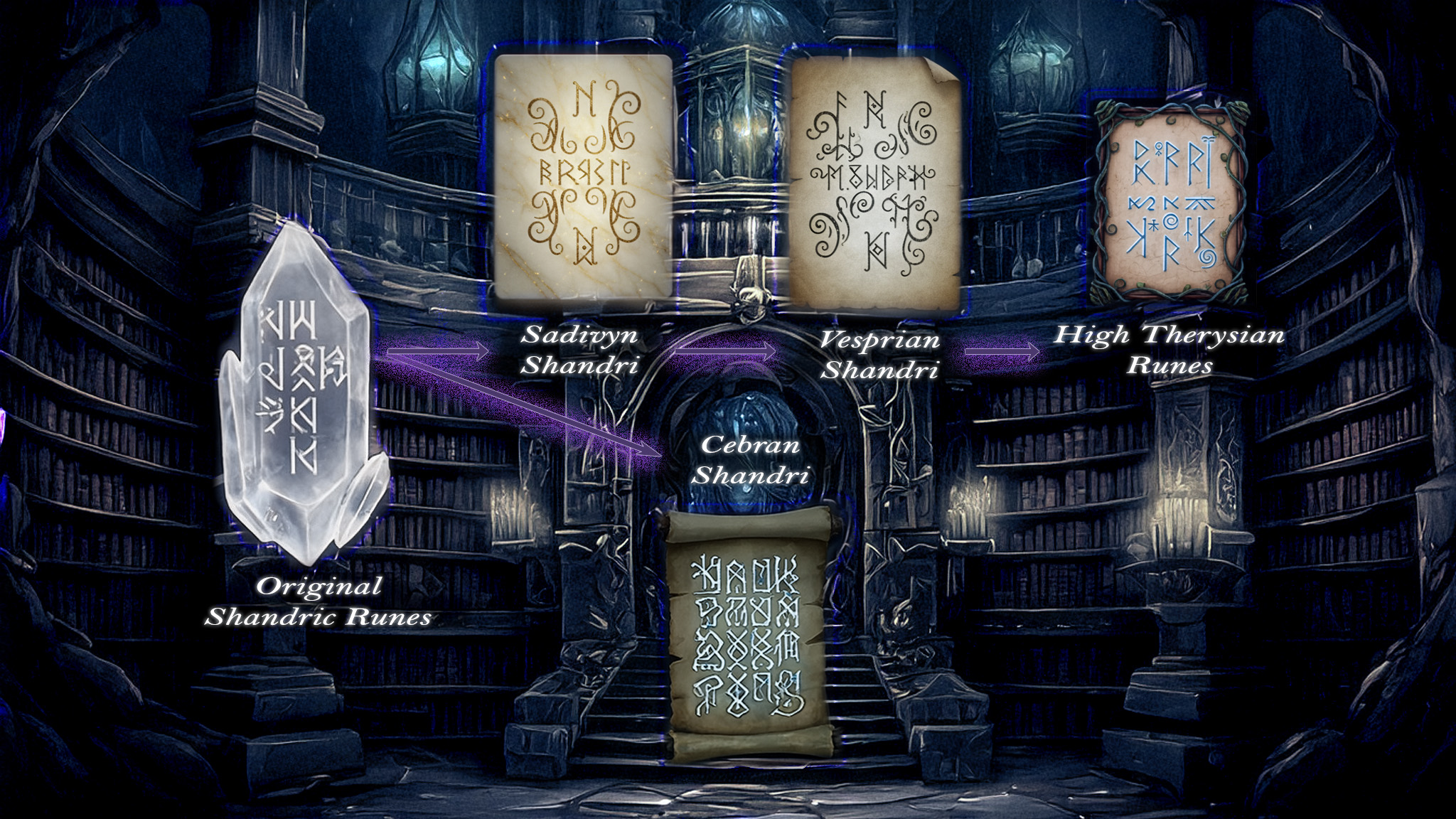
True recorded language came to us through the vailin. They are the secretive children of Valis, the sister who guards all knowledge. The vailin were the ones who first gave the spoken tongue of the shandaryn, Shandri, its written form, bridging the gap between the emerging mortal races and the ancient dragons.
Shandric Rune Evolution
This diagram shows the evolution of script from original Shandric Runes to the contemporary High Therysian Runes.
The Elowyr and the Great Divergence
The very first shandaryn kind called themselves the Elowyr. In the millennia that followed, their civilization spread across the world, growing into a great forest that stretched across the plains and into the deserts. They carried an innate connection to the world, a way of "Composing" with the Eternal Song that created works of breathtaking art from the living world itself.
But their path was not a single one. While some shandaryn found purpose in a partnership with the great Scales and their children, building the first magnificent cities where their own creative visions reshaped the land, others chose a different way.
This was the great divergence that gave us the Elowyn. They were the shandaryn who held true to the oldest lessons of the orfian. They saw the great cities as a turning away from the natural harmony of the world. While other shandaryn followed the full pantheon of the Ashta Vespri, the Elowyn held to a simpler, older faith in a Father of Light and a Mother of Stars. They used their connection to the Eternal Song not to reshape landscapes to their will, but for protection and preservation, subtly guiding the evolution of their forest homes over centuries. It is a path of patience and reverence, one that the scholar Krysaalis a'Ciermanuinn would later embody.
The Diaspora of the Firstborn
(Main article: Shandaryn Ethnicities)
The long, chaotic darkness that was Dome Oira—the Night Eternal—shattered the old world and scattered the seeds of the shandaryn people. From those dark ashes and the devastation that followed, the descendants of the Elowyr spread and adapted, laying the foundation of every shandaryn ethnicity we know today.
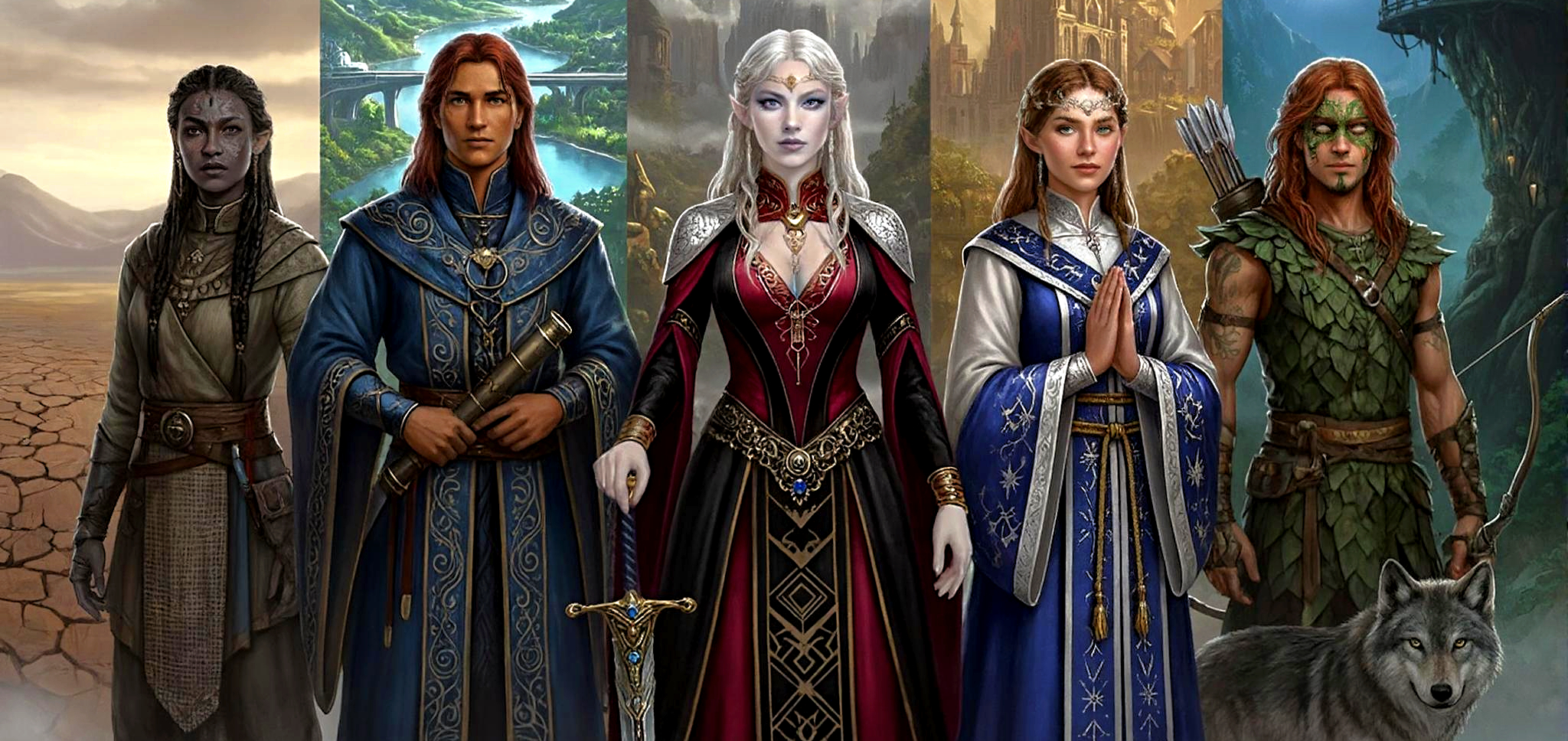
The needs of survival divided them: the Elowyr split into distinct lineages based on the vast new continents they settled—the Cebran of the shattered south, the True Oryn who journeyed into the west, and the Andwyr who built new kingdoms in the east. From these great streams, new cultures emerged, such as the Torwyn, who are themselves a blending of the old world’s elegance and the natural strength of the new.
Yet, even through that great scattering, one group held fast. The Elowyn—the quiet guardians of the natural world—remained unchanged at their fundamental level across the millennia. They held to the simplicity of their ancient faith, keeping their reverence for a Father of Light and a Mother of Stars pure, even while their brethren evolved and sought new gods.
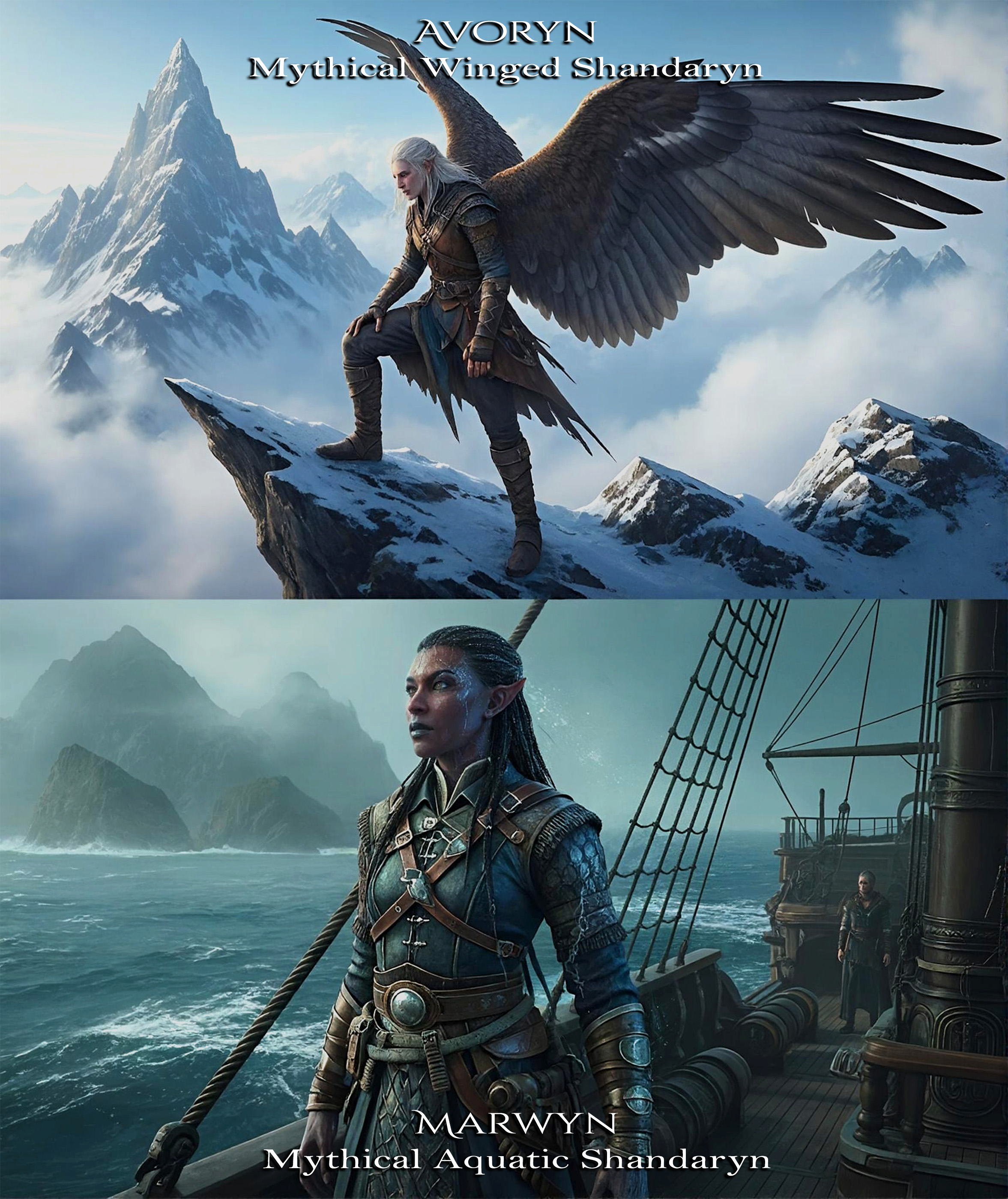
And the archives whisper of others: extraordinary strains who chose different paths to the extremes of our world. Rumors persist of those rare few shandaryn born with the gift of wings and those who claimed the deepest ocean currents as their domain, living beneath the waves—mythic figures like the Marwyn that serve as a constant, quiet reminder of the full scope of our shared heritage.
Interspecies Relations and Assumptions
The Burden of the Eternal Eye
To live among the shandaryn is to be forever humbled by the crushing vastness of time. Their lives are measured on a scale we can scarcely comprehend; we, in our brief and hurried existence, are but mayflies of Spring dancing in their twilight.
A shandaryn who has watched a full human lifetime wither and pass may not have aged a single day in any meaningful way. It is this weight of experience that inevitably slows them, turning their spirits inward, making them more contemplative, more patient. Humans often mistake this for perfectionism, a vanity of the immortal. It is not. They are not obsessed with a flawless end, but with the endless process of refinement—always seeking a better way to shape a sword, a treaty, or a life. It is a patient art, yet I have seen in their eyes a quiet, burning envy for the swift, intuitive leaps of the human mind, which can seize a truth in a moment that might take them a decade to ponder.
This long view has also shaped the very architecture of their faith. Despite possessing the truest account of creation in their ancient scrolls, their belief has waxed and waned like the moon over the millennia. I have read the dusty histories of their decadent decline in old Sinda'lar and witnessed firsthand the fierce, rekindled piety of the Vesprians. Even a people who live for centuries are not immune to the fracturing of belief.
And there is the silence between us. Their long memory means that when they speak, their words can sound archaic to the ever-changing tongues of younger peoples. It creates a gulf of years that many find easier to leave uncrossed, preferring to remain aloof in their own timeless halls rather than struggle to speak to a world that changes faster than they can find the words to name it.
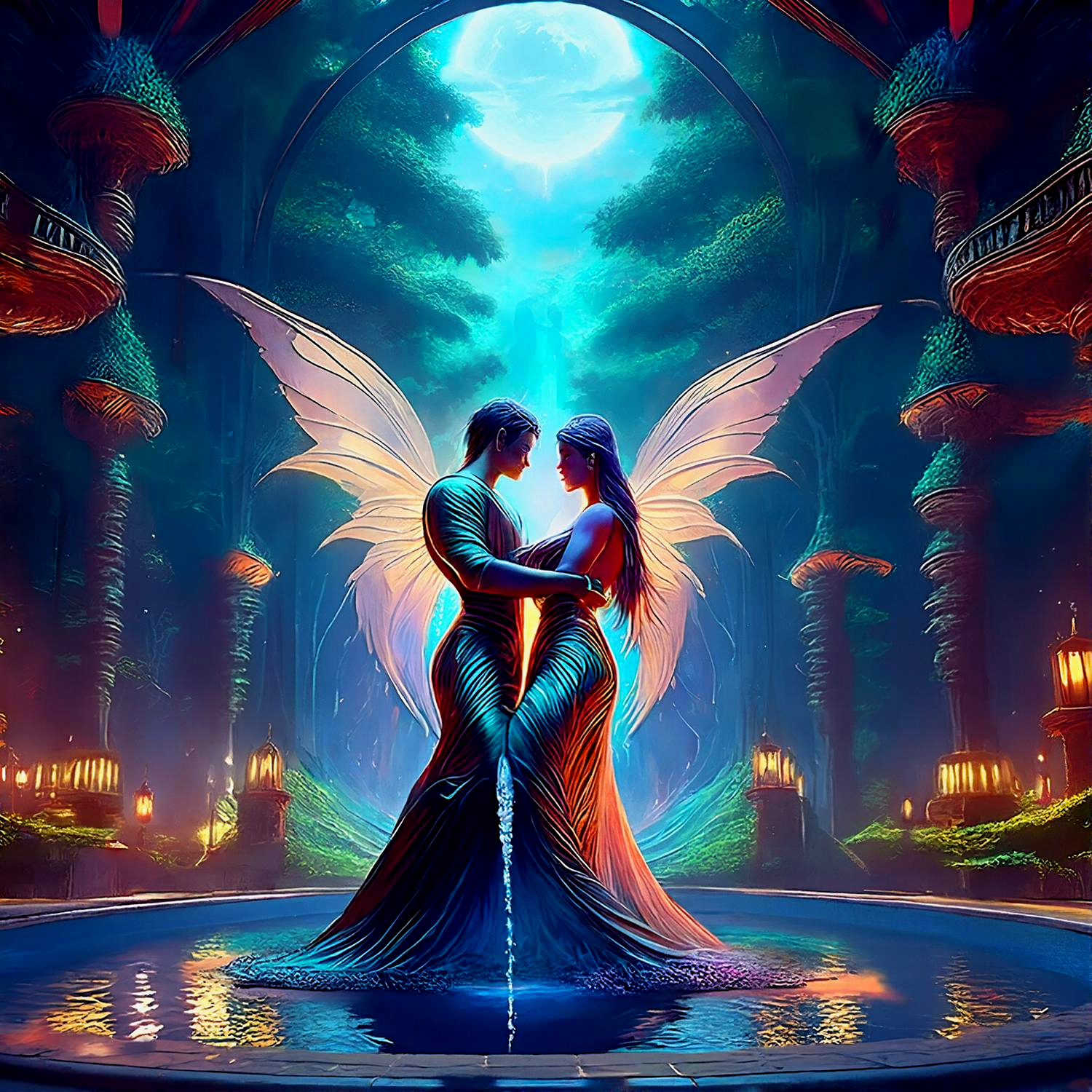
Temple of Harmony in Ciermanuinn (before 928 AV)
The Weaving of Souls
I have walked among them as a son and bound partner, and I tell you this: their most sacred laws are not written in ink, but in the beat of the heart. For a people who bear life so rarely, the act of family is not a private joy, but a profound and communal covenant.
To them, a Binding Ceremony is not a mere wedding. It is a symbolic weaving of souls, a recognition that two melodies have chosen to become a single harmony. You see this truth in their smallest gestures. Watch how they greet one another: a fist placed firmly to their own heart. It is a sign of self, of holding one's own Light. But to touch another’s heart with an open palm? That is a declaration of absolute surrender, a sign of trust and love so deep it is rarely seen outside of a Binding.
Their family structures are built upon this deep architecture of connection. In the Old Traditions, when the blessed twins of a Birthbond were born, they were often shared—one raised by the mother’s kin, the other by the father’s. To a human, this might seem a cruelty, to separate siblings. But to the shandaryn, it was a masterstroke of unity. Because the twins share a Soul-Song that cannot be severed, placing them in different houses forced those families to remain forever linked, bound by the living bridge of the children between them.
Even those born outside a formal Binding—the "natural" children—are never scorned. They are treasured as part of the mother’s blood, a truth I have witnessed in my own life.
But the greatest difference lies in the raising. A mother’s primary duty is to her child for their first Arc—those first nine years when they are small and fragile. But as the child grows in mind while their body lingers in youth, the burden becomes too great for one alone. The entire community takes up the mantle. They call it the shalarra. It is more than a school; it is a sanctuary of shared guidance, where the young are raised by many hands, ensuring that even in their long, quiet adolescence, they are never without kin. It is a system built on a foundation of collective love, a village raising a child not because they must, but because every new life is a victory against the silence.
The Saga of the Silver Blade begins!
Read Excerpts
Available now!
Ethnicities and Cultures
Elowyr
This is the collective name the earliest shandaryn used for themselves before they diverged into specific regional cultures, primarily distinguishing themselves from the Elowyn later.
- Andwyr: This ethnicity occupied most of eastern and south-central Tey-Semal and is characterized by distinct facial features, having also helped create the shin'misal predecessors of the Yan.
- Cebran: The oldest known Elowyr culture, they were largely based in the southern hemisphere on Alumnar and are visually recognized by their very dark complexion.
- Sadivyn: This Elowyr sub-ethnicity was isolationist before growing nationalistic to create the Sinda'lar Empire, eventually fracturing due to secularism and giving rise to the Torwyn.
- Torwyn: Descendants of the schism led by Torryaen the Great, they are renowned master mariners, merchants, and the spiritual custodians of the revived Ashta Vespri faith in Vespria.
- True Oryn: Having fled Alumnar, these Elowyr founded the multicultural city of Oran and were noted for their ingenuity, exploration, and exceptional tolerance of other races.
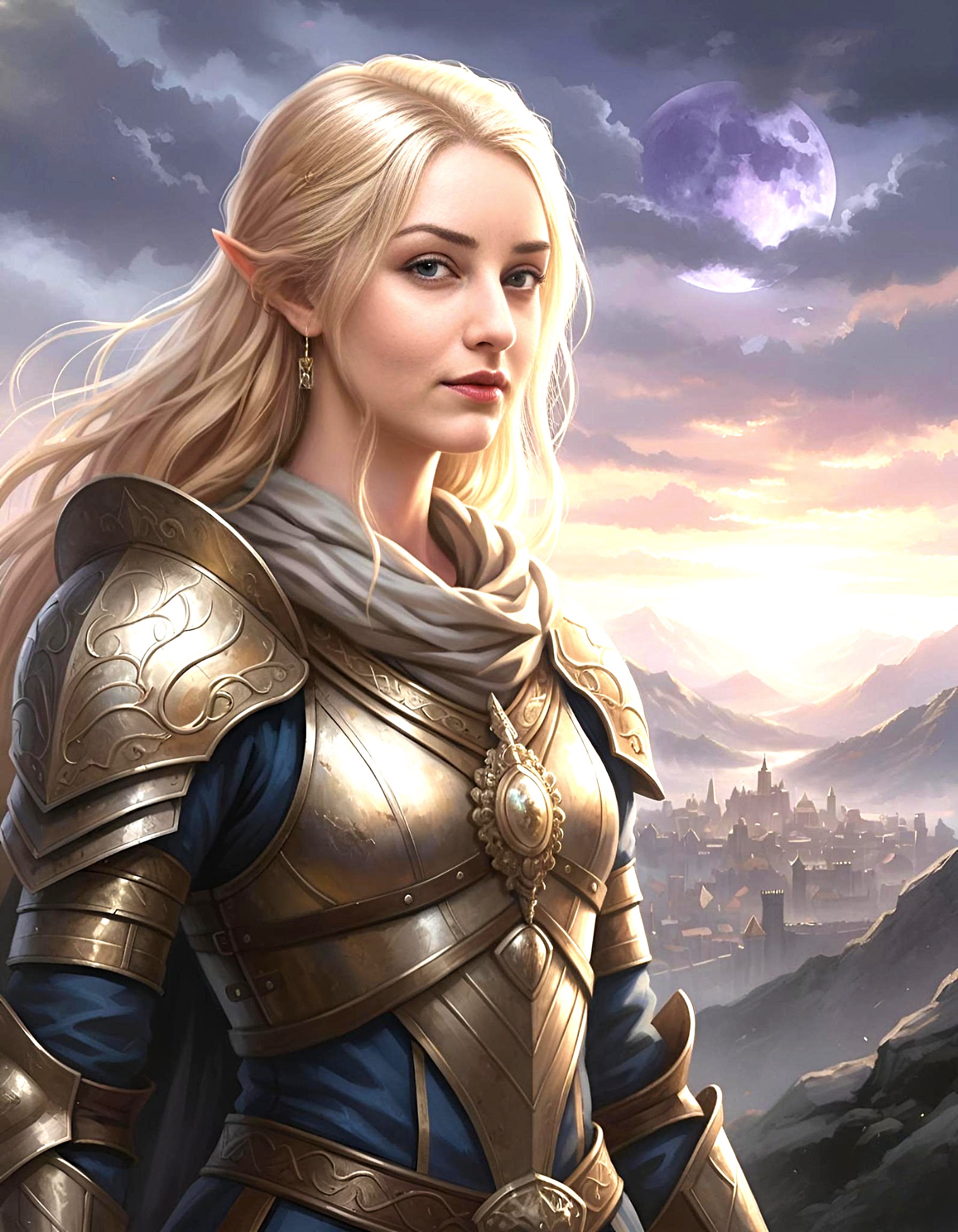
Torryaen the Great, leader of the Torwyn against the Sadivyn.
Elowyn
This diverse cultural group learned from the orfian to live in harmony with the natural world and adheres to a triune faith centered on the Great Mother, Father, and Moon Daughter.
- Whisperleaf Elowyn: A distinct Elowyn culture known for their artistic sensibilities and adherence to Gaily'a and Selyne, whose heritage became a foundational aesthetic element of the Torwyn ethnicity.
- Eleysian Elowyn: The Eleysian Elowyn are not a singular nation but a diverse and ancient collection of distinct Elowyn cultures, bound together by a shared geographical heartland in and around the Eleysian Sea, a common ancestral root, and a universal adherence to the Elowyn Triune faith.
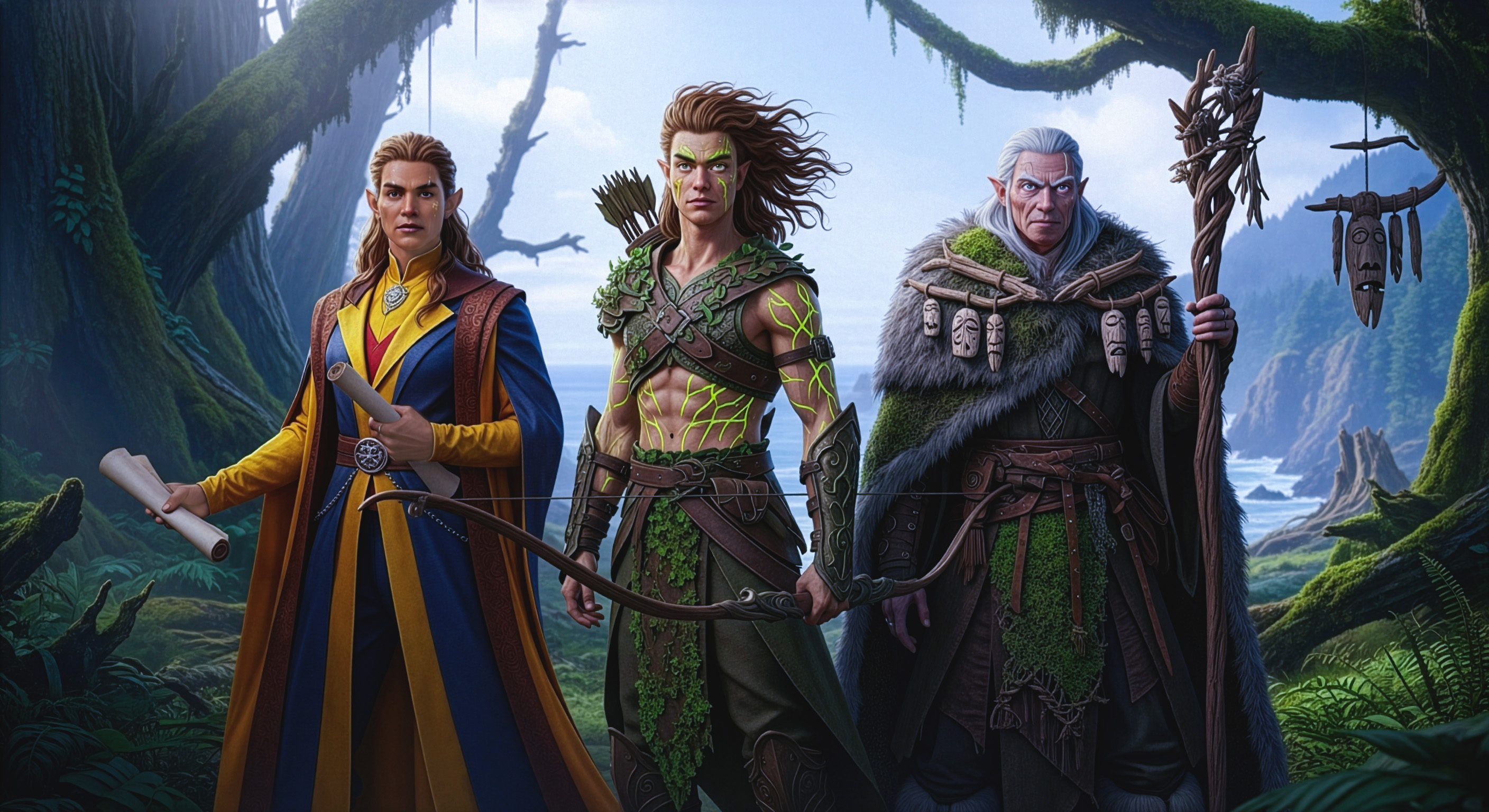
Three different Elowyn cultures of the Eleysian Sea.
Cultures of the Eleysian Sea
- Dragondown: This Elowyn nation on the Dragonhead peninsula cultivated a profound bond with dragons and reverence for Asharavae.
- Lockstone (Altarryns): A unique, proto-Eleysian culture whose primary duty was the guardianship of the powerful Lockstone artifact and who were tragically annihilated during an invasion.
- Shintlaran: A blended, metropolitan culture designated as guardians of the Shadowleaf (Shintlar) Forest and surrounding lands (Shintlara).
- Sindaaran (Moonwood): This ancient, mystical lineage is considered the cradle of Elowyn civilization, revering Selyne as the Night Mother and guarding the metaphysical Moon Gate.
- Syruni: A synthesized Elowyn culture resulting from the blending of Torwyn with refugee Veridian lineages within the sanctuary of Ciermanuinn, marked by their profound reverence for Selyne as the Night Hunter.
- Veridian: An ancient Elowyn nation devoted to the Triune that once claimed the Black Hammer Pillar as their homeland, but now are a scattered people who might be completely extinct.
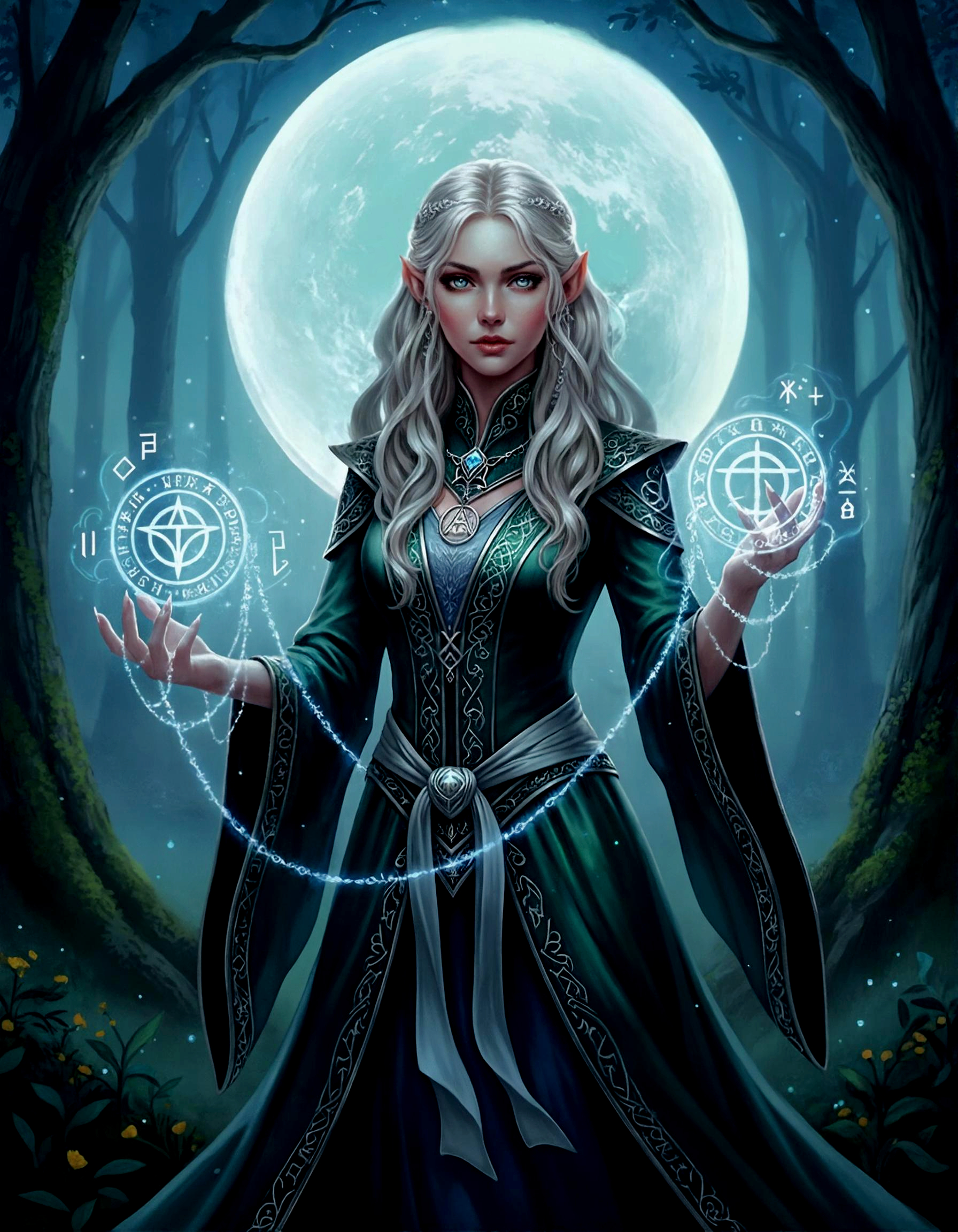
Avaaya a'Minyr, Song of Dawn for Ciermanuinn
Mythical
- Avoryn: A legendary race of graceful, winged shandaryn, they inhabit the highest and coldest places and are occasionally sighted intervening to save lives, inspiring human myths of angels.
- Marwyn: A legendary, dark-complected, sea-faring shandaryn race who are rarely encountered beyond the equatorial and southern oceans and are the source of mythological mermaid tales.
Comments