
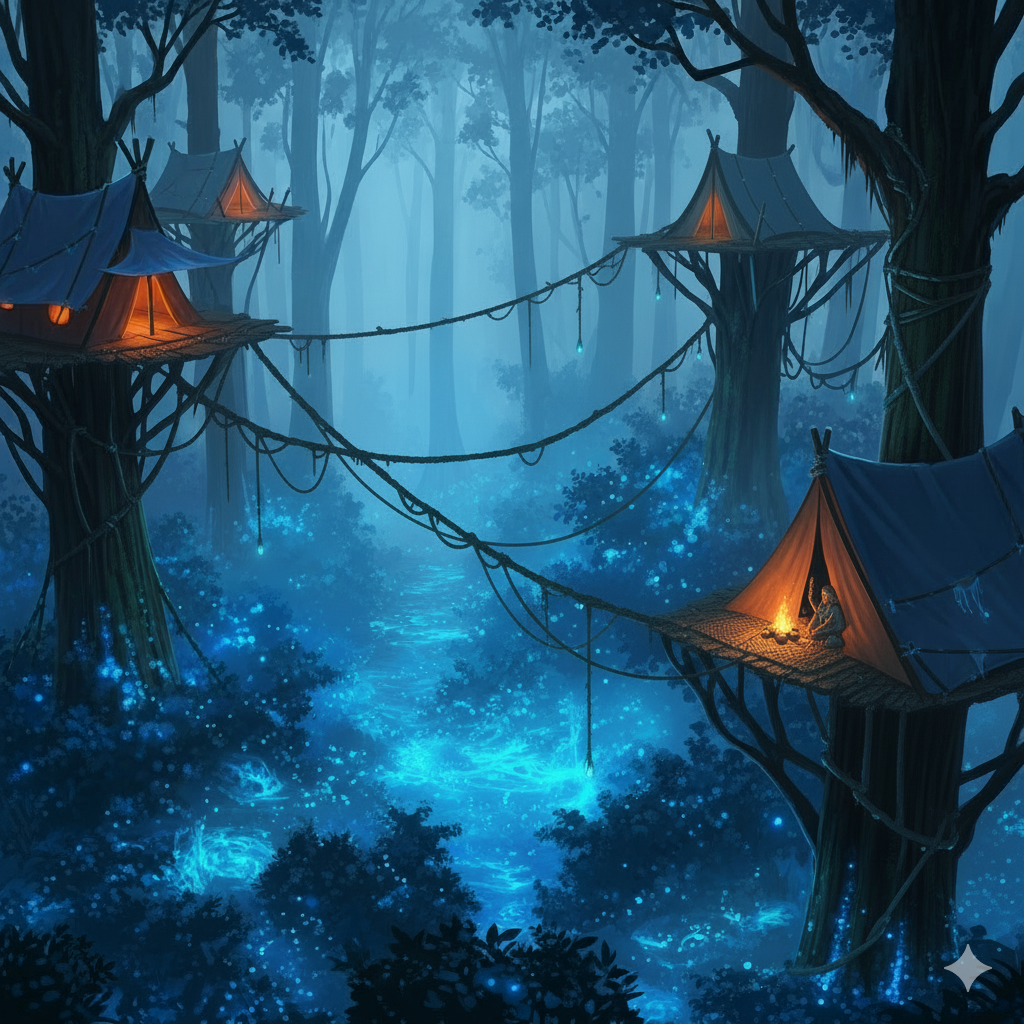
The Sapphire Leaf Rangers
Within the human kingdom of a new age, the Kingdom of Owenar, lies a large subtropical forest known for its beautiful blue algae that cover every foliage. Named the Sapphire Forest, and blocking the path between Westenra and Ninthiad, it has seen many attempts to cross the vast and perilous forestscape. However, if you seek to find the safest way across, you must seek those who permit passage. Calling themselves "Ceruleans," they would later be called by outsiders as "The Sapphire Leaf Rangers." Founded by Venodat, the First Ranger, they started as a band of harengon who ventured into the forest looking for new burrows to settle in. The natural beauty of the forest was so captivating that they wanted to ensure its blue glow remained. They are an autonomous tribe that is allied with the Kingdom of Owenar under the marriage pact between Queen Lauren Owenar and Ranger Theodore Spidersbane. This oath binds the rangers to uphold the kingdom's laws, while the Owenarians respect the forest's boundaries, spanning from the South Valley Mountains to the dwarven bridge in the Nol Muldhur. The rangers live a life of protecting the forest from unwanted visitors and ensuring the balance of nature, observing and protecting the last of the sapphire dragons that make the glowing blue algae possible, quarantining the dark regions where the algae have yet to spread, and repelling dangerous animals that threaten the wildlife. They collect many algae-enriched herbs, which they have mastered into unique medicines that they keep secret. Their culture revolves around the cultivation of the sapphire algae and cherishing the wildlife. They never leave any parts of deceased animals to waste or let any interference with nature go unpunished. They live scattered in mobile camps that patrol the distant forest—a hermetic community of skilled marksmen, herbalists, hunters, surveyors, and animal specialists.
Structure
The Sapphire Leaf Rangers are a stealth-focused organization of harengon and humans. Their fighting style depends heavily on their deep knowledge of the Sapphire Forest, which they use to their advantage. They use the thick vegetation to ambush unwelcome visitors and are experts at vanishing without a trace, leaving enemies confused and defeated before they even realize they've been attacked.
The Rangers' tribal structure is divided into packs, each led by a Cerulean Captain. These captains organize their camps and assign missions to their pack members under the guidance of the tribal council of elders. At the top of their hierarchy is the Cerulean Chief, who serves as the tribe's ultimate authority. New members join the rangers through a ritual trial, where a trained recruit must venture into the dark parts of the forest with a pack to hunt a wild pale panther—a local predator. This fierce animal, which adapts well to the blackest parts of the forest, tests their hunting and stealth skills as well as their ability to work together. If their pack succeeds, they are each given a sapphire-encrusted leaf to signify their official unit with a chosen member as their captain. These ecampments are vagabond, constantly moving within weeks to follow assignments and track herds.
Within each pack, knowledge is passed down through an apprenticeship system. Recruits are paired with experienced members who mentor them in their specialty, whether it’s marksmanship, herbalism, or tracking. The skills of the Rangers vary from pack to pack, creating a wide range of expertise across the tribe. The tribal council of elders consists of retired rangers who have dedicated their lives to the tribe. Before a council member steps down, they select their successor from among the senior tribesmen. The council works alongside the Cerulean Chief to protect their tribal laws, traditions, and collective knowledge.
The Ceruleans establish rules and laws that their eldest members enforce. These elders are culturally regarded as sources of knowledge and wisdom who have dedicated their entire lives to the Cerulean's oath to protect the forest. Only those born and raised as a ranger and earned more than three ceremonial rings of mastery can be granted the authoritative power, and only 15 may hold that power at any one time. During their solstice festivals, they gather at isolated encampments to discuss current issues and cast a majority vote on their responses. These decisions are then presented to the Cerulean chieftain for execution. When laws within the tribe are broken, the Cerulean Captain in charge organizes a trial where those accused are judged for their actions. With the help of selected rangers, evidence is collected against the defendant, who also chooses rangers to help with a defense. The verdict is then decided by a 3/4 majority vote from the entire encampment, including the accused. Once a verdict is reached, the Captain may determine the punishment. The Cerulean Chief is the sole executive authority of the tribe. He is chosen among the Cerulean Captains by the elders in a majority vote. He is relieved of his duty by the same agency when they deem him no longer capable of the title, or when enough captains protest for his resignation. He takes on no executive assistance as a means to mitigate his authority over others. While he commands the captains' assignments, he has no power over the individual rangers, who are permitted to refuse a command directly from him; only their captain may assume that command. He has no control over the laws made by the elders, as they make decisions for the tribe by consensus or approval.
Culture
The core tenet is an oath quoted as "honor the hunt, sustain the blue," which means to hunt those who disturb the balance of the ecosystem, whether mortal or beast, and to maintain the growth of blue algae so it can return to every inch of the forest. They regularly see outsiders in a neutral stance, permitting those who seek to cross only if no hostile intent is found. They are watched every step of the way. Since it started as a harengon colony, they are cautious of humans’ presence because neighboring factions have sought to cross or cause harm. Their alliance with the Kingdom of Owenar has held thanks to the few humans in their tribe who honorably keep the forest safe as fellow rangers.
To protect the last of the sapphire dragons, the rangers hold a ceremonial title for those chosen to protect the dragons for life. Known as a Wyrm-Singer, they are selected through a ritual called the Wyrm-Singer's Ascent, a rite to a successful bond with one of the sapphire dragons. Where success is rare because the dragons are difficult to connect with socially. Additionally, every solstice, the tribes partake in a feast to honor the lifeblood of the forest, consuming food laced with sapphire algae to gain resistance to its toxins, often eliciting hallucinations and ecstasy. Day-to-day, rangers start their mornings by climbing to the highest point nearby to watch for activity, then, after a light breakfast, begin their assigned roles—gathering herbs, locating herds, tracking movements, hunting strays, crafting tools, surveying footpaths, and organizing camp. To make setting up and dismantling camp easier, they combine their unique tree-climbing skills with ropes made from vines, forming a pulley system that allows them to hang materials and fabrics for elevated tents on branches. Their diet consists of a form of bread and a variety of supplements added to it. The most common plant, spider grass, has a unique quality: it can be dried into spider wheat using an underground furnace. When mixed with herb-infused water, it forms dough, which is then baked into ranger bread—potent enough to feed a hungry man daily. To enhance flavor, rangers often add crushed oak berries made into jam. During successful hunts, nothing goes to waste—meat is dried into jerky, bones ground into powder to enrich soil, or crafted into basic tools.
Rangers work together regardless of age or experience. To them, preserving the forest is more important than personal interests. Experienced or older members serve as guides, and their survival skills, learned strictly for their own safety in the wild, benefit the whole group. Because age and experience are vital for survival, the eldest rangers hold the highest honor, as their knowledge of wildlife is invaluable. Knowing animal behaviors, gathering the right herbs, choosing the correct crossing paths, climbing the appropriate trees, and establishing camp are crucial skills passed down to ensure future generations’ efficiency and survival.
Passed down through generations of harengon, their entertainment includes practicing the harengon flute. This hand-carved wooden instrument produces a resonant sound that attracts small animals, such as sapphire squirrels, blue jays, and sapphire foxes. They create melodies to enjoy during moments of levity at camp. One well-known tune is "the Spider's Bane," a song believed to calm hostile sonic spiders. The ranger Theodore Spidersbane earned his name from his mastery of this song. They also tell campfire stories to share their history, such as their founder Venodat, who was the first to bond with a sapphire dragon. To symbolize their experience and mastery, rangers collect wood-carved rings with a small object encased in oak resin. The object varies based on their skill or experience: a vine twig for herbalism, a piece of leather for crafting, a bone sliver for hunting, a metal piece for combat, and tree bark for leadership. Higher-ranking individuals, such as captains, receive a high-quality, decorated leather shoulder pad. Those who have bonded with a sapphire dragon are awarded a crystal necklace featuring a fragment of sapphire algae from their bonded dragon.
With centuries of practice using sapphire algae, the rangers have passed down advanced knowledge of herbal medicines and other mixtures that are so precise and complex that most outsiders find it difficult to replicate. Things like heart medicine and muscle relaxants are the simplest, but treatments for viral infections and injuries require more advanced techniques that only the most experienced are capable of handling. As such, the practice of such concoctions is strictly regulated to the more knowledgeable, as any errors can lead to sapphire blood disease—a dangerous affliction. While there is use in medicine, some rangers have been known to try to create poisons. To prevent an abuse of such practices, the elders consider the practice of lethal concoctions as taboo. A defiance of the natural order of life. Forbidden only if the intent is to kill a target rather than paralyze or confuse.
Public Agenda
The public agenda of the Sapphire Leaf Rangers centers on two main areas: preserving the Sapphire Forest and regulating all who enter it. As forest guardians, their primary mission is to protect its fragile ecosystem, which includes the precious sapphire dragons and the blue algae that characterizes it. This commitment involves maintaining ecological balance by managing wildlife populations and ensuring the ongoing health and spread of the algae. By acting as protectors of the forest, they openly guarantee that its unique resources and rare creatures remain safe from harm, upholding their core oath to "honor the hunt, sustain the blue."
The Rangers' most significant public challenge is containing the Great Scar, a vast, perpetually dark region of the forest. This area, a haunting remnant of the Fuxenarian Empire’s bombardments, hosts a unique and dangerous ecosystem of creatures adapted to life without light. Among them are the blind, aggressive Pale Panthers—species whose expansion from the Scar constantly threatens the forest's balance. They actively quarantine this zone,
Beyond conservation, the Rangers serve as a regulatory force authorized by the Kingdom of Owenar. They control access to the forest, a crucial route between different parts of the kingdom, and provide safe passage for those they deem worthy. This role is vital in enforcing the peace treaty between their tribe and the monarchy, ensuring the forest boundaries are respected and monitoring all activities within their territory. This dual public mission establishes the Sapphire Leaf Rangers not only as conservationists but also as a vital, autonomous authority within the political landscape of the Kingdom of Owenar.
History
Before the onset of the Dark Ages, the Harengon people lived in a state of tranquility on the hilly slopes of the Southern Valley. This peace was shattered by the arrival of the conquering Fuxenarian Empire, which laid claim to the shores of Westenra. Without the protection of their creator, Ahem, many Harengon were forced to flee south, crossing the mountain wall and seeking refuge in the vast, subtropical expanse of the Sapphire Forest. It was here, surrounded by the forest's glowing, blue beauty, that their new beginning was nearly brought to a tragic end. The imperials pursued them, and in a moment of protective instinct for the natural landscape, the Harengon refugees fought back, defending the forest as if it were their own. Unable to establish a foothold, the empire resorted to remote bombardments, leaving indelible scars on the forest and driving the refugees into despair.
From this hopelessness, a leader emerged. Venodat, a Harengon who had lived in the forest long before the conflict, rallied the natives and trained them into a formidable force. United in the year 217 of the Dark Ages, they became the Ceruleans, a collective dedicated to hunting any threat to the forest and ensuring the survival of the blue algae. Venodat’s famous oath, "honor the hunt, sustain the blue," became their guiding principle. Her prowess in battling the imperials earned her such fame that she was chosen to lead the greater Fuxenarian Rebellion, which ultimately ended the empire's global reign. Before her departure, her final wish was for the Ceruleans to live by her words, restoring the blue to the scarred regions and allowing it to bloom once more.
In the wake of the Fuxenarian Empire's defeat, the Ceruleans organized the forest's defenses and honed their unique skills, developing advanced surveying techniques, mastering the toxicity of the algae through microdosing, and studying the flora and fauna. However, a new threat to their sovereignty soon emerged. The human refugees who colonized the continent of Westenra had, especially after the empire's fall, begun expanding their territories in conflict with one another. An additional escalating danger was the conquering and pillaging of the Salted Steel Tribe. They proved to be a challenge to the harengon as they attacked from land and sea. Even so, they held their ground, being the only tribe in Westenra not occupied by the raiders. When the grip of the Salted Steel Tribe fell, the unity of the harengon in Southern Valley with the human refugees within it created a steady peace in the north. To the south, the dwarves of Ninthiad pursued their travel within the forest to survey and gather resources. They did not act on this with force, but with pestering and bartering. The Ceruleans did not enjoy the constant unwanted visits and random trades, but they took the most out of it through the importation of tools, weapons, and camping supplies.
When the Kingdom of Owenar was first established, its founding king, Utheos Owenar, saw the Sapphire Forest as a key to his expansionist dreams. Knowing the Rangers were isolationists, he attempted to parley alone, but when he failed to convince them to join his kingdom, he regretfully ordered a campaign to lay siege to the forest. For three years, the Kingdom laid siege to the mountains bordering the Sapphire Forest, but each attempt was met with failure and high casualties. The Ceruleans, with the aid of Wyrm-Singer Ocutulan and the bonded sapphire dragon, Gorn, held their defenses. Realizing he would only cause further damage, King Utheos called for a truce, establishing an annual token of peace to be delivered to the Rangers. This tradition endures to this day as a reminder of the honorable peace that once existed between the two factions. The truce laid the groundwork for a growing relationship between the factions. Some humans who shared the Rangers' protective ethos were welcomed into their ranks. This led to a more neutral, trade-focused bond with the Kingdom of Owenar. The final, powerful symbol of this newfound unity came with the marriage of Queen Lauren Owenar and Ranger Theodore Spidersbane. While many alliances are born of political necessity, theirs was a genuine bond that began when Lauren, still a princess, met Theodore during an annual peace offering to the Ceruleans. Their romance blossomed over time, and their marriage in the year 77 after the Dark Ages served as a powerful symbol, solidifying the pact that binds the kingdom to the Ceruleans.
Centuries later, ambition would once again threaten this peace. King Baron Owenar, a distant successor to King Utheos, sought to expand the kingdom's territory by force. When Parliament denied his proposals to annex the Tempete Archipel and Ninthiad, he refused to accept their decision. His ambitions, fueled by the sheer power of Owenarian weapons, led him to assemble his army to invade the dwarven bridge city of Nol Molduhr. The Sapphire Rangers, however, refused to allow the armies to pass through the forest, fearing the inevitable conflict would cause irreparable harm. King Baron's obsession with conquest intensified, and he ordered his forces to push through, earning him the name "Baron the Cruel Fool." Four months into this misguided campaign, Prince Beyl Owenar, the heir to the throne, staged a coup. In a final, tragic confrontation, he defeated his father in the throne room and ascended to power. Ending the reign of the ambitious monarch. The invasion's aftermath raised tensions between humans and dwarves, with reports of discrimination against dwarven travelers becoming common. In an act of atonement, King Beyl spent years in diplomatic efforts, exchanging metals and food, and eventually concluded a treaty with the Dwarven Clans & the Ceruleans.
Today, the Rangers continue their fight against the lingering effects of the past. The greatest threat is not a new empire, but the remnants of the old: pitch-black "dark regions," including the massive Great Scar, a testament to the Fuxenarian bombardments. Within these lightless areas, an ecosystem of wildlife, including the blind and aggressive Pale Panthers, has thrived, ensuring that the Rangers’ mission is far from over.
Foreign Relations
Their relationship with the monarchy is one of autonomy and mutual respect. While the Rangers report to the kingdom and are legally obligated to uphold its laws, they have the right to refuse any request that they deem a threat to the forest. As a sign of their continued alliance, the monarchy sends a trove of goods to the Rangers every year on the anniversary of Queen Lauren and Ranger Theodore's wedding. This annual gift recognizes the Rangers' autonomy and their crucial role in safeguarding the Sapphire Forest.

Honor the Hunt, Sustain the Blue
"They're the gatekeepers of the forest. No one would dare to challenge their conviction in the life they chose. You cannot change the culture they created to thrive in such a dangerous place, the same way one can't change the rocks that bear the ocean storm. You must be molded to its flow, or fall into the depths." - Queen Lauren Owenar.
Founding Date
217 DA
Type
Geopolitical, Nomadic tribe
Alternative Names
The Ceruleans
Training Level
Elite
Veterancy Level
Experienced
Demonym
Cerulean
Leader Title
Founders
Government System
Gerontocracy
Power Structure
Semi-autonomous area
Economic System
Barter system
Parent Organization
Location
Controlled Territories
Neighboring Nations

Comments