
Uzzez (Ooze-zez)
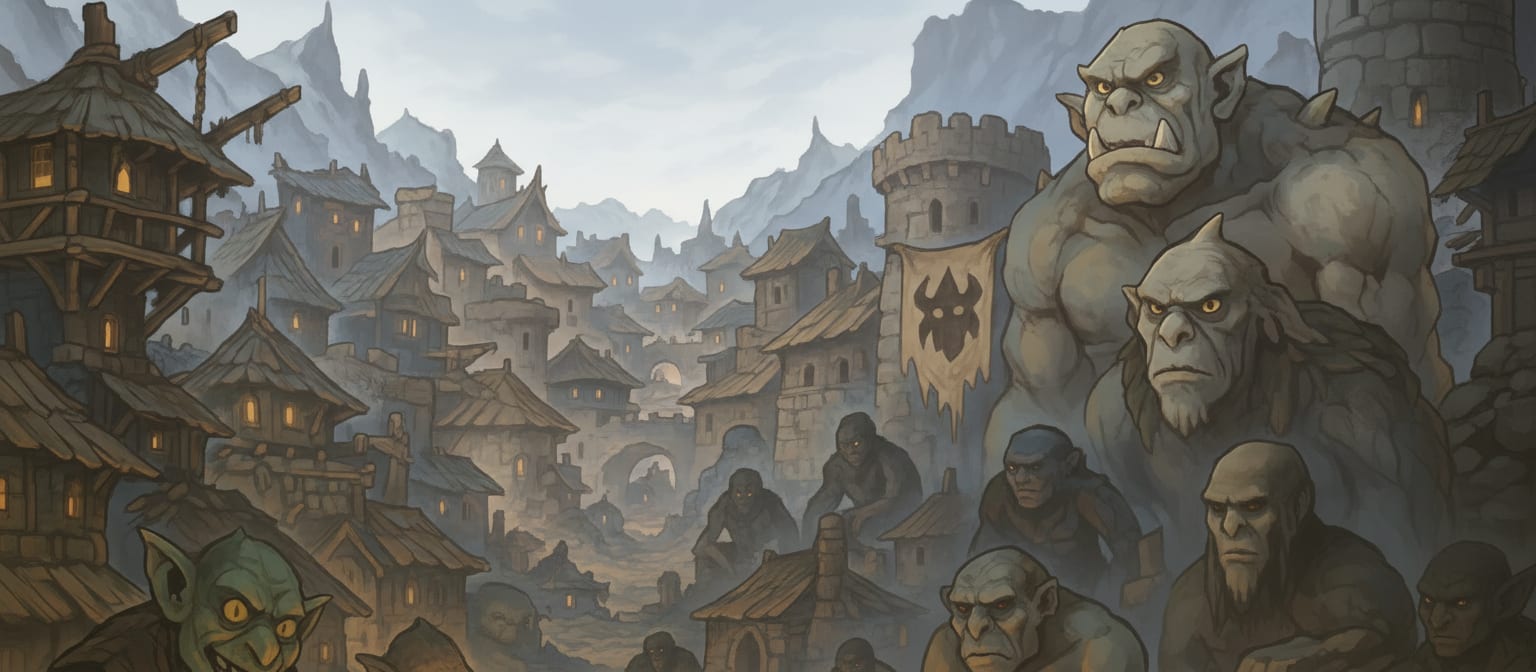
Uzzez stands in the windswept grasslands west of the Bridge of Chuldriz, a place built from the stray pieces of long wars, wandering clans, half-buried siege works, and the stubborn survival instincts of monster-folk who refused to fade. From afar, the city looks like a chaotic spread of hide tents, timber towers, crude stone bastions, and mismatched structures patched together by generations of clawed and gnarled hands. Uzzez was never meant to become a city. It grew because the plains demanded a crossroads and because no other place accepted the people who settled here. Now it stands as the de facto capital of monster-kind in the northern plains, a marketplace, sanctuary, battleground, and cultural melting pot all at once under the guidance of the almost forgotten war goddess. Uzzez is one of the few remaining cities that sees the god of war in her true form and keep to the original tenants of The Faith of War rather than some of the more brutal and bloodied sects.
The City When the Light Fades
The Bone Market at Night
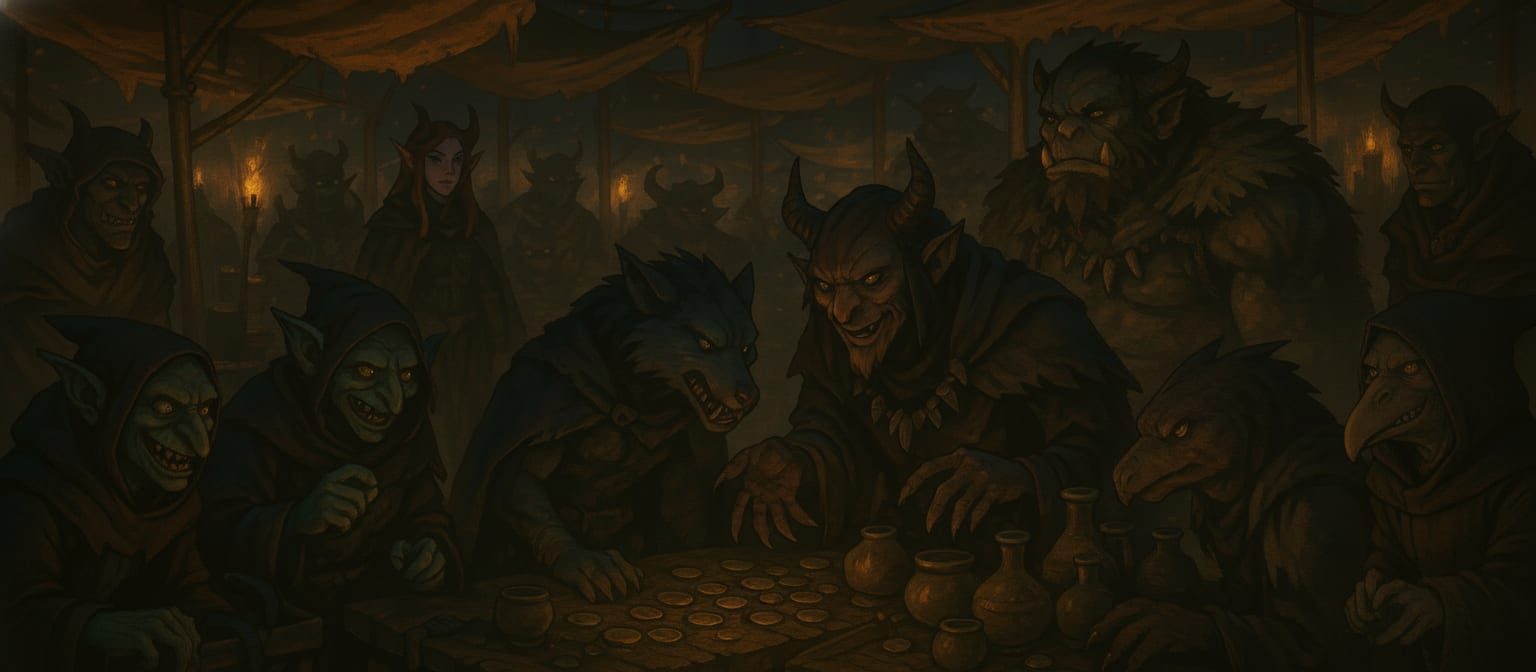
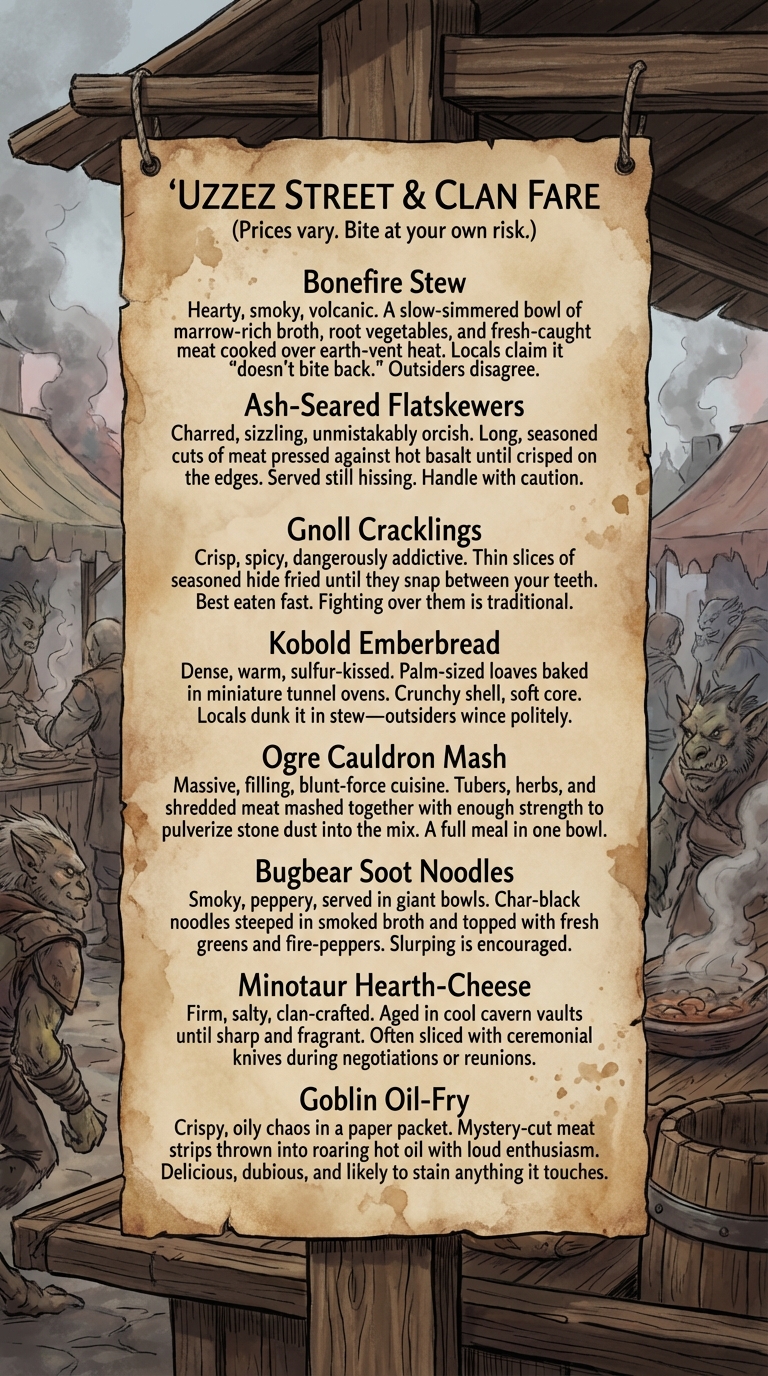
During the day it’s just a rough bazaar. After sundown it becomes something mythic. Torches burn with fat-rich smoke, casting golden haze over stalls piled with skull totems, chitin armor, hooked blades, and strange alchemical brews. Minotaur merchants stand sentinel behind their wares while gnoll butchers laugh over still-fresh cuts of meat. At the edges, hooded figures barter in low tones, kobolds with maps of tunnels no one else should know, tieflings offering relics that hum faintly in the dark. Sparks drift upward like fireflies from a dozen hidden forges.
The Fighting Pits
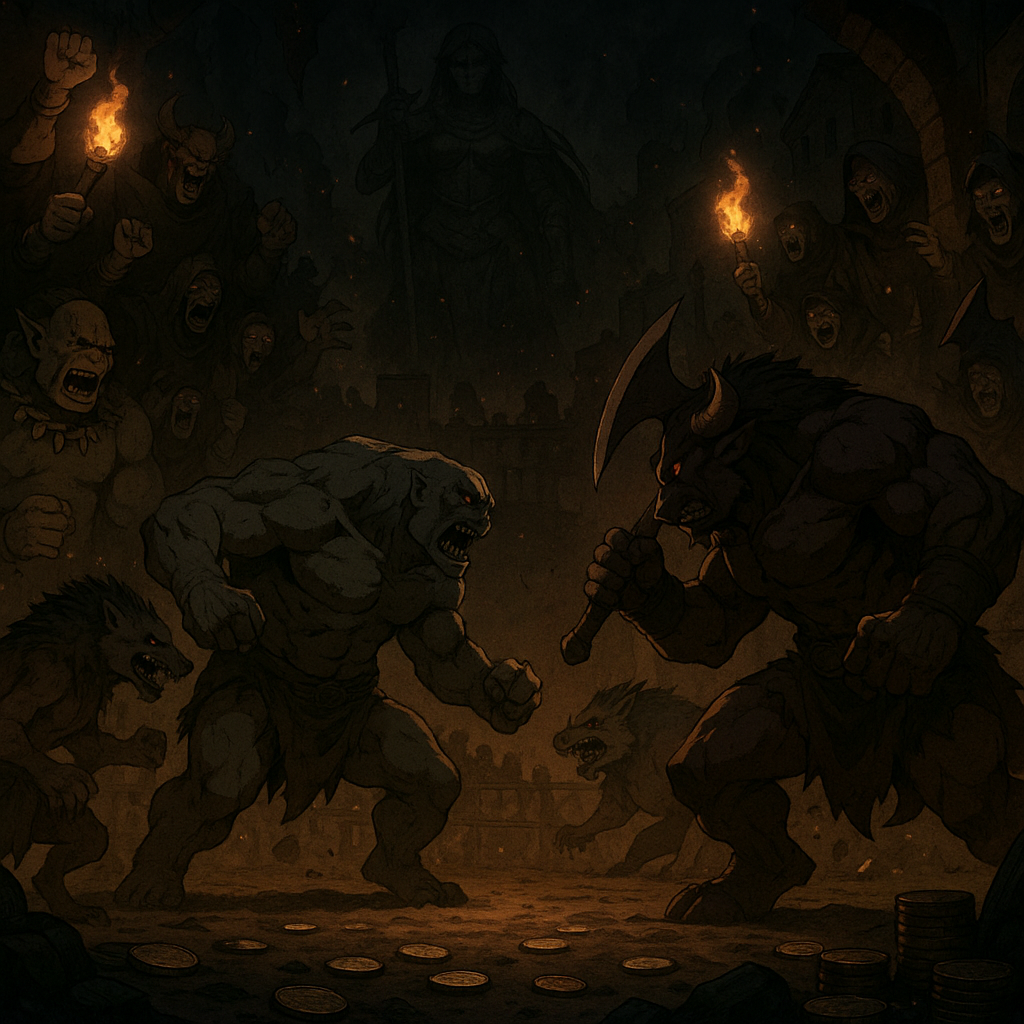
Monster-folk don’t come to the pits simply for entertainment, they come because something inside them must be loosed. The Four Orders know this, even if no one says it aloud. The fighting pits are pressure valves for instincts that, left unchecked, would rip through the streets of Uzzez far more violently. Down below, beneath the torch smoke and the ringing of coin, every combatant is trying to bleed out whatever the city forces them to hold in.
The Blind Circles are where instinct becomes ritual. When two or more fighters step into the smoke-filled chamber, the world disappears into heat and shadow. Burning resin clouds the air, thinning thought and sharpening instinct until combatants move on raw sensation alone. Hearing replaces sight. Muscle memory replaces conscious strategy. The crowd watches from slits in the walls, catching only glimpses of shapes colliding, flaring silhouettes, showers of sparks when metal meets stone. The fights often end with a single sharp cry, a thud, or the abrupt collapse of a shadow onto the ground.
Clan Shadows
Uzzez is held together by the Four Orders, but clans still operate their own justice. In the darker side of the city, you see it everywhere; orc longhouses painted with blood oaths, ogre cairns that glow faintly in moonlight, goblin banners strung with trophies from old conflicts. These areas are loud with drums at night, thick with smoke and ritual song. Outsiders can enter them safely… but only if they understand they’re stepping into a place older and more sacred than the city itself.
Demographics
The population of Uzzez is an unruly spectrum of monstrous ancestries who never found acceptance in the larger kingdoms. Orcs and ogres form the bulk of the city’s strength, while goblins and bugbears act as its nervous system: messengers, tinkers, builders, and troublemakers. Gnolls wander in from the plains and stay long enough to take work as trackers or caravan guards. Lizardfolk from the warmer southern rivers find the region dry but profitable, adapting their craftwork to the climate. Minotaurs, half-giants, kobolds, beastfolk, and a surprising number of tieflings round out the population. Humans, elves, dwarves, and halflings do live here, but they are either hardened by frontier life or have specifically chosen Uzzez for its freedom from preconceived notions.
Government
Uzzez’s government is built directly on the four Orders of the War-Mother based in the The Faith of War and the city treats these Orders not only as religious branches but as the practicality of civic rule. Each Order oversees the part of governance that naturally aligns with its doctrine, and together they create a system that is rough, functional, and surprisingly stable for a population of varied monstrous ancestries.
The Order of the Blade holds responsibility for day-to-day security. Its members direct the city watch, organize defensive patrols, and intervene whenever violence threatens the streets. Their authority is immediate but not absolute, they are expected to act quickly, keep order, and protect the populace, not dictate policy. The current Blade-Marshal, Rovuun Dakhar, a hobgoblin veteran with a reputation for rigid discipline, is widely respected even among clans who dislike being told what to do.
Strategic direction falls to the Order of the Guard. They plan defenses, negotiate with neighboring settlements, manage the flow of trade into and out of Uzzez, and coordinate long-term projects. Nothing large moves in Uzzez, whether it’s a caravan, a fortification improvement, or a mobilization, without the Guard’s careful planning. The Grand Warden, Selka Thornhide, a minotaur tactician known for her steady temperament, chairs the Guard’s deliberations and is considered the closest thing Uzzez has to a traditional statesperson.
Craftsmanship, infrastructure, and specialized training belong to the Order of the Grip. They oversee the forges, repair the heat-tunnels beneath the streets, regulate the work of engineers and tinkerers, and maintain the specialized units that require precision rather than raw force. When something must be built, repaired, or improved, the Grip has the final say. Their First Gripmaster, Dharro Velk, a wiry gnoll whose craftsmanship is as respected as his temper is feared, ensures that every tool and weapon used in Uzzez meets a standard worthy of the War-Mother.
The most subtle authority rests with the Order of the Sheath. They interpret law, mediate disputes, and determine whether an Order’s proposed action is justified or reckless. They hold the power to delay or halt decisions if they judge that the timing is wrong or the city is at risk of acting out of impulse. Their Matron, Issra Venn, a lizardfolk elder with a reputation for even-handed judgment, often plays the role of stabilizer when the other Orders clash.
These four leaders form the Sword, the body that meets whenever decisions extend beyond the scope of a single Order. Any Order may act freely within its domain, but actions that would shift the city’s direction, declaring war, forging new alliances, introducing new laws, or restructuring districts, require at least two Orders in agreement. The Sheath alone holds the right to delay a major action if it determines that the city risks acting in haste, though this power cannot permanently block the combined will of the other three.
Strength governs violence, strategy governs planning, craft governs development, and restraint governs judgment. No single Order can overreach without being countered by another, and none can neglect its duties without the others stepping into the void. The system is not elegant, but it is dependable.
Defences
Uzzez was shaped by war, and its defenses reflect this history. The outer “walls” are not true walls at all but a sprawled ring of fortifications built over centuries: earthen ramparts, spiked trenches, palisade towers, wrecked siege engines converted into watchposts, and narrow kill-paths engineered by goblins with a love for traps. Patrol packs (usually gnolls or worg-mounted goblins) circle the city at all hours.
Within the city, clans maintain their own defensible compounds, ready to act as fallback positions. Uzzez’s strength doesn’t lie in height or stone but in its ability to turn into a unified war machine in minutes. Every inhabitant knows how to fight, and every street can be turned into a gauntlet of spears and fire.
Industry & Trade
Uzzez’s economy thrives on scrap, salvage, and ingenuity. The city grew as a midpoint between Port Miklagil’s coastal trade and the harsher lands to the east and south. Caravans bring coastal goods inland, and monster artisans repurpose everything into something useful or dangerous.
Smithing is the backbone trade, especially among ogres and orcs who maintain open-air forges heated by natural vents and crude bellows. Goblin engineers fabricate weapons, traps, gadgets, and mechanical oddities that fetch high prices. Leatherworking, bonecarving, pottery fired in earth-fire pits, and monster cuisine give Uzzez its distinct culture.
Because the plains provide poor crops but excellent grazing, the city trades in meat, hides, and monstrous livestock. The desert’s edge offers minerals and strange stone deposits veined with volcanic heat. Port Miklagil sends metal and tools; Uzzez sends mercenaries, scouts, and raw materials in return.
Infrastructure
Uzzez’s infrastructure feels improvised but surprisingly effective. Water is drawn from deep wells and stored in elevated cisterns; these structures look unstable but function perfectly. Streets are more like trampled pathways divided by clan banners and makeshift fences. Transport is mainly by foot, wagon, or massive pack-beasts adapted to the plains.
The city’s power grid (if one can call it that) relies on geothermal vents, communal fire pits, and a crude but ingenious series of heat tunnels that run beneath major districts, used for blacksmithing, cooking, and winter survival.
Districts
The city is divided by who built what and why.
The Clan Yards are broad spaces of tents, hide shelters, and family compounds.
The Iron Quarter is a dense tangle of forges, heat pits, smithies, weapon shops, and metal salvage.
The Warrens form a chaotic maze of stacked shacks and scaffolds where goblins and kobolds thrive.
The Bone Market serves as the city’s central bazaar, selling everything from scrap metal to exotic beasts.
The Spire District surrounds the old siege tower and houses the more permanent buildings, including shrines, council chambers, and longhouses where treaties are negotiated.
The districts don’t have fixed borders; they grow, collapse, and migrate over time.
Guilds and Factions
Uzzez is a mosaic of groups, each holding influence rather than control. Smith-clans, mercenary bands, monster tribes, caravan brokers, shamans, trap-engineers, bone-singers, wandering priests of warlike gods, and veteran companies from the Chuldriz conflict all maintain headquarters here. Even the criminal factions claim their space openly; Uzzez doesn’t pretend to be lawful, only fair. Some groups operate like guilds, others like tribes, and many like militarized families.
History
Uzzez began as a gathering place long before it was a city. The plains in this region are harsh, windswept, cold at night, blisteringly hot in summer, and the land offers few natural shelters. But beneath the soil lie warm currents of deep earth heat, creating scattered pockets where winter frost melts quicker and fires burn hotter with less fuel. Early monster clans discovered these sites centuries ago and used them as seasonal encampments, returning year after year because survival was easier here than anywhere else nearby. Over time, different groups would find each other occupying the same ground during migrations, and out of necessity (not camaraderie) they learned to coexist.
In the earliest days Uzzez wasn’t a settlement so much as a truce. Orcs, gnolls, goblins, ogres, and wandering beastfolk would camp in proximity under a set of unspoken rules: no raids, no blood feuds, no midnight ambushes while winter storms howled. It was a place to rest, to mend wounds, to share heat, and to avoid the violence that plagued the rest of the plains. When the War-Mother’s earliest priestesses appeared—solitary travelers who taught that strength without strategy collapses, and war without restraint becomes suicide—they found the perfect soil for their doctrine. Their philosophy spread not through conquest, but because it offered a workable solution to a problem every clan faced: how to survive each other.
The shift from encampment to settlement took generations. Families began digging permanent storage pits; hunters laid the first communal smokehouses; smiths discovered that the ground’s warmth made winter forging possible. Timber structures replaced tents, then evolved into crude longhouses and clan halls. Goblin and kobold engineers built the first tunnelwork beneath the camp, expanding the natural heat fissures into usable chambers. By then everyone agreed the place needed a name, and “Uzzez” became the one that stuck; a word from an old ogre tongue that simply meant “the place we return to.”
Various clans erected their own districts, staking out territory not through walls but through lineage and craftsmanship. The faith of the War-Mother also formalized during this era. What began as scattered teachings solidified into the Four Orders (Blade, Guard, Grip, and Sheath) and gradually those Orders took on roles that extended beyond faith into the daily function of the growing city. Their structure proved resilient, especially in a place where no single people could dominate the others. Instead of fighting for control, Uzzez’s inhabitants ceded authority to the Orders because it preserved balance.
When the Battle for the Bridge of Chuldriz erupted, Uzzez found itself unwillingly thrust into the role of a supply spine and last safe ground before the front. The city never marched as a unified army, but its clans and companies flowed outward in waves, each answering the crisis in their own way. The Blade sent patrol bands to hold the plains routes, the Guard orchestrated supply lines and evacuation paths, and the Grip’s forges burned hotter than ever, outfitting mercenaries, ally caravans, and even rival clans who needed steel fast. Refugees from the fighting poured in, and Uzzez absorbed them with its usual rough pragmatism: if you could work or fight, you had a place. Though the city never claimed victory or loss, its quiet endurance kept the western war effort alive; without Uzzez’s grit and its constant churn of bodies, blades, and provisions, the battle at the bridge would have collapsed long before its end.
Architecture
Uzzez’s architecture is a living record of the people who built it. Stone is scarce, so most structures combine wood, bone, hides, clay, earth, and scavenged metal. Goblin scaffolding climbs the sides of taller buildings like spiderwebs. Orc longhouses feature heavy timber frames and broad communal spaces. Ogres construct blocky shelters reinforced with boulders or scrap plating. Minotaur builders favor circular layouts and labyrinthine courtyards. Buildings are rarely stable-looking, but constant maintenance and clan pride keep them standing.
Climate
Uzzez endures the full temperament of the northern plains—dry winters, hot summers, harsh winds, sudden storms, and dust blowing in from the desert. The city is adapted to cold nights and scorching days, using underground heat tunnels and shade-screens to survive.
Natural Resources
The plains provide game, hides, and grazing; the eastern desert offers mineral-rich stone; and the earth below gifts geothermal warmth. The region lacks fertile soil, making agriculture sparse and precious—another reason monster-folk rely on hunting, trade, and craft instead of farming.
“Welcome to Uzzez, traveler. Don’t stare too long, don’t flinch too fast, and you’ll live to see the sunrise. We ain’t gentle, but we’re fair and iff'n you treat this city right, it’ll treat you better than anywhere else on these plains.”
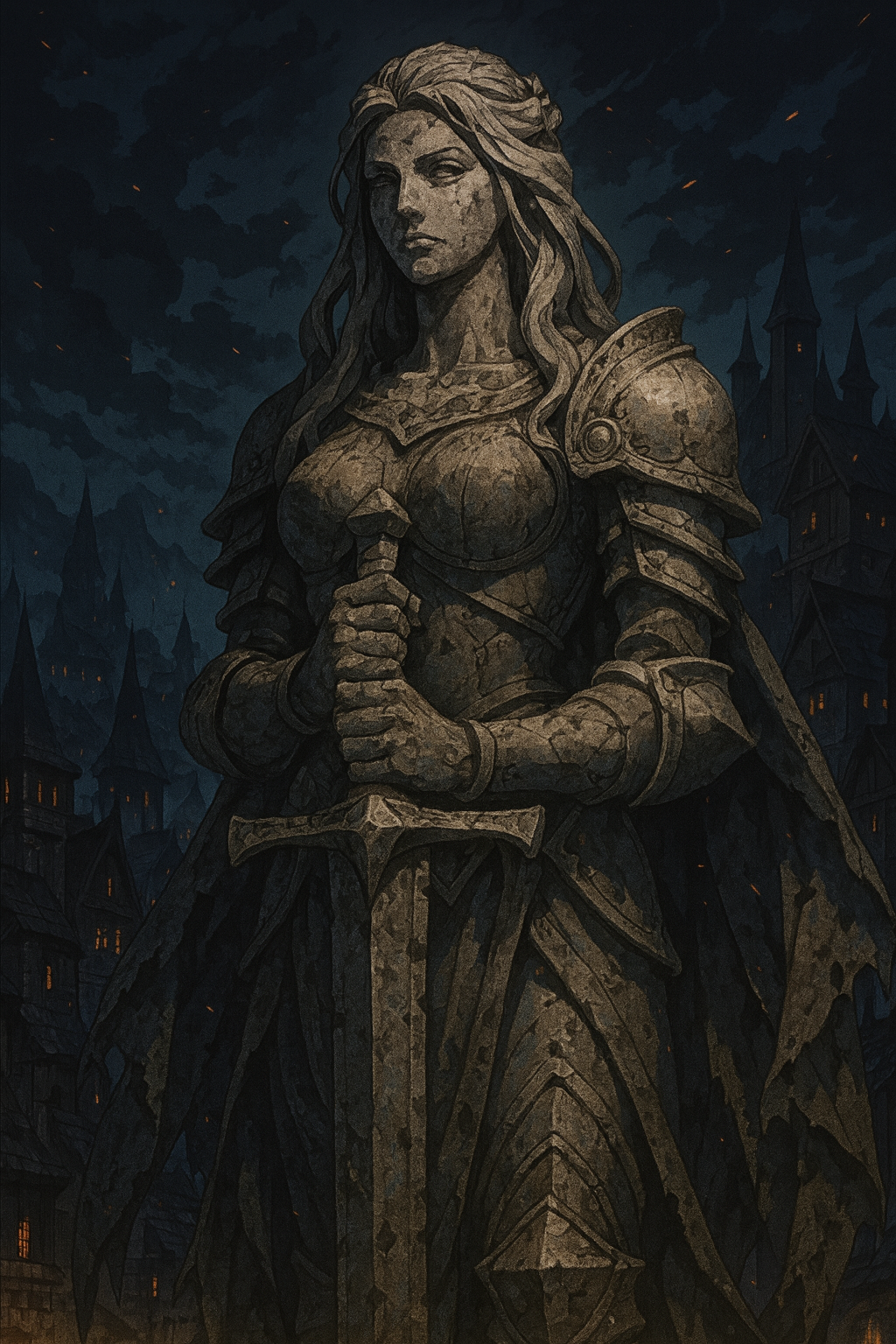
“Across the plains her name is a whisper lost to time, a relic spoken only in old battle-prayers… but not in Uzzez. Here, the War-Mother still stands tall in the marrow of every clan. Others may forget her, but this city remembers the one truth she gave us: strength without purpose is ruin, and purpose without strength is death.”
Comments