
Faujan (Faugh-Jaun)
Demographics
Faujan’s population reflects centuries of caravan movement and desert clan consolidation. Humans make up the majority, but their cultures vary depending on whether their families descend from early desert tribes, caravan traders, or later migrants. Dwarves are common in the lower districts, drawn generations ago by the city’s reliance on stonework, mining, and deep well engineering. Halflings and gnomes often manage trade logistics, supply chains, and inventory for the caravanserai. Tieflings and other ancestries appear in modest but consistent numbers—usually families who arrived with caravans and stayed.
Wealth divides sharply: the old well-holding families stand at the top, followed by merchants tied to caravan companies, then skilled laborers and craftsmen. At the bottom are water-haulers, day laborers, porters, and those who work the driest jobs—repairing aqueducts, hauling bricks, tending pack animals, and maintaining the evaporation nets. Social mobility exists, but slowly; water rights and old alliances still shape the city’s hierarchy.
Government
Faujan is ruled by the Council of Wells, a body formed by the five surviving families from the Well Disputes. Each family controls one or more of the major aquifers, and political power is tied directly to access, maintenance, and allocation of water. Laws revolve around water security, trade protection, and safeguarding the caravan routes that the city depends on. The Council meets in a central chamber where disputes between merchants, clans, caravans, or citizens are mediated—though “mediated” often means the Council quietly shepherds outcomes that favor stability and protect their interests.
Below the Council is a network of stewards and inspectors responsible for monitoring distribution, collecting water tariffs, overseeing maintenance, and enforcing rationing protocols during lean seasons. Punishments rarely involve imprisonment; instead, offenders are sentenced to labor maintaining wells, hauling water, or clearing sand-blocked roads. The system is strict but functional, rooted in survival rather than ideology.
Defences
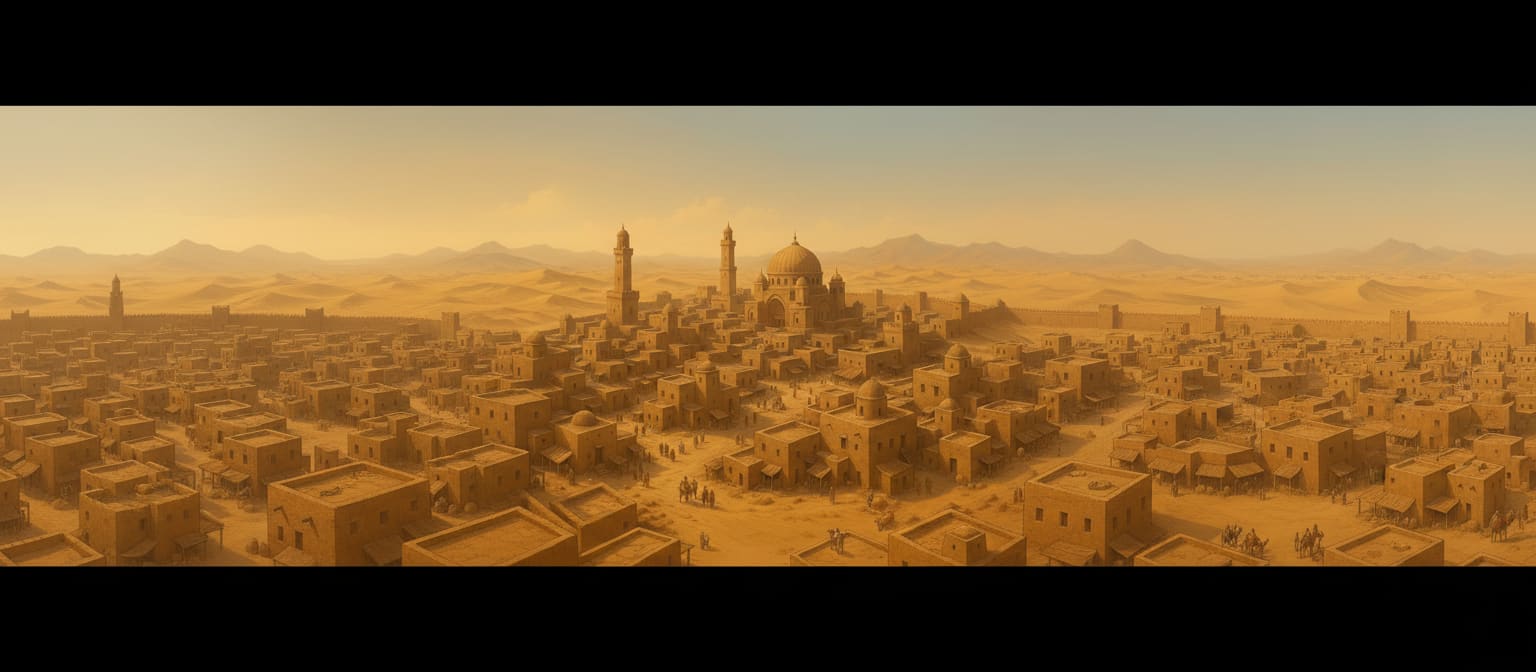
Faujan’s defenses evolved out of necessity rather than grand strategy. The oldest structures are thick sandstone walls reinforced over centuries with desert brick, stone veneers, and occasional metal braces from salvaged caravan wagons. Watchtowers overlook the approaches, not for armies but for raiders, rogue caravans, sandstorms, and predators that follow trade routes.
The city maintains a modest militia trained in spear formations, shield walls, and mounted skirmishing—tactics ideal for narrow passes and shifting dunes. More important than the fighters are the city’s scouts: desert riders who patrol the surrounding roads, monitor weather patterns, and guide caravans away from dangerous terrain.
Internal defenses rely on careful control of gate access and the city’s compartmentalized layout: districts can be sealed off quickly if needed, and water stores are heavily guarded. The Council families each maintain private guards, and while conflicts between them are rare today, the tension still lingers in the architecture.
Industry & Trade
Faujan exists because of trade and water, and nearly every industry feeds directly into one of those.
Key economic pillars include:
Water Brokerage – The beating heart of the economy. Water is collected, stored, rationed, and sold in regulated tiers. Caravans pay access fees, storage fees, distribution fees, and seasonal taxes tied to water volume.
Caravan Services – Repair yards, tanners, blacksmiths, wheelwrights, pack animal breeders, cartwrights, and negotiators all thrive here. Entire families specialize in only one caravan company or route.
Desert Goods – Aromatics, resins, preserved goods, medicinal plants grown in courtyard gardens, textiles suited for harsh climates, and salt-derived products.
Craftwork & Engineering – Stonecutting, well construction, rope production, net weaving, and specialized metalwork developed to withstand desert heat.
Salvage – Items recovered from ruins farther west or abandoned caravan wrecks. Nothing mystical—mostly metals, tools, old foundations, and scrap materials repurposed for construction.
Faujan doesn’t produce grand luxuries; it produces reliability, survival, and the expertise needed to move goods safely through a harsh region.
Infrastructure
Faujan’s infrastructure is built around capturing, storing, and protecting water. Deep wells tap ancient aquifers; cisterns lie beneath public squares; evaporation nets stretch between rooftops; and a network of underground channels carries water from the wells to distribution centers. Everything is engineered for durability and redundancy.
The city’s streets are narrow and angled to create shade and channel wind. Buildings share walls to keep interiors cool. Below the surface lies a honeycomb of tunnels—some official, some forgotten—originally used for storage and now repurposed for cooling, transport, and (quietly) smuggling.
Road maintenance is a constant effort. Sand shifts daily, and teams are always clearing, reinforcing, or marking safe pathways. The caravanserai district serves as a logistical hub, with stables, barracks, markets, and repair pits designed for high traffic and quick turnaround.
Guilds and Factions
The Council Families
The five original well-holding bloodlines. Their influence is political, economic, and cultural, and their alliances—both public and secret—shape the entire city.
The Water Stewards’ Collective
Engineers, inspectors, well guardians, and ration overseers. They implement the Council’s authority and have immense practical power.
The Caravan Guilds
A network of merchant companies and independent caravan leaders who coordinate trade routes. They’re not openly antagonistic to the Council, but they often push against regulations and fight for better access and lower tariffs.
The Boundary Wardens
Scouts, riders, and desert navigators responsible for safety on the roads. They have almost military autonomy when outside the walls and are highly respected despite lacking political clout.
History
Faujan began as little more than a gathering spot on the desert’s eastern trade run. Long before the city existed, caravans moving between the inner territories and the deep desert followed a narrow arc that curved near an unnaturally barren region to the west. The land there was already lifeless by the time written records begin, but travelers cared less about its origin and more about the fact that its edge provided a reliable landmark and a relatively sheltered place to stop.
By around 1120, caravans from different regions had independently begun using the same shallow basin along the ridge as a rest point. It wasn’t a settlement—just a practical place to pause, fix equipment, and take stock before continuing the long desert haul. Temporary camps rose and vanished every few days, leaving only fire pits and trampled sand behind.
Everything changed in 1242, when an unusually violent storm cracked open the bedrock near the basin. Desert guides exploring the fissure found an aquifer far below the surface. A constant, clean water source in such a harsh landscape immediately drew attention. Within weeks, three different desert clans had staked competing claims on the site. By the next year, caravans arriving for water found armed watch posts instead of quiet shelters, and tensions escalated into the first of several conflicts that later generations would call the Well Disputes.
Over the next two centuries, from roughly 1260 to 1480, the basin transformed from a contested watering hole into a permanent encampment held by whichever clan or caravan group could maintain control long enough to fortify their claim. New wells were dug, sometimes peacefully, sometimes not. Rival clans sabotaged each other’s ropes and pulleys, caravans hired mercenaries to enforce access, and brief, bloody skirmishes flared up whenever a new water source was discovered. The people who lived through this period would later describe it simply: “Those who held water survived, and those who didn’t, didn’t.”
By 1510, after generations of conflict, five surviving families emerged as the dominant forces in the region—families who controlled the most stable wells and had forged enough alliances to rise above constant feuding. They formalized their authority by creating the Council of Wells, an agreement that divided water rights, imposed rules on caravan access, and established neutral ground for trade. This marks the accepted founding date of Faujan as an actual settlement rather than a battleground.
Between 1600 and 1900, Faujan slowly grew from a fortified well-site into a true trade hub. Market shelters became permanent stalls, storage tents became sandstone warehouses, and caravans began timing their routes to coincide with the city’s growing infrastructure. The Council families sponsored construction of defensive walls, public cisterns, and shade corridors to make the settlement livable year-round. As the city stabilized, more desert families migrated toward it, drawn by the promise of trade, security, and work maintaining the wells.
By 2100, maps consistently identified Faujan as a major checkpoint on the eastern routes. Its influence grew steadily, driven by its command of water and its strategic position between the desert tribes and the inland kingdoms. The city grew slowly but continuously over the next two millennia, expanding outward only as new wells were discovered or reclaimed.
In the year 3692, Faujan acted as a proxy base for the moon elves that fought in the battles of Hacuito during The Falling of Stars campaign.
Today, in 4229, Faujan stands as one of the oldest continuously inhabited settlements in the desert region. Its ruling families still trace their lineage to the survivors of the Well Disputes, and water remains the foundation of every political and economic decision made within its walls. Though it began as an accidental oasis used by passing caravans, it endured because people fought for it, bled for it, and eventually learned to build around the only resource that mattered in its harsh and unforgiving corner of the world: water.
Comments