

The Magnus Confluxus
“No single world could birth such a land. Only the Rift, in its terrible wisdom, could weave a continent from the fragments of fallen realms.”
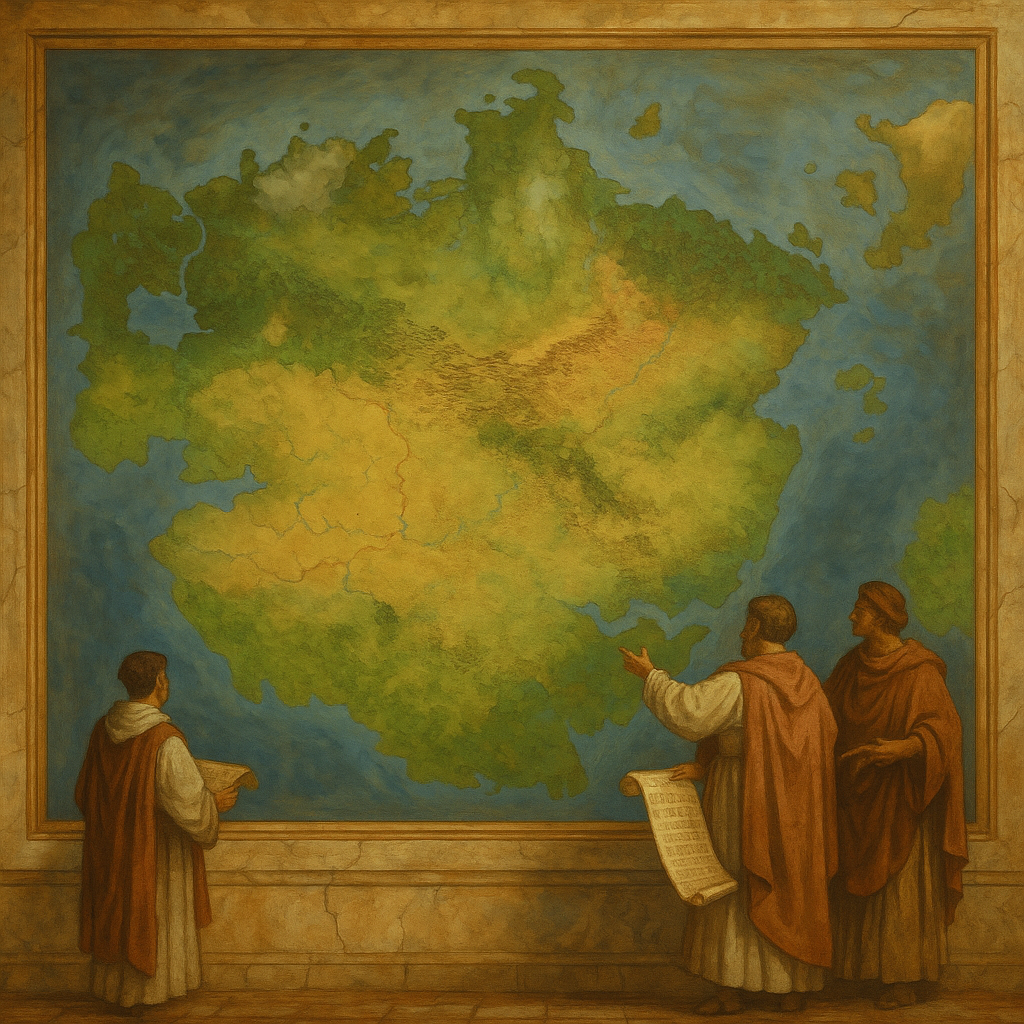
The Magnus Confluxus stands unrivalled as the greatest landmass known to scholars, legates, and arcanists alike. Unlike the continents of old Earth or the singular cradle-realms of other Rift arrivals, this vast expanse is not the product of patient geology. It is a mosaic, a fused immensity of landscapes torn from alien worlds and welded together by the cosmic convulsions of the Rift across nearly three millennia. Nowhere else in Exilum Novum does one walk from a fertile Roman valley into ancient elven woodland within a single day’s march, nor witness desert dunes that begin abruptly where once a northern marshland lay.
To the Imperium Novum, the Magnus Confluxus is nothing less than the axis upon which civilisation turns. It is the seat of imperial power, the crossroads of all major diplomatic networks, and the fulcrum of arcane study due to the continent’s unusually stable central Rift energies. Every major culture of the known world claims a portion of this vast mosaic, from the disciplined dominions of the Empire to the sun-scorched sovereignty of the Brass Cities, from the war-hardened highlands of the Warborn to the runeforged halls of the Dwarrow. The Magnus Confluxus is a continent of many worlds, yet it stands as one tapestry of fate, unified by the collisions that birthed it.
Geography
The geography of the Magnus Confluxus is a study in cosmic upheaval rendered strangely habitable. No other land in the known world wears its origins so plainly upon the surface. Every league of terrain bears witness to the violence of the Rift: abrupt changes in soil composition, mountain ridges whose strata contradict one another like rival histories, forests that begin with no prior foothills or transitional brush, and rivers whose courses seem almost deliberate, as though guided more by arcane harmonics than by gravity or erosion.
At the centre of the continent lie the Rift-stabilised plains of the Dominia Imperii, long regarded as the most geographically “rational” region of the Confluxus. The land there undulates in soft rises and gentle valleys shaped by the ancient Roman province and the Rift’s surprising tendency to harmonise certain landscapes. Soil quality is uniformly high, rivers flow with calm predictability, and the region hosts one of the world’s most orderly ley-line networks. Scholars of the Collegium frequently note that the heartlands appear almost curated, as though the Rift had paused its destructive impulse to create a foundation suitable for civilisation. This central stability stands in stark counterpoint to the wild frontiers that surround it.
Travel westward and the continent’s seamless façade quickly fractures. Wide tracts of evergreen forest rise suddenly, without the gentle climatic transitions expected in natural worlds. These are the domains of the Clannae Belligeri, a landscape of wet soil, moss-coated boulders, and trees whose roots clutch at the land as though still resisting their forced transplantation. The terrain is unforgiving — steep ridges give way to sudden bogs, and valleys twist in patterns that defy conventional geomorphology. Many Imperial cartographers speculate that the Warborn highlands consist of multiple Rifted forest-belts welded together along fault lines only partially stabilised, resulting in the dizzying and often treacherous topography that their legions dread.
Far to the north and northeast the land heaves upward into the monumental ridges and multifaceted mountain corridors of the Foedus Dvarum. These mountains are perhaps the most dramatic evidence of the continent’s assembled nature. In some peaks, three different rock types meet at impossible angles, their alignment preserved through Rift compression rather than geological time. Crystals foreign to this world protrude from faulted seams like ossified lightning, while cavern mouths open into labyrinths that continue deeper than any natural formation should. The Dwarrow claim, with typical stoicism, that the mountains are exactly as the Rift intended them: places of stone, secrecy, and mineral abundance. Yet even they concede that the mountains change subtly from generation to generation, as though the Confluxus still shifts beneath their feet.
Eastward, the land grows gentler but more mysterious. Here lie the ancient forests and glimmering waterways of the Curiae Veteres, a landscape older than Imperial memory and charged with mana so subtly woven into the soil that even the air feels heavier. The boundaries of these forests seldom obey topographic logic. A ridge that should break the woodland instead flows into uninterrupted canopy for miles, while some valleys hold glades that appear to predate even the elven arrival. Rivers behave strangely, too, sometimes changing depth and clarity from one bend to the next, a phenomenon that elven archons cryptically describe as “mana tides.” To Imperial geographers, the east remains the least understood region of the entire continent.
In the south, the continent opens like a great fan into rolling plains, where grasslands sway in long waves shaped by wind more ancient than the Horse-Lords who ride upon them. This is the domain of the Domini Equitum Campestrium, a region defined not by mountains or forests but by distance itself. The steppe stretches for so many leagues that its curvature seems to challenge the very shape of the earth. Its hills rise with shallow grace, then fall again into immense open flats where entire migrations can travel for weeks without seeing a fixed landmark. The soil varies wildly, from dark-loam belts to dusty, pale expanses where even hardy shrubs cling with difficulty — a remnant of conflicting Rift baselines whose influence still lingers.
In the far southwest the world changes again, this time with brutal suddenness. The fertile south gives way to the incandescent dunes and sun-forged stone of the Civitates Aereae, a region where deserts collide with mountains in a patchwork that should be impossible. Here vast seas of sand extend across territory that once belonged to multiple deserts from multiple worlds, all fused into a single, scorching continuum. Dunes rise like frozen waves against sun-blackened ridges, while plateaus of polished stone reflect so much heat that the horizon wavers with mirage-light. These deserts interact strangely with the continent’s arcane energies, creating microclimates of searing dryness or sudden cold when night falls. It is a land shaped by heat, ritual, and the unknown desert magics that the satraps guard with unbreakable discipline.
Overall, the geography of the Magnus Confluxus is a symphony of contradiction. No single natural process explains its form; no singular climate governs its breadth. It is a continent that should not function, yet it thrives, stitched together by the Rift’s ancient violence and sustained by the cultures that have adapted, conquered, negotiated, and endured within its bounds. To walk the Magnus Confluxus is to travel through the remnants of countless worlds — a journey through memory, destruction, and the strange, tenacious beauty of survival.
Ecosystem
The ecosystem of the Magnus Confluxus is an impossible harmony born from cosmic violence. No natural continent could contain such an array of biomes within its borders, nor see them interlock with such eerie functionality. Across its breadth, one can witness interactions between organisms that were never meant to meet: desert predators stalking prey shaped for misty elven forests, alpine fungi competing with Rift-born grasses that once belonged to a world ruled by alien moons, and migratory herds whose instincts — old as their original skies — still guide them along routes that now traverse wholly different climates.
The ecological foundations of the continent are fractured along the seams of ancient Rift events. Each Rift arrival brought not only land, but the living networks that clothed it: soils rich with microorganisms alien to this world, forests populated by species whose behaviours were sculpted by foreign seasons, predators that evolved alongside prey long lost in the cosmic dislocation. The first centuries following each arrival were marked by catastrophic instability, as species abruptly found themselves in new climates or forced into competition with organisms from distant realms. Many perished, yet those that adapted did so with startling tenacity, creating new relationships that Imperial naturalists now regard as uniquely emblematic of the Confluxus.
The balance of predator and prey cycles has been reshaped again and again by the Rift’s lingering energy. In the Dominia Imperii, the ecosystem appears deceptively stable. Rift-stabilised plains favour reliable crop growth, and native and Rift-borne herbivores coexist with surprising ease. But this stability belies deeper undercurrents. Certain grasses still respond to invisible arcane pulses, blooming late or early depending on subtle surges of cosmic residue. Insects whose ancestors once lived under twin suns now hatch in uneven cycles, sometimes producing devastating swarms that move in narrow, ley-guided formations. Imperial farmers have learned to read the shifting colours of dusk skies as auguries for such outbreaks.
In the Clannae Belligeri highlands, the ecosystem is shaped by perpetual conflict — not only between clans, but between organisms themselves. Thick-canopied forests encourage the rise of apex predators of immense cunning, while the rugged valleys host toughened herbivores with thick hides designed to resist tusk and claw. Plants compete fiercely for sunlight in places where foliage from multiple worlds jostles for dominance; some species climb over others in spirals inspired by alien star-patterns, while others hatch spores that glow faintly during the region’s frequent thunderstorms. The Warborn have built their culture on an intimate awareness of these ecological rhythms: their seasonal hunts, their migrations between fortified holds, and even their battle rites are influenced by the movements of beasts whose ancestry remains a mystery.
In the mountains of the Foedus Dvarum, ecosystems descend vertically rather than laterally. Alpine meadows host hardy shrubs and nimble prey animals that race between boulder-fields shaped by clashing worlds. Below them, cavern mouths lead into entirely separate ecosystems — fungal forests fed by geothermal warmth, blind lizard-like creatures navigating by tremor-sense, and insects adapted to chambers where Riftstone deposits emit pale, steady light in colours unknown to the surface. Dwarrow scholars insist these subterranean ecosystems are not passive environments but evolving ones, responding to the shifting tectonics and long-term arcane settling that still occur along deep Rift seams.
The Curiae Veteres possess perhaps the most enigmatic ecosystem on the continent. Their ancient forests pulse with mana, creating conditions that defy standard classification. Some trees exhibit seasonal changes unrelated to temperature or rainfall, instead shifting according to mana tides measured only by elven archons. Flowers bloom in patterns that resemble geometric spell-circles, and certain groves host luminous insects whose life cycles are timed to the waxing phases of the twin moons. Predators within these forests often display intelligence higher than their counterparts elsewhere, leading Imperial naturalists to suspect that long-term exposure to elven magic has altered not only behaviour but cognitive function. The elves, predictably, offer neither confirmation nor denial.
In the south, the steppes of the Domini Equitum Campestrium embody a more traditional ecological structure — albeit one influenced by the vastness and subtle Rift remnants beneath the soil. Herd animals migrate in sweeping arcs across the plains, guided by instincts carried from their ancestral worlds and reshaped by the new land’s winds and scents. Predators trail them at great distances, often sparring with rival species brought together by Rift convergence. Here, survival depends on speed and keen senses. The Horse-Lords read the land’s health through the behaviour of herd animals, the colour of grasslands after rainfall, and the density of night-calling insects. Their shamans claim that the plains speak in patterns of wind and hoof, and Imperial scholars reluctantly admit that seasonal predictions made by these nomads often exceed those forecasted by the Collegium’s meteorological experts.
The deserts of the Civitates Aereae present the most hostile ecosystem of the Confluxus. Species that evolve in such extremes typically specialise in conserving water, yet Rift convergence has produced organisms capable of harnessing heat in ways no Imperial zoologist can fully explain. Certain cacti store thermal energy, releasing it during cold nights in faint shimmering waves that protect them from frost. Desert predators have eyes adapted for both glaring sunlight and eerie dusk-glow, an adaptation believed to be tied to the sands’ crystalline content. Some plants only germinate when sand-singing — the harmonic resonance produced by desert winds — reaches a precise pitch. The Brass Satraps have made a science of these phenomena, though their findings are guarded with a secrecy that frustrates foreign scholars.
Across all regions, the most striking feature of the Magnus Confluxus ecosystem is its capacity for unexpected harmony. Species from wildly different worlds form new symbiotic relationships: fungi that feed on Riftstone dust fertilise plains that would otherwise fail; tiny avian species help pollinate mana-sensitive flowers of elven groves; desert insects crossbreed with forest strains, creating hybrids that stun predators with defensive light displays. Even competition produces balance as foreign species learn to adapt, retreat, or die out, slowly shaping an ecological equilibrium that defies all conventional models.
In its entirety, the ecosystem of the Magnus Confluxus is less a single natural system and more a grand experiment set in motion by cosmic calamity. It is proof that life — even when uprooted from its origin, cast into new skies and new magic — will claw its way toward continuity, forging new worlds from the fragments of old ones.
Ecosystem Cycles
The rhythms of life across the Magnus Confluxus follow a broad, coherent continental pattern, shaped by familiar solar seasons, prevailing winds, and the continent’s varied climates. Yet woven into this otherwise natural cadence are the quiet interruptions left behind by the Rift: small enclaves of foreign worlds, each no larger than a province, that still remember the temperatures, tides, and celestial rules of the skies they once belonged to. These pockets do not overturn the continent’s primary ecological cycles, but they complicate them—introducing subtle distortions that ripple outward before fading into the greater harmony.
In the Dominia Imperii, the annual cycle mirrors that of a stable temperate world. Winters are cool but not severe; summers warm and reliable; springs and autumns arrive with crisp transitions. The consistency is so marked that Imperial scholars often describe the heartlands as “naturally civilised,” a quiet boast that the land itself favours order. Yet even here, small Rift enclaves interrupt the rhythm. A handful of old-growth groves bud weeks earlier than their neighbours, guided by a forgotten seasonal logic. Certain insects engage in brief, frantic mating surges on lunar cycles alien to this world, though these events fade quickly and rarely travel beyond their Rift-born enclaves. The surrounding plains absorb these phenomena with ease, demonstrating the resilience of the broader ecosystem.
In the Clannae Belligeri territories, the dominant cycles are those of northern forests: long winters, swift springs, and summers filled with dense undergrowth. The native species—those shaped by this world’s natural climate—move according to predictable patterns of thaw, rainfall, and forage. Yet scattered throughout the region lie narrow Rift scars where foreign ecosystems persist in miniature. Valleys from colder worlds hold onto winter’s chill weeks longer than the surrounding land, creating delayed blooms that entice migrating herbivores into unexpected detours. In other places, predators from Rifted forests still follow instinctive cycles that no longer suit the wider climate, stalking prey that has already moved on. These mismatches occasionally spark brief ecological tensions, but the overall forest cycle remains firmly anchored in the Confluxus’ natural seasons.
Within the Foedus Dvarum, the mountains adhere to traditional alpine cycles: snowpack accumulation, spring meltwater, brief summers bursting with high-altitude blooms, and long returns to ice. Yet the Rift-carried sections of ancient subterranean realms intrude upon this pattern in small, isolated patches. Fungal networks taken from worlds with bioluminescent cycles still brighten in steady pulses unrelated to surface seasons. Caverns transplanted from hotter regions retain geothermal warmth for decades, harbouring species whose reproductive rhythms remain stubbornly tied to forgotten climates. These enclaves persist like fossils of foreign ecologies, but they remain contained and do not alter the mountains' overarching seasonal heartbeat.
The Curiae Veteres follow a more temperate, moisture-rich seasonal cycle, shaped by rainfall rather than extreme temperatures. For most of the forests, spring arrives gradually, coaxing out blooms and calling forth the migration of pollinating species. Autumn descends with stately grace, painting the canopy in deep reds and golds. Yet some pockets within the elven woods belong to worlds where seasons marched to very different rhythms. In these enclaves, trees may hold their leaves longer or shed them earlier, flowers bloom out of step with the surrounding forest, and certain creatures remain active during seasons when their kin grow lethargic. Elven archons claim these pockets are not mistakes but reminders—a mosaic of lost worlds preserved within their domain. Still, the broader forest follows the natural seasons of Exilum Novum, not the foreign cycles of these tiny enclaves.
Far to the south, the Domini Equitum Campestrium live in harmony with the steppe’s vast annual cycle. Summers bring intense heat that drives herds to distant watering grounds; winters sweep across the plains in fierce, unbroken winds that shape migration patterns and survival strategies. Rift enclaves exist here too, but they are unusually fragile, for foreign grasslands and prairies rarely withstand the aggressive competition of native species. In a few rare basins, foreign grasses still bloom according to alien rainfall patterns, luring herds into brief, unexpected migrations before the basin dries and the steppe reasserts its dominance. These anomalies remain curiosities, not defining features, of the steppe’s ecological cycle.
In the southwest deserts of the Civitates Aereae, the ecosystem follows the extremes one would expect: cruel summers, frigid nights, sparse and dramatic rainfall. Yet small Rift-oases complicate this austere rhythm. Springs from foreign aquifers may swell unexpectedly during times of the year that local patterns would never permit. Dune plants from other worlds sometimes launch synchronized flowering events guided by moon phases no longer relevant, creating bursts of colour that last only days. The satraps study these enclaves with both scientific zeal and religious reverence, but even their most dramatic fluctuations cannot overturn the desert’s fundamentally relentless cycle.
Across the entire Magnus Confluxus, it is the Rift’s whisper, rather than its roar, that shapes the continental cycles. Most of the land now obeys the seasons of a unified world. The Rift-born micro-ecosystems persist as pockets of biological memory, their foreign rhythms gradually softening with each generation as species adapt or perish. Their influence is local rather than continental, intriguing rather than destabilising. The greater cycles—spring thaw, summer heat, autumn decay, winter rest—remain the unquestioned rulers of the land.
Yet to the trained naturalist, these scattered enclaves offer quiet testimony to the world’s fractured past. They are the scars of cosmic upheaval made gentle, living reminders that every year’s turning carries not a single story, but the layered echoes of many worlds.
Localized Phenomena
The Magnus Confluxus is punctuated by a constellation of Rift Zones—small, sharply defined regions where the natural laws of Exilum Novum intersect, overlap, or clash with the residual laws of foreign worlds. Each Rift Zone represents a surviving fragment of another reality, carried into the continent during one of the great translocations. Though modest in size, seldom exceeding the two-hundred-kilometre footprint of their original arrival, their influence is profound, altering local geography, ecology, and even perception in ways that defy the larger world’s stability.
These zones form the continent’s most distinct and unmistakable phenomena. They are relics of cosmic violence, pockets of the past preserved within the present, and their existence marks the Magnus Confluxus as a world forever caught between natural order and interdimensional inheritance.
Within a Rift Zone the air itself often feels subtly different. The humidity may echo a long-lost climate; the scent of unfamiliar flora may linger even where such plants can no longer survive; the very quality of light may shift into tones and undertones that seem foreign to the continent’s sun. Scholars of the Collegium describe these sensory differences as "residual harmonics," while the Elder Courts call them “echoes of skies that no longer shine.”
The most widely recognised manifestation of Rift influence is the Rift Scar—a narrow seam of altered stone, soil, or lingering aether that marks the perimeter of an ancient arrival. Rift Scars vary dramatically between zones. In some places, the earth appears fused as though by incomprehensible pressure; in others, the soil changes colour or texture over a distance no broader than a man’s stride. Some Scars carry mistranslated geological memories: stones from cold worlds sit beside red sands from desert realms, and neither fully blends with the native land. These borders are rarely dangerous, but always unsettling, for they make visible the truth that the world is stitched together like a tapestry whose threads do not entirely agree.
Certain Rift Zones exhibit temporal anomalies, not in the sense of time travel or paradox, but rather in the subtle rhythm of environmental processes. A grove transplanted from a world of shorter years might bud early or drop its leaves late, creating a micro-season at odds with the surrounding climate. A glade once tied to a binary star system may brighten or dim in unusual patterns, influenced by forgotten instincts embedded in its species. These shifts never extend beyond the Rift boundaries, yet their contrast to neighbouring regions makes them distinctly noticeable.
Some zones host arcane turbulence, a phenomenon caused by unstable Rift residue still diffusing into Exilum Novum’s ley network. In these places, spellcraft behaves unpredictably. Simple incantations may strengthen without warning, and intricate rites may falter at the slightest interruption. Collegium arcanists have recorded spells that whisper in unknown languages, flames that burn without heat, and illusions that linger long after their caster departs. Elves avoid such zones entirely, claiming that the ancient mana of their own forests reacts poorly to these “foreign rhythms.”
Other Rift Zones exhibit altered natural acoustics. Caverns imported from hollow worlds may resonate with unnatural clarity, amplifying soft sounds while muting those that should be thunderous. Plains carried from worlds of thin atmosphere may distort the travel of sound, allowing distant hoofbeats to arrive as faint echoes minutes after their source has passed. Such distortions fade at the zone’s edge, as though the air itself regains its rightful shape.
Perhaps the most striking phenomenon found in Rift Zones is the presence of biological echoes—behaviours or traits preserved beyond environmental necessity. Plants may open only during hours long since lost to their original world’s rotational cycle. Animals might attempt migrations that lead them in circles around a now-isolated terrain. In rare cases, a species might retain defensive instincts suited to extinct predators or climates, resulting in patterns that appear irrational when viewed through the lens of Exilum Novum’s natural cycles. Over generations, these behaviours fade, but in the newest Rift Zones they remain sharp and poignant, like cultural memories encoded in living tissue.
Even weather behaves strangely within certain enclaves. Clouds may gather in structured formations reminiscent of alien pressure systems. Rain might fall in sudden, almost geometric patterns, as though guided by a sky that no longer exists. The most extreme examples include luminous mist that drifts against the wind, frost that forms in triangular tessellations, or heat that radiates upward instead of outward. These anomalies are always localised, their boundaries as clean as a razor-cut, beyond which normal climate reasserts itself instantly.
The people of the Magnus Confluxus regard Rift Zones with a mixture of reverence and caution. The Imperium treats them as natural wonders and potential arcane laboratories. The Brass Satraps consider them divine imperfections—scars left by cosmic upheaval that must be studied, mapped, and respected. The Warborn view them as the bones of dead worlds and treat them with ancestral wariness. The Dwarrow consider them geological curiosities, unstable but valuable. Only the Elder Courts speak of them as living wounds, remnants of a cosmic act that tore countless homes from their rightful heavens.
Though the Rift Zones continue to shrink slowly over centuries, becoming ever more integrated into the wider world, they remain the most visible reminders that the Magnus Confluxus is not a singular land, but a world woven from many worlds, each leaving behind faint but indelible fingerprints upon the continent’s skin.
Climate
The climate of the Magnus Confluxus is a vast and intricate system shaped primarily by the continent’s natural geography and its position beneath Exilum Novum’s sun and moons. It follows the familiar rhythm of temperate worlds: warm summers that ripen crops and draw herds across the plains, cool autumns that redden the forests and sober the air, sharp winters that gather frost upon the mountains, and generous springs that fill rivers with meltwater and coax dormant seeds into bloom. Yet overlaid upon this stable foundation are the lingering signatures of Rift collisions—small, local distortions that behave like foreign accents within an otherwise coherent language of weather.
In the heartlands of the Dominia Imperii, the climate is mild and remarkably consistent, a trait that Imperial scholars insist contributes to the region’s prosperity and cohesion. Summers are warm without becoming oppressive, the heat softened by river winds that sweep across the farmland. Winters are gentle, rarely severe enough to threaten crops or livestock. Rainfall follows dependable seasonal patterns, with spring storms nourishing the fields and autumn rains preparing the soil for the next cycle. This gentle climate is one reason the Imperium believes itself divinely favoured; the land appears to welcome human habitation, offering stability in a world shaped by cosmic disruption.
Travel westward and the air cools, the skies darken, and the land grows more rugged. The Clannae Belligeri territories experience a harsher cycle dominated by long winters and persistent cloud cover. Snow clings to ridgelines for months, and the melt arrives swiftly, often flooding the forest floor with frigid streams. Summers are brief but vibrant, filling the woods with a dense moisture that supports mosses, ferns, and towering evergreens. Fog is a constant companion, drifting through the highlands like a living presence. While small Rift enclaves disrupt the cycle with pockets that remain icy long after thaw or dry long before winter, these anomalies fade quickly into a larger pattern dictated by cold winds from the northern seas.
The mountains of the Foedus Dvarum host some of the most dramatic climatic ranges on the continent. The peaks endure fierce alpine winters where storms roar across the high passes and snow accumulates in layers that can survive into early summer. As one descends, the air warms with surprising speed, shaped by geothermal vents and valley inversions that create pockets of unexpected mildness. These microclimates allow for hardy shrubs and rare mountain flowers that bloom only for a moment before the returning cold claims them again. Rift pockets within the range—small caverns that retain heat from other worlds, or ridges that hold unusual frost patterns—add a strange punctuation to the mountains’ otherwise traditional cycle, but the greater rhythm remains firmly alpine.
Eastward, the Curiae Veteres enjoy a temperate climate moderated by dense forest cover. Summers are warm but softened by shade, creating an air that feels perpetually two degrees cooler than the outside world. Winters are chilly but rarely biting, their severity blunted by the insulating canopy. Rainfall is frequent and often arrives without warning, descending through the leaves in soft, whispering sheets. Occasionally, one may encounter a secluded Rift enclave where the seasonal cycle appears strangely altered—trees blooming out of step, or mists persisting in places that should be dry—but the forest soon reclaims these deviations, folding them gently into the wider cadence of its natural climate.
The Domini Equitum Campestrium inhabit a continental climate of striking contrasts. Summers across the steppe are vast and sweltering, the grasslands shimmering beneath heat that builds for weeks at a time. The winds carry the scent of dry earth and distant storms, often sounding like distant drums across the open land. Winters sweep in suddenly with cutting cold, driving the herds southward and hardening the earth until hooves strike sparks from stone. Rift enclaves survive here only in shallow depressions where moisture or unusual soil composition allows foreign grasses to linger; they create only faint distortions, quickly drowned out by the steppe’s overwhelming climatic authority.
In the southwest, the deserts of the Civitates Aereae obey a climate of fierce extremes. Daylight burns with a heat that seems to pour from the sky in molten sheets, while the nights invert the furnace and draw cold from the depths of the wind-sculpted stone. Rain falls infrequently, yet when it comes it arrives in swift, dramatic bursts that carve temporary rivers through the dunes. Certain Rift enclaves manifest traces of climates now lost—oases where humidity surges unexpectedly, or small basins where frost forms under clear summer skies—but these phenomena remain tightly bound to their origins and never alter the broader desert cycle.
Despite its fractured origins, the Magnus Confluxus has forged a coherent climatic identity. The continent breathes in wide, predictable patterns, shaped by ocean currents, dominant winds, the rhythms of its native sun, and the great interplay between mountain, forest, plain, and desert. The Rift-born enclaves embedded within it behave more like ancient footnotes rather than active participants in the climate. They are reminders of other worlds, preserved in miniature, but they no longer determine the seasons. Their influences are local, fleeting, and ultimately carried upon the shoulders of a climate that has chosen to harmonise the land into a single, living world.
To study the climate of the Magnus Confluxus is therefore to study resilience. The continent has stitched itself together, smoothing the fractures of its birth with seasonal rhythms both familiar and deeply rooted. It stands now not as a patchwork of broken skies, but as a unified realm whose weather speaks with one voice—even if that voice occasionally whispers in the accents of other worlds.
Fauna & Flora
The living world of the Magnus Confluxus is defined not by the dominance of any single evolutionary lineage, but by the prolonged negotiation between native life—that which arose naturally on Exilum Novum—and Rift-introduced organisms brought in fragments from distant realms. The encounter between these two categories has shaped an ecology that is neither entirely foreign nor entirely familiar. Instead it is a living treaty, renegotiated each generation as species adapt, compete, or blend.
Native flora tend to be sturdy, opportunistic, and well attuned to the continent’s prevailing climate patterns. These plants evolved within the natural cycles of the world and thus respond reliably to local rainfall, soil chemistry, and the changing of the seasons. When Rift events deposited foreign ecosystems across the land, the native flora initially suffered severe shocks—competing suddenly with species whose growth cycles, pollination strategies, or defensive mechanisms were evolved for climates and predators long vanished. Over time, however, native plants learned the same lesson the humans and dwarrow learned: adaptation is the cost of survival on a world reshaped by cosmic upheaval. In most regions the native flora eventually reasserted dominance, overrunning Rift enclaves except where the foreign species possessed advantages so specialised that even continental winds could not dislodge them.
Foreign plants exhibit a remarkable range of behaviours. Some cling stubbornly to the microclimates of their original arrival, unable to thrive beyond those few kilometres of land that remembered their home-world’s temperatures or daylight rhythm. Others adjust with surprising speed, repurposing dormant traits or stretching their tolerance until they can survive outside their original Rift boundaries. A few rare species have proven so adaptable that they spread throughout the continent within centuries, blending seamlessly into surrounding ecosystems until their alien origin becomes little more than a footnote for scholars.
Faunal interactions follow a similar pattern. Native animals, shaped by Exilum Novum’s stable climate and evolutionary pressures, tend to outcompete newly introduced species once the immediate shock of a Rift event fades. Their advantage lies not in ferocity or speed, but in the simple fact that their instincts match the land: they know when to migrate, when to hide from storms, where water gathers, and how to sense changes that would confuse creatures from other worlds. Yet Rift-born animals are not always outmatched. Many arrive with biological adaptations too specialised to be easily displaced. Some possess natural armour, venom, or hunting strategies unknown to this world; others can digest plants that native herbivores avoid; still others mate or den at times when native predators are least active. As a result, a complex patchwork emerges: small enclaves where Rift-born species persist, fringe territories where native and foreign animals compete, and wide swathes where only the original fauna remain.
Perhaps the most intriguing outcome of these interactions is the emergence of hybrid species. While not common, hybridisation occurs when foreign organisms resemble native ones closely enough—whether in form, behaviour, or magical resonance—to interbreed. These hybrids often inherit unusual combinations of traits: the resilience of native stock mingled with the foreign parent’s heightened senses, or a Rift-born creature’s unusual pigmentation softened by the continent’s own evolutionary norms. Some hybrids thrive, carving out ecological niches unavailable to either parent species; others are unstable, surviving only a generation or two before being absorbed back into the gene pool or fading away entirely. In a few notable Rift zones, scholars have documented hybrid lineages that appear to be stabilising into entirely new species, neither native nor foreign but genuinely born of the Confluxus.
The cycle of adaptation is further complicated by the lingering magical resonance within Rift enclaves. Plants exposed to low-level arcane residue sometimes develop subtle luminescence or altered flowering patterns. Animals raised near Rift scars occasionally display heightened sensitivity to mana currents or exhibit anomalous behaviours during ley surges. These traits rarely spread beyond the confines of the zone, but within those boundaries they form miniature evolutionary theatres—worlds within worlds—where survival hinges not only on tooth and claw but also on the ebb and flow of magical forces.
In the broader picture, however, the continent is no longer defined by the conflicts of its disparate origins. The Rift-introduced species, once disruptive, now exist mostly as curiosities or local variations upon a coherent ecological theme. The native flora and fauna have absorbed the shocks, incorporated what they could, resisted what they must, and emerged dominant in all but the most isolated enclaves. Through this slow, relentless process of negotiation, the Magnus Confluxus has forged a living world that is uniquely its own: a continent where remnants of many ecosystems survive not as invaders but as threads in a single, richly woven tapestry.
Natural Resources
The Magnus Confluxus is a continent of extraordinary wealth, not because it was born whole from one world, but because it carries the remnants of many. Its natural resources reflect this layered past: rich native deposits shaped by Exilum Novum’s own geology, and strange, often unpredictable materials introduced through Rift events—substances whose properties, origins, and limitations challenge the assumptions of miners, farmers, scholars, and statesmen alike.
Across the Dominia Imperii, the land itself is a resource of singular importance. The plains yield abundant grain, hardy fruits, and timber suited for construction and shipbuilding. Native iron, clay, and stone provide the backbone of Imperial infrastructure, enabling the growth of cities across a heartland blessed with reliable seasons. Yet woven into these native advantages are small but significant Rift-born additions: pockets of unusually fertile soil that retain ancestral nutrients from distant worlds; a handful of orchards whose fruits display subtle resilience to drought; and rare stands of Rift-introduced hardwoods whose fibres resist rot and toolmarks alike. Though limited in scale, these foreign contributions deepen the Empire’s agricultural and artisanal strength.
In the northern and western highlands, the resources of the Clannae Belligeri reflect the rigours of the land. Thick forests furnish hardy timber and pelts, while cold streams teem with resilient fish. Here too the Rift has left its mark, introducing strains of undergrowth with unusual medicinal properties or fungi that appear only in pockets of foreign soil. These resources are modest in scale but highly prized, for they offer qualities not found elsewhere: bitter tonics that strengthen the body against cold, resins that burn with a distinctive blue flame, and dense hardwoods that retain unusual tensile strength. The Warborn value these gifts as ancestral boons, though their true origins lie in worlds long forgotten.
The mountains of the Foedus Dvarum host the greatest mineral wealth on the continent. Native seams of iron, silver, granite, and crystal have long supported dwarrow craft, but it is the Rift-introduced deposits that draw awe from foreign scholars. Some caverns contain metals with impossible grain structures, resistant to corrosion even when left in open air for years. Others hold gemstones that refract light in ways no native crystal can mimic, or pockets of rare ores whose magical resonance is detectable even to untrained senses. These introduced materials are almost always limited to the two-hundred-kilometre footprint of their original Rift arrival, yet within those boundaries they may be found in astonishing purity. The Dwarrow guard these zones fiercely, for they consider them sacred gifts of stone—fragments of worlds that perished so that their own might endure.
In the Curiae Veteres, the forests offer abundant native resources: alchemical herbs, aromatic woods, and animal products prized for their natural balance. Introduced species exist here too, though the elves alone understand their true extent. Certain foreign plants flourish only within narrow glades, producing oils with shimmering magical undertones or fibres that shift colour depending on moonlight. Some Rift-born animal species persist in the underbrush, their hides or bones carrying properties faintly foreign to this world. Yet the Elder Courts harvest these resources sparingly, guided not by profit but by reverence for the fragile ecosystems entrusted to them.
The steppe of the Domini Equitum Campestrium yields resources shaped by distance and endurance. Native grasses sustain herds whose numbers can darken the horizon, and these herds, in turn, support nomadic livelihoods of leather, bone, wool, and meat. Rift-introduced resources appear here in only a handful of sheltered basins where foreign soil or water endured. Sometimes these enclaves produce unusual grasses that offer superior nutrition or bloom at odd intervals, subtly influencing migration patterns. The Horse-Lords prize such basins not for their rarity but for their reliability, for a single Rift-fed meadow can sustain herds during difficult seasons, preserving clans that would otherwise be forced to scatter.
The deserts of the Civitates Aereae possess two categories of wealth: what the native sands provide in their harsh generosity, and what the Rift has scattered among them like cosmic jewels. Copper, salt, and sun-baked stone form the backbone of their native economy, bolstered by the clarity of the desert sky which fuels complex solar rituals and technologies. Yet it is the Rift-introduced minerals—heat-crystals, reflective sands, metal nodules formed under pressures unknown to this world—that give the Brass Cities their legendary craftsmanship. Some of these resources respond to sunlight in unexpected ways, glowing, humming, or altering temperature when struck by specific angles of light. Though restricted to the confines of their Rift origins, they form the foundation of the satrapies’ most prized works.
Across the continent, a few resources defy categorisation entirely. Certain Rift-stones, fragile and crystalline, crumble into powders that heighten magical clarity; others, dark and metallic, disrupt spells when placed in close proximity. Rare pockets of foreign soil remain inexplicably fertile even when transplanted or diluted, leading to discreet competition among Imperial nobles eager to acquire parcels of land bearing such enchanted earth. Even more peculiar are the occasional biological imports—ferns that exude natural fire-retardants, vines whose fibres rival fine steel, or insects whose chitin can be refined into alchemical compounds. Though few and scattered, these resources hold immense strategic value, often becoming catalysts for alliances, rivalries, or tightly guarded secrets.
In total, the natural resources of the Magnus Confluxus blend the expected and the extraordinary. The continent is blessed with the foundational wealth of a stable world—fertile soil, timber, metals, stone, and grazing land—yet enriched by the rare, brilliant artifacts of other realities. These introduced resources do not dominate the economy, but they illuminate it, creating pockets of unparalleled value and wonder. Through them, the continent tells its story: a tale not of scarcity or abundance alone, but of worlds meeting, colliding, and leaving behind treasures in their wake.
History
The history of the Magnus Confluxus is not the story of a single land gradually shaped by time, but of a continent assembled piece by piece from the remnants of other worlds. Long before the Imperium Novum carved its first road or raised its first boundary stone, the Confluxus was already ancient in a way no mortal kingdom could comprehend. Its origins lie in the era when the first Rift tore open above Exilum Novum and drew a fragment of alien forest into the waiting void below. That fragment became the seed of the Elder Courts, who still claim—neither proudly nor boastfully—that their arrival heralded the awakening of the continent’s true fate.
Centuries later another Rift brought stone rather than soil: a mountainous realm of deep caverns, ore-rich seams, and fortified ridges. This land slammed into the existing forest belt with tectonic force, fusing at its edges but retaining its foreign geometry. From those mountains the Dvar clans emerged—short in stature, long in memory, and utterly unshaken by the knowledge that their world had ended and begun again in the same breath. Their earliest chronicles speak of the terror and wonder of that moment, yet they quickly adapted, carving the first deep-forges and claiming the mountains as though they had always been theirs.
The next major arrival reshaped the western frontier. The Rift tore open once more, depositing a rugged highland realm of cold forests, swift rivers, and jagged ridges. The people who emerged from this land—those the Empire would later call the Warborn—brought with them not only new terrain but a culture forged in perpetual struggle. Their lands fused with the existing continent much as the previous realms had, creating faultlines where foreign stone collided with native earth. These borders soon became battlegrounds as clans tested their surroundings, hunting unfamiliar beasts and clashing with the Dwarrow and Elves who now shared their horizon.
By the time the Roman Nova Province arrived eight centuries ago, the Magnus Confluxus was already a continental mosaic of disparate realms bound loosely by geography but not yet by diplomacy or law. The Rift tore open above the provincial capital, fields, and surrounding villages, carrying nearly two hundred kilometres of Roman territory into a land where nothing fit the patterns of the old Earth. Yet unlike many before them, the Romans brought not just people and land, but institutions: legions, laws, magistrates, engineers, merchants, and scholars. Their arrival marked a turning point in the continent’s history—not through conquest alone but through the steady imposition of structure upon a world that had previously existed in loosely overlapping circles of influence.
The first century of Roman presence was defined by survival and cautious expansion. They secured alliances where possible, most notably with the Elder Courts after decades of respectful diplomacy, and fought where necessary. Their wars with the Dwarrow—protracted, grinding, and deeply costly on both sides—ended not in victory but in stalemate, followed by the Treaty of 9 NE, mediated in part by the Elves. This agreement forged the first great triad of continental power: Human, Elven, and Dwarrow. It allowed for trade, knowledge-sharing, and the exchange of military auxiliaries. It also formalised borders that had shifted irregularly for centuries, stabilising a portion of the Magnus Confluxus for the first time since the earliest Rift arrivals.
Over the centuries that followed, Imperial influence spread steadily across the central plains, binding once-fractured regions into what would become the Dominia Imperii. Roads connected distant settlements; fortified towns grew into cities; and the Collegium Arcanum emerged as the premier authority on Rift phenomena. The Empire’s expansion was not unchecked—Warborn raids, Dwarrow stubbornness, and Elven aloofness all limited its reach—but it was relentless in its pursuit of order.
New arrivals continued to shape the continent. The Halfling Enclave appeared along distant coasts two centuries after the Empire’s own arrival, bringing maritime expertise and trade networks that would eventually thread the world together. The Brass Cities emerged during the Rift of Year 600 NE, adding a formidable new civilisation to the southern deserts—one that valued discipline, geometry, and sun-forged power. Their arrival unsettled the political balance, introducing a rival whose culture and ambitions ran parallel to the Empire’s own, sometimes in cooperation, often in wary opposition.
The most recent Rift of Year 800 NE introduced fresh instability. Reports speak of strange banners glimpsed on distant horizons, of beasts unrecognisable even to Elven loremasters, and of landscapes suspended in states that defy natural harmony. Scholars of the Collegium warn that the continent is entering another period of adjustment, where even a small Rift arrival may tip delicate balances of ecology, diplomacy, or magic.
Through all these transformations, the Magnus Confluxus has remained a continent defined not by its unity, but by its accretion. Its history is not a linear march of ages, but a layered accumulation of worlds—each bringing its own peoples, climates, myths, and scars. Every valley, every mountain ridge, every forest line tells a story of origin and collision. The Imperium Novum, though young by the continent’s standards, has woven these stories into a coherent political fabric. Yet beneath that order lies the truth known to every arcanist and every elder: the continent was forged by the Rift, and the Rift remains its silent architect.
The Magnus Confluxus endures not because it is stable, but because its peoples have learned to thrive within instability. Its history is one of absorption, resistance, compromise, and resilience—a testament to the capacity of worlds to survive even when torn from their heavens and replanted in unfamiliar soil. In that sense, the continent itself is the greatest survivor of all.

Comments