

Dominia Imperii
“The Dominia Imperii is the calm heart of a restless continent, its lands shaped by Riftfire and bound by human will.”
The Dominia Imperii encompasses the central and most temperate expanse of the Magnus Confluxus, a broad and fertile realm that forms the geographic heart of human civilisation. Its lands, shaped in part by the ancient Rift arrival that delivered the Roman Nova Province to this world, possess a stability and richness unmatched elsewhere on the continent. The soils are generous, the rivers wide and navigable, and the plains stretch in long, gentle arcs that encourage settlement, agriculture, and the growth of cities. From these natural advantages, and from the predictable climates surrounding the Rift-stabilised core of Solaria, the Dominia Imperii grew into a densely populated and finely cultivated region capable of supporting an enduring state.
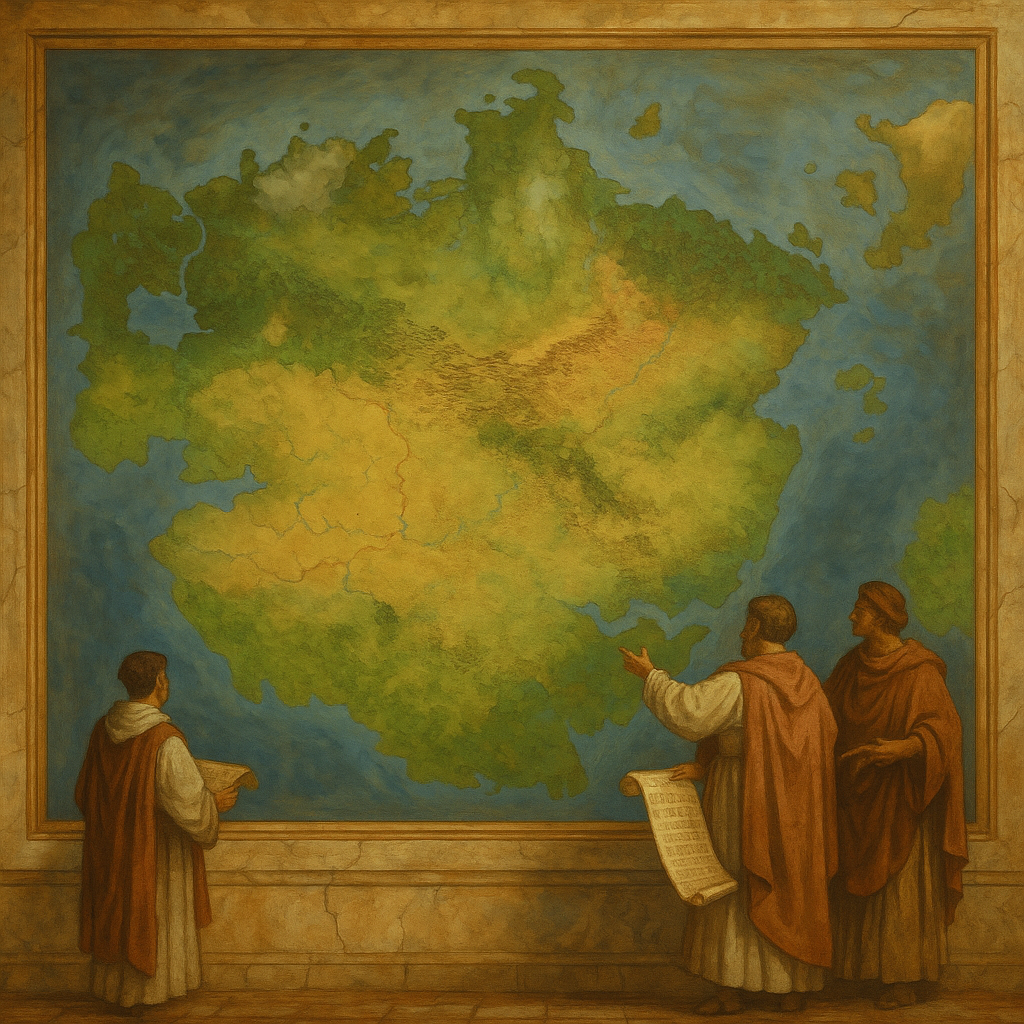
Although its administrative boundaries define it as a single country, the Dominia Imperii is in truth a tapestry of distinct landscapes bound by shared geography. To the east lie the rolling plains and coastal belts where Novaium, the Imperial capital, stands upon ancient Riftstone foundations. To the north and west, the land rises into wooded hills and transitional forests that buffer the Empire from the harsher highlands beyond. In the south and centre, inland valleys and broad grasslands provide the agricultural surplus that sustains both provincial populations and the great cities of the realm.
The territory’s expansion followed natural corridors shaped by rivers, passes, and fertile basins. Human settlement spread swiftly where the land was open and gentle, then slowed as it approached the borders defined by mountains, dense forests, or cultural frontiers. Over centuries the Dominia Imperii absorbed neighbouring lowlands not through abrupt conquest alone, but through the slow pressure of population, cultivation, and infrastructure that turned wild country into settled province. This steady growth transformed the region from a modest Rift-born enclave into one of the most interconnected landscapes on the continent.
Today the Dominia Imperii stands not merely as the homeland of the Imperium Novum, but as a geographical engine of stability. Its reliable climate, abundant resources, and navigable terrain enable the logistical coherence of a vast empire whose roads, trade routes, and riverways radiate outward from Solaria. The land itself has shaped the Empire as much as human ambition has shaped the land, producing a country whose identity is inseparable from the physical world it occupies.
The Dominia Imperii is thus a place where geography and civilisation advance in concert: a fertile, tempered expanse at the centre of the Magnus Confluxus, whose natural advantages laid the foundation for one of the continent’s most enduring powers.
Geography
The Dominia Imperii occupies the central and most temperate expanse of the Magnus Confluxus, stretching across a landscape whose gentle contours and reliable rhythms have shaped the rise of human civilisation on this continent. The land is defined not by violent extremes but by continuity: long plains, controlled river valleys, rolling coastal belts, and broad interior basins that lend themselves to settlement and agriculture. From the Rift-stabilised soils of Solaria outward, the landscape unfolds in generous gradients that encouraged expansion and the founding of provinces over the course of centuries.
To the east, the land slopes steadily toward the bright waters of the Sinus Mercatorius, the Bay of Merchants. Its coastline is characterised by low cliffs, sandy inlets, and river deltas that have supported fishing communities and port towns since the earliest Imperial generations. Across these calm waters lie the Halfling dominions, whose maritime routes intertwine with Imperial trade. This eastern littoral, warmed by gentle currents and blessed with fertile soils, remains one of the most densely inhabited regions of the Empire.
North of Novaium, cultivated plains yield abruptly to the ancient forests of the Elder Courts. The change is immediate and unmistakable: neat fields give way to towering trees whose roots grip the earth with quiet authority. These woods form an unbroken frontier stretching east to west, older than any settlement of the Dominia Imperii and resistant to intrusion. The northern provinces have long grown around the forest rather than into it, following rivers and open clearings instead of challenging the deep, enchanted canopy.
To the northwest, the terrain rises into the rugged foothills that mark the beginning of the Foedus Dvarum, the Dwarrow Confederacy. Here the land becomes rockier, its soils thinner but still productive in sheltered valleys. These uplands bear subtle geomorphic scars—evidence of the ancient Rift that pressed foreign stone against the native continent. High passes and stony ridges funnel travel into predictable routes, shaping centuries of trade and conflict between the two civilisations.
Further west, the landscape resolves into one of the Empire’s most defining natural borders: the frontier with the Clannae Belligeri, the Warborn clans. A long hill-spine runs east to west, forming a rugged, undulating barrier between the temperate imperial provinces and the darker, storm-fed forests of the Warborn beyond. The hills rise in irregular folds, their slopes dotted with fortified towns, watchtowers, and signalling beacons. For centuries these ridgelines have served as both shield and threshold, containing the unpredictable wilds to the north while providing high ground from which the Empire monitors its most volatile neighbour.
Beyond the western end of this hill-spine the land changes abruptly, dissolving into the burning expanse of the Deserta Solis Aeternae, the Desert of the Eternal Sun. This arid frontier forms the true western terminus of the Dominia Imperii. Here dunes, broken stone, and heat-shattered plateaus stretch toward the Brass Cities beyond the horizon. The transition from the hill-country to the desert is sudden and absolute, marking a border defined not by politics alone, but by the land’s unwillingness to support sustained habitation.
The southern frontier is broader and more varied. Grasslands and warm plains extend outward into the vast steppes of the Horse-Lords, blurring the boundary between Imperial territory and nomadic domain. These southern provinces exist in dialogue with the shifting ecologies and seasonal migrations of the steppe. Yet the region is not without dramatic geography. Near the cities of Gegodui and Usumour, a mountain range thrusts southward for nearly one hundred kilometres. Known as the Montes Equitatus—the Horseman’s Range—these mountains divide the southern plains, forcing the great herds and clans of the Horse-Lords into distinct western and eastern migratory routes.
From the eastern flanks of the Montes Equitatus rises one of the continent’s most imposing natural features: the Silva Extensa, a vast, ancient forest that runs northwest for nearly eight hundred kilometres. Its canopy sweeps upward across river-fed valleys, rising ground, and old Rift-weathered soils until it approaches the very threshold of the Warborn frontier. Dense, humid, and ecologically rich, the Silva Extensa forms a deep green corridor between the Empire’s southern heartlands and the western hill-spine. Much of the forest remains unmapped, its interior shaped by ancient ecological patterns that predate Imperial settlement. Locals regard it with a mixture of respect and caution, for though it does not belong to the Elder Courts, it possesses a gravity and antiquity of its own.
At the centre of all these borderlands stands Solaria, the province forged from the Rift arrival itself. The terrain here is unusually even and resilient, its geological layers harmonised by centuries of slow stabilisation. Decades of cultivation have transformed the region into a quilt of farmland, orchards, towns, and estates. Novaium rises at its heart, seated upon Riftstone foundations that grant the capital both symbolic weight and literal security. From this core, the Empire’s rivers branch outward, carving fertile valleys that stitch the provinces together into a coherent whole.
Taken together, the geography of the Dominia Imperii is a landscape of temperate abundance framed by stark, ancient boundaries: enchanted forest to the north, mountains to the northwest, a fortified hill-spine to the west, desert beyond, and open steppe to the south. Its shape has guided the Empire’s growth for centuries, its natural corridors encouraging settlement, expansion, and connection. The land does not resist human ambition—rather, it channels it, forming the stable geographic heart around which much of the continent’s civilisation revolves.
Ecosystem
The ecosystem of the Dominia Imperii is a living testament to the adaptability of life carried across worlds and the deliberate shaping hand of human civilisation. When the Roman province of Solaria arrived through the Rift eight centuries ago, its fields, orchards, and domesticated animals appeared abruptly in a land whose soils, seasons, and ecological rhythms were entirely foreign. Yet the Rift-stabilised heartlands of the Dominia Imperii proved astonishingly compatible with Old Earth species. Wheat, barley, olives, grapes, and orchard fruits took root with almost uncanny ease, their growth encouraged by fertile plains and a temperate climate mirroring the Mediterranean patterns the settlers once knew.
Over time these Old Earth species did not merely survive—they thrived. Agricultural practices refined in the old world translated seamlessly into the new, allowing Roman crops to spread far beyond the original Rift footprint. Vineyards climbed inland valleys; grain fields rolled outward across the plains; orchards cast pockets of shade over once-wild grassland. Herd animals such as cattle, sheep, goats, and horses adapted readily to the terrain, and in turn reshaped the countryside through grazing patterns that favoured open farmland over naturally encroaching brush.
Yet the Dominia Imperii is no simple transplant of a lost Earth. From the earliest centuries Imperial farmers, herbalists, and animal-handlers recognised the value of native flora and fauna, gradually incorporating them into the expanding agricultural landscape. Hardy Exilum Novum grains were domesticated and crossbred with Earth cultivars to create resilient frontier staples. Native fruiting trees with unusual nutrient profiles found their place alongside imported orchards. Wetland herbs and riverbank reeds, once unknown to the settlers, entered the pharmacopeias and craft traditions of the provinces.
This blending of worlds was not accidental. Romans—ever pragmatic, observant, and willing to improve upon nature—approached the ecology of the new land with the same discipline they applied to law, architecture, and governance. They studied the habits of native game animals, learned which forage plants supported the region’s natural herbivores, and gradually shaped the frontier into a semi-managed mosaic where Earth-born species and native life coexisted in stable cycles. In the central provinces, where the climate is gentle and predictable, this synthesis produced landscapes that feel both familiar and distinct: fields of grain bordered by native flowering shrubs; orchards buzzing with hybrid pollinators; rivers rich in both Earth fish and local freshwater breeds.
As the Empire expanded, so too did its ecological palette. Trade with neighbouring civilisations—and with peoples delivered by later Rifts—introduced additional plants and animals into the Dominia Imperii. Some came from the Halfling Isles, hardy coastal crops that prospered along the eastern shores. Others arrived from the Dwarrow, including unique underground fungi cultivated in controlled surface gardens. From the Horse-Lords came steppe grasses and fast-breeding riding stock, while long-distance trade with the Brass Cities brought desert-adapted grains and draught animals suited for hot climates. A handful of rare species from foreign Rift zones even found limited foothold in the Empire, carefully regulated by both the Collegium Arcanum and civic agronomists.
Despite this diversity, the ecosystem remains remarkably stable. Unlike wilder regions of the Magnus Confluxus—where Rift-born enclaves still generate unpredictable ecological tensions—the Dominia Imperii exhibits a balance shaped by centuries of human management. Old Earth species dominate cultivated lands; native Exilum Novum flora thrives in controlled margins and interstitial spaces; hybrid ecologies flourish where the two intersect; and introduced species remain carefully monitored to prevent disruption. Nowhere else on the continent is the synergy of worlds so evident or so deliberately maintained.
The result is an ecosystem neither wholly foreign nor wholly familiar, but uniquely Imperial: a landscape where vineyards share valleys with ancient native groves, where domesticated animals graze alongside resilient frontier breeds, and where the rhythms of Old Earth agriculture coexist with the living memory of this world’s own deep ecological heritage. The Dominia Imperii is not simply a place where ecosystems coexist—it is a land where they have been woven together into something new, durable, and distinctly human in character.
Ecosystem Cycles
The ecosystem cycles of the Dominia Imperii exhibit a rare harmony for a continent shaped by Rift upheaval. While much of the Magnus Confluxus still bears the fractured seasonal rhythms of many worlds, the central Imperial provinces experience a far more coherent cycle—one that has been steadily refined by climate, geography, and centuries of deliberate human cultivation.
Old Earth species, brought across the Rift with the Roman arrival, adapted readily to the familiar temperate seasons of Exilum Novum. Wheat and barley sprout with the spring rains; vines bud at the first sustained warmth; orchards bloom in predictable intervals that almost mirror their ancient Mediterranean ancestry. The livestock introduced from Earth likewise follow well-established breeding and grazing rhythms, settling naturally into the continent’s cycle of mild winters and warm summers. Within Solaria and the surrounding heartlands, these species became the backbone of an agricultural cycle that feels both ancient and astonishingly well suited to its adopted home.
Native Exilum Novum flora and fauna follow their own rhythms—not alien or contradictory, but shaped by a world with slightly different rainfall patterns, soil chemistry, and daylight gradients. Many native trees leaf earlier than their Old Earth counterparts, drawing deeply on Exilum Novum’s spring moisture. Some flowering shrubs bloom in two short bursts rather than one sustained season. Several native grass species begin their growth cycles in late winter, hardening themselves against cold before exploding into summer vitality. Native animals follow similarly adaptive patterns: some breed in early spring, others in high summer, and some migrate stochastically between river valleys depending on rainfall rather than fixed instinct.
Where these cycles meet, a distinctive Imperial ecology has formed. Over generations of cultivation and hybridisation, the two worlds’ rhythms have begun to align in subtle but meaningful ways. Native pollinators now time their flights to Old Earth orchard blooms; hybrid grain varieties sprout on Old Earth schedules but rely on Exilum Novum soil microbes to flourish; Imperial-bred livestock adjust their grazing to match the waxing greens of native grasses. The result is a seasonal choreography far more synchronised than nature alone would have produced.
In the frontier provinces this harmony softens, giving way to more complex cycles where native species maintain dominance and Old Earth cultivars adapt to new ecological pressures. But within the Dominia Imperii proper—especially the central provinces shaped by centuries of human stewardship—each season unfolds as a balanced interplay of elements from two worlds.
Spring is a period of mutual awakening. Earth crops germinate as native wildflowers burst into colour, and the air fills with a blend of pollens from both lineages. Summer brings the height of agricultural activity, with grainfields ripening beside hardy native shrubs that thrive in the warmth. In autumn, orchards and vineyards reach their peak, while native trees shift into deep copper and violet hues unknown to Roman memory. Winter arrives gently across much of the country, a season of rest in which native evergreens and imported livestock maintain the last notes of life until the cycle begins again.
Trade-driven introductions add further nuance to these cycles. Steppe grasses from the Horse-Lords lengthen the grazing season in southern provinces; hardy halfling island crops thrive in cooler eastern climates; Brass Cities desert herbs bloom only at the height of summer, offering a brief burst of foreign colour. These additions remain minor yet enriching accents—seasonal curiosities that enhance but never destabilise the wider ecological rhythm.
Unlike the unpredictable Rift enclaves found elsewhere on the continent, the Dominia Imperii experiences no major arcane disturbances in its annual cycles. The Rift around Novaium has long stabilised, its ecological influence now absorbed into the land’s natural cadence. What remains is a country where the cycles of two worlds have interwoven into a single, enduring pattern—a testament to resilience, adaptation, and the quiet, cumulative artistry of cultivation.
Localized Phenomena
At the heart of the Dominia Imperii lies the only true anomaly within an otherwise stable and unified landscape: the Solaria Rift Zone, the ancient footprint of Earth carried into Exilum Novum. Though centuries have passed since the arrival of the Roman province, this territory continues to exhibit a quiet but measurable climate dissonance—an echo of a world whose seasons once obeyed a different sun.
Within the Rift Zone, the air holds a faint and persistent warmth even in early spring, and winter frost lingers for a day or two less than in neighbouring provinces. The rainfall pattern, too, is subtly offset. Solaria’s earliest showers tend to fall before the surrounding heartlands receive their spring rains, and the last storms of autumn often pass over the Rift Zone when adjacent regions have already settled into cooler, drier days. These discrepancies are never dramatic; no traveller unfamiliar with the land would notice them immediately. Yet to the farmers, scholars, and magistrates of Solaria, the difference is unmistakable—a slight tilt in the rhythm of the year, a cadence inherited from a vanished Earth.
This misalignment expresses itself most clearly in agriculture. Wheat and barley planted within the Rift Zone germinate a touch earlier than identical seed sown outside its bounds; vines begin to swell with green before neighbouring hillsides stir; orchards hurry into blossom by a margin of days. While these variations do not disrupt the wider agricultural cycle of the Empire, they create a distinctive Solaria-first seasonal sequence. The province’s markets are often the first to send fresh produce north and west each year, a small advantage that has grown into a point of regional identity.
Faunal behaviour within the Rift Zone follows a similar pattern. Livestock brought from Old Earth long ago retain instinctive cues tied to this inherited microclimate: breeding cycles, herd migrations between pastures, and even nocturnal activity patterns remain subtly earlier than in other provinces. Native Exilum Novum species that inhabit the fringe of the Rift Zone often adapt to this shifted rhythm, resulting in a narrow transitional belt where the two ecological calendars meet and momentarily diverge before merging again into the dominant cycle of the Dominia.
Despite this climatic divergence, the Solaria Rift Zone no longer exhibits the unpredictable arcane turbulence seen near newer Rift arrivals. Its stability is one of the Empire’s quiet foundations. The ley-lines beneath Novaium run consistently, the soil no longer stirs with foreign resonance, and the land has been fully claimed by centuries of cultivation. What remains is less an active anomaly than a persistent memory of origin, expressed as a soft dissonance in temperature, rainfall, and seasonal pacing.
To Imperial scholars, the Rift Zone is an invaluable natural chronicle. It demonstrates that a transplanted world may settle into new patterns without fully relinquishing its past. To the people of Solaria, it is simply the rhythm of home—an annual cycle that feels familiar even if it stands a fraction out of step with the country that grew around it. And to the Dominia Imperii as a whole, the Rift Zone serves as a small but enduring reminder that the Empire’s heart beats to the cadence of two worlds, its seasons braided but never quite identical.
Climate
The climate of the Dominia Imperii is among the most temperate and dependable on the Magnus Confluxus, shaped by long, gentle seasons and moderated by the inland sea to the east. Across much of the country, summers are warm but rarely oppressive, winters mild and brief, and rainfall evenly distributed across spring and autumn. This stability has long been recognised as one of the Empire’s quiet privileges, for it allowed agriculture, settlement, and infrastructure to flourish without the extremes that challenge other civilisations on the continent.
In the broad central plains and eastern coastal provinces, the climate resembles that of a mild Mediterranean world: warm summers cooled by ocean winds, long growing seasons, and predictable spring rains that swell the rivers feeding Novaium and the surrounding heartlands. Inland valleys deepen these patterns, capturing warmth that extends harvest cycles and nurturing the orchards and vineyards that have become emblematic of the region’s identity. These gentle conditions encouraged rapid expansion during the Empire’s early centuries, creating the agricultural surplus that supported urbanisation and the rise of provincial power.
Toward the north, the climate cools gradually as the land approaches the ancient forests of the Elder Courts. Here the air grows sharper, winter frosts more frequent, and the summers shorter but no less lush. Moisture carried on northern winds gathers in the tree canopy before rolling southward as soft, persistent rainfall that keeps the border provinces green well into late autumn. The high shade of the elven forests moderates temperature swings, creating a quiet, humid buffer between the heartlands and the wilder biomes beyond.
To the northwest, the foothills leading toward the Dwarrow Confederacy experience colder winters and brisker winds. Snow falls here more reliably than in the central provinces, though it rarely settles for long. Summers are mild, with cooler nights that favour hardy grains, root crops, and pastoral herding. Weather moves swiftly in these uplands, driven by the complex interplay of mountain air and valley currents.
The west presents one of the most striking transitions. As one travels from the provincial plains into the east–west hill-spine marking the Warborn frontier, the climate grows cooler, wetter, and more unpredictable. Storms form quickly along the rising ridges, breaking upon the hills with sudden force before dissipating into calm skies on the Imperial side. The forests beyond the hills trap moisture and generate their own atmospheric patterns, but their effects diminish sharply south of the ridge, leaving the Dominia Imperii largely untouched by the wilder weather of the Warborn lands.
From the westernmost hills to the border of the Deserta Solis Aeternae, the climate shifts again with remarkable speed. The warm winds of the inland plains meet the dry breath of the desert, creating a narrow transition where hot, gusting air sweeps eastward in late summer. Yet these effects remain tightly localized; the desert’s extremes do not penetrate the Empire’s cultivated interior, and the heartlands remain sheltered from the blistering heat that defines the Brass Cities’ territory.
To the south, the Dominia Imperii mingles with the climates of the Horse-Lords’ steppe. Summers grow warmer and drier, winters slightly harsher, and seasonal winds stronger. The plains here are shaped by broad temperature swings that favour hardy grasses and mobile herds. Near the Montes Equitatus, the southern air cools along the slopes before warming again over the vast Silva Extensa. This interplay creates pockets of humidity and mist along the lower forest edge, enriching its biodiversity and shaping regional weather patterns.
At the heart of all these climatic zones lies the Solaria Rift Zone, whose influence, though subtle, remains unique. Its temperatures run slightly warmer in spring, slightly milder in winter, and its rainfall arrives a few days earlier or later than the surrounding provinces. These deviations do not alter the wider climate of the Dominia Imperii, but they impart to Solaria a rhythm of its own—a faint echo of Earth’s Mediterranean cadence that persists even now, centuries after the Rift’s stabilization.
Taken together, the climate of the Dominia Imperii is one of moderation and quiet abundance, shaped by its position at the centre of the continent and insulated by the natural boundaries that surround it. Its gentle seasons and reliable weather patterns have allowed human civilisation to grow outward from Solaria with confidence, building the logistical and agricultural backbone of an empire whose fortunes are intimately tied to the land’s enduring generosity.
Fauna & Flora
The flora and fauna of the Dominia Imperii reflect eight centuries of convergence between Old Earth ecosystems and the natural life of Exilum Novum. Nowhere else on the Magnus Confluxus has this blending produced such a harmonious, structured, and richly cultivated environment—a landscape where two worlds’ biology not only coexists, but thrives together under human stewardship.
The core of the Imperial heartland is dominated by familiar Old Earth species: wheat, barley, grapes, olives, apples, pears, chestnuts, and a broad array of herbs and legumes transplanted from the Roman province of Solaria. These plants adapted remarkably well to Exilum Novum’s temperate climate, their growth encouraged by Rift-stabilised soils and the gentle seasonal rhythms of the central provinces. Orchards and vineyards now stretch across valleys that once knew only native grasses, and the agricultural plain around Novaium is considered one of the most productive regions on the continent.
Native flora, too, is woven into this cultivated tapestry. The Dominia Imperii is rich in Exilum Novum grasses, hardy shrubs, and broad-leaved trees that predate human settlement. Some of these species were quickly recognised for their practical value—either as fodder for livestock, as sources of sturdy timber, or for their medicinal and aromatic properties. Over time, native trees such as tall canopies with violet-tinted autumn leaves were integrated into Imperial forestry. Wetland reeds became essential to local craftwork. Shrubs once considered wild intrusions now serve as stable hedgerows supporting pollinator species introduced from both worlds.
The fauna of the Dominia Imperii is equally syncretic. Old Earth animals—cattle, sheep, goats, pigs, horses, dogs, and poultry—remain foundational to rural life. They adapted readily to the land’s climate and landscapes, often outcompeting their native counterparts in open plains and cultivated zones. Yet native species continue to thrive in forests, river valleys, and transitional biomes. Local deer with unusual antler structures graze alongside herds introduced from Solaria; river mammals nest in waterways now populated by Old Earth fish; and small omnivores with bright crests share territory with Imperial livestock, scavenging along the edges of farms and roads.
Hybrids have emerged wherever Old Earth and native species resemble one another closely enough to interbreed. Though relatively uncommon, these hybrid animals and plants are notable for their resilience and adaptability. Mixed-lineage grazing animals have appeared in several southern provinces, possessing the hardiness of native stock and the temperament of their Earth-born ancestors. Certain harvester plants now cultivated on the frontier show hybrid traits in their colours, bloom cycles, and seed structures, the result of generations of deliberate cross-pollination. These hybrids seldom dominate their ecosystems, but they provide the Empire with valuable traits—heightened drought resistance, improved yields, or stronger fibres—accumulated through patient experimentation.
Trade with neighbouring realms and Rift-born cultures introduced further variety into the Imperial ecosystem. Steppe horses bred by the Horse-Lords now mingle with old Roman stock, producing cavalry lines famed for endurance. Dwarrow undergrowth fungi are cultivated in shaded Imperial groves, prized for their flavour and alchemical uses. Halfling coastal crops flourish in the eastern littoral provinces. Even a few exotic species gathered from other Rift arrivals have taken root in controlled environments: ornamental flowers with iridescent petals, hardy desert herbs from the Brass Cities, and resilient pack-beasts adapted for hotter climates.
What distinguishes the Dominia Imperii from more chaotic ecosystems on the Magnus Confluxus is the degree of human curation. Centuries of careful cultivation, selective breeding, and ecological management have produced a landscape where Old Earth species dominate the agricultural core while native flora and fauna thrive in margins, forests, and riverlands. The Rift-anomalous microclimate of Solaria influences some species subtly—orchards blooming slightly early, livestock adjusting breeding cycles—but does not produce instability. Instead, the land supports a diverse yet harmonious biological mosaic: a stable equilibrium shaped by geography, climate, and the steady hand of Imperial husbandry.
The result is an ecosystem that feels deeply lived-in—an environment shaped not only by natural forces but by the ambitions and adaptability of its inhabitants. The flora and fauna of the Dominia Imperii bear the imprint of both worlds, forming a uniquely fertile foundation upon which the Empire grew, thrived, and continues to sustain its vast population.
Natural Resources
The Dominia Imperii possesses some of the richest and most varied natural resources on the Magnus Confluxus, a consequence of its temperate climate, stable Rift-forged soils, and centuries of disciplined Roman stewardship. While many regions on the continent contend with erratic weather, fractured geomorphology, or the lingering volatility of ancient Rift arrivals, the Dominia stands apart: a land whose abundance feels almost deliberate, as though the Rift had chosen its heart with uncommon generosity.
The most valuable of these resources is arable land. The plains around Solaria—especially those lying within the old Rift footprint—remain among the most fertile on the continent. Here the soil retains a near-ideal balance of minerals and organic richness, allowing wheat, barley, fruit trees, and vines to flourish with a consistency unknown in harsher regions. As settlement expanded outward, these advantages extended into the river valleys and lowland basins, forming vast belts of farmland that sustain the Empire’s population and support large-scale grain exports to frontier provinces.
Water resources are equally abundant. The Dominia is veined by a network of broad, steady rivers whose courses are unusually stable for a continent shaped by cosmic upheaval. These waterways provide irrigation for agriculture, power for mills, and natural transport corridors that move goods from inland estates to coastal markets. Freshwater fisheries thrive in these rivers, blending Old Earth species with native ones to support both local diets and trade.
Forestry forms a second pillar of the Imperial resource economy. Though the Dominia Imperii is not as heavily wooded as the Elder Courts or the Silva Extensa, its forests supply a dependable stock of hardwoods and softwoods used in construction, shipbuilding, and carpentry. Native trees with dense, resilient fibres provide excellent timber for tools and wagons, while Earth-born species contribute straight-grained lumber ideal for architecture and fine craftsmanship. Managed forest groves near Solaria and the central provinces demonstrate centuries of human cultivation, their growth cycles aligned to produce predictable yields.
The land also offers mineral wealth, though not on the scale of the Dwarrow mountains. Clay deposits across the plains support pottery and brickmaking; pockets of iron, copper, and tin lie in the western uplands; and alluvial sands in certain rivers contain trace amounts of gold and electrum. The Empire relies on trade with the Foedus Dvarum for more exotic metals, yet the Dominia itself produces all that is required for tools, arms, and civil engineering. Quarry stone—especially limestone and marble—remains an abundant and prized resource, fuelling the architectural grandeur of Novaium and its satellite cities.
Pastoral lands in the southern and central provinces support vast herds of sheep, cattle, and horses. Old Earth livestock have integrated well with native grasses, and selective breeding over generations has produced resilient hybrids suited to local conditions. Wool, hides, and leatherwork form a thriving rural industry, while stud farms near the Montes Equitatus and eastern plains supply the legions with cavalry mounts renowned across the continent.
Trade and diplomacy have further broadened the Dominia’s resource base. From the Horse-Lords come durable grasses and fine horses; from the Halfling Isles, hardy coastal crops and salt-fish; from the Dwarrow, refined metals, worked stone, and subterranean fungi now cultivated experimentally in shaded Imperial groves. Even the Brass Cities contribute desert herbs and heat-forged glass in exchange for grain and textiles. These imported resources enrich the Empire’s internal markets but do not supplant its native strengths.
The Solaria Rift Zone remains a minor but unique contributor to the region’s resource diversity. Though its arcane anomalies have long stabilised, its soil retains an unusual vitality that supports early harvests and high-yield orchards. A few Rift-borne plant strains—survivors from Earth’s Mediterranean clime—produce fruit with distinct flavours and chemical properties prized by apothecaries and vintners. While limited in scale, these resources form part of Solaria’s cultural identity and contribute to the mystique surrounding the Imperial capital.
Taken together, the natural resources of the Dominia Imperii form a foundation of wealth and stability unmatched elsewhere on the Magnus Confluxus. The land is not merely abundant—it is dependable, productive, and capable of sustaining a dense population, extensive trade networks, and the vast logistical apparatus of empire. It is from this quiet, enduring generosity that the Imperium Novum draws much of its strength, its confidence, and its enduring claim to civilisation.
History
The history of the Dominia Imperii begins not with slow geological ages or mythic epochs, but with a single moment of cosmic violence: the Rift Arrival that tore the Roman province of Solaria from Earth and cast it, intact but bewildered, into the heart of the Magnus Confluxus. The land that emerged was small—its original boundaries little more than two hundred kilometres across—but it bore with it farmland, settlements, archives, infrastructure, and a people trained in the habits of empire. This arrival created a stable, temperate enclave in a continent of wilder landscapes, seeding the foundations of what would become the centrepiece of human civilisation.
In the months that followed, Solaria’s geography determined its survival. The Rift footprint opened onto fertile plains rather than desert or mountain, and the region’s mild climate mirrored the Mediterranean world the settlers had lost. Rivers flowed outward in predictable courses, native flora proved compatible with Old Earth agriculture, and the absence of hostile megafauna allowed the Romans to consolidate quickly. As the Rift Zone stabilised and its climatic dissonance softened, Solaria expanded outward in cautious arcs, securing arable land and establishing fortified farmholds that soon grew into the earliest provinces of the Dominia.
Expansion was rarely sudden. It followed the natural geography: east along the gentle coast of the Sinus Mercatorius, north into the river valleys that skirted the Elder Courts, and south into the rolling grasslands that would form the Empire’s pastoral heart. The west and northwest were more resistant. The hill-spine bordering the lands of the Clannae Belligeri forced the young Imperium into a defensive stance that would define centuries of vigilance, while the stony uplands of the Foedus Dvarum demanded diplomacy as often as arms. Yet even these frontiers became manageable, shaped more by terrain than by insurmountable hostility.
By the time the Rift’s first century had passed, Solaria had become the nucleus of a growing realm—a realm whose identity was shaped as much by its geography as by its institutions. The fertile plains could support dense populations; the rivers enabled a coherent transport network; the coast offered maritime links to the Halfling Isles; and the natural borders of forest, hill, desert, and steppe encouraged a stable, defensible shape. It was within these contours that the Dominia Imperii crystallised into a country: not yet an empire in name, but unmistakably one in potential.
The land continued to influence its political development. The temperate heartlands produced agricultural surpluses that supported urbanisation and the rise of Novaium as the capital. The predictable climate allowed for regular taxation and supply lines, which in turn enabled the training and provisioning of legions. Over time, the expansion of settlement outpaced the growth of administration, and many of the ten modern provinces emerged from earlier territorial divisions shaped by river basins, trade routes, and defensible ridgelines.
Not all growth was peaceful. The west remained a frontier of conflict, marked by skirmishes with Warborn clans and periodic incursions into the hill-country. A more profound crisis emerged in the second century of the Empire’s development: the War of Broken Mandates, sparked when an emperor attempted to depose a provincial noble without the constitutional authority later codified in the Constitutio Novae Imperii. The conflict spread across several western provinces, revealing both the vulnerability and the strength of the land. Though the fighting scarred fields and shattered towns, the geography itself—its rivers, hills, and supply-rich plains—allowed loyal provinces to sustain the struggle until the constitutional order was restored.
In the centuries that followed, the Dominia Imperii matured into the stable heartland known today. Its borders solidified along natural lines: the enchanted forests of the Elder Courts, the rugged foothills of the Dwarrow Confederacy, the east–west hill-spine against the Warborn, the Deserta Solis Aeternae in the far west, and the expansive southern grasslands of the Horse-Lords. These boundaries, rooted in the land itself, prevented overextension and encouraged internal consolidation.
By the modern era, the Dominia Imperii stands as a country whose history is inseparable from its geography. Its rivers, plains, and Rift-conditioned heart nurtured the rise of the Imperium Novum; its borders shaped its diplomacy, conflicts, and alliances; its fertile land sustained its people; and its stable climate allowed the empire to focus not on survival but on statecraft, culture, and expansion. The Dominia Imperii is more than the cradle of a political power—it is the landscape that made that power possible.
Tourism
Visitors to the Dominia Imperii are often struck first not by any single landmark but by the quiet abundance of the land itself. The heartland of the Imperium Novum offers a kind of cultivated splendour rare on the Magnus Confluxus: orderly vineyards ascending river valleys, broad plains rippling with grain, ancient groves standing beside well-planned roads, and cities whose architecture blends Old Earth aesthetics with the materials and traditions of this world. For many travellers—Halfling merchants, Dwarrow envoys, scholars of the Elder Courts, and even Brass City desert nobles seeking cooler air—the Dominia Imperii represents a vision of human civilisation at its most settled and secure.
Foremost among its destinations is Novaium, the Imperial capital. Built atop Riftstone foundations, the city attracts visitors who come to witness the subtle climatic distinctions of the Solaria Rift Zone. Though the Rift’s surface anomalies have stabilised across centuries, its influence remains visible in the early blossom of orchards, the slightly warmer spring winds, and the architectural grandeur that arose from a land unusually fertile and forgiving. Novaium’s libraries, basilicas, and terraced districts—some of which retain the faint geomorphology of Old Earth—draw scholars from every corner of the continent.
Beyond the capital, each province offers its own appeal. The eastern coast along the Sinus Mercatorius is famed for its markets, fishery-harbours, and lively maritime atmosphere. Travellers from the Halfling Isles often describe these towns as familiar yet grander versions of their own, where coastal traditions meet Imperial stonework and ceremonial precision.
In the northern provinces, the proximity of the Elder Courts transforms the landscape into something almost mythic. Visitors speak of the sharp scent of ancient pines drifting southward, of mist rolling across fields at dawn, and of brief but unforgettable glimpses of elven architecture deep within the forest shade. Though the Dominion enforces strict boundaries, guided journeys along the border trails are common among scholars and pilgrims seeking communion with the oldest known lands of the Confluxus.
To the northwest, the foothills near the Dwarrow Confederacy attract their own kind of traveller—geomancers, miners, engineers, and those who appreciate the stark beauty of rising stone. Here the land offers a preview of the great mountains without the full severity of the Dwarrow homeland. Carved chapels, mineral springs, and market-towns selling Dwarrow-forged trinkets make the region a favourite for those interested in stonecraft or cross-cultural trade.
The western hill-spine along the Warborn border, though less frequented, appeals to adventurers, historians, and chroniclers of conflict. Forts perched on high ridges provide panoramic views across both the orderly Imperial plains and the untamed forests beyond. Visitors often speak of a palpable tension in the air—a reminder that the land itself remembers centuries of vigilance and discord. The pass-towns here host storytellers who recount battles, duels, and the long watch kept between two irreconcilably different worlds.
Further south, the Montes Equitatus and the vast Silva Extensa offer striking contrasts. The mountains provide crisp air, terraced farms, and riding paths favoured by those studying the Horse-Lords’ migratory routes. Meanwhile, the Silva Extensa—vast, humid, and ancient—draws naturalists and explorers who wish to experience a forest untouched by either elf or empire. Its deep green corridors, fed by rivers descending from the mountains, offer a sense of primordial stillness found nowhere else within the Dominia.
Agritourism flourishes across the central provinces. Travellers participate in grape harvests, learn traditional breadmaking, observe hybrid livestock breeding, or visit experimental farms where native and Old Earth crops are cultivated side by side. Many come simply for the food: dishes combining Roman culinary heritage with native Exilum Novum ingredients have become famous throughout the continent, especially those produced in the Rift-altered soils of Solaria.
Finally, the Dominia serves as a gateway to the broader Imperium Novum. Roads radiate outward from Novaium in carefully maintained arcs, allowing travellers to reach every province with ease. Hostels, roadside shrines, hilltop lookouts, and caravanserai support a steady flow of scholars, merchants, pilgrims, and wanderers. For many, the Dominia Imperii is not merely a destination—it is the beginning of a wider journey into the civilised heart of the Magnus Confluxus.

Comments