

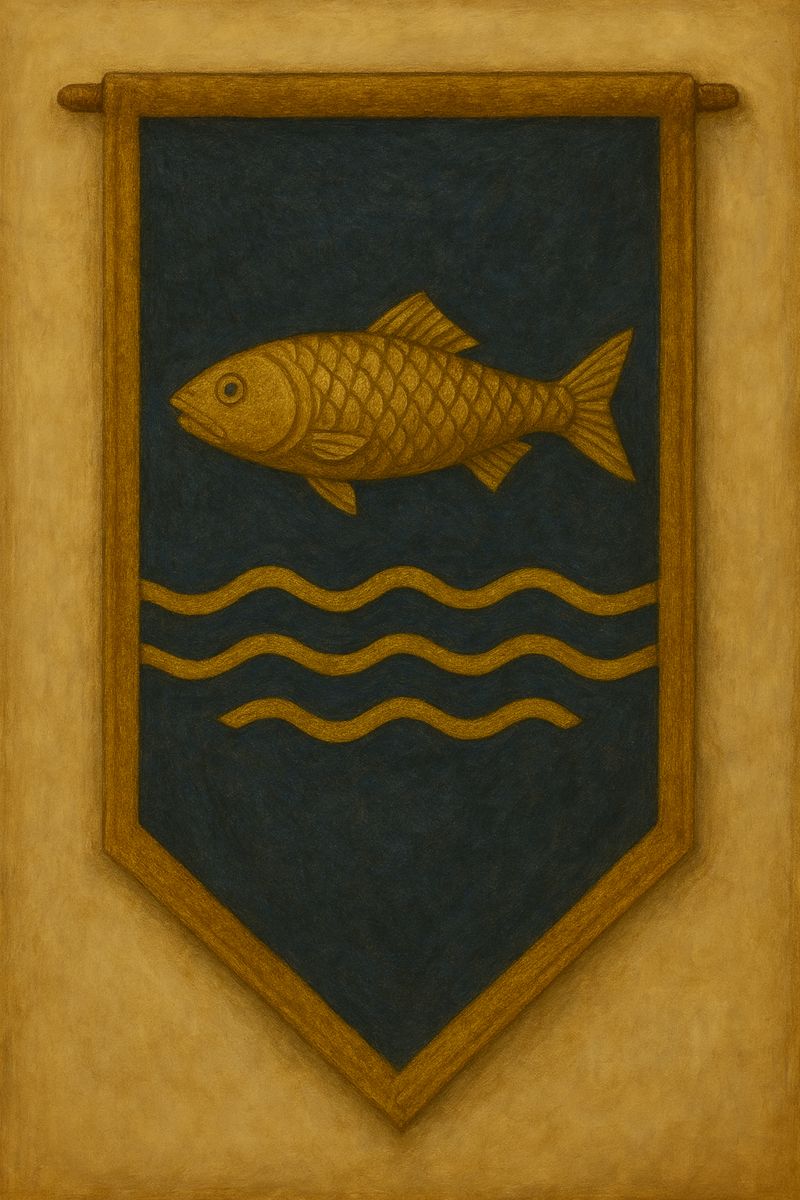
Meliaqua
“Meliaqua stands where forest meets sea and road meets river; a province shaped not by conquest, but by passage. Its strength lies in what moves through it, not what it holds.”
Meliaqua occupies the northern reaches of the Sinus Mercatorius, a coastal province defined by water, humidity, and movement rather than by rigid borders. It is a land where river mouths, wetlands, and forested lowlands meet the sea, and where Imperial authority is expressed through ports, routes, and regulation rather than fortresses or massed legions.
The province serves as a maritime counterpart to the inland provinces, translating overland trade into sea-borne movement along the Sinus and onward to distant Imperial and foreign ports. Its coastline is irregular and alive with inlets, marshes, and navigable channels, making Meliaqua less defensible in the traditional sense, but exceptionally valuable as a logistical and commercial region. Control here is maintained through harbours, customs stations, and patrol craft rather than walls.
Meliaqua’s interior transitions quickly from open grassland into savanna and temperate forest, with wetter ground and heavier vegetation as one moves east and south toward the coast. Roads exist, but they bend and adapt to the land rather than imposing straight lines upon it. Many settlements owe their existence to natural crossings, river junctions, or sheltered anchorages rather than deliberate Imperial planning.
The cities of Cancia and Myangai anchor the province’s coastal economy, acting as ports of exchange, ship repair, and redistribution. Smaller settlements such as Guzah serve inland routes and diplomatic traffic moving toward the Elder Courts, while river towns manage the slow but constant movement of goods from the interior. No single city dominates Meliaqua entirely; instead, authority is distributed across a network tied together by water.
To the Empire, Meliaqua is essential precisely because it cannot be simplified. It is a province where land and sea overlap, where borders blur into trade routes, and where governance relies on vigilance and adaptability rather than force. Its strength lies not in what it holds, but in what it allows to pass—quietly sustaining the Empire’s reach along the Sinus Mercatorius.
Geography
Meliaqua lies along the northern curve of the Sinus Mercatorius, its geography shaped overwhelmingly by water and low-lying land. The coastline is irregular and broken, formed of shallow bays, reed-choked inlets, and wide tidal flats that blur the boundary between land and sea. Rather than a single clear shore, Meliaqua presents a shifting littoral zone where channels, mudbanks, and marshes change subtly with season and tide.
Inland from the coast, the terrain rises only gradually. Wetlands and floodplains dominate the immediate interior, fed by multiple slow-moving rivers and distributaries that fan out before reaching the Sinus. These waters are navigable in places but unreliable, favouring shallow-draft vessels and local knowledge over rigid mapping. Settlements cluster on slightly raised ground—natural levees, old riverbanks, and forested ridges—where flooding is less frequent.
Beyond the wetland belt, the land transitions into savanna and grassland, firmer underfoot and more suited to roads and overland travel. This zone forms Meliaqua’s inland spine, crossed by established routes that link the province to Solaria and Verum Auctoritas. These roads tend to curve and branch, avoiding saturated ground and following older paths shaped by herding and trade rather than Imperial survey lines.
Patches of temperate forest occupy the higher and better-drained areas, particularly toward the eastern reaches of the province. These forests are interspersed rather than continuous, forming corridors and groves rather than a single mass. They provide both timber and shelter, but also act as natural constraints on settlement density.
Meliaqua’s geography resists simplification. It cannot be neatly divided into coast and interior, nor easily fortified or regimented. Instead, its land and water interlock in layers, favouring movement by familiarity and adaptation rather than by force. This complexity has shaped Meliaqua into a province where navigation—by river, road, or tide—is as much an art as a science.
Ecosystem
Meliaqua’s ecosystem is dominated by water-driven environments, forming one of the most biologically active provinces along the Sinus Mercatorius. Wetlands, tidal flats, and river-fed marshes create a layered system in which land and water species intermingle, adapt, and migrate with ease. Life here thrives not through stability of ground, but through tolerance of saturation, salinity, and seasonal change.
The coastal wetlands and estuaries support dense plant growth—reeds, sedges, water grasses, and salt-tolerant shrubs—whose root systems bind soft soils and slow erosion. These zones teem with insects, crustaceans, and small fish, forming the base of a rich food web. Birdlife is especially abundant, with migratory species arriving in great numbers to feed and breed along the marsh edges and shallow waters.
Inland floodplains extend this ecosystem deeper into the province. Periodic inundation deposits nutrient-rich silt, sustaining grasses and low vegetation that support grazing animals adapted to wet ground. Amphibians and semi-aquatic mammals are common here, moving freely between river channels and flooded meadows. Predators tend to be patient and opportunistic, relying on concealment rather than pursuit.
Where the land rises into savanna and forested ridges, the ecosystem shifts but remains closely tied to water availability. Trees favour deep roots and broad canopies, while understory plants grow rapidly in the humid air. These higher areas act as refuges during flooding, concentrating wildlife temporarily before dispersal resumes as waters recede.
Imperial settlement has altered but not disrupted Meliaqua’s ecology. Raised roads, managed embankments, and controlled drainage have redirected water flow without severing it, allowing agriculture, fishing, and forestry to coexist with native systems. Over generations, Old Earth species introduced through the Rift have adapted to the province’s wet conditions, often interbreeding or forming stable hybrids with native life.
Meliaqua’s ecosystem is therefore one of continuity through movement. Rather than fixed habitats, it consists of shifting zones that expand, contract, and overlap. This fluidity mirrors the province itself—a land where survival depends on adaptation, and where nature remains an active partner rather than a conquered resource.
Ecosystem Cycles
The ecological cycles of Meliaqua are governed primarily by water movement, rather than temperature alone. Tides, seasonal rains, and river swelling combine to create rhythms that are predictable in pattern but variable in expression, ensuring that life here is in constant adjustment rather than fixed routine.
Along the coastal wetlands, daily tidal cycles expose and submerge mudflats and reed beds, driving feeding patterns for birds, fish, and crustaceans. These short cycles are overlaid by longer seasonal shifts, during which higher tides and storm surges push saltwater farther inland, reshaping plant growth and redistributing nutrients. As waters retreat, new growth follows quickly, sustaining dense biological activity.
In the river floodplains, seasonal rains cause slow, spreading inundation rather than sudden flooding. These floods deposit rich silt across wide areas, triggering bursts of plant growth and insect emergence. Grazing animals move onto newly enriched ground as waters recede, followed by predators and scavengers that take advantage of concentrated prey. These cycles define the agricultural calendar as much as the natural one, aligning planting and harvest with the land’s saturation.
The savanna and forested ridges experience subtler cycles. During wetter periods, vegetation thickens and forest edges advance slightly, while in drier phases grasses thin and trees shed leaves to conserve moisture. Wildlife shifts elevation rather than distance, retreating to higher ground during floods and dispersing widely during dry intervals.
Throughout the province, these cycles overlap and interlock. No single season dominates Meliaqua; instead, it is shaped by recurrence and return. Floods do not devastate, tides do not conquer, and dry periods do not linger long enough to exhaust the land. Life here persists by timing and movement, a pattern mirrored by the people who inhabit and govern the province.
Localized Phenomena
Meliaqua is marked by a number of subtle but persistent phenomena arising from the constant interaction of tide, river, and saturated land. These effects are well known to local navigators and administrators and are treated as environmental conditions to be managed rather than mysteries to be feared.
Along the coastal marshes and tidal flats, a phenomenon known locally as the Breathing Coast occurs. As tides advance and retreat, pockets of trapped air and gas escape through soft mud and reed beds, producing low sounds and faint vibrations beneath the ground. While harmless, this effect has influenced settlement patterns, with buildings traditionally raised or set back from the most active flats.
In the river mouths and estuaries, temperature differences between water and land frequently generate dense, low-lying fogs at dawn and dusk. These fogs drift inland along channels and waterways, reducing visibility and dampening sound. Mariners are trained to navigate by current and shoreline memory during these periods, and harbour traffic often pauses until the fog lifts.
Across the interior wetlands, long periods of still, humid air can give rise to shimmering distortions just above the water’s surface. These are caused by heat trapped near saturated ground and can create the illusion of movement or reflected shapes. While easily recognised by locals, such effects have led to misjudged distances by outsiders unfamiliar with the terrain.
None of these phenomena are considered arcane in origin. Imperial scholars attribute them entirely to Meliaqua’s geography and hydrology, though the Collegium Arcanum maintains a quiet interest in how consistently these effects recur. In Meliaqua, the land itself is in constant motion, and its peculiarities serve as reminders that stability here comes from adaptation rather than resistance.
Climate
Meliaqua experiences a warm, humid coastal climate, shaped by the Sinus Mercatorius and the province’s extensive wetlands and river systems. Temperatures remain relatively even throughout the year, with seasonal variation expressed more through moisture and wind than through heat or cold.
The coastal zones are moderated by sea breezes that temper daytime heat and keep nights warm but rarely oppressive. Rainfall is frequent, arriving in steady systems rather than violent storms, and contributes to the constant saturation of low-lying ground. Sudden weather shifts are uncommon, though prolonged overcast periods can linger along the coast.
Further inland, across the savanna and grasslands, humidity lessens slightly and rainfall becomes more seasonal. These areas experience clearer skies and greater temperature range between day and night, though extremes remain rare. Dry periods occur but are brief, as moisture from the coast and rivers continues to influence the land.
During transitional seasons, weather systems forming over the Sinus can push inland, bringing heavy rain and wind for short periods. These events feed the wetlands and rivers rather than overwhelming them, reinforcing the province’s cycle of renewal.
Overall, Meliaqua’s climate is defined by consistency and moisture. It favours life adapted to water and warmth, and while it demands careful planning from those who settle and travel here, it rarely delivers sudden or catastrophic extremes. The land expects patience, and in return offers endurance.
Fauna & Flora
Meliaqua supports one of the most diverse biological environments along the Sinus Mercatorius, its life shaped by constant moisture, shifting ground, and the close relationship between land and water. Species here tend toward adaptability rather than dominance, thriving through tolerance of flooding, salinity, and dense vegetation.
The coastal wetlands and tidal flats are dominated by reeds, sedges, water grasses, and salt-tolerant shrubs whose interwoven root systems stabilise mud and channel water flow. These plants support vast populations of insects, molluscs, and small crustaceans, which in turn attract dense birdlife. Wading birds, fish-eaters, and migratory species are common sights, their movements tracking tides and seasonal abundance.
In the estuaries and rivers, aquatic flora supports rich fish populations, including slow-water species and migratory spawners that move between river and sea. Amphibians are widespread, and semi-aquatic mammals inhabit reed beds and riverbanks, feeding on fish, invertebrates, and water plants. Predators here favour ambush and patience, using cover and familiarity with channels rather than speed.
The interior floodplains and savanna support tough grasses and scattered trees adapted to periodic inundation. Grazing animals are common, often moving in loose herds that follow receding waters. These plains are also home to burrowing mammals and ground-nesting birds, while predators tend to range widely, exploiting the open terrain between wetter zones.
On higher ground and forested ridges, vegetation thickens into temperate woodland with broad-canopied trees, dense undergrowth, and climbing plants. Fauna here includes arboreal species, forest browsers, and predators adapted to concealment and humidity. These areas act as refuges during floods, concentrating wildlife temporarily before dispersal resumes.
Across the province, Old Earth species introduced through the Rift have integrated into native systems, often adapting quickly to wet conditions. Over generations, hybrids have emerged—plants tolerant of both brackish and fresh water, and animals capable of moving between forest, marsh, and plain. Meliaqua’s flora and fauna thus form a living mosaic, defined not by purity, but by resilience.
Natural Resources
Meliaqua’s natural wealth is drawn less from the earth beneath it than from the water that moves across it. The province lacks major mineral deposits, but compensates through resources that are renewable, abundant, and deeply integrated into its wetland ecology.
The wetlands and river systems provide Meliaqua’s most valuable assets. Fisheries along the rivers, estuaries, and coastal shallows supply a steady yield of fish, shellfish, and crustaceans, forming the backbone of the provincial economy. These resources are carefully regulated, with seasonal limits aligned to breeding cycles to prevent exhaustion of stocks.
The floodplains and savanna support agriculture adapted to saturated ground. Grains, reeds, and water-tolerant crops are cultivated on raised plots and natural levees, while grazing lands provide livestock suited to humid conditions. Though yields are modest compared to drier provinces, they are reliable and resilient to seasonal fluctuation.
The forested ridges and inland woodlands contribute timber, fibres, resins, and medicinal plants. Harvesting is selective rather than intensive, focusing on materials suited to shipbuilding, piling, and water-resistant construction. Meliaquan timber is valued less for hardness than for durability in damp environments.
Reeds and rushes harvested from marshlands are widely used for weaving, roofing, matting, and insulation, forming a significant local industry. Peat and organic fuel sources are extracted in limited quantities from older wetlands, providing domestic fuel where imported wood is impractical.
Meliaqua’s resources favour continuity over exploitation. They sustain local populations, support maritime trade, and reinforce the province’s role as a provider of movement and maintenance rather than conquest or extraction.
History
Meliaqua emerged as an Imperial province later than many of its inland neighbours, its incorporation driven less by ambition than by necessity. As trade along the Sinus Mercatorius intensified, the northern reaches of the bay could no longer remain a loosely governed patchwork of ports, wetlands, and river mouths. What had once been tolerated as peripheral space became too important to leave unmanaged.
Early Imperial presence in Meliaqua was maritime rather than territorial. Coastal stations, customs posts, and river patrols were established first, aimed at regulating shipping, preventing smuggling, and ensuring safe passage along the Sinus. Only gradually did authority extend inland, following navigable channels and raised ground where settlements already existed. The province grew outward from its ports, not inward from conquest.
The wetlands proved resistant to conventional administration. Roads were difficult to maintain, boundaries shifted with flood and tide, and large-scale settlement was impractical. Rather than forcing the land into rigid order, Imperial planners adapted, developing raised causeways, seasonal routes, and floating infrastructure. These solutions became characteristic of Meliaquan governance and were later replicated in other lowland provinces.
Meliaqua’s cities rose as nodes of regulation rather than centres of power. Cancia formalised trade along the Sinus, while Myangai expanded as a shipyard and provisioning port. Smaller river towns managed inland movement, ensuring that goods from the savanna and forest reached the coast without disruption. Throughout this process, the province remained lightly garrisoned, relying on patrol craft and local authority rather than legions.
Despite its strategic value, Meliaqua has rarely been the site of open conflict. Its geography discourages massed armies, and its economic importance makes stability preferable to confrontation for all parties involved. When tensions flared elsewhere, Meliaqua endured as a conduit, keeping trade and communication alive even during periods of wider unrest.
In Imperial records, Meliaqua is often described as a province that was absorbed rather than taken. Its history is one of accommodation—between land and water, centre and edge, order and adaptation. It stands as a reminder that the Empire’s reach is sustained not only by force, but by its willingness to govern places on their own terms.
Tourism
Tourism in Meliaqua is shaped by curiosity rather than comfort. Visitors are drawn not by monuments or ceremony, but by the province’s distinctive relationship with water and the way life here adapts to a landscape in constant motion. Those who travel to Meliaqua tend to be scholars, naturalists, merchants, and officials rather than casual sightseers.
The coastal cities, particularly Cancia, attract visitors interested in maritime trade and wetland engineering. Harbours, raised quays, and tidal warehouses are studied by Imperial planners and shipwrights, while guided boat tours through nearby channels offer insight into the province’s unique infrastructure. Markets here are lively, filled with goods drawn from river, marsh, and sea, and provide a vivid sense of Meliaqua’s role in Sinus commerce.
Inland, river journeys are a common draw. Slow travel along distributaries and floodplains allows visitors to observe wildlife, seasonal flooding patterns, and the rhythms of wetland agriculture. Lodgings are sparse but well maintained, often built on stilts or natural rises, and cater to those seeking experience rather than luxury.
The wetlands themselves attract a smaller, more specialised audience. Natural philosophers and sanctioned hunters venture into the marshes to study flora, fauna, and ecological adaptation. These excursions are tightly regulated, both for safety and preservation, and conducted with local guides whose knowledge is essential.
For many travellers, Meliaqua leaves a lasting impression precisely because it resists easy consumption. It is a province that must be approached slowly and attentively. Those who do are rewarded not with spectacle, but with understanding—of how an empire learns to live with land it cannot simply command.

Comments