
The Falling Star
“I saw his arm draw back, the head of the flail glow red... Then the gates weren’t gates anymore, they were dust, and so were the men behind them.” -Sir Isaac on the Sacking of House Stone.
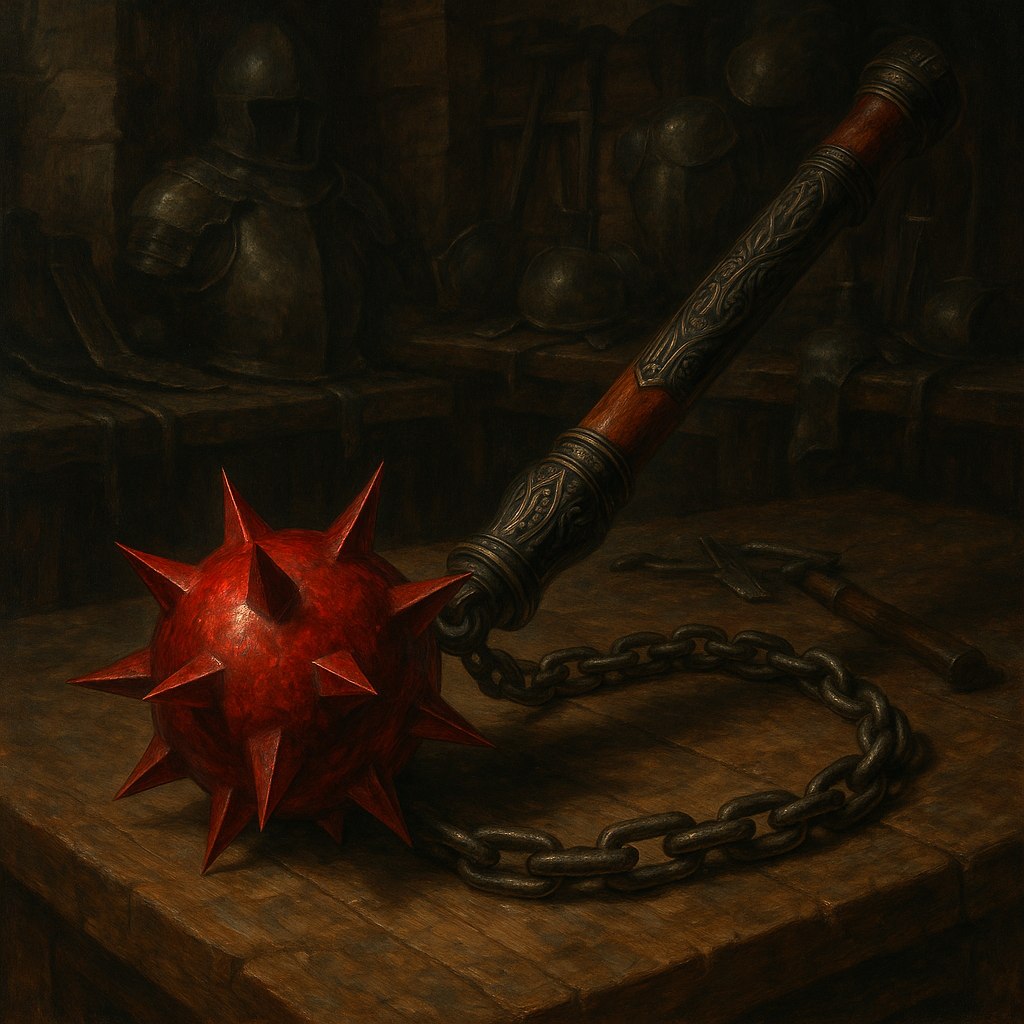
The Falling Star is a Pyrrhium-forged masterwork, one of the most coveted and lethal relics in Everwealth. Its design is deceptively simple, a crimson, spiked head the size of a skull, attached to a short length of chain that can be locked into a reinforced sleeve to function as a fixed morningstar. When released, however, its true nature is revealed. Each swing gathers momentum as though drawing on the very pull of the stars, storing force until it crashes down with ruinous, fortress-breaking power. In the hands of a master, it can topple siege engines, crumple armored giants, or crack open battlements with a single strike. But the gift is never free. Every missed blow lashes back through the haft, capable of snapping ribs or dislocating arms. Each overcharged strike tears blood and sinew from its wielder, leaving scars that never fade. The longer it is used, the brighter its Pyrrhium core glows, and the heavier its toll becomes, dreams filled with burning constellations, phantom stars screaming overhead, the wielder’s body breaking down under the weight of momentum not meant for mortals. Coveted by kings, whispered of in taverns, feared by generals, the Falling Star is the kind of weapon that reshapes battles, and then kills the man who carried it.
Mechanics & Inner Workings
The Falling Star’s enchantment is rooted in its Pyrrhium head, bound to a forging ritual now lost to all but the deepest vaults of the Lost Ages, yet to be unearthed. Its primary effect is the storage of momentum, every rotation of the head while loose on the chain builds force and binds it into the weapon's next swing, exponentially magnifying impact until it strikes with the fury of a falling meteor. In the form of a morningstar, it is a devastating bludgeon capable of piercing any armor with ease. In the form of a flail, it is destruction incarnate.
- Mode transitioning: To switch between a mace and flail, the user need simply press a single mechanical button at the top of the grip; Wherein a magickal rune affixed to it will trigger an enchanted weight within which drags the chain into the grip until the head is firmly slotted into slots made for it in the handle's tip, firmly sealing it in-place. Or inversely releases the ball from the grip allowing it to again be used as a flail.
- Momentum Accretion: Force multiplies with each uninterrupted revolution of the change. At peak, the weapon can crater stone barricades or fold siege armor like paper.
- Backlash Recoil: A missed strike channels all stored energy back into the wielder, often breaking bones or tearing muscle if not obliterating them entirely leaving a traumatizing mess to witness indeed.
- Residual Glow: The Pyrrhium grows brighter with each kill, radiating a faint crimson light visible even in daylight. This glow does not fade, marking the wielder as its servant until they fall, fading into darkness once more as they go. One wielder, Crusius, a warrior of the Ursi was said to have felled so-many foes with the weapon that it could illuminate a darkened cave as-if under the light of a red sun.
Manufacturing process
The forging of the Falling Star is shrouded in ritual and secrecy, but fragments of lost records suggest the following process. The Pyrrhium was melted in a triple-forge fed by enchanted oil and cooled in the sacred quenching process that stabilized its star-like resonance. Chains of Hexsteel were bound to it using sacrificial star-dust, fusing the links to the head with protective runes that made it nigh unbreakable. The chain-sleeve locking mechanism was an innovation of desperate smiths during the late Lost Ages, intended to give soldiers more control of its otherwise uncontrollable power. The final binding was sealed with blood, not of slaves or prisoners, but of the forgemaster himself, willing to tether part of his own soul to the weapon to ensure it did not annihilate its wielder outright.
History
The Falling Star’s earliest known appearance is in the late Lost Ages, during the border wars with Vile's armies amid The Fall. Chronicles speak of a lone champion of the Goblins who carried it into battle against Devil warbeasts, shattering their plated hides with each swing until his body failed beneath the weapon’s weight. It vanished into the chaos of The Great Schism, only to resurface centuries later in the hands of rebel warlords, zealot kings, and condemned champions who briefly carved their names into history before succumbing to its toll. The most infamous wielder was Magus Rhelgar Thorne, a deserter of The Arcane Coalition who seized the Falling Star during the Sacking of Opulence. In a single night he broke three gates and slaughtered two companies of knights, but by dawn his body was found twisted and mangled, every bone broken from within as though crushed by invisible chains. Every attempt to seal or destroy the Falling Star has failed. The Pyrrhium core resists fracture, and attempts to bury it only result in its inevitable rediscovery, glowing faintly through earth and stone.
Significance
The Falling Star is more than a weapon, it is an obsession. Nations covet it as a deterrent, warriors seek it as proof of worth, and scholars fear it as a relic that refuses to die. Its legacy is one of endless circulation, no wielder holds it long, no kingdom keeps it forever. And yet all who hear of it dream of what they could achieve, if only for a moment, with the strength of a star chained to their hand.
Creation Date
Exact date unknown. Believed to have been forged in the final century of the Lost Ages during The Fall.
Rarity
Unique in form and function to be certain.
Weight
Excessive even for a mace, nearly 10 pounds. Nearly unwieldable by weaker mortals.
Dimensions
The head is the size of a human skull, spiked and crimson. Its chain, short, reinforced with heavy duty steel links. The overall length us similar to a war-morningstar, but with chain-sleeve extension for modular use.
Base Price
Incalculable. No coinage could purchase it.
Raw materials & Components
- Pyrrhium Core: Star-metal capable of holding potentially infinite enchantment.
- Adamant Chain: Rune-bound, forged with sacrificial star-dust.
- Blood-Oil Quenched Sleeve: Locking mechanism stabilizing its dual form.
Tools
Forged in volcanic crucibles, fed with enchanted bellows, star-dust hammers, and magickal oil quenching vats. The final ritual allegedly required a forgemaster’s life, binding his soul to the weapon to empower it.

Comments