
Caelbrith
"The silence after breath is not peace, it is the knife that severs what should never rise again." -Scripture from the Ash-Dirges.
Caelbrith is the Veil Between, the cold cessation of all things, the god of endings and absence. He is not concealment, that is Orram’s deep, but obliteration. Where others speak of death as a passage, Caelbrith is the wall that ensures nothing returns. To mortals he is dread, for his hand cannot be bribed nor delayed; once his silence falls, it is absolute. Kings beg for reprieve in his name, assassins whisper prayers that their strikes be final, widows curse him when graves remain too silent for ghosts. Yet Caelbrith is worshipped. For those who fear the endless gnawing of Xaethra, or the crushing secrecy of Orram, his silence is mercy. He offers release, a true end unmarred by hunger or concealment. Among his faithful, Caelbrith is a shield against horrors that refuse to die, a promise that what is cut down stays cut. His temples are not places of light, but cold halls hung with black veils, doorways marked by ash, stones etched with void-runes. His followers claim he is the only god who has never lied, his silence is truth itself. But whispered among priests is another story, before Xaethra’s invasion, Caelbrith moved unseen. Some suspect it was his unseen hand that opened the door for her invasion, to feed on the desolation left behind. Others suggest darker plot, that in silence, he made a bargain of his own, extinguishing something even gods feared. His absence is not emptiness, but choice, and none know what he has chosen to erase.Divine Domains
- Primary Domains: Endings, absence, silence, severance. Caelbrith rules the final breath, the quiet after destruction, the void where memory falters. His silence is not concealment, but totality: what he takes cannot return.
- Secondary Connections: Forgetting, severed oaths, extinction, finality of judgment. His hand is felt when lineages end, when entire tongues fall silent, when once-sacred bonds are broken beyond mending.
- Tertiary Reflections: Erasure, entropy, decay into nothing. Caelbrith does not revel in rot (Ny’yala uses decay to feed the cycle). He simply ends. His touch is the entropy that finishes all things, whether honored or cursed.
Artifacts
- The Severant Blade: A rustless sword said to unmake whatever it strikes, not killing but erasing entirely. Blood spilled by it leaves no ghosts, no afterlife.
- The Ash-Veil: A funerary shroud that nullifies necromancy when wrapped around the dead, sealing the soul beyond reach.
- The Null Stone: A black sphere that swallows sound and light. To carry it is to carry silence itself, though prolonged touch frays memory and leaves minds hollow.
Holy Books & Codes
- The Ash-Dirges: Funerary chants recited in silence, punctuated only by strikes of iron on stone. Each dirge is meant to end grief by severing ties between the living and the dead.
- The Book of the Last Word: Sparse fragments carved into obsidian tablets. Each verse ends abruptly, mid-thought, as if cut short by Caelbrith himself.
Divine Symbols & Sigils
- Predominantly a broken circle, representing the severed cycle.
- A black veil or torn shroud.
- A hollow mask with no mouth.
Tenets of Faith
- All things end. To resist this truth is heresy.
- Sever what festers. Do not allow corruption, hunger, or rot to linger.
- Oaths break; silence binds. Words are lies, endings are truth.
- Mercy is finality. To let suffering persist is cruelty; to end it is compassion.
Holidays
- The Last Ember (Onyx 28th): Fires are snuffed across villages at midnight, relit only at dawn. Meant to honor the severance of one day from another.
- Harrow Day (Topaz 30th): Where Xaethra’s cults mock devils with feasting, Caelbrith’s faithful dress in veils and keep silent vigils, honoring those who should never rise again.
Divine Goals & Aspirations
- End the Unending. He despises what refuses to die, lichdom, revenants, hunger without closure.
- Erase Falsehood. What lies, deceives, or festers must be cut away, leaving only the void of truth.
- Guard the Veil. Death must remain inviolate; no necromancy, no hunger, no cycle may breach what is his.
Physical Description
General Physical Condition
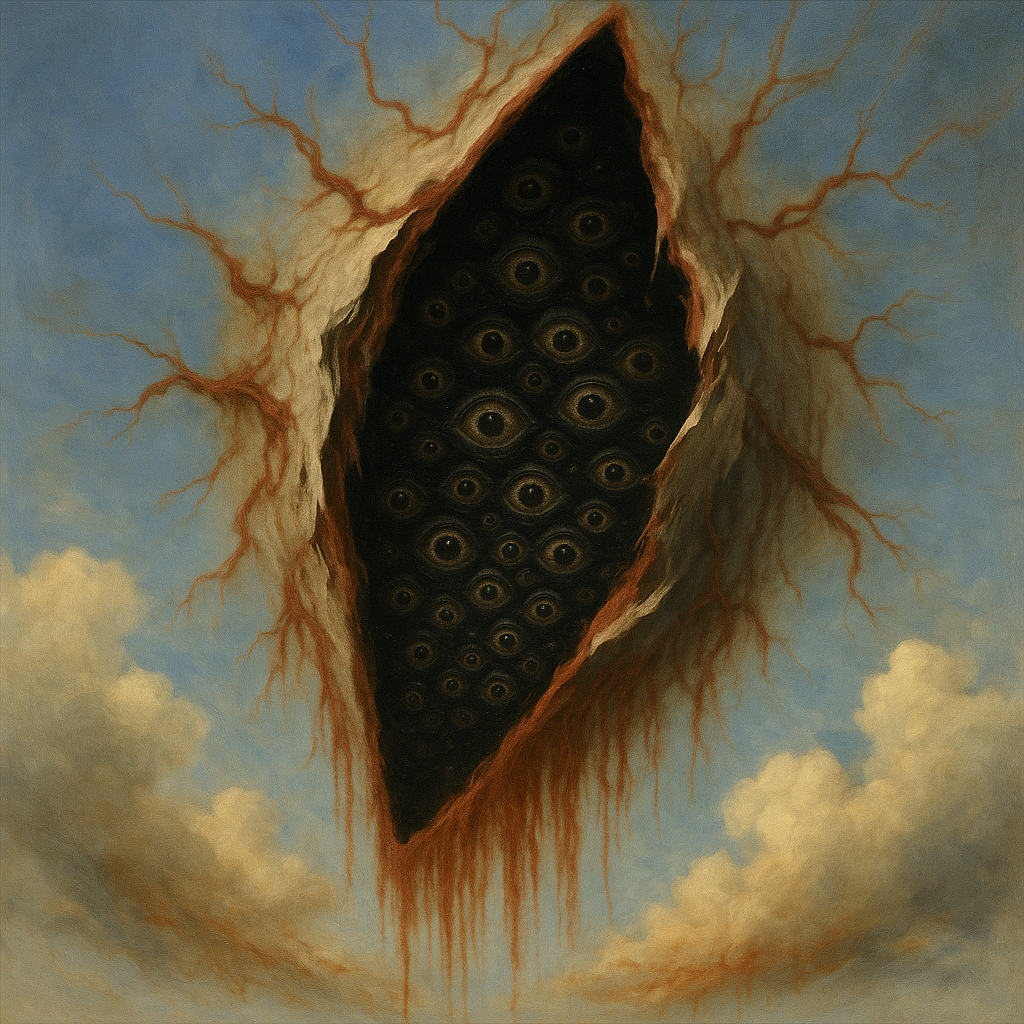
Caelbrith’s true form is not cloaked but torn open, a rift in the fabric of reality itself. Those who have witness him firsthand accidentally or otherwise describe him as a wound in the world, a gash across the sky through which light, sound, and thought bleed away into nothing. The edges of this wound quiver and split, forever breaking wider, yet never healing, jagged rents that gape into voids of absolute silence. Some survivors who gazed exceptionally deep swear that what lies inside the wound is worse still, glimpses of thousands of eyes in all directions yet al locked onto you wherever you go; Even after Caelbrith's form is long gone. Others speak of vast, ringed fractures, concentric halos of shattering crystal, that rotate and collapse upon themselves, erasing memory with every turn. To look upon him is to feel thought itself stutter and fail: words cut mid-sentence, memories collapse into blankness, entire languages abandoned in the space of a breath. Those who survived Caelbrith’s manifestation describe not merely horror but erasure. One soldier returned from his vision unable to finish any spoken word; another wept constantly, unable to recall why; still another stood frozen for weeks, his face locked in an unfinished scream. His form is not endured, it is survived, if one is not reduced to silence or unbeing altogether. When Caelbrith cloaks his essence for communion, it is no less unsettling. In dreams, he appears as a fissure running through sky or soil, bleeding black light that drowns sound. In waking avatars, he manifests as executioners without mouths, pallbearers whose faces are scarred with cracks, or statues that fracture when seen too long before repairing themselves in silence. Wherever he walks, time feels interrupted, as though the world itself forgot what it was doing. His presence is not weight like Orram, nor turning like Ny’yala, it is rupture. A divine subtraction. A wound that cannot heal.
Divine Classification
God.
Children

Comments