





Talinghaga (tah-LING-ha-gah)
Nightjar
There is a breath the forest takes, just before sleep. It is not the wind, nor the hush of falling dusk, but something more intimate—a pause in the rhythm of growth, as if the canopy itself leans inward to listen. In that breath, the Talinghaga opens its eyes. Not suddenly, and not with purpose, but with the slow awareness of something returning to a world it never truly left.
They do not arrive so much as unveil. What once appeared to be a mottled leaf, a knotted root, or the flecked hollow of bark reveals itself with gentle certainty. There is no transformation—only recognition. The space it occupied was always its own. The eye merely catches up. Where others seek definition, Talinghaga offers resemblance without anchor: an echo of shape in shadow, the implication of presence between tree and stone.
It does not move often, but when it does, it is as if rearranging silence. Its wings do not disturb the air; they accompany it. Even its ascent is obscured, as though the forest consents to part around it without parting. Talinghaga does not navigate—it reenters, tracing the liminal edge of being seen and being sensed. Its body is the pattern, its feathers the memory of fallen bark and moonlit ash.
Rarely glimpsed in full, it is not because it hides. Rather, it does not insist. It exists precisely where it need not be proven. And yet, to those who do see it, it feels like encountering a thought one has not yet formed—a presence that completes an unspoken sentence. Talinghaga never startles. It reminds.
The twilight is not quieter when it perches, but deeper. The moment elongates, holding the listener gently between one breath and the next. That is where the Talinghaga lives—not in night or flight, but in the spaces where language has not yet reached.
Among forest-dwelling peoples of the Malay Peninsula, the nightjar is seen as a boundary spirit between waking and dreaming. Its silence is considered sacred, and it is said to hold memories of those who have lost their way beneath the canopy. The Talinghaga echoes this in its appearance near seekers, offering not direction, but presence. Philippines – Tagalog & Visayan Lore
Called *wakwak* or *kandarapa* in various folk beliefs, nightjar-like creatures were thought to be shapeshifters or spirit-guides who carried whispers to the dead. The Talinghaga transforms this myth into gentleness: it appears not to frighten, but to cradle unspoken grief and carry it away on wingbeats unheard. Indonesia – Javanese Mysticism
In shadow puppetry and royal court rituals, silent birds such as the nightjar symbolize inner wisdom and concealed messages. Talinghaga’s emergence in sacred glades is interpreted as a sign that knowledge long buried is ready to rise—if approached in stillness. Thailand – Lanna Folklore
Night-souls or *phi khao* were said to travel in the bodies of owls and nightjars. The Talinghaga, in contrast, holds no soul, but waits at the edges where one might be lost or found again. Monks on silent retreat sometimes interpret its appearance as a benediction. Vietnam – Đạo Mẫu Practice
In ancestral altars dedicated to the Mother Goddess, birds of the night are left tokens of cinnamon and charcoal. These offerings are said to soothe unseen messengers between realms. The Talinghaga is believed to frequent such sites, though never to claim the offering—only to honor the silence left behind.
Behavior & Communication
Talinghaga are motion-minimal beings, remaining nearly indistinguishable from forest detritus for long intervals. Their preferred posture—flattened along stone or root—appears as a seamless continuation of their surroundings. Movements are deliberate and near-silent, with slight head tilts and feather micro-adjustments aligning precisely with shifting shadow or moonbeam. They do not vocalize in patterned calls but rather release intermittent, tonal emissions—single, rounded pulses spaced irregularly. These notes do not form songs but seem to mark changes in the air’s metaphysical texture. Some report hearing these pulses only when they close their eyes or turn their head slightly, as if their perception must meet the sound halfway. Talinghaga do not group or flock. Their encounters with others of their kind are rare and wordless. Occasionally, two may appear in the same glade, aligning on opposite stumps or branches, perfectly still. Their presence forms a mirrored hush, deepening the forest’s silence into a kind of resonance chamber. After a time, both vanish—often without motion, leaving the space altered. Communication is environmental rather than expressive. The way dust settles around them, the flicker of light across their cryptic plumage, the curvature of their resting shape—these serve as subtle indicators of nearby aetheric shifts. Dreamwalkers and hedge-scribes sometimes seek them during reverie, believing their presence clarifies visions or protects against symbolic dissonance.Ecological Niche
Talinghaga are most commonly found in low, thick-canopy biomes: tropical forests, vine-draped stone groves, and fern-cloaked hollows where sunlight diffuses into amber haze. These regions are defined not by climate alone, but by aural density—places where sound is softened, and spatial awareness folds inward. Their favored resting spaces often correlate with leysong tangles, forgotten cairns, or convergence zones of fading memory. They do not act upon their environment through consumption or alteration, but by modulating the ambient rhythm of a location. Forests with long-standing Talinghaga presence show irregular but harmonious cycles of growth, pollen drift, and nocturnal flowering. Their stillness acts as a metaphysical buffer, absorbing resonance overstimulation and preserving the contemplative stillness that allows other beings to calibrate. Although solitary, they are occasionally found near beings undergoing rites of threshold or identity—those passing through personal transformation, spiritual fracture, or silent endurance. Whether they are drawn to such moments or serve to harmonize them remains unknown. Still, their presence is interpreted by many as a gentle anchoring of self within place.Common Myths & Legends
Malaysia – Orang Asli TraditionAmong forest-dwelling peoples of the Malay Peninsula, the nightjar is seen as a boundary spirit between waking and dreaming. Its silence is considered sacred, and it is said to hold memories of those who have lost their way beneath the canopy. The Talinghaga echoes this in its appearance near seekers, offering not direction, but presence. Philippines – Tagalog & Visayan Lore
Called *wakwak* or *kandarapa* in various folk beliefs, nightjar-like creatures were thought to be shapeshifters or spirit-guides who carried whispers to the dead. The Talinghaga transforms this myth into gentleness: it appears not to frighten, but to cradle unspoken grief and carry it away on wingbeats unheard. Indonesia – Javanese Mysticism
In shadow puppetry and royal court rituals, silent birds such as the nightjar symbolize inner wisdom and concealed messages. Talinghaga’s emergence in sacred glades is interpreted as a sign that knowledge long buried is ready to rise—if approached in stillness. Thailand – Lanna Folklore
Night-souls or *phi khao* were said to travel in the bodies of owls and nightjars. The Talinghaga, in contrast, holds no soul, but waits at the edges where one might be lost or found again. Monks on silent retreat sometimes interpret its appearance as a benediction. Vietnam – Đạo Mẫu Practice
In ancestral altars dedicated to the Mother Goddess, birds of the night are left tokens of cinnamon and charcoal. These offerings are said to soothe unseen messengers between realms. The Talinghaga is believed to frequent such sites, though never to claim the offering—only to honor the silence left behind.
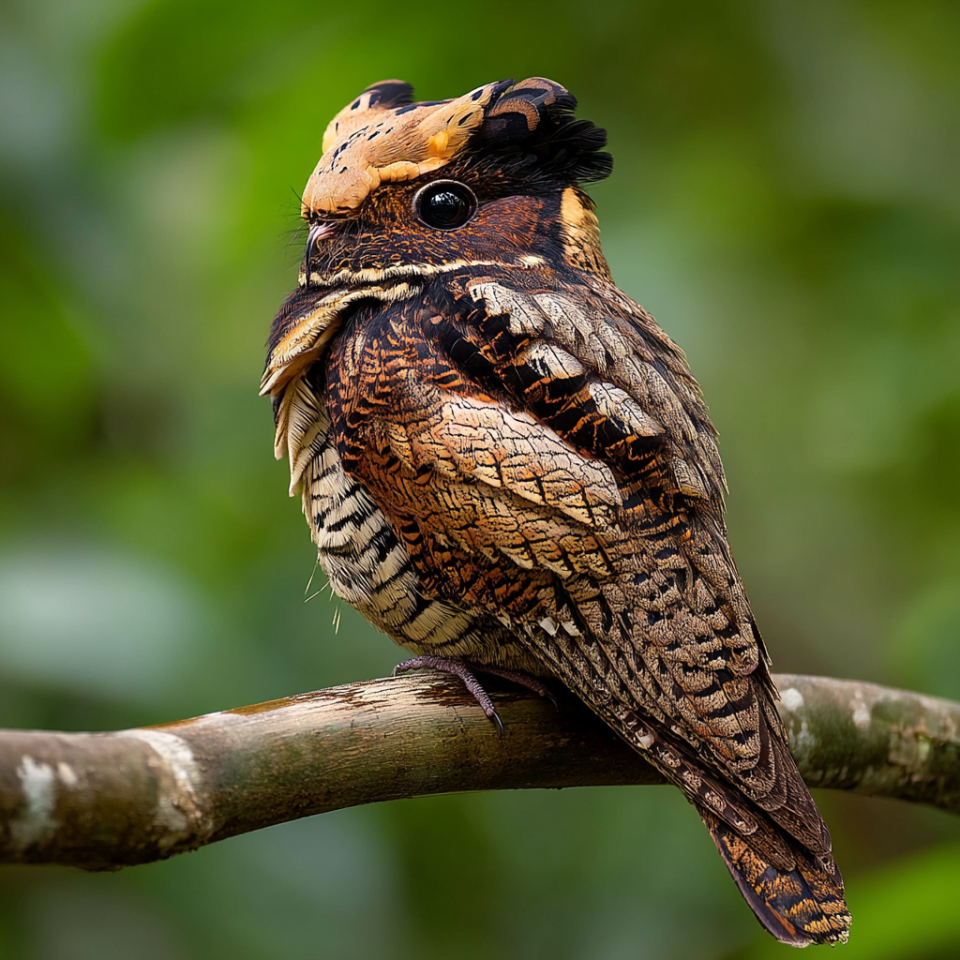
Talinghaga (Nightjar)
| APPEARANCE/PHENOTYPE |
|---|
| Avian-bodied with elongated wings and a broad-mouthed, subtly upturned jaw, the Talinghaga exhibits exceptional camouflage. Plumage consists of cryptic earth tones—mottled greys, deep rusts, and pale umber streaks—which allow it to disappear against forest debris. Distinctive feathery tufts on the head resemble exaggerated ears, though they serve no auditory function. Their form appears loosely flattened when at rest, with limbs tucked under the torso and tail aligned to ground contour. Their eyes are large and soft-reflective, capturing ambient light without gleam. The inner curve of their chest feathers is tuned to temperature fluctuation, absorbing warmth from decaying wood and releasing it slowly as they rest |
height |
length |
weight |
|---|---|---|
0.3 m |
34 cm |
0.9 kg |
Genetic Ancestor(s)
Scientific Name
Ainmhí; Nádúrtha; Suvarnabhūmi talinghaga



