





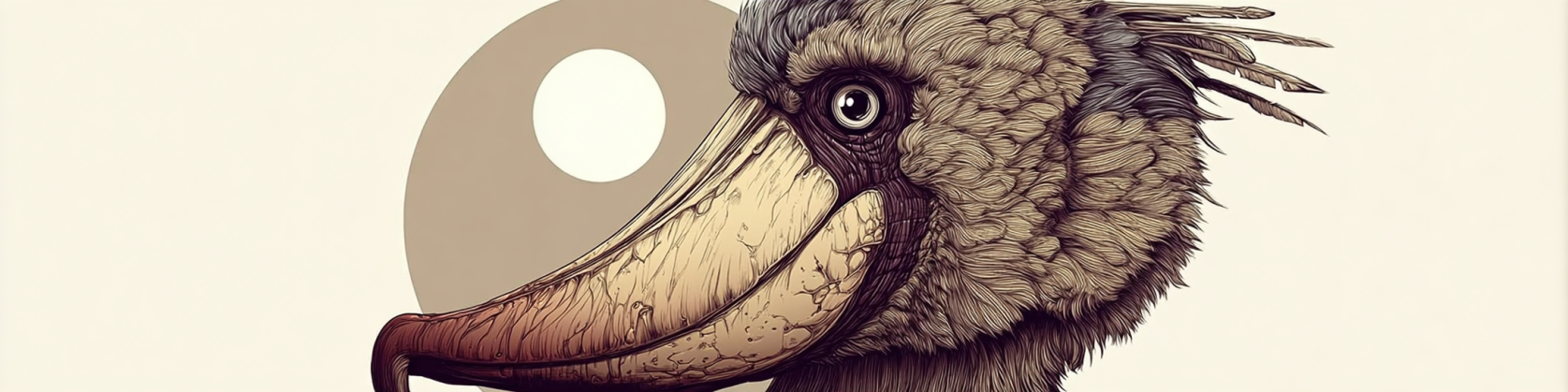
Bbulwe (BUUL-weh)
Shoebill
In the reed-choked waters of Tír na nÓg’s marshes, the Bbulwe rises like a statue carved from dusk itself. It does not hurry, nor does it yield its stance to wind or water; instead it becomes a fixture of silence, as though the swamp has decided to wear a guardian’s form. The stillness around it deepens, and one can almost feel the air take on weight, as if the Realm itself waits for a signal it alone perceives.
The creature’s presence is not a matter of sight alone. Its shadow lingers long after it moves, leaving the impression that one has been measured and found worthy of regard. At twilight, when the horizon blurs, Bbulwe seems less a bird than a boundary, marking the seam where time folds and stillness takes dominion.
Though its body is broad and avian, there is a deliberate grandeur in the way it inhabits space. Its bill, immense and block-like, appears not as a tool but as a symbol—an emblem carried into the world. Standing upon the shallows, the bird’s calm density radiates a singular power, a paradox of immensity contained within quiet.
Travelers of the marsh speak of its gift for suspension: the ability to dissolve into the landscape without effort. It waits, unblinking, a still column among reeds that sway and rustle while it does not. The patience it embodies creates an aura of inevitability, as though every movement it makes was chosen by the marsh itself.
This power of poise is its truest threshold. Where others flit, dart, or leap, the Bbulwe becomes something elemental. It reminds all who encounter it that stillness is not absence, but force in its most uncompromising form.
Among Nilotic peoples, the shoebill has long been seen as an avatar of patience and water’s hidden depth. Stories speak of a bird who waits for centuries beside a lake, and whose gaze can steady the storms. These motifs echo in Tír na nÓg, where the Bbulwe appears whenever marshlands approach timelessness. Great Lakes – Buganda Tradition
In Luganda culture, the bird is called “B’bulwe,” often invoked as a figure of quiet persistence. Within the Realm, its form resonates with ancestral memory, a living echo of the stories once told by riverside firesides.
Behavior & Communication
The Bbulwe is defined by the precision of stillness. Hours may pass with its frame unmoving, its posture erect in shallow water. When it does shift, the motion is measured—each stride placed with certainty, each turn of the head exact as a sundial marking time. Its stillness is not passivity, but a form of expression, communicating balance to all who watch. Sound is rare but resonant. The Bbulwe produces hollow, resonant clatterings from within its massive bill, a rhythm that rolls across wetlands like distant drums. These sounds mark its presence to others of its kind, but also seem to affect the rhythm of the marsh itself—frogs pause, reeds lean, and waters calm as the vibration spreads. When gathered in twos or threes, their synchrony becomes visible. One bird may lift its bill skyward while another lowers, both movements deliberate, echoing a form of mirrored ritual. These displays have the character of conversation, though unhurried, their silences as meaningful as their motions. Even solitary, the Bbulwe gives the impression of awareness beyond the immediate. Its gaze follows not merely what passes, but what is about to emerge. In this way, its communication is as much with the landscape as with its kin.Ecological Niche
The Bbulwe inhabits deep marshes and swamp-fed floodplains of Tír na nÓg. It prefers still waters layered with reed thickets, where its presence lends a sense of order. In such regions, other waterfowl gather around its favored perches, as though drawn to the calm it enforces. Its influence over the wetlands extends beyond its solitary stance. Reeds appear to thrive in areas frequented by the bird, growing tall and unbroken, and amphibians settle in greater numbers near its chosen haunts. In this way, the Bbulwe becomes a silent architect of the marsh, fixing stability into an otherwise shifting terrain. The bird is seldom found away from water, yet its appearance in high, windless riverine clearings is regarded as a rare event, marking the landscape as one of long equilibrium. These moments reinforce the perception of the Bbulwe as a being of thresholds, where earth and water negotiate their balance.Common Myths & Legends
Central Africa – Nilotic TraditionsAmong Nilotic peoples, the shoebill has long been seen as an avatar of patience and water’s hidden depth. Stories speak of a bird who waits for centuries beside a lake, and whose gaze can steady the storms. These motifs echo in Tír na nÓg, where the Bbulwe appears whenever marshlands approach timelessness. Great Lakes – Buganda Tradition
In Luganda culture, the bird is called “B’bulwe,” often invoked as a figure of quiet persistence. Within the Realm, its form resonates with ancestral memory, a living echo of the stories once told by riverside firesides.

Bbulwe (Shoebill)
| APPEARANCE/PHENOTYPE |
|---|
| Avian-bodied with broad, heavy frame. Feathers are slate-grey with subtle iridescence along the wing coverts. The bill is massive and block-shaped, pale in tone with faint striations, resembling carved wood. Legs are tall and strong, supporting upright stance in deep water. Eyes are pale yellow, lending the bird its unblinking aspect. |
height |
length |
weight |
|---|---|---|
1.2 m (from shoulders) |
1.2 m (from shoulders) |
5.5 kg |
Genetic Ancestor(s)
Scientific Name
Ainmhí; Nádúrtha; Niloticus bbulwe



