




Oíchéanfáel (SLEE-av-EE-han-fail)
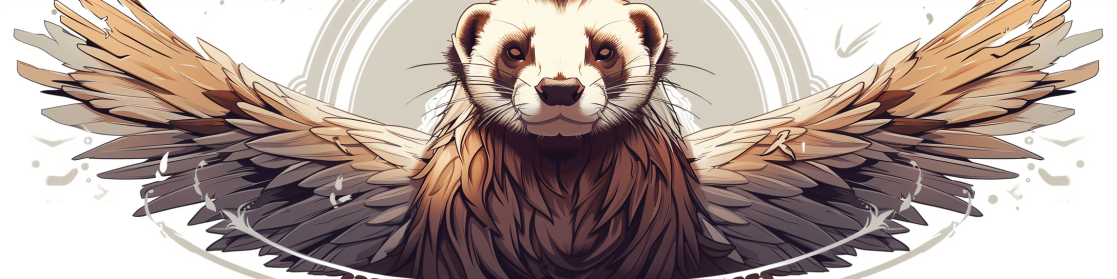
Winged Ferret
In the high shadowed passes where night touches first and leaves last, the Oíchéanfáel is more suggestion than creature—felt in the tilt of a leaf, the sudden hush of a glade, or the ripple of wind beneath unseen wings. It does not descend or arrive; it unfolds into perception, like a presence that had always been there, waiting for you to notice. Between root and cloud, it moves with intent softened by silence, as if shadow itself had grown eyes and breath.
The forests remember it differently than the mountains do. Beneath the canopy, its passage stirs no branch nor bird, only the faint shimmer of displaced dusk. There is no rustle or flash—only the soft recalibration of light, a hush pressed gently into the world’s edge. In the heights, it is more seen than felt: a brief silhouette gliding against the half-light, bearing the weightless gravity of stars untethered from the sky. Its form is not borne by the wind but carried by it, as one might carry a promise.
When the Oíchéanfáel pauses, the land shifts. Not by movement, but by stillness made deliberate. Moss seems to darken, bark to deepen, as though time folds in slightly around its chosen perch. Nothing watches, yet everything notices. Even among the thickest shadows, its outline resists vanishing—not from brightness, but from presence. It does not blend in; it is what blending becomes when it learns patience.
They are not creatures of solitude, but of separateness—a quiet separation that knows the difference between loneliness and the sanctuary of dusk. Where they gather, the air holds resonance like breath held in prayer. No two ever seem to move together, yet their presence harmonizes across distances, like a low chord strung across mountaintops. Silence, in their company, ceases to be absence. It becomes companionship.
To follow the path of an Oíchéanfáel is not to chase it, but to slow one’s pace until the world begins to whisper again. It will not guide or mislead, teach or trick. It will not turn back to regard you. But if it moves beside you—unbidden, unafraid—you are no longer alone. It is not a companion in the Mortal sense, but the echo of kinship that does not need naming to be understood.
The Oíchéanfáel bears echoes of the selkie and the dùnach—the hidden folk of twilight hours in Scottish lore. While it does not shapeshift or wed mortals, its silence, aerial grace, and affinity for dusk mirrors these fae-like beings, believed to move unseen between glens and moors. Its presence may underlie whispered tales of winged shadows that ferry lost children not away, but gently home. Japan – Ainu Tradition
In Ainu belief, certain owls and weasels were thought to hold spiritual insight, watching over liminal paths or appearing during significant moments of personal change. The Oíchéanfáel’s calm observance, paired with its avian-mammal form, reflects a similar role as an intermediary spirit—one who witnesses quietly without intervening, and whose presence marks a transition point between inner and outer realms. Andes – Incan Folklore
Among Incan traditions, winged mammals were sometimes considered night-keepers or watchers of sacred paths. The Oíchéanfáel's hybrid form and crepuscular emergence align closely with such figures, especially those believed to accompany travelers across mountain passes or through hidden caves, unseen by day. Its gliding presence through Realm dusk echoes these ancestral guardians of transition and quiet movement.
Behavior & Communication
The Oíchéanfáel’s movements echo the liminal rhythms of its home terrain—stillness broken by sudden lift, glides that pause just before contact, and climbs that do not disturb the air. Males tend toward sloped descents, banking in wide arcs beneath cloudbreak, while females spiral upward with featherlight correction before alighting silently on outcroppings or the upper bows of alder groves. Neither flies with haste. Each movement seems measured against the light it displaces. Their presence is most often revealed through gesture and gaze. Male Oíchéanfáel carry an unmistakable tension in their shoulders—a coiled stillness that communicates readiness rather than threat. A single wing-tilt or tail drop may shift the mood of an entire glade. Females are more expression-forward, often holding long eye contact with other beings or tilting their feathered ears toward points of distant sound. They do not vocalize in any conventional sense. Instead, their communication manifests through harmonic breath—inaudible pulses of rhythm emitted during inhalation, subtly modulating the air around them. Other animals often pause, as if noticing a change they cannot trace. When Oíchéanfáel gather briefly—typically no more than three at a time—their combined presence generates a pressure shift that encourages quiet in the surrounding area. Rarely do they approach mortals uninvited, yet they do not avoid them. A curious child seated near dusk may be graced with a hovering glance, while a still elder might find one resting nearby, only to vanish without sound. They exhibit a distinct preference for those who move gently through the forest, often mirroring such movement at a distance before departing.Ecological Niche
The Oíchéanfáel inhabits the twilight band between Tír na nÓg’s high alpine forests and shadowed mid-mountain valleys. Males favor crag-laced ridges, basalt overhangs, and abandoned terraces where airflows spiral between stones. Their role in these regions appears to involve vibrational shaping: altering wind slipstreams, pressure gradients, and the ambient stillness that defines migratory paths for winged fauna. Females are more often found in the denser canopy corridors below, especially along moss-rich hollows and branch-bridges braided with lichen. Here, they are believed to influence the vibrational ecology of flowering nocturnal plants—nudging petal openings and helping regulate the luminous tension held in certain bioluminescent vines. Realm biologists note the synchronized blooming of several species in areas frequented by these gliding mammals. Both sexes seem to act as transitional anchors between vertical habitats, linking wind corridors to root-sheltered ecosystems through rhythmic aerial routes. Their regular passes across altitude zones suggest they serve as calibrators of ambient tension between earth and sky—softening the metaphysical dissonance that sometimes accumulates during shifts in seasonal light.Common Myths & Legends
Celtic – Scottish HighlandsThe Oíchéanfáel bears echoes of the selkie and the dùnach—the hidden folk of twilight hours in Scottish lore. While it does not shapeshift or wed mortals, its silence, aerial grace, and affinity for dusk mirrors these fae-like beings, believed to move unseen between glens and moors. Its presence may underlie whispered tales of winged shadows that ferry lost children not away, but gently home. Japan – Ainu Tradition
In Ainu belief, certain owls and weasels were thought to hold spiritual insight, watching over liminal paths or appearing during significant moments of personal change. The Oíchéanfáel’s calm observance, paired with its avian-mammal form, reflects a similar role as an intermediary spirit—one who witnesses quietly without intervening, and whose presence marks a transition point between inner and outer realms. Andes – Incan Folklore
Among Incan traditions, winged mammals were sometimes considered night-keepers or watchers of sacred paths. The Oíchéanfáel's hybrid form and crepuscular emergence align closely with such figures, especially those believed to accompany travelers across mountain passes or through hidden caves, unseen by day. Its gliding presence through Realm dusk echoes these ancestral guardians of transition and quiet movement.

Oíchéanfáel-male

Oíchéanfáel-female
| APPEARANCE/PHENOTYPE |
|---|
| Mustelid-bodied and winged, the Oíchéanfáel resembles a long-limbed ferret hybrid with a sinuous frame and highly articulated musculature. Males possess scaled, membranous wings with talon-hooked fingerlets at the apex, while females bear feathered wings that taper into fan-like trailing edges. The sexes are easily distinguished in flight. Facial traits include wide-set, reflective eyes and long whiskers capable of subtle air calibration. Male coloration trends dark—espresso, slate, and volcanic brown—while females exhibit a gradient from stone-white to pale gold. Both exhibit low-level iridescence under moonlight, with dense fur adapted to retain ambient stillness. |
height |
length |
weight |
|---|---|---|
36.6 cm |
91.4 cm |
3.2 kg |
Genetic Ancestor(s)
Scientific Name
Ainmhí; Measctha; Sleevafelis oíchéanfáel
Origin/Ancestry
Born from the whispers of ancient forests and the secrets of hidden caves, the Oíchéanfáel is believed to be a creation of the night itself, a blend of shadow and silence given form.



