
Quickness
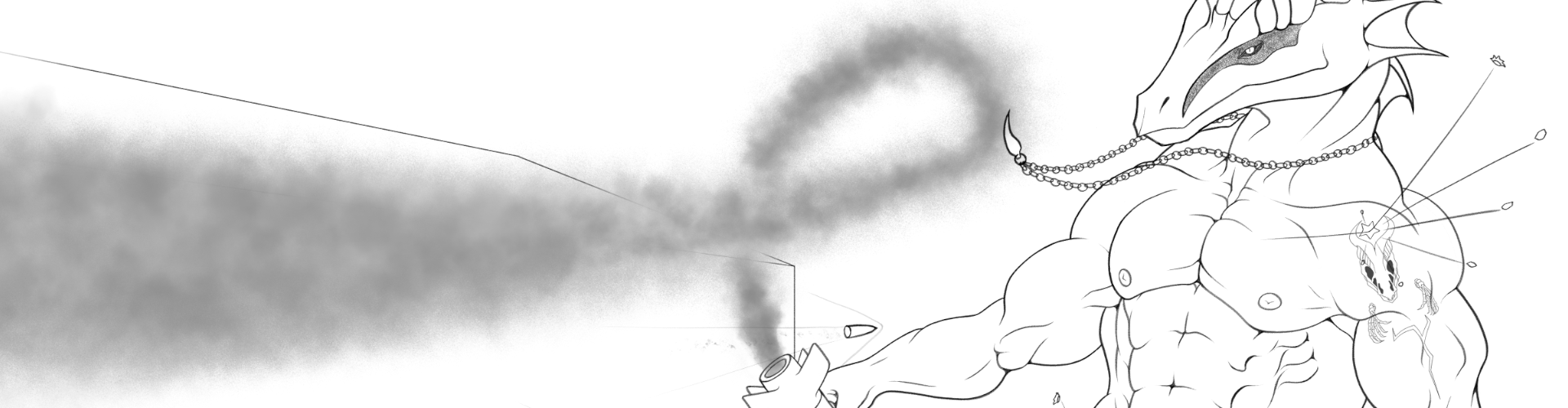
Within the interstices binding one moment to the next is where Rodinians and their Nadrakian rivals think and act. At least, that’s one particular phrasing of an often-quoted line, and it's not far from the truth either. From most people’s vantage point, they seem act instantly when they need to. If ever unfortunate enough to be anywhere near infighting Rodinians, or a battle against their arch rival Nadrakians, you wouldn’t see much at all.
There'd be a stand-off. Bodies would tense. Fists would clench. Stances at the ready. And then everything would explode at you. You’d be deafened from sonic booms rupturing your eardrums as their bodies tear open the air. Fire and blinding light would engulf the battlefield as a consequence of extreme adiabatic compression of air as they plough through it. If you aren’t incinerated then the pressure shockwaves would hurl dirt and fragments of stone at velocities so great they’d kill you instantly if they hit you. Trees and buildings would be torn free from the ground and swept along by hurricane force winds. Your lungs would be crushed and your organs pulped by the shockwaves.
When the battle is over a few seconds later, bloodied victors would stand in a field of total carnage over the broken bodies of the slain.
Reaction Time
Rodinians process large volumes of sensory information from multiple sources very quickly; quick enough that supersonic projectiles don't appear to move; quick enough to pick out a single conversation in a crowded stadium of thousands; and quick enough to replace a navigational computer. They also move fast, but it’s all relative. In their eye, its normal. To mortals, they frequently break the sound barrier (defined at atmospheric pressure, ~340m/s) with casual movement, creating sonic booms and whiplike cracks, and flashes of static electricity around their limbs produced from air friction. When exerting themselves, Newtonian physics is no longer sufficient to describe Rodinian movements, and Special Relativity is required. The average Rodinian’s conscious reaction time is around eight nanoseconds. This is the time it takes between external stimuli and the beginning of a physical reaction. It's far, far beyond what you find in ordinary psikinetic species.Operating at the Limit
Rodinian sensory cells (such as retinal photoreceptor cells, olfactory receptors, hair cells of the inner ears, etc) consist of crystallized materials producing flashes of light in response to specific stimuli, such as temperature, pressure, light, sound, or chemical bonding. These light flashes discharge significantly faster and travel quicker than the action potentials of human neurons and receptors, taking place at the speed of chemical reactions transferring electrons between atomic electron orbitals. It's therefore hard-capped in the high femtosecond/low picosecond range (10-13 s to 10-12 s) without room for improvement. These optical discharges travel along short glass-like nerves at close to light-speed into nearby localised translink cells. These are neural cells combining sensory signals from nearby groups of receptors in a similar fashion to retinal ganglionic cells, glomeruli olfactory cells, etc. They are capable of performing some initial processing of sensory information and then, using Psikinetics, they transmit these signals “wirelessly” to corresponding translink cells in the brain. Signals from remote parts of the body therefore skip over intervening distances between them and the brain, limited only by the universal speed of light limit. The quickest signals are received from sensory receptors nearer to the brain, i.e. those of the eyes, ears, nose, etc. These arrive in the brain between 300 and 600 picoseconds after stimulation. The most delayed signals are from touch receptors of the feet, which take around eight nanoseconds to arrive after activation. Within the brain, their glass-like neurons act as intermediaries between the physical body and the Rodinian’s soul, the latter of which is where the vast majority of the processing goes on. The brain co-ordinates the use of the soul’s huge information processing resources to vastly exceed its own processing capability. It’s analogous to the firmware allowing applications to use physical components in a computer, except in this case the brain contains the firmware allowing the body (and the brain itself) to offload processing into the soul. Signals travel from translink nodes in the brain to nimata cells – special neurons linking the physical body and the soul. At this point we're still dealing with light-speed signals traversing optically transparent nerves across distances measuring at most 20 cm. This adds up to a further 660 picoseconds to the total reaction time. The Rodinian soul itself almost instantly processes information from the perspective of the outside world, and experiments have capped it's processing time for recognising specific visual stimuli at 10-38s, which is still six million times longer than the plank time. This varies significantly between intelligent species however, with human Souls having parity with their physical brain's own processing time due to their under-developed non-psikinetic souls. In a Rodinian's case, the limiting factor here is how long it takes them to make a decision, which is limited by how much data they obtain about the world to then be fed into their soul. This therefore can vary by a wide margin. It could be 10-38s, or it could be ten minutes. It depends entirely on the circumstances. For most simple, reflexive based situations however, like responding to threats, Rodinians can begin reacting after the timeframes below:- Visual/auditory/olfactory/taste identification of threat: 1.2 nanoseconds
- Recognition of threat from physical contact with:
- Head: 1.2 nanoseconds (ns).
- Neck: ~2 ns.
- Chest/Upper Arms: ~3 ns.
- Abdoment/Lower arms/Hands: ~4 ns.
- Legs: Between 4 and 8 ns.
- Feet: 8 ns.
- Strength of Psikinetic Forcing: More powerful Rodinian souls can pump out larger amounts of energy when contracting their muscles using psikinetic forcing. This is influenced by the strength of the underlying soul, and whether it's tapping into one, two or all three hypostases.
- Development of Sense of Reach: Reach is a telekinetic sense measuring ripples in the Higgs field caused by moving masses. It can also directly measure the position of particles and any changes in it. This sense conveys information at the speed of light and skips the lengthy conversion of environmental stimuli into neural signalling.
- Theosis Charisms: Precognition and other forms of remote viewing can provide information otherwise impossible to obtain within the laws of physics.
- Word of Power: Also known as an aura, a Rodinian's own unique soul can manifest a power able to circumvent limitations in obtaining awareness of their surroundings.
Controlling Perception
If Rodinians continuously experienced the world in eight nanoseconds slices, then the world around them would take an eternity to change. Days would feel over 37 million times longer. Objects in free fall would barely move. Lightning bolts would slowly snake their way across the sky or towards the ground, and even light beams passing through a material and being scattered would be seen. The world would be frozen. Furthermore, as their bodies need to move far slower than nanosecond timescales so as to avoid destroying their surroundings, a Rodinian would feel trapped inside a body they must move agonisingly slowly. Rodinians therefore have variable reaction times that they can dial down when not in situations that require instant reactions. When interacting with mortal species they dial down their reaction time to a single-digit millisecond range. When dealing with each other they typically operate in the microsecond range, and increase or decrease this to make their daily life as easy as possible. When in combat or other life or death situations they try to max out their reaction time into the nanosecond range, providing ample time to think. They've trained involuntary triggers that drop their reactions down into their nanosecond limits in response to specific stimuli. Some examples of these include:- Triggering their flight or fright response.
- The sudden and abrupt motion of an object in their field of view.
- A sudden noise they aren’t expecting.
- A vibration, a change of pressure, a change in ambient lighting, a change in ambient electric and magnetic fields, or a change in ambient temperature they aren’t expecting.
- A physical sensation either breaking the skin or applying a large force in a short time (Likely to be a physical blow of some kind).
- The sudden and abrupt motion of an object within range of their sense of reach.
- Sudden changes in the density of dyne around them (such as the release of a spiritual aura).
Perception Speed
A few illustrative examples of the world in which Rodinians inhabit. A bolt of lightning travels at 120,700 metres per second. Within the standard Rodinian reaction time of 8.34 nanoseconds, a bolt will travel one millimetre. So, within what a Rodinian would perceive as “five seconds” (that being fifteen times their reaction time, the same as how fifteen times the human reaction time of 330 milliseconds is five seconds) the same lightning bolt would only move fifteen millimetres. Rodinians can therefore watch lightning unfold in front of them in intricate detail. If the lightning bolt were heading straight for them however, then they'd take around sixteen nanoseconds to evade on average. In this time, such a lightning bolt will move more than two times farther to around thirty millimetres. This soberingly means that to hit a Rodinian with something as fast as a lightning bolt, the attack would need to occur from a source less than thirty millimetres away from them to have any hope of making contact. It’s therefore accurate to say that lightning fast isn’t fast enough when it comes to fighting Rodinians and Nadrakians.Force Generation and Strength
With regards to their limb speed and reflexes, your average Rodinian can move their limbs to complete most movements after eight nanoseconds, as mentioned above. In the simple case of snapping their arm out in front of them to punch or deflect something, this moves the limb from stationary to outstretched within that span of time. Their hand will move around 1.25 metres (roughly the length of a Rodinian’s arm) and accelerate with an eye-watering amount of g’s; somewhere in the region of three quadrillion g, which is 5000 times the acceleration due to gravity on the surface of a neutron star and a billion times that of a white dwarf's. This is why compact stellar bodies (aside from Black Holes) are no risk to Rodinians and Nadrakians. Their bodies produce forces able to overcome even the gravitational accelerations of these stellar corpses, such that they may stand and walk across their surfaces. Firstly, the high g-force their muscles generate means there’re no gravitational fields in the universe capable of stripping a Rodinian of their mobility, except for those at the event horizon of black holes. A white dwarf’s meagre 390’000 g isn't even sufficient to be noticeable. Mighty neutron star gravitational fields, at 5000 times weaker than Rodinian muscle, can't entrap them either, but in some cases could at least be noticeable. When told tales of such outlandish feats, most people vehemently dismiss them out of hand, as they sound absurd. They are absurd. It simply shouldn't be possible for anything to stand, let alone walk, on the surface of such bodies and yet they do. They do so with such casual briskness demonstrating that Rodinians and Nadrakians simply aren't in the same league as everyone else. And such feats are a warning as much as they are an interesting story; if the universe's second deadliest environment can't hurt them, then what can your civilisation possibly do when they show up for business? A theoretical upper bound on their strength can be analysed from this. If we assume their hand and forearm weigh 30kg (due to their high density tissues and bone), then the force driving this motion is 3.4x10²³ newtons. If you wished to create an equal weight on Earth under its 1g of gravitational acceleration so you could pin that Rodinian's/Nadrakian's arm to the ground and stop them lifting it, you’d need a mass of 3.49x10¹⁹ tons. These numbers are impossible to imagine when presented this way, which is possibly why some civilisations try to fight these creatures, as they simply can't grasp the disparity. However to try visualising it, or to at least relate it to something we can imagine, the estimated mass of the Great Pyramid of Giza is roughly 6 million tons. So the average Rodinian could theoretically lift five trillion of them. This still isn't useful though, and so in the same order of magnitude is the mass of Earth's crust, and the mass of Earth's moon. It needs to be said though, if a Rodinian or Nadrakian tried to manipulate such massive objects, it would deform locally and break apart at any contact/grapple points due to its enormous inertia and limited structural strength. Therefore, almost all Rodinian/Nadrakian strength is useless outside of interactions among themselves.Energy Generation
The energy delivered in such a blow would be staggeringly high. If a Rodinian’s forearm and hand weigh around 30kg, then the energy contained in this strike would be equivalent to 43 gigatons of TNT, far in excess of conventional and practical nuclear weaponry. The bare knuckle fists of these creatures occupy the same strata of destruction as relativistic and antimatter weapons. It should be noted though that a Rodinian won't produce an explosion this large should they choose to hit something as hard as this, as the energy is released and directed differently (Adiabatic compression of air will produce an explosion however, if they punch within an atmosphere, but this will be far smaller in magnitude). Whatever receives the blow needs to deal with this energy however. This is usually enough to breach heavy energy dispersive barriers in one or two blows, such as those surrounding starships, fortresses, and small-to-medium sized space stations. Recalling that the Rodinian or Nadrakian punched something within eight nanoseconds, they could presumably follow up with another 125 million such strikes over the next one second of time, potentially popping super-heavy energy barriers protecting large space stations and small planets. The deluge of energy their souls produce and pump into their fists in this case would be 100'000 times the energy of the Chicxulub impactor that wiped out the dinosaurs, or 100 times the amount of energy the Sun puts out each second. The statement that a single Rodinian produces more energy than 100 Type I civilisations isn't an exaggeration.Velocity, Momentum, Mass and Lorentz Contraction
With the time span of eight nanoseconds and a distance of 1.25 metres, the final velocity of the punch is 99.99% light speed with a Lorentz factor of 68. This is significant. Their fist and forearm, nominally with an inertial mass of 30kg, now weighs two tons. With a speed of 99.99% light speed, it has the momentum of the Great Pyramid of Giza if it were moving at 223 miles per hour. There're also significant length contraction and time dilation effects. The fist and forearm would appear length contracted in the direction of motion, appearing to be only nine millimetres long instead of their nominal sixty-five centimetres from elbow to knuckles. If the Rodinian were wearing a Mycomatter watch (the only material that could survive such a motion), then it would be ticking sixty-eight times slower than a clock elsewhere. Rodinians consequently need to correct their worn or carried clocks quite often. For the duration of this motion, sensory data is delayed in emerging from the near-light speed limb due to all physical processes being time dilated within the fist and forearm. This produces an unsettling diminishment or even loss of all sensation in the limb until the motion has stopped. Blood pressure also increases within arteries leading into the limb, as the flow slows down within the limb itself causing a back-up. Blood flow out from the limb drops as blood takes longer to emerge. Sustained relativistic motion of limbs can therefore deprive tissues of optimal oxygenation, increasing the rate of exhaustion in those muscles. Rodinians need to carefully manage this in a fight with psikinetic techniques manipulating cellular chemistry during windows of non-relativistic motion. Depending on one's vantage point (and speed of perception) their limbs appear either red-shifted or blue-shifted. If you’re the one being punched, then the fist appears extremely blue-shifted. From the Rodinian's perspective, their limb is red-shifted.Interaction with Matter
Rodinians are bound by strict laws governing the exercise of their abilities outside of Rodinia. One such regulation is the maximum acceptable velocity of moving one's body and limbs on life sustaining planets with atmospheres. The reason why such laws exist is now explored. A Rodinian’s fist is about 0.001 cubic metres, and will displace a volume of air equal to some factor of that during its movement. As the fist moves at 299'760'192 metres per second and air molecules only move at 500 metres per second, all air molecules in the fist's path become trapped in front and undergo rapid increases in pressure and temperature. At these speeds, air feels 420 times more viscous than water and exerts 250 trillion newtons of air resistance against the Rodinian's fist as they drive it forward. The pressure exerted by this strike across the front of their fist (assumed to be 0.01 square metres) and therefore upon the gasses trapped there would be 34 trillion terapascals (or 4.9 billion trillion psi). These are pressures found within the cores of white dwarf stars, and would form layers of ultra-dense plasma composed of oxygen, nitrogen, helium, argon, and hydrogen nuclei in a soup of unbound electrons upon contact. No physical material in the universe not reinforced with psikinetics can withstand this. The 0.001 cubic metres of air compressed in this way forms a thin film of very hot and dense plasma in front of the Rodinian’s fist that's only three femtometres thick, however electron degeneracy pressure would limit this to perhaps a picometre instead, similar to inter-nuclear distances within the core of a white dwarf. Under such extreme adiabatic compression the temperature and density (100 million degrees celcius at two trillion kilograms per cubic metre) would be sufficient to ignite nuclear fusion of oxygen and carbon nuclei inside the plasma film, triggering a release of nuclear energy. Due to the low mass of material involved, the fusion of oxygen atoms in the fist's path of motion would be negligible however compared to the adiabatic heating effect powered by the Rodinian's punch, and far below the energy in the blow itself. It'd generate 25 tons TNT of extra energy across a 1.25 metre path, released in the form of gamma rays. It would however inflict devastation upon their immediate surroundings, producing a fireball of nuclear plasma forty metres wide that inflicts a 100% chance of third degree burns to exposed flesh up to 150m away (roughly across a total area encompassing two city blocks), and a 50% chance of second degree burns up to 200 metres away. Virtually all buildings within 60 metres would be flattened by a 20 psi blast wave, and most structures out to 134 metres collapse. Fatalities would be enormous. Up to 350m away from the epicentre, windows would break and the likelihood of long-term hearing damage would be high. More serious than the blockbuster explosion of a Rodinian's or Nadrakian's nuclear fists would be the radiation emitted from this. The combination of gamma and x-ray output plus radioactive fallout would produce an area four city blocks wide (roughly 740m) where exposure would likely be fatal within a week. Cancer rates would be elevated for years afterwards in those who were present up to half a kilometre away. In Rodinian law, relativistic motion is prohibited under almost all circumstances. No body part may at any point move with a velocity greater than 10% the speed of light within any atmosphere where there's intelligent life. Nadrakians of the Ninth Caste (and rogue 'Tinpot God' Rodinians) are of course aware of this, and readily exploit it by hiding within the societies and civilisations of mortals, guaranteeing that any potential confrontation results in horrendous casualties to innocent people.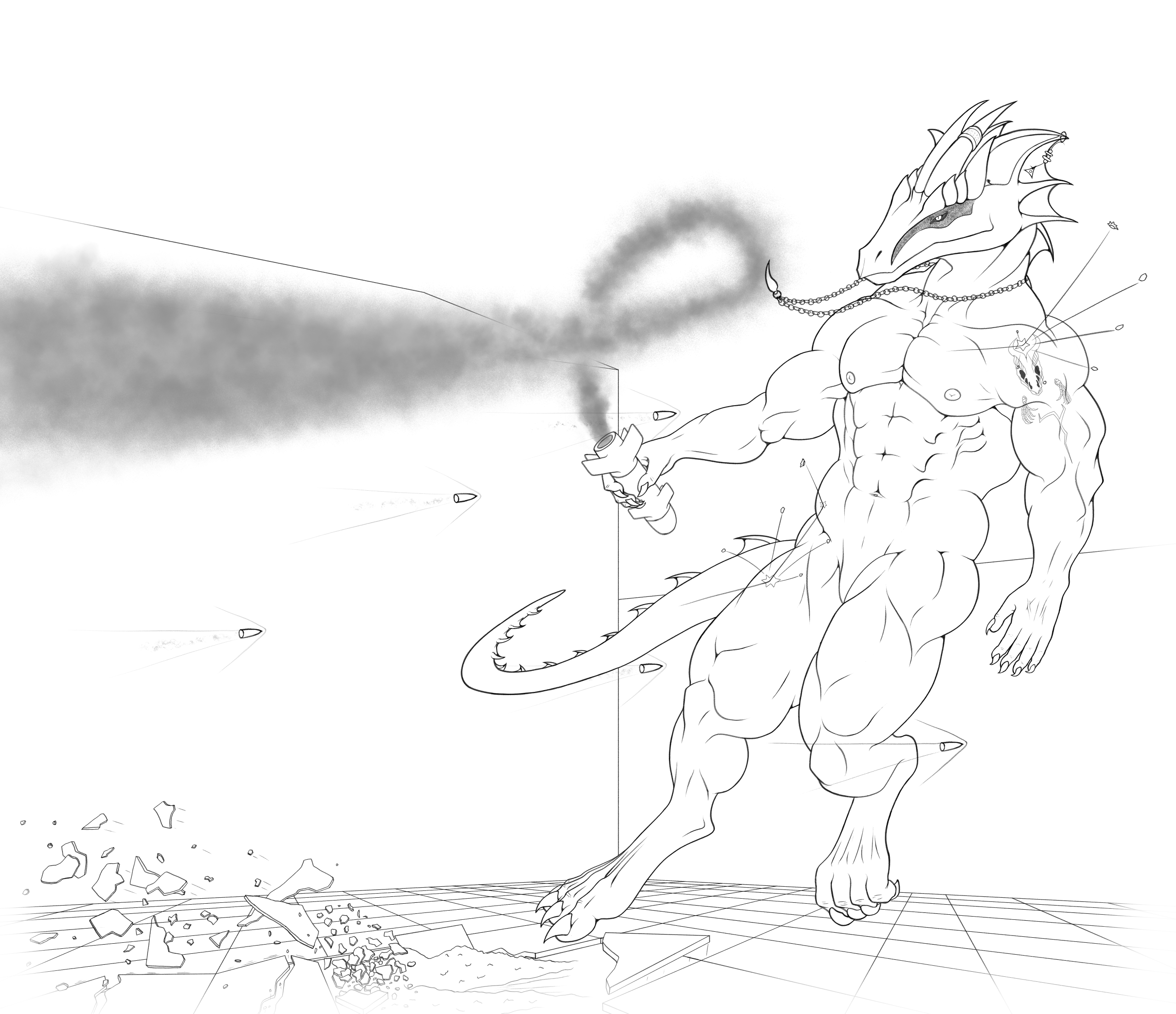
by Ossian

Comments