
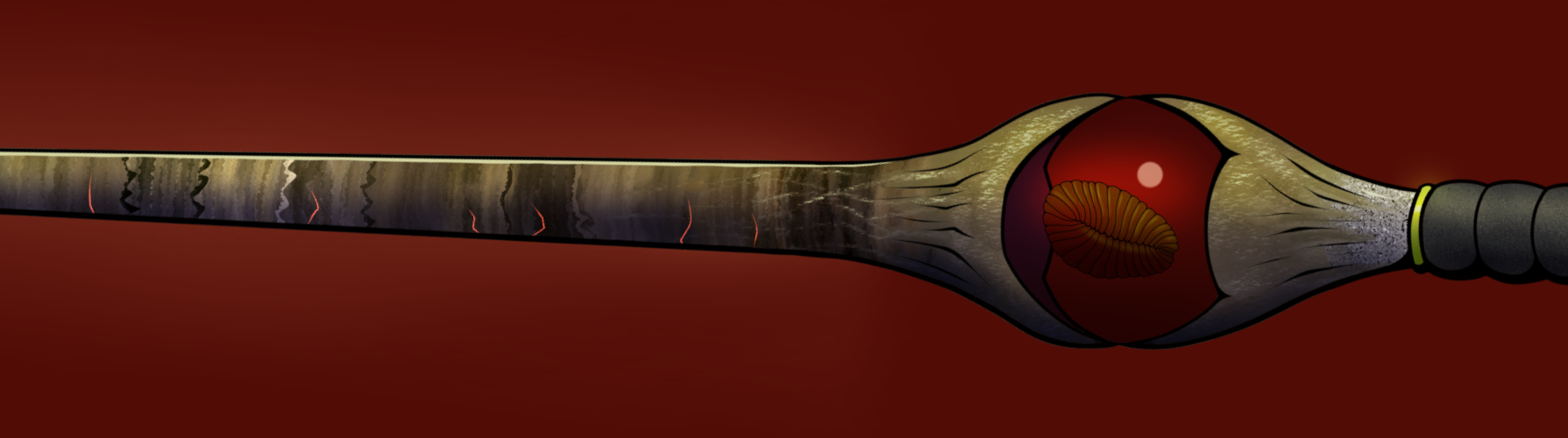
Bequethor
Embedded as the fulcrum of Rodinian political and spiritual life is Bequethor, also known infrequently as Costata, or the Holy Imperial Selection Sword.
For Rodinians, Bequethor unites their politics and largest faith, Vaalbaran, whilst mythologizing the natural history of ancestral Earth and her life. In many respects, it's a vital structural keystone in the architecture of their society, culture and politics: it selects Imperial Majesties and determines when their reign ends, and confers upon them the blessing of Earth in the eyes of Rodinia's largest faith. Together, these factors stabilize Rodinian politics and society at large.
At the same time, its nature presses upon the shoulders of those who propound themselves as worthy of leading the Creatures of Earth the incredible weight of the four and a half billion year long story of Earth and her life. It reminds Imperial Majesties, and Rodinian culture at large, of the grandness of the evolutionary family tree they're merely a capstone for, and of the paramount responsibility to preserve the history and continue the story of Earth and her life.
That responsibility is the most fundamental tenet of the Vaalbaran faith, and indeed Rodinian spirituality in general. Unimaginable spans of natural history occurred with much of the loss contained therein occurring without purpose; without the necessary element of choice for such losses to be considered sacrifices. Nevertheless, they happened. All those creatures were born, lived, evolved and died without any real purpose and without leaving their individual mark upon the world, but they nevertheless existed. And the sum of their existence has produced a breathtaking array of complexity, beauty and history, culminating in the Rodinians themselves.
The Rodinians of the Vaalbaran faith, revering this sword as one of their most sacred artifacts, therefore create and give themselves the purpose of remembering this history, thereby recognizing the existence of all those creatures, sapient or not, before them. They make it their purpose to respect them by preserving and enhancing the tree of life that exists today. Otherwise, to allow this history to be forgotten, such as through the extinction of all Earth life, would be to succumb to utter nihilism and invite an act of natural vandalism. It's therefore central to their beliefs for this history to continue, ensuring there're those who can continue to remember it; to ensure the tree of life continues to grow. Bequethor is one of the strongest symbols of that purpose as it's passed from Imperial Majesty to Imperial Majesty.
Background, Creation and Purpose
Bequethor was essentially created to solve a political problem. The position of Imperial Majesty exists to constrain the lords and matrons of the eight great houses of Rodinia, acting as a lid that confines their excesses, abuses and psychopathic tendencies. They're the people's champion, guaranteeing that never again would Rodinians be reduced to mere serfs in the great houses' feudalistic dystopia. Imperial Majesties are democratically elected upon winning the popular vote of all Rodinians, and serve indefinitely until deposed. The position has been shaped ad hoc throughout the ages in search of stability, with the rules being fine-tuned with each succession. The method by which an Imperial Majesty was originally deposed was via recall petition – one referendum to call their leadership into question with a 50% threshold to initiate the second referendum, which would be on the question to remove them from high office. That subsequent vote required 60% to remove them from power. On paper this worked. In practice it didn't. Forty-two million years ago, the now infamous Emperor Lyor Kanessar came to power, and betrayed his oath to be the people's champion. He believed the great houses were an existential threat to the continuity of the Creatures of Earth in their manner of sowing constant division within Rodinian society through dynastic power struggles, proxy wars and their fundamental attitude of viewing Rodinians as material. He wanted to annihilate them. The problem was there were, as there still are, trillions of Rodinians loyal to their great house masters, but Emperor Kanessar cared not. To him, they were enablers. His Imperial Government created some of the most draconian and discriminatory laws since the days of direct rule by the great houses, limiting the freedoms and rights of those who swore an oath to them. He seized worlds from the great houses, forcibly relocated their populations, and brainwashed them to engineer loyalty to him. As people soured on his rapidly deteriorating reign and growing paranoia about being assassinated, he started to ironically take the Imperial Government down the path of a great house. A recall petition was started against him, but with his laws having stripped most functional voting rights access from great house affiliated populations, and his insistence on opposition to him being treason via proxy from the great houses, this vote was largely a sham. He wielded his powers of decree to shut down meaningful opposition. He was eventually ousted when he declared war on the great houses and ordered the Imperial Service to bring him the heads of the eight lords and matrons, an act that would've plunged Rodinia into a bloody civil war. The most senior military officials in the Imperial Service refused these orders, and personally delivered the news to Kanessar that his reign was over. Former Emperor Kanessar revealed an obvious weakness in the system that Rodinian's didn't want to admit existed. Attacking or criticizing the institution responsible for delivered them from direct rule by the great houses was felt deeply as tacit endorsement of that older system with the risk of relapsing. However the weakness of an all-powerful people's champion couldn't be denied after Kanessar, and it was simply the fact the Imperial Majesty can be a tyrant too. It's a significant flaw given the power they wield; command over the largest single military force throughout Rodinia, and the consent of the people to issue imperial decrees superseding any other branch of government. Bequethor was created to solve this problem. During the subsequent imperial election and painful resurgence of the great houses following Kanessar's disgrace, the Saint's Sovereign made a rare intervention in Rodinian politics. They presented Bequethor to the people and claimed to have hand crafted it from the Earth herself; that it would weed out those unfit to serve as Imperial Majesty. The Vaalbaran Church immediately accepted the blade's legitimacy due to its holy origins, along with its quadrillions of followers. The great houses pushed back as much as they could against it, demanding proof and decrying it as mumbo-jumbo, but they were up against the religious devotion of nearly half of their own people, as well as skirting perilously close to defaming the Saints Sovereign. In the end, they lost this political battle, and Bequethor was set as the final test of any prospective candidate for Imperial Majesty. Today, after winning the largest vote share in the imperial election, one must demonstrate their fitness for rule by holding Bequethor and observing the mysterious Ediacaran creature inside its central zircon. If the Ediacaran fluoresces and lights up the zircon containing it, then the sword has accepted the candidate's claim of being fit to rule, and they shall at once be known as Imperial Majesty. Otherwise, they must set the sword down and depart, making way for the candidate with the next highest vote share (by ranked choice voting) to take their turn at holding the sword. This continues until someone lights the zircon.Construction
When one thinks of what a blade created by a hyper-advanced civilization of near-godlike species would look like, they may be tempted to envision a technological wonder, countless millennia beyond the understanding of current human science. Alien alloys impenetrable to spectroscopy, energy blades composed of baffling subatomic particles burning with white hot intensity; dazzling gadgetry, sleek and smooth construction, and underlying physics exploiting as yet unknown phenomena. Bequethor is none of that. Bequethor is, fundamentally, a rock, held together by fungal mycelial networks and containing a strange Ediacaran creature in the middle that's mostly composed of proteins and fats. And yet this silicate stick is by far one of the most frightening implements of war fashioned by any mind. One shouldn't expect anything less from the blade that cut Archnadrakian Balaine in half from the forehead to the navel. It's the finest example of the Horseshoe Theory of Psikinetics – as a species' psikinetic power and proficiency increases, their reliance on technology and instrumentation decreases. The Rodinians rest unbothered at the apex of that idea, conquering the universe with sticks, stones and ships grown from fungus. The handle of Bequethor is polished granite with a basalt grip, dated roughly 4.03 billion years old. This makes it the oldest rock known from ancestral Earth, and hence gives it the name 'The Hadeon Core', named after the eon of Earth's formation. For huge swathes of the population and especially within the Vaalbaran Church, the Earth is sacred, and a deity. Rocks, minerals, water, and living things directly from the planet carry special religious significance. And the older something is, the more divine it's perceived to be on the basis that older things from Earth have bathed in its soul and spiritual aura for longer, and therefore carry greater spiritual potency. The sword's ability to exorcise demonic entities has never failed, even in the case of truly horrific psychological entities of immense power to induce mass hysteria. The blade is polished sedimentary rock carved from an ancient fossilized stromatolite, formed at the beginning of Earth's Archean Eon (thus known as 'The Archean Core'). The Saints Sovereign describe in their possession a fossil containing the remains of a stromatolite that once existed deep within Earth's oceans near a thermal vent, where extremely primitive chemo-synthesizing unicellular organism lived. They formed colonies of microbial mats near these vents, which laid down successive layers of sediment to produce the stromatolite fossil. These organisms were neither bacteria, archaea or eukaryotes (the cells that comprise animals, plants, and fungi), but instead were the simple ancestors of all three branches of life on Earth, otherwise known as the last universal common ancestor (LUCA). At nearly four billion years old it's the earliest signs of Earth life the Rodinians have, and it holds immense religious significance to them. It's a powerful visualization of their commonality; that despite their differing species, they all come from the organisms that once thrived and created those rocks. It's also a major source of pride for them; to have arisen as apex predators on a cosmological scale from something so small. Between the handle and blade is a fungal colony composed of dense mycelial hyphae. These hyphae penetrate deep into the handle and blade, and are spread systemically throughout. This special mycelia is called Saint Lueras' Mycelia, and it's essentially the power source for the sword. This sentient fungi practices Psikinetics upon the materials in the sword like Rodinians do upon their own bodies, rendering them indestructible to everything but trihypostatic psikinetics and extreme space-time curvatures. It also generates the sword's flight and translocation capabilities, its ability to disrupt psikinetics, and its energy generation. It possesses an intelligence of its own that's able to telepathically link with its current wielder to understand their intentions, and obey commands via thought. This is also how the blade assesses if it's wielder is fit to become or remain Imperial Majesty. The Mycelia of Saint Lueras is unique among all the Creatures of Earth (other than the Costata Progenitor) in that it maintains an active link to Earth. One half of this entity resides in the sword, whilst the other half resides somewhere on Earth itself. Through this ineffable link is channeled a gargantuan quantity of spiritual power, in theory giving this blade the ability to channel psikinetics straight from the Earth's own soul. This is why the Imperial Majesty has persisted as a position for so long against the great house lords despite being held by Rodinians far weaker than them: Bequethor gives them access to power in excess of all great lords combined. Whilst wielding Bequethor, the Imperial Majesty is undoubtedly the most powerful Rodinian alive. It's through this link that the Mycelia of Saint Lueras judges the fitness of Imperial Majesties. It's link with the soul of Earth allows it to read the overall sentiments, wishes and needs of the Rodinian people and compare those to the sentiments, wishes and desires of the prospective Imperial Majesty. If there's "alignment", then it's believed the candidate passes the test, and it's always testing its wielder. The final component of the sword is the hollow jewel in the center – a red polished zircon containing an enclosure housing water and the only still extant specimen of Dickinsonia Costata. The zircon itself is the oldest piece of Earth at 4.4 billion years old, and hence carries the strongest known anti-demonic repelling power of any known material in the Rodinians' possession. Contained within is something far more special however; an enigmatic pre-Cambrian creature that sits near the very base of Bilateria – or all animals with symmetric body plans. It predates fish, arthropods (including arachnids and insects), reptiles, and mammals and is a distant ancestor to them. This one is sometimes colloquially known as the Sire of Rodinians, but there's a great deal of dispute over whether it's literally everyone's ancestor. Saint Okur the Chrononaut, one of the Saint's Sovereign and founder of the Guild of Time Streamers, claimed to have personally obtained it from the late Ediacaran Period oceans 566 million years ago. She also claimed that it's offspring continue onwards to diversify, leading into the Cambrian explosion to form the basis of all major animal clades. It's kept alive by the Mycelia of Saint Lueras, which excretes a microbial goo down the inner wall of the zircon that the creature feeds on. It's not sentient, as it lacks a sufficiently complex central nervous system, but it does possess some rudimentary nerves used to help it "sense" where food is and slowly wriggle around the inside of the zircon. It therefore possesses an extremely weak soul that produces a spiritual aura seen by Rodinians. It causes the creature to appear to fluoresce in their eyes, and this is a signal that the sword Bequethor currently accepts its wielder as the current Imperial Majesty. When their reign is over, the light fades from the Progenitor Costata, which triggers a new election.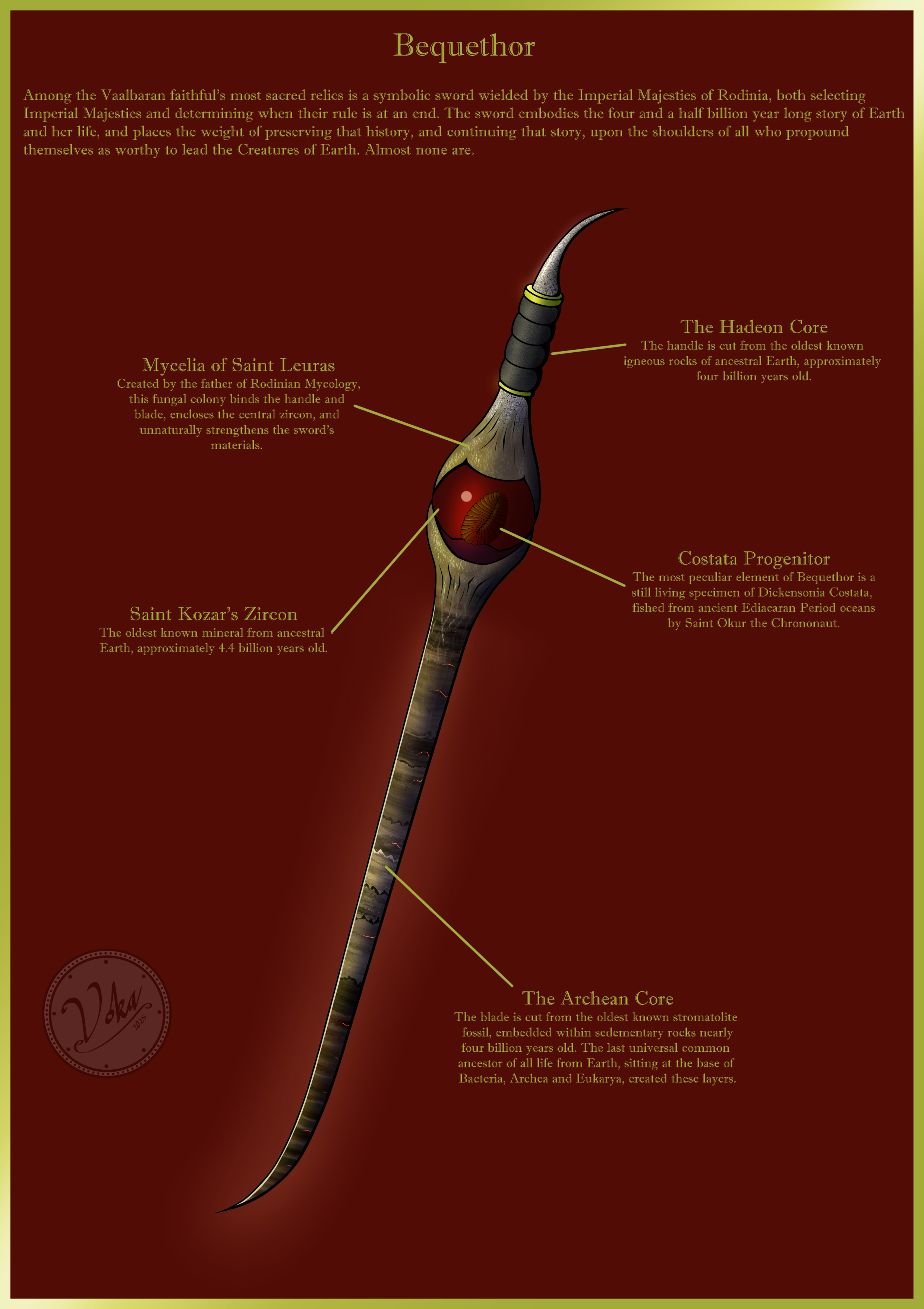
by Ossian

Comments