The Horseshoe Theory of
Psikinetics is a generalised description of the trend that civilisations usually follow as they develop ever more powerful psikinetics. It states that the more powerful and practical a civilisation’s psikinetics become, the less reliant they become on technology to achieve specific outcomes.
The theory highlights the dangers of assuming, from first appearances alone, the level of development a civilisation may possess. Those with exceptional psikinetic talent may appear primitive to the untrained eye, with technology that may not be recognisable as such. They may not even require technology in many circumstances, which is underscored by the
Rodinians who have almost no requirement for technology or tools anymore.
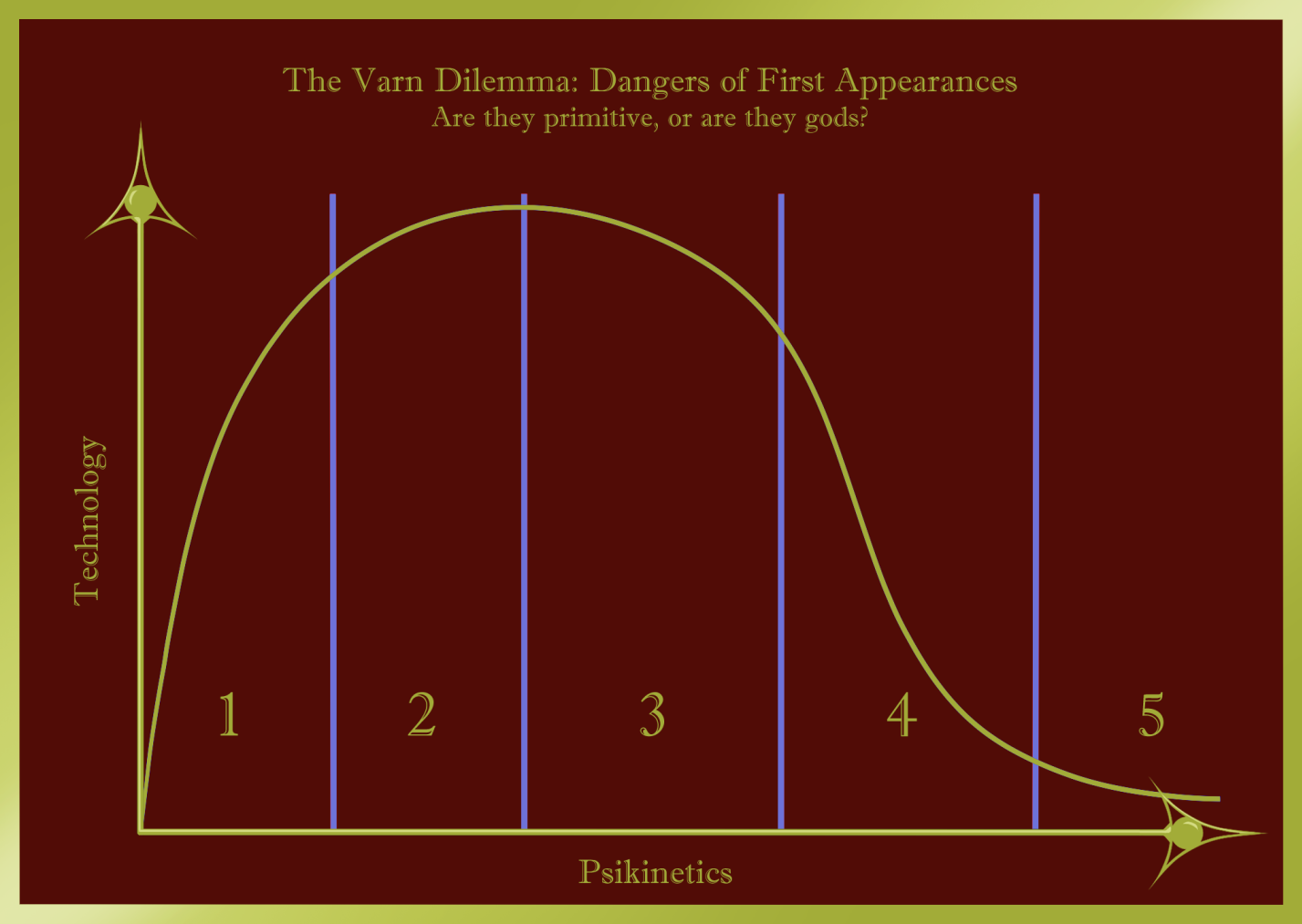
The below graph illustrates this trend.
by Ossian
Definitions
Technology
This is loosely defined as the reliance an individual from that society has upon a tool to achieve a desired outcome. A tool is an object sourced from the environment that an individual uses to modify their environment, or make other tools with. Examples are:
- Digging an irrigation trench using either a spade or an excavator.
- Constructing a building using heavy machinery such as a crane to move heavy loads, and using rivets, bolts, nails, screws, welding, adhesives and sealants to fasten them in place.
- Travelling a distance using a vehicle such as an automobile, aircraft or ship.
- Automating tasks with robotics or doing calculations, simulations and storing, transforming and administering of data using computers.
- Generating usable energy with windmills, solar panels, nuclear fuel or combustion.
Almost every endeavour of 21st century humanity involves tool/technology usage. It’s almost inconceivable to imagine completely eliminating most tool and technology usage from our lives. With no access to psikinetics, almost all desired outcomes in human civilisation are built upon tools and technology.
Psikinetics
A more in-depth overview of exactly what psikinetics is can be viewed
here. In this context however, this is the ability of a sentient being to directly alter their environment using merely their mind and willpower, through influencing and controlling certain parameters of matter, energy, space and time.
With reference to the examples above:
Digging an irrigation trench using either a spade or an excavator.
A potent user of psikinetics would move the dirt and dump it elsewhere using their mind.
Constructing a building using heavy machinery such as a crane to move heavy loads, and using rivets, bolts, nails, screws, welding, adhesives and sealants to fasten them in place.
Again, a user of psikinetics would move objects with their mind, and be able to position the components of a building with no need for machines to move them or hold them in position. Other components can be assembled, configured and positioned without the need for tools. Materials can be fused together at the atomic level through alteration of chemical and inter-atomic bonding.
Travelling a distance using a vehicle such as an automobile, aircraft or ship.
Users of psikinetics can move their own bodies just as they would move another object, hence enabling flight. Potent users can alter the wavefunction of the particles in their bodies to change the probability of their physical location in space, and thereby teleport.
Generating usable energy with windmills, solar panels, nuclear fuel or combustion.
Potent psikinetic users can create reservoirs of electric charge, split atomic nuclei, construct energy dense forms of matter, and draw energy from quantum fields.
Psikinetics tends to emerge as a competing and ultimately far more powerful way of manipulating one’s environment than tools and technology, and so usually replaces the latter. As a civilisation’s psikinetics becomes more powerful, their reliance on technology diminishes.
The Horseshoe Graph
Region One: The Technological Era
The first region of the graph shows technological development dominating the movement of the graph, with a strong upward trajectory and little horizontal progression. Psikinetics, on the other hand, has only just been discovered and so contributes very little to the civilisation’s desired outcomes at this stage.
In these early years, the phenomenon is poorly understood, wildly erratic in its capabilities, and varies significantly in capability from person to person. It’s a profound novelty that offers a great opportunity to completely redefine how one interacts with the world, but is held back through poor understanding. Institutions are wary of incorporating it due to its unpredictability and lack of ubiquity. On the other-hand, the civilisation’s technology is advancing at great pace.
Region Two: The Technological Ceiling
Due to fundamental barriers and limitations caused by the laws of physics themselves, technological progress begins to slow down. Examples include quantum effects complicating the downscaling of transistors beyond a few nanometers, decoherence making large scale quantum computers impractical, the speed of light limit forbidding FTL travel, thermodynamics limiting energy generation, storage and transmission, biological limitations on curing illnesses, disease and ageing, etc.
Psikinetics on the other hand is becoming better understood and more refined, offering promise of bypassing some of these barriers. It may already be seeing some usage in society in limited, simple circumstances.
Region 3: Maturing Psikinetics
Technological progress has essentially stagnated in the face of insurmountable barriers imposed by the laws of physics, the limitations of biology, and exceedingly complex engineering challenges.
The fundamentals of psikinetics however are now well understood, and it achieves consistent and reliable results across the vast majority of the population. Psikinetics therefore sees adoption by institutions and wider usage in everyday life. Reliance on and usage of technology begins to decline as psikinetics begins to usurp its functions.
Region 4: The Psikinetics Revolution
The civilisation’s understanding and grasp of psikinetics now allows it to overcome some of the biggest challenges it faced as a technological society, allowing it to achieve what was previously considered to have been impossible. Tools and technology rapidly diminish in importance as people achieve similar results with psikinetics alone.
Biotechnology using semi-sentient, psikinetic capable organisms begin to replace what technologies are left, and what individual people are still unable to do themselves. These psikinetics biotechnologies facilitate the impossible, such as FTL travel.
Region 5: Post-Technology
There are few civilisations at this level, and those that make it are regarded as ‘Great Civilisations’.
Civilisations at this level use psikinetics for almost everything. That is to say, survival and modification of the environment is conducted solely through the power of the mind. There is minimal, if any, technology used by these civilisations. Exceptions are usually found in semi-sentient biotechnologies, such as the Rodinian’s Mycelium, that carry out psikinetics at scales too large for individuals.
Individuals tend to require no life support, need minimal sustenance, have no need for armour, protection or weaponry, have no use for energy generation, computation or construction and synthesising technologies, and no need for transportation at scales within a solar system. They likely appear primitive at first glance, but are among the most powerful beings in the universe.


Comments