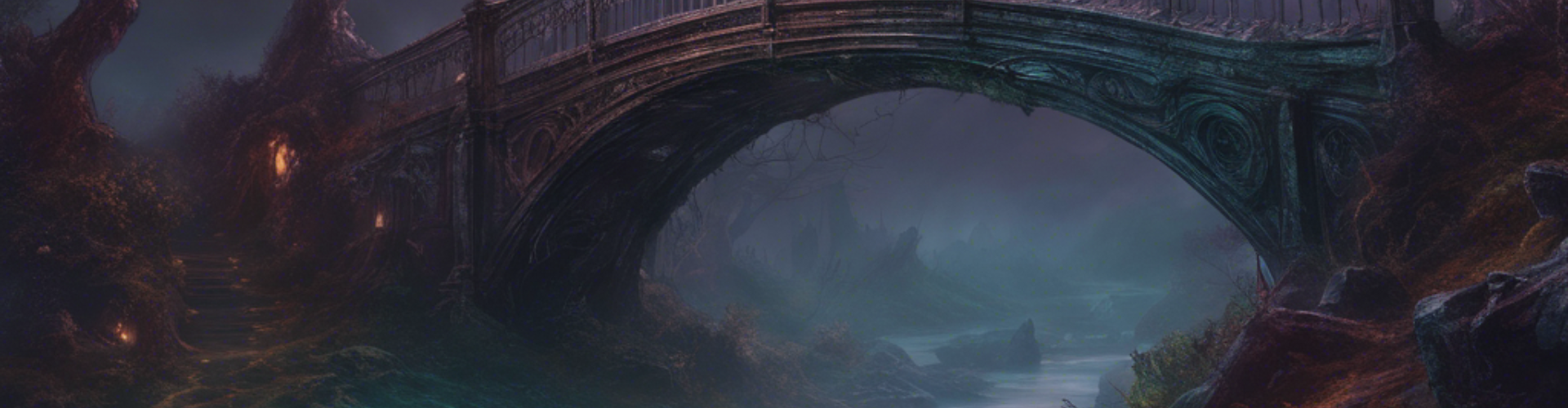
Jindi River
Geography
Only 30 miles long, the Jindi River is relatively short, but its depth rivals much larger rivers. In several places it plunges into sudden ravines carved by ancient glacial movement, creating a deep channel that required the construction of the monumental Hollow Coast Bridge.
The river cuts westward through a narrow valley, beginning at the meltwaters of the mountain and emptying into the sea. Its banks are steep near the mountain and more gentle near the sea, where humid lowland vegetation dominate.
Because of its depth, locals refer to it as a "bottomless river," though this is more poetry than face. Still, many stretches remain so deep that no modern sonar has mapped them completely.
Ecosystem
Upper Jindi (Mountain Waters)
- Glacially fed, extremely cold
- Fine mineral sediment suspended in the water
- Home to cold-water fish and luminous algae patches
- The riverbanks are rocky, home to small alpine mammals
Mid-Jindi (Transitional Zone)
- Gradual warming
- Mossy boulders and overhanging trees create shaded pools
- Amphibious creatures nest here
- Wind-Grazers descend in the early morning to drink
Lower Jindi (Lowland)
- Warm, humid, slow-moving water
- Thick vegetation along the banks
- The highest biodiversity: insects, aquatic mammals, migratory birds
- Freshwater kelp and floating star-lily pads
The river acts as a life corridor, connecting cold mountain ecosystems to warm rainforest ecology. Species migrate up and down the length depending on the season.
Ecosystem Cycles
The Thawing Surge
At the beginning of each Verdant Cycle, melting snows dramatically increase water levels. The river widens, sometimes swallowing whole trails near its banks.
Fish populations bloom
Star-lilies flower
River spirits (according to Bumia's folklore) become restless
The Breathless Nights
During humid months, fog from Cubria's rainforest drifts upriver. At night, the Jindi appears to emit a soft shimmering halo.
Nocturnal animals become more active
Local shamans say ancestral voices are clearest during this time
The Soul-Tide
At twilight, on the anniversary of certain deaths, the river thins its veil between the living and the dead, allowing drowned spirits to manifest.
Localized Phenomena
The Twilight Crossing (Supernatural Phenomenon)
The Jindi River exhibits a metaphysical law unique to its waters, attributed to blessings placed upon it and the natural power of the region.
Manifestation
If a person drowns in the Jindi River while burdened with deep unresolved matters (guilt, secrecy, grief, broken vows) their spirit re-manifests once a year, at twilight, on their death date.
Only their closest loved one can see and interact with them.
Spirits appear physically present: solid to the touch, articulate, self-aware.
As twilight ends, they dissolve like mist.
Cause
Convergence of ancient spiritual beliefs of the Anyaia: Children of the First Note, fire-born ancestral rites of the Iskashita: The First Spark, multiple blessing from priests of Eternal Harmony and a natural leyline beneath the riverbed.
Effects
It's not talked about often. Many don't even believe, dismissing it because it scares them. They want to believe that everyone makes it to the Cosmic Tapestry without any delays. I can't say that I blame them. I was them until I lost my wife drowned here. Once a year I came, until she told me the truth, told me why she committed suicide. I was shocked but also relieved. We were able to close the matter and she was able to move on at last.~ Anonymous Man
The grieving travel to the river yearly for closure. Many fear it; others rely on it, and some see it as sacred, yet others as unsettling.
When the spirit resolves its tether (grief expressed, truth spoken, or acceptance gained) the manifestation ceases. Loved ones always know when closure has occurred; it strikes them like a sudden calm.
Climate
Upper River: Cold, dry mountain air; harsh winds
Mid River: cool mornings, mist-filled afternoons
Lower River: warm, humid, prone to fog drift from Cubria
The river's temperature gradient is dramatic; one of the reasons it's considered sacred.
Fauna & Flora
Fauna
Silvercreek Fish: Cold-water species with shimmering scales used in ritual offerings.
Twilight Otters: Known for their intelligence and tendency to mimic human behavior
Gloom Herons: Hunt at twilight, believed to see spirits
Riverback Elk: Drink exclusively from the Jindi during migration cycle
Flora
Star-Lilies: Floating flowers that glow faintly at twilight; harvested by Anyaia musicians for ceremonial ink
Whisperweeds: Reeds that produce soft tones when wind passes through them
Lurkmoss: Grows along shaded river stones, bioluminescent during the Breathless Nights
Many plants serve ritual, medicinal, or artistic purposes.
Natural Resources
Freshwater fish
River reeds for basketry and flute-crafting
Medicinal herbs and mosses
Sediments rich in useful minerals
Who Uses them
Bumia's healers harvest medicinal flora
Anyaia ritualists gather star-lilies
Iskashita fire-shamans use certain stones for heat-resistant crafting
Protection & Depletion
The river is under strict protection of the Prince/Princess Regent. Certain species, like large star-lily clusters, have become rare due to overharvesting centuries ago.
History
The Jindi River is one of the holiest sites in South Chrysalis.
Spiritual Importance
Both the Anyaia: Children of the First Note and the Iskashita: The First Spark consider it one of Caelum Prime's first living waters, an original channel of creation. For thousands of years, both groups have traveled here to offer thanksgiving for any water they use.
Ritual songs echo from the banks at dawn.
Ritual fires burn safely on insulated stones at dusk.
Offerings are launched as floating baskets downstream.
Blessings of Eternal Harmony
Multiple Priests from the Vatican on Eternal Harmony have blessed the Jindi in its long history. These blessings have strengthened the metaphysical laws affecting reincarnation, grief, and closure.
The Drowned Echoes
The modern supernatural properties of the river, where spirits return once a year, seem tied directly to:
- The number of blessings
- The concentration of ancient rituals
- The natural leyline beneath
- The locals say the river became "awake" only in the last 600 years
Tourism
The Jindi River draws:
- The grieving seeking twilight closure
- Scholars studying metaphysical waterways
- Musicians of the Anyaia creating river-songs
- Mystics hoping to witness a manifestation
- Hikers crossing the Hollow Coast Bridge
- Couples placing star-lilies on the water for blessing


Comments