
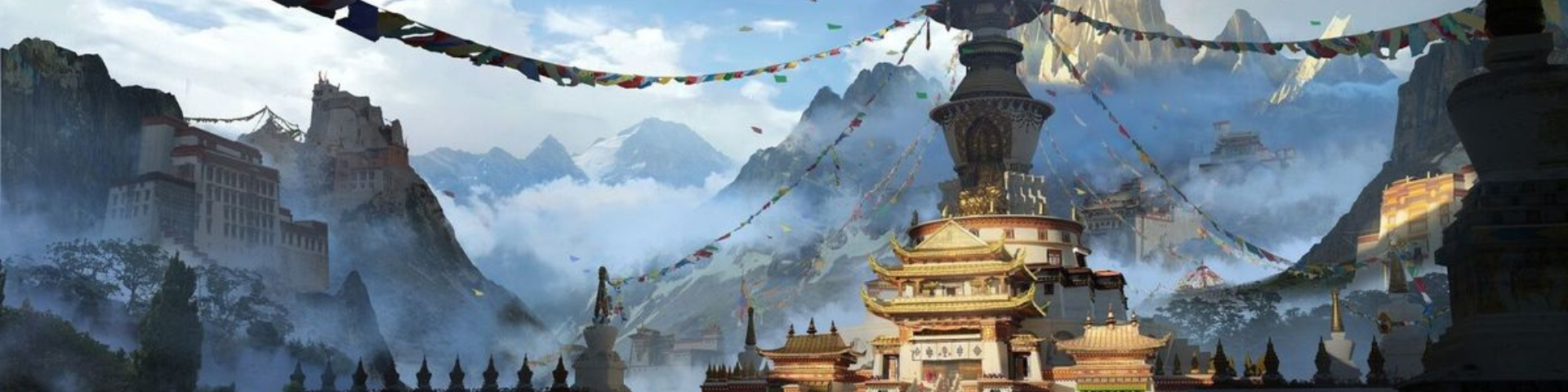
The Harmonious Way
"Step lightly, yet leave footprints where wisdom may follow. Speak softly, yet let your words echo through the ages. Hold neither past nor future too tightly, for the river does not cling to the banks it has passed. In balance, find strength; in stillness, find motion. Walk the Harmonious Way, and you shall become the path itself."- First Psalm of the Taoki Chowa
The Harmonious Way is a vast and evolving spiritual tradition rooted in the Mysts of Myth, ancient dimensions nestled within the Astral Realms, where it first flourished among the native Fey. Though its origins lie in primordial sensibilities, it gradually developed into a deeply personal understanding of the rhythms of life, destiny, and reincarnation, before crystallizing into a rich, non-theistic cosmology centered on the pursuit of Samatue, or spiritual alignment. Adherents of the Way do not worship deities in pursuit of salvation; rather, they seek to harmonize the self with the Sutra, the infinite, metaphysical lattice through which all realms and souls are intricately bound. The faith is animated by the Samatue Gayhaana, the Four Gems of Truth; Karma, Dharma, Nirvanya, and Sutra. These truths are brought to life through practical discipline designed to cultivate Enlightenment across lifetimes.
The Harmonious Way was introduced to Terrans and other mortal peoples of Acarcia through the Duergar. Due to this cultural diffusion, most formal teachings and scholarly texts are recorded in Imitsu, while older sects, particularly among the Vaernar Caelei of Tenebrucia, preserve the original Vaesyuedu terminology. Today, the Harmonious Way endures as a multifaceted spiritual path, transcending race, culture, and even species, offering a universal invitation: not to worship, but to awaken.
Structure
"A path untended is soon swallowed by the wild. Stones shift, roots rise, and the traveler stumbles where none have walked before. But a careful hand clears the way, not for itself, but for those who follow. To walk is a journey, to tend the path is a calling. The keeper of the road does not seek Nirvanya alone, but ensures the way remains for all."- The Taoki Chowa
The structure of the Harmonious Way is elegantly simple yet profoundly spiritual, reflecting its core values of self-cultivation, enlightenment, and the sacred rhythm of existence. The faith is divided into three primary expressions of devotion. The most numerous are the wayfinders, or Kairosai—lay practitioners who walk the path in their own way, known in Vaesyuedu as Haeyas and as Haellasin among the Elves. These adherents engage in daily meditation, ritual, and acts of enlightenment without the need for clerical oversight. Those who dedicate their entire mortal lives to contemplative discipline and spiritual refinement may become monks, or Shusai (called Yoagi in ancient Vaesyuedu and Yogei in Avuhuash). They live in voluntary monastic service, often at remote shrines or temples, where they train body and mind in pursuit of dharmic perfection. Rarest of all are the priests, or Saishin (once known as Guruvu in Vaesyuedu and known as the Guereu in Avuhuash) who are formally ordained and serve as stewards of holy sites, ritual leaders, and teachers of the sacred philosophy. The most venerated among them bear the exalted title of high priest, or Daisaishin (originally known as Shuudyo in Vaesyuedu, and later as Sheudei in Avuhuash), and are often sought as spiritual advisors to royal courts such as the Vaernar Caelei or the Kinko-shitsu of the Duergar.
Despite this tripartite hierarchy, the Harmonious Way is not a faith of bureaucracy or dominance. It is a personal and inward journey. Most temples and shrines are tended by a small number of monks or priests, while the vast majority of worship is conducted individually. Unlike more dogmatic faiths that prioritize conversion, conformity, or communal gatherings, the Harmonious Way emphasizes sacred sites and individual pilgrimage. The faithful believe that true understanding arises from direct experience of the divine harmony of Jinen Jehan, not from sermons or scripture alone. Thus, priests and monks serve not as intermediaries but as luminous examples, walking the Way themselves in hopes of inspiring others. Many practitioners embark on lifelong Kairosi Pilgrimages, traveling to sacred places, seeking ancient mentors, or protecting forgotten sanctuaries in pursuit of Perfect Harmony. Even positions of honor, such as the Sheudei, are understood not as appointments of power but as outcomes of spiritual resonance and karmic alignment. In this way, the Harmonious Way resists institutional rigidity and instead flourishes as a living tradition, forever unfolding in step with the pathless route of cosmic balance.
The Saishinate Priesthood
The priesthood of the Harmonious Way, known as the Saishinate, is a spiritual mantle rather than a formal office—one attained not through decree, but through karmic calling. These ordained practitioners are a rare and deeply respected caste of ecclesiarchs. Their primary role is not to intercede between mortals and divinity—as there is no true divide—but to serve as Living Echoes of the Path, guiding others by example and subtle instruction. A Saishin is the light that illuminates the trailhead of the Way, not the hand that pushes others down it. As such, they officiate sacred rites, consecrate pilgrimages, maintain holy spaces, and offer spiritual counsel to those who seek alignment with their divine purpose. They may also serve as keepers of the sacred verses of the Harmonious Way, reciting them through ceremonial storytelling, meditative dance, or calligraphic scripture.
Each Saishin is tasked with overseeing one or more shrines or temples, often accompanied by a few Shusai, though many prefer solitude in remote sanctuaries. Their duties include preserving the physical integrity of these sites, guiding initiates in their spiritual growth, and interpreting omens or dreams through ritual contemplation. Despite their ceremonial importance, Saishin never place themselves above the faithful; their influence is spiritual, not hierarchical. Among them, the most revered ascend to the rank of Daisaishin, elders of profound enlightenment who act as spiritual advisors to kings, queens, and councils. Even these figures do not command, but are listened to with rapt reverence, their wisdom earned through lives of selfless service and inward mastery.
Individuals elect to become monks or priests not for glory or security, but because they feel irresistibly drawn toward spiritual truth. Some are born under rare astrological signs, others experience dreams or visions, and still others find themselves unable to remain tethered to secular life after touching glimpses of Samatue—inner harmony. Monks take vows of simplicity and detachment, devoting themselves to physical, mental, and spiritual discipline. They live at temples or wander the world in silent pilgrimage, often guarding sacred sites or offering aid to fellow travelers on the Way. To become a Saishin is a step further still: an acceptance of a life where one must become the Way, living transparently in truth, restraint, and compassion. There are no rituals of ordination save acknowledgment by another Guereu and the signs of spiritual readiness written in one’s aura, breath, and Hanya—the sacred tattoos that bloom across their flesh. In the Harmonious Way, such titles are not claimed—they are recognized.
The Cleric
Yukanobi Saishin, or simply Yukanobi, are the ordained clerics of the Harmonious Way. Warrior-priests who take sacred vows of devotion not to a god, but to the Kairosi, the divine rhythm of the Sutra itself. Unlike philosophers or sages who guide through teaching, the Yukanobi serve through action, walking the world to protect the vulnerable, confront monstrosity, and restore spiritual balance where it falters. They are trained in occult mageia, specializing in invocations of life-giving and purifying energies, and are often called upon to perform rituals of cleansing, blessing, atonement, and karmic smiting. All adventuring clerics within the Harmonious Way are members of the Yukanobi Order, and are held in high esteem as wandering anchors of Samatue, embodying compassion, discipline, and divine will without ever kneeling before a god.
The Monk
Yogaobi Shusai, or simply Yogaobi, are the monastic warriors of the Harmonious Way—martial artists who dedicate their entire being, body and soul, to the pursuit of Kairosi, the ever-flowing rhythm of the Sutra. Trained in a wide array of disciplines, Yogaobi refine themselves as living instruments of harmony, embodying discipline, grace, and clarity in every motion. While many monks may travel in search of meaning, the Yogaobi understand that the journey itself is the meaning, and so they walk the world not to complete quests, but to remain in perpetual alignment with the way of things. They are the most common monastic Wayfinders to become adventurers, not as seekers of fame or power, but as spiritual pilgrims whose fists, feet, and willpower are tools of balance. Regardless of their school, all Yogaobi share the belief that every breath, strike, and step is an act of Sutric devotion.
The Templar
Bushobi Saishin, or simply Bushobi, are the Templars of the Harmonious Way. Holy warriors who blend martial prowess, spiritual discipline, and ceremonial duty in service of cosmic harmony. Unlike the more ancient Yukanobi or Yogaobi orders, the Bushobi are a relatively recent addition to the Saishinate, modeled in part after the Paladins of the Eightfold Faith and the Wardens of the Primal Laws. Their role is to act as guardians of sacred sites, protectors of the faithful, and emissaries of alignment, often representing the Harmonious Way in times of political strife, social unrest, or worldly danger. Among their many branches, the Bushobi Yukasai, those dedicated solely to the Kairosi, are the most likely to become adventurers, viewing the battlefield as yet another corridor of the Sutra. All Bushobi are trained in multiple forms of armed combat, diplomatic engagement, and ritual invocation of occult mageia, particularly protective blessings and martial enhancements. They are most commonly seen wielding polearms and clad in sanctified armor, their presence a symbol of poise, conviction, and disciplined compassion.
Other Classes in the Harmonious Way
Within the Harmonious Way, the diverse adventuring classes are viewed through a spiritual lens, each interpreted by how they align—or misalign—with the Sutra. Among the brawlers, Berserkers are venerated as holy warriors of pure emotion, souls who channel their fury into sublime revelation, achieving flashes of Nirvanya through the heat of battle. In contrast, Mercenaries are often met with disdain, perceived as having surrendered their Dharma to coin and carnality, squandering karmic potential for fleeting profit. Scoundrels who follow the Way often become Shenobi, shadow-guides who surgically adjust imbalances in the world. Hunters, whose pathfinding embodies the literal and spiritual search for alignment, are well-respected and common within the faith. Artificers are held in high esteem, as their craft demands a nuanced understanding of Samatue and the structural complexity of the Sutra, while Bards, known as Utaobi Saishin or "Song Priests", are revered as wandering philosophers who speak divine truths in lyric and legend.
Among the magi, relationships are more complex. Druids often regard the Harmonious Way as a tangled abstraction of the Primal Laws, though less spiritually perilous than other faiths, while the Harmonious Way respects Druidism as primitive but pure, harboring echoes of ancient truth. Warlocks are met with strange pity, seen as souls who follow power rather than walk their own Sutric path. Yet paradoxically, many powerful Daisaishin act as Patrons to eager Warlocks, especially among the Vaernar Caelei. Wizards are respected as "accidental" pilgrims, methodical seekers whose intellectual rigor often places them in alignment with truth, if not always intention. Sorcerers, however, are viewed with awe and reverence, believed to be living conduits of Dharma itself, their very blood a chorus sung by the Sutra. Many are recognized as Daisaishin, "divine beings-in-progress", striding perilously close to Nirvanya with every breath.
The Jiin Mandala
The Jiin Mandala is a complex array of sacred sites that is weaved across Aemaphia like a bejeweled cloak of enlightenment. Each Jiin, the generalized term used for any holy site; from simple shrines to enormous temple-cities, hold profound significance in the Harmonious Way, serving as sacred conduits between the physical world and the ever-flowing essence of balance. These revered places, whether natural wonders, ancient shrines, or sites of great spiritual resonance, are where the faithful seek clarity, enlightenment, and harmony with the cosmic order. Each Jiin carries its own unique connection to the Okatigami and Kamigami, acting as a focal point for meditation, ritual, and the cultivation of inner peace. Pilgrimages to these sanctuaries are seen as essential rites of passage, offering seekers a chance to attune themselves to the delicate equilibrium that governs all existence. Through devotion to these sacred Jiins, followers of the Harmonious Way strive to align their spirits with the eternal rhythm of the universe.
The Hidden Temples of Balance
These twin temples are devoted to the esoteric philosophies of the Onmyo Okatigami are among the most enigmatic sacred sites of the Harmonious Way, existing beyond the constraints of permanence and place. Known as the Hidden Temples, these elusive sanctuaries are not bound to any fixed location, instead manifesting through Feygate Sanctuaries that shift unpredictably across Aemaphia. Their transient nature reflects the fluid balance of Jinen Jehan, appearing only to those whose spirits are prepared to receive their teachings or whose fates have intertwined with their mysteries. Legends speak of seekers who have wandered for decades in pursuit of these ethereal sanctums, while others have stumbled upon them in moments of dire need or profound revelation. Within their ever-shifting halls, initiates are guided through the most arcane aspects of celestial and terrestrial harmony, learning to wield the unseen forces that shape reality itself.
The Primary Temples of Perfection
The four sacred temples devoted to the teachings of the Kenmeina Okatigami remain concealed from the uninitiated, their whereabouts veiled in secrecy and mysticism. Unlike common shrines, which welcome all seekers, these sanctuaries reveal themselves only to those whose unwavering faith and disciplined pursuit of wisdom have marked them as worthy. Pilgrims on the path to enlightenment do not merely seek these temples. They are guided to them, drawn by divine omens, cryptic visions, or the whispers of enlightened sages. Each temple is said to reflect a different facet of the Kenmeina Okatigami’s wisdom, offering trials of mind, body, and soul that refine a pilgrim’s understanding of the Harmonious Way. To glimpse even one of these temples is considered a profound blessing; to walk within all four is to transcend the barriers of the mundane and step ever closer to the luminous truth of balance and insight.
The Temples of the Enlightenment
The Temples of Enlightenment stand as enduring beacons of spiritual growth, dedicated to the revered Shudyo and Seishin Kami. Unlike the elusive Primary Temples of Perfection or the lofty, nearly unreachable Hidden Temples of Balance, these sacred sites remain well known and easily accessible to all who seek wisdom, guidance, and solace. They serve as vital conduits for the spiritual elevation of the common folk, offering a tangible path toward transcendence through disciplined study, communal service, and personal reflection. Far grander than simple shrines, these fortified sanctuaries act as the heart of religious life within a region, housing vast monasteries where monks preserve sacred teachings, schools where philosophy and martial arts are taught in equal measure, and serene gardens designed for meditation and prayer. Within their walls, storehouses ensure the well-being of the faithful in times of hardship, community kitchens provide sustenance to the hungry, and hospitals offer healing to the sick and wounded. Each temple is not merely a place of worship but a living testament to the Harmonious Way, guiding all who enter toward enlightenment through devotion, discipline, and selfless service.
Orrery of the Sixteen Governors stands as the pinnacle of Fey astronomical and metaphysical ingenuity. Located aboard an ancient gnomish flying citadel that gently drifts along the course of the stellar equator of Aemaphia, the Orrery is a vast and wondrous construct of whirling, interconnected rings and spheres designed to chart the intricacies of the Cosmos in relation to the ever-shifting Mysts of Myth. Named for the sixteen ancient Fey constellations (each representing a revered Shugo Kami) this celestial mechanism was first conceived by primordial Fey cosmologeists upon their arrival to Aemaphia, who sought to harmonize their astral origins with temporal reality. More than a mere star chart, the Orrery models the interstices between realms, offering insight into the liminal alignments that allowed for the creation of the Feygates. In addition, the Orrery possesses three powerful telescopes, each constructed by one of the primary Fey species. The complex Duergar telescope, largest of the three, is capable of scanning the depths of the Cosmos with total precision, the elegant Elven telescope, boasting the most lenses, can pierce the very veil between the Temporal and the Astral Realms with ease, while the garish, ramshackle, and constantly smoking Gnomish telescope claims, when functional, to chart the flow of the Ethereal itself, granting the scholars of the Orrery incalculable information to the nature of Existence. Though the Orrery drifts within the lowest layer of the Supragercia, it is regularly attended by pilgrims of the Harmonious Way. This is accomplished by permanent teleportation circles located at each of the sixteen lesser temples dedicated to the individual Shugo Kamigami. Beyond this, bold aeronauts and cosmonauts can dock their marvellous flying ships at the harbor of the flying citadel which houses the Orrery itself, as the whole settlement is open to all who come in peace. The few foolish skypirates, marauders, or aerial monstrosities who would dare raid the Orrery are quickly dealt with by a small army of Clockwork Golem guardians empowered by fierce Temple Kami. Today, Orrery of the Sixteen Governors serves as a sacred site and scientific marvel for the Seelie Fey, used to predict fey rifts across Aemaphia, conduct advanced divinatory rituals, and aid in meditations upon one’s cosmic purpose. Within its luminescent halls, Haellasin and secular scholars alike gather to decipher the silent speech of the stars, and Kairosai pilgrims kneel to contemplate their place among the infinite, while daring cosmonauts consult its shifting arms before embarking on their Starschuners into the unknown beyond the bow of the sky.
The Many Temples of the Seishin Kami form a vast network of sacred sites scattered like pearls across the land of Faselicia, each Jiin venerates a distinct Seishin Kami or enshrines a particular spiritual myth. Unlike the grand, centralized sanctuaries of the Eightfold Faith, these temples do not form a unified hierarchy but rather an ever-growing tapestry of monasteries, shrines, and abbeys. Each a unique reflection of the moment, miracle, or martyrdom it commemorates. Some rise upon soil sanctified by transcendence, where a mortal ascended to enlightenment or a Wayfinder received a vision that forever altered the Harmonious Way. Others mark the sites of legendary deeds: where a Bushobi felled a fiend with a single stroke, a Yogei monk cleansed a blighted grove through tireless meditation, or a Shenobi assassin defended the helpless with nothing but a whispered prayer and a willow branch. Still more temples have been raised atop defiled ground; former lairs of unspeakable monstrosities, ruined shrines once haunted by wrathful dead, or war-ravaged fields now reclaimed for peace and purification. Regardless of their origin, each temple stands as a living sermon to the Seishin Kami at its heart. A shrine not merely to their acts, but to the lingering resonance of their divine presence. Pilgrims journey from distant lands to kneel in these hallowed spaces, seeking strength from the sacred walls, wisdom from devoted priests, and solace in the echoes of celestial grace.
The Ten Thousand Score Shrines
The Ten Thousand Score Shrines, as they are reverently known, represent one of the most enduring and ubiquitous expressions of the Harmonious Way. Scattered across the continents of Aemaphia—most densely in Faselicia but extending deep into Acarcia. These shrines number over two million, each one dedicated to a distinct lesser Yori Kami; local spirits that govern specific sacred phenomenon. Ranging from humble stone cairns beneath ancient trees to ornate roadside altars carved with delicate glyphs and offerings, these shrines serve as both spiritual beacons and diplomatic necessities for any Wayfinder wandering the wide world. To the faithful, they are more than places of worship. They are points to connect with the transcendent. To honor these shrines is to display acts of divine respect, invitations for spiritual harmony, and wards against deific displeasure. Wayfinders stop to leave incense, whispered prayers, gifts of liquors, meats, or fresh fruits, hand-written incantations, or bits of polished glass to honor the lesser Kami's presence, seek their guidance, or simply avoid attracting their wrath. Every bend in the road, every hill, stream, forest edge, and forgotten corner might bear such a shrine, each shaped by its region’s traditions and the nature of the Yori Kami it honors. This web of sacred sites forms the spiritual infrastructure of the Harmonious Way, binding travelers, villagers, monks, and nobles alike in a shared reverence for the invisible forces that dwell in all places, great and small.
Community Shrines serve as the spiritual heart of many Fey settlements, where a summoned Yori Kami (chosen through ancestral rites or collective petition) takes up residence to watch over the township, village, or city. Known as Community Kami, these divine patrons embody the hopes, burdens, and essence of the people who dwell there. Their shrines are often centrally located; at the town square, crossroads, or amidst a sacred grove, and maintained by local Haellasin and Shusai monks who serve as intermediaries between the Kami and its people. Seasonal festivals, vibrant with dance, offerings, and shared rituals, are held in honor of the Community Kami to ensure bountiful harvests, civic harmony, and warding against spiritual misfortune. The Kami's favor is neither guaranteed nor passive; neglect of these rites, or communal disharmony, can lead to dwindling prosperity, strange phenomena, or even the wrathful withdrawal of the Kami’s presence. Thus, the Community Shrine is not merely religious—it is an essential covenant between the mortal and divine, the visible and invisible, the many and the one.
House Shrines are sacred fixtures within Wayfinder or Fey homes, constructed as the final and most vital phase of a dwelling’s completion. Once the structure is made sound, a Saishin priest performs the necessary rites to summon a lesser Kami, inviting it to dwell within the house shrine and serve as the spiritual guardian of the home and its inhabitants. This Kami is treated not as an object of distant worship, but as an honored member of the household; offered daily praise, incense, symbolic gifts, and spoken gratitude. In return, a content house Kami wards against sickness, misfortune, and natural disaster, subtly guiding harmony within the walls it calls home. Yet the bond must be nurtured with care; should the Kami feel disrespected or neglected, it may turn its blessings into malice, drawing illness, accidents, or spiritual unrest upon those beneath its roof. To families who walk the Harmonious Way, the house shrine is not mere tradition. It is a living pact, a spiritual hearth as vital as any stone or beam.
Gate Shrines are powerful liminal sanctuaries erected at the thresholds of fey settlements, trade routes, and sanctified borders, where the physical and spiritual realms intersect most vulnerably. Serving as both divine sentries and spiritual customs houses, these shrines house guardian Yori Kami who oversee all passage through their domain. Travelers, merchants, and pilgrims stop at these shrines to offer respect and request safe passage, while wardens and Bushobi invoke their blessings to repel malice, misdirect spectral incursions, and detect ill intent. In times of peace, Gate Shrines bless caravans with fortune and weatherless roads; in times of strife, they stand as arcane bastions, their Kami flaring with divine force to delay or deflect invasion. As such, Gate Shrines are maintained with utmost reverence, their rituals as important to commerce and diplomacy as they are to warcraft. Fey society regards them not only as practical fixtures of transportation and defense, but as proof that even the road itself may be sanctified.
Grave Shrines are solemn sanctums dedicated to the reverent appeasement and eternal care of ancestral spirits, built upon or beside sacred burial grounds. The Yori Kami enshrined within acts as a custodian of memory and a sentinel of death’s dignity, maintaining the spiritual boundary between the departed and the living. When properly honored with offerings of incense, elegiac verse, seasonal rites, and careful tending of the gravesite, a grave kami ensures peace for the souls interred, preserving harmony across generations. In times of great need, they may even rouse ancestral shades as spectral guardians to defend the community that remembers them. Yet should the shrine fall into neglect, or its rites be abandoned or defiled, the grave kami’s sorrow may curdle into wrath. In such rare and terrifying cases, they can unbind the graves they once guarded, unleashing cursed revenants, wrathful phantoms, or entire undead hordes upon the land as a haunting punishment for the forgotten and the faithless. Thus, Grave Shrines serve as both sanctuaries and silent warnings. Never forget the dead, lest they remember you in vengeance.
Harbor Shrines are vital spiritual junctions where land, sea, and sky converge beneath the watchful presence of the Yori Kami. Found at docksides, river mouths, coastal piers, and fisher villages, these shrines act as guardians of maritime life, travel, trade, and the delicate temperaments of waterbound spirits. Sailors, fisherfolk, merchants, and coastal communities revere the harbor Kami with daily offerings—knotted cords, salt-dried fish, wind-charms, and driftwood carvings—to secure calm waters, bountiful catches, and safe passage. Like Gate Shrines, they defend against intrusion; like Nature Shrines, they honor the mercurial forces of the world; and like Road Shrines, they mark sacred paths—only these are the shimmering waterways that crisscross Aemaphia. Harbor Kami are deeply emotional, and a harbor shrine poorly maintained may rouse their ire, inviting storms, spoiled catches, or even the rising of the sea itself in wrath. As such, these shrines are among the most diligently tended, for those who live by water know too well the price of neglecting the tide.
Nature Shrines are sacred thresholds between civilization and the untamed wilds, acting as spiritual buffer zones where the will of the Yori Kami mediates the balance between order and wilderness. Typically established at the fringes of vast forests, mountain ranges, wetlands, or deserts, these shrines are rarely solitary structures. Instead, they consist of a central sanctum surrounded by a constellation of smaller satellite shrines. Each one attuned to a facet of the encompassing landscape. These satellites function as spiritual relays, extending the reach and vigilance of the shrine's guardian Kami across the entire perimeter, forming a metaphysical boundary that both respects and restrains the untamed power of nature. Wayfinders, rangers, and frontier dwellers maintain these shrines with ritual offerings—feathers, leaves, stones, incense, and carved tokens—ensuring harmony is preserved. Should this covenant be neglected, nature may surge forth with unchecked fury: floods, beasts, plagues, or roots that consume settlements whole. Conversely, when honored, the Kami of Nature Shrines offer bountiful harvests, protective winds, gentle seasons, and safe passage through the wilds they so vigilantly oversee.
Road Shrines are grand sanctuaries along the vast web of fey roadways, often the most elaborate and well-maintained shrines within the Harmonious Way. These sacred waystations, practically small monasteries, serve not only as places of veneration, but as inns, supply posts, and safe havens for pilgrims, caravans, and wandering Kairosai. At the heart of each shrine resides a Road Kami; immensely powerful and notoriously prideful spirits charged with overseeing the safety, prosperity, and sanctity of the roads. When properly appeased, Road Kami can shield travelers from torrential storms, turn aside rampaging beasts, confuse the minds of bandits, or even illuminate the path with starlight. But to offend a Road Kami is to invite misfortune without mercy. Travelers have vanished in mists, been plagued by swarms of biting insects, or found the road stretching endlessly ahead without destination. Thus, veneration is not only expected but mandated: tolls must be paid in silver, poems recited aloud, and lavish offerings placed in the shrine’s central brazier. The haughtiness of these Kami is legendary, but so too is their protection. For to win the favor of a Road Kami is to walk beneath the blessing of the path itself.
Temple Shrines are subsidiary sanctums nestled within the grounds of larger temples, each one devoted to the supporting figures, adversaries, or divine motifs present in the central Kanrinin Kami’s mythic tale. These shrines serve to complete the spiritual narrative enshrined by the temple itself, ensuring no thread of enlightenment is left untended. For instance, within the grand Temple of the Golden Snail Shell—dedicated to the Maiden of the Golden Snail Shell—there stand seven smaller shrines: one to her steadfast lover, the Forester; three to her traveling companions, Clever Ferret, the Loud Shenobi, and the Monk of Many Faces; and three more to the infernal beings she bested in her trials—the Storm Fiend, the Devil with Nine Eyes, and the infamous Demon-Frog Prince. By honoring all players in a Kanrinin Kami’s myth, worshipers deepen their understanding of the cosmic balance between virtue, challenge, and transformation. Though these Temple Shrines are rarely defiled due to their protected location, the Yori Kami that dwell within them are not immune to neglect. Should their role in the sacred story be overshadowed or forgotten, they may grow resentful—disturbing the harmony of the temple until balance and reverence are restored.
Stupas, the Sanctuaries of Stillness
Stupas are humble, dome-shaped sanctuaries scattered across the sacred geography of the Harmonious Way, serving as sites of intimate silence and personal revelation. Unlike temples or major shrines, stupas have no priests, no resident Kanrinin or Yori Kami, and no ceremonial attendants—they are places where the soul speaks plainly, without intercession. Pilgrims enter these small, often cramped chambers to commune with passing spirits, engage in profound meditation, or swear sacred oaths directly to the Sutra, carving their vows into the air with breath and stillness. While modest in form, stupas are spiritually potent, infused with deep occult mageia that renders them hallowed ground, impervious to defilement or intrusion. Larger shrines (especially Road, Harbor, Grave, and Community shrines) often include nearby stupas for pilgrims seeking a quiet moment of alignment, and major temples may maintain entire gardens of them, each resonating with its own subtle stillness. In a faith that values inward harmony over outward spectacle, the stupa stands as a silent lighthouse—small, unguarded, and immovable at the edge of the soul.
Architectural Themes
Sacred sites of the Jiin Mandala are architectural meditations in themselves. Sprawling, many-tiered sanctuaries that seem to stretch and meander like a living thought across the land. Built not to conform to nature but to rest delicately atop it, these temples perch along cliffsides, sprawl across hilltops, or coil above misty groves, with gardens, aviaries, and tranquil pools woven into their design like pauses in sacred verse. The structures are multi-winged and magically shifting, with narrow bridges, winding staircases, and hidden corridors that create a sense of eternal passage. Echoing the endless journey through the Sutra. Walls and beams are brightly painted, their surfaces adorned with murals of ancient parables, spiritual trials, and mythic revelations, while intricately carved panels and embellishments depict Kami, dragons, birds of wisdom, and beasts of karmic symbolism. Every stone path, alcove, and tiered roof serves as both shelter and symbol, inviting pilgrims not simply to enter, but to wander, reflect, and lose themselves... if only to find a deeper truth.
Cultural and Spiritual Role
The Jiin Mandala of the Harmonious Way serve as both spiritual beacons and cultural waystations, each fulfilling a distinct role in the pilgrimage of the soul. Temples act as centers of learning, meditation, and preservation; housing libraries, stupa gardens, and Kanrinin Kami who guide seekers through nuanced truths. Shrines, scattered across roadsides, forests, harbors, graves, and villages, offer moments of pause and communion with Lesser Kami, allowing for reflection, prayer, or sacred vow. Stupas, small domed sanctuaries, invite silence and surrender, becoming places where individuals may confront their Dharma alone. Together, these sites form a living map of alignment, not demanding worship, but offering orientation, helping Wayfinders recalibrate themselves to the Sutra as they traverse both world and self.
The Devout Kairosai
The Kairosai, known formally in Avuhuash as Haellasin, form the vast and humble backbone of the Harmonious Way. Unlike faiths that hinge upon centralized dogma or organized rituals, the Harmonious Way reveres the personal journey toward enlightenment, and it is within the Kairosai that this principle finds its truest expression. Numbering in the countless millions across Aemaphia, these lay practitioners are not priests, monks, or warriors. Yet their paths are no less sacred. Each Kairosai walks their own winding road, guided by scripture, vision, intuition, or the subtle synchronicities of the world around them. They study the Taoki Chowa, interpret omens from sacred sites, commune with Kami at household and roadside shrines, and refine their spiritual practice in solitude, in quiet circles, or amid the bustle of daily life.
The Kairosai are not expected to conform to any singular mode of worship. Some pursue silent meditation under waterfalls, others commit to lives of artistic creation, martial training, or tending shrines in their communities. For many, the pilgrimage never ends, for the Harmonious Way teaches that enlightenment is not a destination, but a posture of the soul. The ecclesiastical hierarchy (composed of Saishin priests, Shusai monks, and their sacred orders) exists not to govern the faithful, but to assist them. Temples and shrines offer guidance, ritual, and interpretation only when sought, and even then, answers are often offered in parable, gesture, or silence. The devout Kairosai are self-directed seekers who turn to these sacred spaces not for commandments, but for context. They meditate on dreams, divine callings, and the balance of Jinen Jehan within their own lives.
To be Kairosai is to be a vessel in flux: a student of paradox, a friend of the pathless, and a keeper of spiritual rhythm within the mundane. Whether farmer or merchant, scholar or sailor, sword-dancer or poet—each Haellasin bears the solemn and joyous burden of forging harmony within their own soul, and thereby contributing, in subtle ripples, to the great balancing of all existence.
Expectations of the Kairosai
Within the Harmonious Way, a wayfinder is expected to live as a model of active alignment, embodying the pursuit of Samatue through both personal practice and civic engagement. Because the formal Saishinate lacks a traditional sense of hegemonic structure, wayfinders are often called upon to guide others by example, demonstrating humility, patience, wisdom, and ethical consistency in their actions. They are expected to engage regularly in the Four Pillars of Alignment, and to continuously reflect upon their Karma and Dharma, making course corrections as needed. In communities shaped by the Way, Kairosai often serve as mentors, healers, guardians, scribes, or silent witnesses to truth, depending on their path. They are not above others but are trusted to walk ahead, sharing what they discover on the road. Most of all, they are expected to seek truth earnestly, speak it gently, and embody it boldly, for the betterment of the soul and the harmony of the Sutra.
The Kairosi, Pilgrimage of the Way
The Kairosi is the sacred pilgrimage every Kairosai undertakes, whether knowingly or not—the unseen path that winds through thought, action, choice, and consequence. It is called the "Way within the Way", for it is not merely a journey across land, but a lifelong unfolding of the soul’s relationship with Jinen Jehan, the twin forces that animate all of existence. Where some faiths prescribe linear paths toward salvation, the Harmonious Way teaches that every being walks their own Kairosi. Each intimate, complex, and eternally shifting. The Kairosi is the method by which one discovers their Dharmic direction, the inner alignment of spirit and will, and it is through this method that one purifies their Karmic essence, correcting imbalances accrued across lifetimes, decisions, and divergences.
For most Wayfinders, the Kairosi flows alongside mortal life. A potter may find it in the rhythm of the wheel, a mother in the patience of raising children, a merchant in the art of fair exchange. In these harmonies, the sacred is discovered within the mundane. Yet for others, those who feel the deep stirrings of devotion, the Kairosi becomes a consuming flame. They relinquish their worldly ties to become Shusai monks, Saishin priests, or even Bushobi and Shenobi, dedicating their entire lives to refinement, discipline, and the subtle pursuit of Nirvanya.
No two Kairosi are the same, for no two souls vibrate identically. Some paths wander. Some remain rooted. Some end in stillness. But all are sacred. The Kairosi is both compass and crucible, a sacred interface through which the Wayfinder comes to embody the balance they seek. It is a mirror through which the soul learns to walk not ahead or behind the Way—but as the Way itself.
Culture
"Even the stars must dance to the turning of the Sutra. So too must the soul rejoice when the season bends. For in celebration, the thread remembers it is part of the whole."- The Taoki Chowa
The culture of the Harmonious Way is one of introspection, personal refinement, and spiritual responsibility. It is a deeply philosophical tradition that prizes balance, self-awareness, duty, and intentional living, encouraging its adherents to perceive existence not as a random sequence of events, but as a structured journey through the Sutra, where every action carries karmic resonance. Rather than rely on divine intervention or priestly mediation, practitioners of the Harmonious Way are taught to seek wisdom in stillness, nature, conversation, and the rhythms of daily life. They do not view hardship as punishment, but as correction; not as an obstacle to be overcome, but a refinement to be endured and integrated. The Harmonious Way cultivates a worldview wherein every soul is on a unique path, and comparison or judgment are signs of spiritual immaturity. The culture places tremendous value on personal insight over doctrine, and on honoring silence as much as speech.
In societies influenced by the Harmonious Way; from the stoic Duergar of the Trunsian Archipelago, the Gnomish corporations from Tectusia, the many fey of the Tenebrucia's Vaernar Caelei, to thse rare enlightened Terrans of Acarcia, its teachings manifest through ritual minimalism, community service, and a reverence for natural order and karmic cause and effect. Public life is often shaped around meditative spaces, public shrines, and rotating civic duties, wherein individuals perform Sutric Labor as part of spiritual practice. Roles such as Guereu, Bushobi, and Daisaishin exist to guide but not control, offering insight rather than commandment. Worship is non-communal and iconoclastic, favoring self-alignment through acts, meditations, studies, and oaths, rather than liturgy or spectacle. In many Harmonious communities, the elderly are revered as dharmic guides, artisans are honored as spiritual laborers, and children are taught to listen for the Sutra’s rhythm in wind, water, stone, and silence. Festivals are rare but meaningful, often centered around pilgrimage, atonement, or seasonal alignments.
At its core, the Harmonious Way teaches that existence is a continuum, where Karma, Dharma, Nirvanya, and the Sutra define the parameters of truth. The soul is not something to be saved. It is something to be refined, again and again, until it sings in resonance with the greater harmony. Its primary values include humility, patience, devotion, inner strength, and truthfulness, with an emphasis on personal responsibility for spiritual alignment. The culture encourages each individual to become a pilgrim of their own path, walking with both purpose and openness, refining the soul through the Four Pillars of Alignment. In this way, the Harmonious Way fosters a culture that is not dogmatic, but disciplined. Not rigid, but resolute. Ever in search of that quiet center where understanding and existence meet.
Assets
"The Path is not walked in footfall alone, but in stillness beneath the sacred eaves. At each shrine, temple, and home where the Kami breathe, the Way reveals itself not in the linear, but as an array. Pause, wayfinder. Reflect and venerate those beside, beneath, before, and beyond you. For the world itself is the sutra, and every sacred place a verse holding its unfolding truth."- The Taoki Chowa
Sacred Writings of the Harmonious Way
Sacred writings hold a place of profound importance within the Harmonious Way, not as dogma, but as echoes of enlightenment. The recorded reflections of those who glimpsed harmony and sought to leave a lantern lit for others. From the revered verses of the Taoki Chowa, the vast and ancient compendium of poetic psalms, to humble leaf-bound pamphlets penned by solitary Wayfinders, every text is considered a fragment of Samatue made legible. In a tradition that prizes individual revelation, each written work; whether a riddle, an essay, a drama, or a whispered prophecy, offers a unique dharmic perspective, a moment when thought, word, and spirit aligned. These writings are not merely studied; they are conversed with, debated, transcribed, and sometimes even rewritten as part of the living dialogue between soul and Sutra. Temples of the Harmonious Way often serve as sanctuaries of thought, housing expansive libraries where scribe-priests labor to preserve and translate these sacred expressions, ensuring that wisdom, no matter how quiet or ancient, may still find ears willing to hear. In a faith where truth is a path walked rather than a throne declared, every voice that seeks alignment becomes sacred scripture.
The Taoki Chowa
The tenets of the Harmonious Way are preserved and passed down through the Taoki Chowa, a sacred collection of philosophical poetry attributed to the many Seishin-o Mugengami ni Chowa, or “Infinite Guides of Harmony.” Unlike rigid scriptures that dictate moral absolutes, the Taoki Chowa presents teachings as allegories, parables, and meditative verses, encouraging each reader to uncover their own understanding of the truths within. The lessons within its passages are not meant to be memorized, but lived—contemplated through personal reflection, debated among scholars, and expressed through acts of artistry, craftsmanship, and devotion. Fey and mortal alike revere the text for its poetic depth, its ability to convey enlightenment not as a destination but as a path walked through countless lifetimes. It is said that no two beings will read the Taoki Chowa the same way, as its words shift in meaning based on the experiences of those who seek its wisdom. In this way, the sacred text is a mirror to the soul, revealing only what an individual is ready to understand.
Mythology & Lore
"The river does not ask the stone how to flow, nor does the wind seek counsel from the mountain. Yet both find their way, and in their passing, leave paths for others to follow."- The Taoki Chowa
Myths within the Harmonious Way serve not as rigid doctrine, but as guiding parables—fluid narratives that offer wisdom, insight, and pathways to enlightenment rather than absolute truth. Unlike theistic traditions that rely on divine revelation, the myths of the Harmonious Way are open to interpretation, their meanings shifting depending on the perspective and experience of the individual. These stories, often centered on the trials and triumphs of the Okatigami and Kamigami, or how one interacts with the mysterious force knowns as Jinen Jehan, illustrate the challenges of existence, the virtues of balance, and the dangers of straying too far from harmony. To elves, these myths emphasize refinement of the self, the pursuit of beauty in all things, and the discipline required to resist the chaos of unbridled emotion. To duergar, they are parables of craftsmanship, endurance, and the forging of one’s soul against the hardships of existence. Through meditation, study, and storytelling, adherents of the Harmonious Way engage with these myths not as literal history, but as tools for understanding their place in the cosmos, guiding them along the endless cycle of dharmic reincarnation toward the distant hope of Nirvanya.
Jinen Jehan
Yore hence, before the memory of memory, there were only two; nameless and eternal. One surged upward with heat and brightness, ever striving, ever blazing; the other plunged downward with stillness and shade, ever anchoring, ever quenching. They were not beings, but forces, immaculate in form and flawless in function. Wherever one moved, the other resisted. Wherever one gave, the other withheld. They were opposition incarnate, and thus, existence could not unfold. For a thousand eternities they danced in futility, each act nullifying the other, spinning in a silent waltz that birthed no light, no sound, no breath of world. The venerable scholars call this Kusho Keiro, or the Way of Nullification, the thrum of unrealized cosmos, when all that was, was not.
Yet in that endless contest, the forces beheld one another and saw not enemy, but mirror. One knew it could not rise without something to fall beneath it; the other knew it could not be still without something to still. In a moment outside all Hence and before all Yon, they ceased their contest. They spoke, perhaps for the first time and gave names to their surrender. Jinen, one called the other, and Jehan the other returned in kind. In that surrender, they mingled and became one; Jinen Jehan, the perfect Harmony. From their union sprang motion and matter, thought and soul, time and its passage. The stars spun from their laughter, the seas wept from their sighs, and the many worlds flowered in their wake. Thus was born reality, not from conquest, but from concord. And so too were born the Astral Realms, and the Fey, and eventually the mortal followers of the Harmonious Way itself, who remember not just what came after, but what came before, and whisper always of the day when Jinen Jehan first bowed to one another and said, "Let it be".
The Pursuit of Existential Balance
In the shimmerfold depths of the Astral Realms, when the Mysts of Myth were still young and the fabric of "when" had yet to bind the cosmos in linear form, there came a moment of absence. Not a silence, but a yearning hum, like a song half-remembered in the dream of a dream. It was then that four ancient spirits, sovereign among the astral hosts, felt a vacancy echo through their essence. These were the Kenmeina Okati, the Primaries: Baiykuoo Uttaraem, the Indigo Cat of Boundless Potential; Jaenbuo Duakseina, the Saffron Tortoise of Enduring Energy; Zeiriyeuo Paudamuara, the Jade Serpent of Celestial Motion; and Suejeuko Tourpu, the Vermilion Bird of Unbridled Spirit.
Drawn by a call neither sound nor sense, the four great spirits converged upon a radiant phenomenon—a pool not of water, but of pure conceptual motion, an eternal spiral of two perfect opposites in motionless tension. This was Jinen Jehan, the Primordial Pulse, locked in eternal contradiction, neither creating nor destroying, only existing in futile perfection. Each Kenmeina saw in the pool the essence of what they lacked: Baiykuoo, purpose; Jaenbuo, momentum; Zeiriyeuo, stillness; Suejeuko, discipline. One by one, compelled by both hunger and harmony, they leapt into the swirling divide.
Their passage ruptured the stillness. From that interstice, between the Astral Realms and the newborn Temporal Realm, they emerged transformed. Their psychoplasmic essence, once unbound and eternal, now fused with the rhythms of reality. In their descent, they were fixed to the Four Pillars: matter, energy, emotion, and direction. Baiykuoo became the Wellspring of Spirit, Jaenbuo the Foundation of Time, Zeiriyeuo the Jetstream of Life, and Suejeuko the Inferno of Will. From them flowed the balanced architectures of existence: the four elements, the four seasons, the four humors, the four dimensions, and all other sacred quaternaries of the Cosmos.
Their crossing cleaved trails through the infinite. Rippling paths of harmonic consequence, radiant with possibility. These trails became the Samatueamaercuele, the Harmonious Way. From their divine passage, Dharma was made manifest; a lattice of balance linking all realms, all souls, and all purposes. Upon these sacred trails now walk the faithful, each step a rebalance of the cosmic seesaw between Jinen Jehan, each breath a verse in the Kenmeina’s eternal hymn, and each life a chance to walk the Way toward Nirvanya, the sublime union that began with the leap of four yearning spirits into the heart of paradox.
The Unknown Mentor
A foundational myth among Mortal Fey, predominantly used by the Samatueamaercuele sect of the Harmonious Way, is the Unknown Mentor. It tells of a nameless Efrit Fey, a luminous proto-being of the Mysts of Myth, who in deep contemplation stumbled upon the cosmic ballet of Jinen Jehan, the eternal binary of existence. In witnessing their paradoxical unity, the Efrit was jettisoned into Nirvanya, surpassing the boundaries of the Astral, Essential, and Eternal Realms to touch the ultimate truth of being. When they returned, rippling with transcendent clarity, they spoke not of power or dominance, but of Samatue and began teaching the first philosophies that would eventually coalesce into the Harmonious Way.
This figure, known only as The Unknown Mentor, is particularly venerated by elves not only as the progenitor of their faith but also as an Aldra, thus proving the Eliveilean are the rightful heirs and stewards of divine wisdom. As descendants of the Aldra, the Eliveilean hold this myth as sacred provenance of their spiritual superiority, and it forms the cornerstone of their cultural identity. They consider themselves the original philosophers of the Samatueamaercuele and view the teachings of other enlightened figures as derivative at best, and blasphemous at worst. Cultural adaptations of the Harmonious Way by other Mortal Fey are viewed with suspicion, and the Duergar’s role in introducing the faith to the Terrans is regarded as a historic tragedy—an unforgivable dilution of sacred truths through lesser, impure vessels. Even among the Dhuerei and Jhanei, there is an undercurrent of scorn for non-elven interpretations, with many elven scholars believing that enlightenment pursued outside of elven tradition is inherently flawed.
Other mortal Fey do not dismiss the myth of the Unknown Mentor, but some among them do interpret the legend differently. The Gnomes believe the Mentor was not an Efrit, but rather a primal, formless being of potential, who had not yet taken on the shape of an Aldra, suggesting that enlightenment transcends form. Hags, who were also members of the Satrae caste, believe the Unknown Mentor was one of their kin who used their innate magical prowess to change form as a means of better spreading the ideals of the Harmonious Way. The Duergar, pragmatic and sharp-tongued, maintain a more caustic view: they accept that the Unknown Mentor may have been Aldra, but argue that they stole their revelation from a voiceless, low-caste Fey who lacked the means to record or defend their insight due to the Vaarner Faeryi.
The Infinite Guides of Harmony
Though the Harmonious Way venerates no gods, it honors the presence of deific-like figures known collectively as the Seishin-o Mugengami ni Chowa, or the "Infinite Guides of Harmony". These enlightened beings, immortalized through legend and wisdom, are not divine rulers but luminous wayfinders—souls who have transcended the cycle of dharmic reincarnation and now serve as beacons for those who seek the path of Nirvanya. Their storied legacies, woven into the sacred verses of the Taoki Chowa, offer guidance through parables and example, teaching practitioners not to worship, but to walk in harmony with existence. By studying their trials, embodying their virtues, and internalizing their lessons, adherents of the Harmonious Way refine themselves, step by step, toward transcendence.
Okatigami, the Perfected One
Adherents of the Harmonious Way exercise their faith by following the examples of the Okatigami, or the "Perfected Ones", beings who have achieved Transcendent Harmony, thereby escaping the dharmic reincarnation by ascending to deific Personifications. The Perfected Ones are the closest beings to gods in the practice of the Harmonious Way. The Vaesyuedu term for the Okatigami is "Okadaenni Pondinavaudu".
The Onmyo Okati
Among the vast pantheon revered within the Harmonious Way, none are held in more profound esteem than the Onmyo Okatigami, or "Those in Perfect Balance". These two sacred figures embody the highest spiritual truths of Nirvanya itself, and their interplay defines the very essence of existence along the Harmonious Path. The first is Inari Hokokyu, the Fox of Nine Paths, a divine trickster of gentle mists and endless tails that ripple like silk through the metaphysical aether. Each of the nine tapering tails curves impossibly, embodying a unique vector of fate. Ever-elusive and eternally beckoning, Inari is the living expression of Choice, Chance, Potential, Dharma, and the infinite possible routes toward spiritual awakening. In contrast, there is Tsumetai Tetsu no Bokun, the Cold Iron Tyrant—a looming, fog-wreathed titan clad in tarnished armor, shaped like an eight-horned Oni. With eight eyes to witness suffering and eight arms to enforce burden, this formidable Okati personifies Calamity, Oppression, Misfortune, Obstacles, and the ironbound consequences of Karmic imbalance. Together, they form the sacred paradox at the heart of the Way: the liberating dance between what draws one forward and what holds one back. Followers of the Harmonious Way are taught not to favor one over the other, but to study and emulate both—learning from the trickster’s open roads and the tyrant’s immovable iron chains. In Vaesyuedu, they are named "Samautuelyaum Okadaenni Pondinavaudu", with the Fox of Nine Paths revered as "Naukkao Toemmeidi Maargaulu" and the Cold Iron Tyrant feared and respected as "Nieraunkuesudouo Caellanie Ienumu".
The Kenmeina Okati
Some of the oldest Okatigami are known as the Kenmeina Okatigami, or the "Primary Perfected Ones" or simply the Primaries. Each of the Primaries represent axioms of reality, understood in the simplest terms by the cardinal directions, the states of matter, and the essential elements of existence. These four Personifications are believed to be vestiges of ancient druidic faiths among the Fey who first followed the call toward Transcendence. The Vaesyuedu term for the Kenmeina Okatigami is "Moudatei Okadaenni Pondinavaudu".
Byakko, the Indigo Cat of the Northern Waters. Mysterious and mercurial, Byakko is the Okati of Curiosity, Spirit, and Possibility. Cloaked in twilight indigo and stripped with flickering lights of unseen stars, they are revered as the Guardian of Hidden Paths and the Patron of the Unwalked Step. Water, ever flowing and impossible to hold in its liquid state, is the ultimate embodiment of hidden paths, and the arduous unforgiving north has long proven to be the route least taken. Byakko's gaze is said to pierce illusions, seeking potential in all things, and their purring breath stirs the anima of those on the brink of revelation. Byakko’s domains include the Ocean, Ether, Dream, Instinct, and the liminal moments between certainty and doubt. Among the Harmonious Way’s Kairosai, Byakko is a symbol of the first drop of the ever-present flood of what might be. Among the Seelie Fey of Tenebrusia, Byakko is known as "Baiykuoo Uttaraem".
Genbu, the Saffron Tortoise of the Southern Stones. Stalwart and slow-moving, Genbu embodies Memory, Time, and Endurance. With a shell etched in endless spirals of ancient truths and a voice that rolls like thunder through bone and stone, Genbu is the Root of the World, the Archivist of Karma. Kind in nature, Genbu lords over the southern path, the downward incline, and the truths that are as evident as the stones beneath one's feet. Their shell contains the first written glyphs of Dharma for all to see, and their gentle stride determines the pulse of eras. Genbu governs the domains of Earth, Longevity, Tradition, and Reflection. Wayfinders meditate upon Genbu when seeking stillness, understanding the past, or grounding themselves amidst storm and sorrow. Among the Seelie Fey of Tenebrusia, Genbu is known as "Jaenbuo Duakseina".
Seiryu, the Jade Serpent of the Western Winds. Tempestuous and calculating, Seiryu is the Okati of Motion, Wind, and Wisdom. Their body coils through the sky like a ribbon of living jade, and their voice, a low long hiss, rides the breeze of every whisper and oath. Seiryu teaches the truths found in adaptation, negotiation, and the ephemeral beauty of change. They govern the domains of Air, Life, Blood, Thought, and Alignment. Among the Shenobi, Seiryu is venerated as the silent watcher between breaths, and among the Yogei, they are invoked as the source of inner balance and surging form. Among the Seelie Fey of Tenebrusia, Seiryu is known as "Zeiriyeuo Paudamuara".
Suzaku, the Vermillion Bird of the Eastern Flames. Radiant and fierce, Suzaku is the Okati of Renewal, Passion, and Discipline. Wreathed in vermilion flames that never burn but always refine, Suzaku soars above the peaks of perfection and dives into the heart of chaos. Their cry stirs courage in cowards and clarity in the lost. Suzaku governs the domains of Fire, the Dawn, Vitality, Will, and Righteous Purge. To the Bushobi, Suzaku is the divine spark of action and the heat of just purpose. In ritual, their flames are invoked to burn away delusion, leaving behind only one’s truest self. Among the Seelie Fey of Tenebrusia, Suzaku is known as "Suejeuko Tourpu".
Kamigami, the Enlightened Ones
Below the Okati in philosophical significance are the Kamigami, or the "Enlightened Ones". The Kamigami are those rare adherents who have achieved Harmonic Enlightenment during one of their past lifetimes, immortalizing that persona outside of the dharmic reincarnation, achieving a degree of deific Manifestation. They represent specific aspects of life, whether a particular concept or literal object within existence. The Vaesyuedu term for the Kamigami is "Jnahaenoudayamn Pondinavaudu".
Shugo Kami, the Sixteen Governors
Chief among the Kamigami are the Shugo Kami, or the "Enlightened Governors". The sixteen kami correspond to the sixteen figures of the Gaanzhie zodiac. Each serves as an example for those born during their astrological reigns, as well as ideal for entire communities to aspire toward. The folkloric nature of their teachings have led to many other cultures adopting variations of their tales in their own myths.
They are...Seishin Kami, the Escorts of Enlightenment
Outside of the Shugo’s domains of domestic enlightenment and social guidance lie the Seishin Kami, or the "Enlightened Guides". These Manifestations protect mortals by compelling followers of the Harmonious Way further toward enlightenment. Unlike their Shugo siblings, the Seishin Kami represent more abstract notions that one must grapple with throughout their many cyclical existences.
They include...Kanrinin Kami, the Custodians of Truth
The Kanrinin Kamigami, or "Enlightened Custodians", are a revered class of Kami who dwell within the hallowed grounds of sacred complexes, each bound to a specific spiritual virtue or philosophical nuance within the Harmonious Way. Though they rank beneath the Seishin Kamigami in the divine hierarchy, their guidance is no less essential. Indeed, their teachings often delve into the subtleties of human experience: romantic fidelity, moral courage, creative honesty, or the balance between mercy and discipline. Where Seishin Kami embody grand cosmic forces and archetypal struggles, the Kanrinin Kamigami offer more grounded wisdom, their parables echoing with mistakes, victories, and dilemmas that mirror mortal lives. As such, Wayfinders often find them more relatable and approachable, viewing them as intimate mentors rather than distant icons. Each temple usually houses a central Kanrinin Kami alongside subsidiary shrines honoring the supporting figures, foes, or tests from that Kanrinin Kami’s mythic tale. Pilgrims seek out these Kamigami not for transcendence, but for clarity in the gray places, trusting that their truths, though quieter than thunder, still echo powerfully in the chambers of the soul.
They include...The Yori Kami
Yori Kamigami, or the "Enlightened Spirits" but more commonly known as Lesser Kami, are the quiet miracles of the Harmonious Way, nameless, deific echoes birthed not from grand acts or sweeping enlightenment, but from the perfect fulfillment of being. These spirits emerge when a non-sapient creature, such as an animal, plant, stone, or elemental force, achieves a moment of flawless Dharma, expressing the totality of its existence with such harmony that it transcends its natural limitations and ascends along the Sutra. When, for instance, a tree lives and dies in perfect accordance with its treeness, rooting deep, offering shade, nourishing insects, and embracing the seasons with unerring rhythm, it may experience accidental Nirvanya. Upon that ascension, part of its animating soul is reincarnated upward, often returning to the cycle as a sapient being such as a Terran or a Mortal Fey. But the moment of enlightenment releases a surge of psychoplasmic energy, a divine aftershock that congeals into a Lesser Kami: a localized, semi-aware spirit that lingers in the world. These Yori Kami do not possess full sapience, but their intelligence exceeds that of their former form, allowing them to communicate symbolically, influence their surroundings, and respond to reverence or desecration. The Tree Kami, now aware of wind, root, song, and gesture, may bless pilgrims with cool shade or withhold its canopy in displeasure. Though nameless and rarely mobile, these Yori Kami are revered and feared in equal measure, for they possess localized divine power, governing the spiritual health of their domain; be it a stream, grove, boulder, or animal trail. It is through their presence that the Ten Thousand Score Shrines find purpose, serving not only as sites of worship, but as spiritual interfaces with these liminal beings, guardians of forgotten truths and accidental gods in waiting.
Ikitesei, the Living Saints
Finally and most miraculously to mortals, practitioners of the Harmonious Way also follow the example of Ikitesei, or "Living Saints"; those rare mortals who have achieved an unprecedented moment of personal Nirvanya in a singular lifetime, unlocking a deific Aspect of themselves. Of the many deific guides for wayfinders to follow, the Living Saints are the most popular, with specific Ikitesei being venerated as patrons by communities of the faithful. The Vaesyuedu term for the Ikitesei is "Sajeiva Suadhuvu".
They include...Nirvanya, the Destination of All
Nirvanya is the ultimate state of transcendence within the Harmonious Way, a deific enlightenment where a dharmic being escapes the endless cycle of reincarnation and ascends to an ethereal existence beyond mortal limitations. Unlike traditional deification, those who achieve Nirvanya do not become gods but instead manifest as eternal Personifications, embodying the aspects of existence they mastered throughout countless lifetimes. This state is not granted by divine will but earned through the refinement of the self, requiring an individual to attain Harmonic Enlightenment, solidify their unique identity beyond the cycle, and ultimately achieve Transcendent Harmony. The concept of Nirvanya is deeply interwoven within broader Fey philosophy, shaping their views on fate, honor, and the pursuit of perfection. For example, elves see it as the pinnacle of personal refinement, while duergar interpret it as the forging of an unbreakable soul. Though widely revered, Nirvanya is rarely attained, and many adherents of the Harmonious Way believe that even the greatest among them remain countless lifetimes away from true transcendence. In the ancient languages of the Fey, the Vaesyuedu term for Nirvanya is "Noksaumge", while in Avuhuash, the elves speak of it as "Neirvhaena", a whispered aspiration that lingers in the hearts of those who seek to escape the burdens of endless rebirth.
All practitioners of the Harmonious Way believe that every being in existence is caught in an endless cycle of reincarnation known as Dharma. The goal of dharmic reincarnation is for a soul to achieve personal Nirvanya and attain deific Personification via Transcendent Harmony. On that journey, a soul must first achieved a singular moment of personal Nirvanya, unlocking a deific Aspect then they must reach Harmonic Enlightenment during one of their past lifetimes, which will solidify an individual persona outside of the dharmic reincarnation, and achieve deific Manifestation. Only then can they attempt to achieve Transcendence.
Cosmological Views
"The traveler who walks only in sunlight is blinded by the glare; the one who treads only in shadow stumbles in the dark. Step where light and shade entwine, and the path will reveal itself. The way forward is not in extremes, but in the harmony between them."- The Taoki Chowa
The cosmology of the Harmonious Way is not merely a backdrop to its philosophy. It is the living framework through which all spiritual truths are contextualized and understood. In this worldview, the cosmos is not chaotic or arbitrary, but structured through the eternal balance of Jinen Jehan, whose union birthed the Sutra: the infinite lattice of reality where all beings journey through cycles of karma, dharma, and potential enlightenment. Realms are not isolated planes, but layers within this Sutric superstructure. Each realm, each soul, and each moment existing in delicate interrelation. This cosmology gives weight to spiritual practice, as every action is believed to reverberate across lifetimes and planes of being. It is not a system of dogmatic answers, but of spiritual orientation. Offering a map for those who seek direction, and a mirror for those who seek truth. While not every practitioner grasps the full scale of this cosmology, all understand its importance: it affirms that they walk a real path, one laid by the motion of stars, the breath of stones, and the unseen harmony that binds all things.
The Pulse of Jinen Jehan
The Harmonious Way teaches that all existence emerged not from a singular point of origin, but from a perpetual truth suspended within Yore; a metaphysical eternity preceding Thence and Hence. To the original fey adherents, born of the Astral Realm, there was no "beginning" as mortals conceive it; instead, there was only the endless opposition of two primordial forces—push and pull, light and void, motion and stillness. These twin absolutes, so flawless in their mutual negation, rendered reality impossible through their perfect imbalance. Yet in their futility, each recognized the flaw of its own supremacy and, in an act of divine surrender, they offered aspects of themselves to the other. Thus, from opposition became synthesis, and from synthesis arose the eternal principles of Jinen Jehan; the Harmony. All that is, from the multitude of realms to the souls of mortal beings, was born from their union. One achieves Nirvanya by balancing the dharmic manifestations of Jinen Jehan that exist within all things. Followers of the Harmonious Way do not seek domination of one force over the other, but strive instead to achieve a living equilibrium within the self, cultivating spiritual purity, wisdom, and the alignment of one’s divine purpose. To find this equilibrium of one's own soul, to balance their personal Jinen Jehan, and thereby achieve Nirvanya, is what it means to walk the Harmonious Way.
The Kaleidoscopic Mandala of the Sutra
From a cosmological perspective, the Sutra is not merely a philosophical metaphor but the very architecture of existence. A living, multidimensional forever-blooming lattice woven from the fundamental interplay of Jinen Jehan, and extending across all realms, all forms, all cycles. It is described in sacred texts as a tower without top or base, an infinite spiral of ascension and descent through which souls move in pursuit of Harmony. To theologians of the Harmonious Way, the Sutra is the fractal blueprint of reality, a metaphysical structure that organizes the planes of existence, the purpose of every soul, and the cycles of reincarnation into a singular, transcendent framework. Realms such as the Temporal, Astral, Eternal, and Essential are not discrete universes, but floors or wings of this cosmic edifice, each housing its own configuration of karmic density, dharmic challenge, and spiritual resonance. The Ethereal Realm, shimmering and formless, is often imagined as the Sutra’s pinnacle, its divine spire, while the Essential Realms, elemental and primal, form its foundation. Yet even these placements are debated, for the Sutra defies linearity; it folds, spirals, and mirrors itself, allowing beings to transcend vertically, diagonally, or in recursive loops of spiritual reformation. Scholars speak of its harmonic resonance, suggesting that entire lifetimes are chords within its song, and that moments of Nirvanya are not exits, but gateways into higher octaves of being. Some mystical traditions believe the Sutra contains hidden corridors. Pathways where Enlightenment may be accelerated, delayed, or transformed entirely. Ultimately, the Sutra is both map and terrain. The ineffable that binds all that is, was, and ever will be in the endless pursuit of Harmony.
Tenets of Faith
"The blossom unfolds with neither effort nor thought, yet no hand can force it to bloom. So too is Nirvanya—effortless in truth, yet beyond the grasp of those who reach too soon."- The Taoki Chowa
The central tenet of the Harmonious Way is the pursuit of individual enlightenment, known as Nirvanya, achieved through countless awakenings across the vast tapestry of existence. True transcendence cannot be attained within a single lifetime; it is a journey that spans innumerable reincarnations, demanding a profound understanding of all facets of reality—both seen and unseen. As such, followers of the Harmonious Way are driven by an insatiable curiosity, seeking wisdom not only in sacred texts and meditation but in the rhythms of nature, the forge of hardship, and the quiet revelations found in daily life. Yet, despite their boundless pursuit of knowledge, they do not shroud themselves in esotericism or impenetrable mysticism; rather, they embrace clarity, balance, and the art of making the profound accessible. To walk the Harmonious Way is to forever seek, forever learn, and forever refine the self, knowing that enlightenment is not a destination but an ever-expanding horizon.
Samatue Gayhaana, the Four Gems of Truth
The Samatue Gayhaana, or Four Gems of Truth, form the radiant cornerstone of the Harmonious Way, encapsulating its most sacred and universal principles. Each Gem represents a fundamental aspect of spiritual reality, woven together in a cosmic chain of understanding and ascension. First is Karma, the Ruby Samatue, the truth that all suffering and struggle are not punishments, but necessary corrections, a friction that refines the soul. Second is Dharma, the Emerald Samatue, the recognition that every being is bound to an eternal cycle of reincarnation, each life a deliberate turn upon the wheel of balance. Third is Nirvanya, the Sapphire Samatue, the promise that through wisdom, discipline, and harmony, one may transcend the cycle entirely and become exalted in spirit. Finally, there is the Sutra, the Topaz Samatue, the revelation that all realms, souls, and outcomes are interconnected through an intricate superstructure of correction, enlightenment, and renewal. Together, these Gems illuminate the path of Samatue: one accepts Karma to understand Dharma, one understands Dharma to achieve Nirvanya, and through Nirvanya, one ascends the Sutra—rising from the temporal into the eternal, and contributing to the balance of all existence.
Karma, the Ruby Samatue is the first and most immediate of the Four Gems of Truth within the Harmonious Way. It is the sacred law of spiritual cause and effect, the invisible ledger by which all thoughts, actions, and intentions ripple across lifetimes. Karma offers an answer to the question every soul quietly asks: Why did this happen to me? In the eyes of a Wayfinder, the answer is neither cruelty nor chance, but correction. A spiritual recalibration. Blessings and misfortunes alike are not random gifts or punishments from divine beings, but natural consequences of one’s prior decisions. Echoes of former selves. Karma grants agency, not condemnation; it means that every moment holds the potential to write a new verse into the Sutra. Wayfinders incorporate Karma into their daily lives through mindful intention; they weigh their choices not only by their outcomes, but by the spiritual echoes they create. Practices such as karmic meditation, daily recitations of past actions, and ritual atonement through service or craft are common among the faithful. When calamity strikes, they do not curse the heavens; they reflect upon the path that led there, and seek to harmonize their soul with the balance they disturbed. Karma is not a burden, but a tool of liberation: it teaches that while one cannot control the world, one can always shape the self.
Dharma, the Emerald Samatue is the second of the Four Gems of Truth, and the most enigmatic for those who walk the Harmonious Way. It represents the soul’s eternal purpose. A sacred rhythm unique to each being, echoing through the endless cycle of reincarnation. If Karma explains why one suffers or succeeds, Dharma answers the deeper question of what one is meant to become. Though often veiled in mystery, Dharma is not unknowable; it is a sacred calling waiting to be discovered, cultivated, and ultimately embodied. To follow one’s Dharma is not to bend to fate, but to surrender to one’s truest self. A paradoxical act of spiritual agency and humility. For many Wayfinders, especially the layfolk, Dharma remains an abstraction. A guiding star glimpsed only in moments of deep clarity or profound synchronicity. Yet for monks, priests, and the devout, it becomes a lifelong pursuit, a living meditation that reveals itself through study, discipline, sacrifice, and stillness. Practitioners engage in pilgrimages, ritual isolation, dream interpretation, and the chronicling of omens, hoping to attune their spirit to the subtle pull of their Dharma. Some discover it in the mastery of a craft, others in moments of selfless compassion or righteous fury. It is a truth not taught, but felt. An inner alignment that, once touched, reorients the soul toward Nirvanya like a compass finding north. To walk in harmony with one’s Dharma is to resonate with the Sutra’s deeper structure. To become a living verse within the cosmic song.
Nirvanya, the Sapphire Samatue is the third and most aspirational of the Four Gems of Truth. A luminous destination glimpsed through the veils of countless lifetimes. It is the belief that through unceasing cycles of karmic correction and dharmic realization, a soul may one day ascend beyond mortal limitation, transcending the cycle of rebirth entirely. This state of exaltation is not given, nor bestowed. It is earned, the natural consequence of a soul fully harmonized with the Sutra, radiant with Enlightenment. Through Nirvanya, one may become an Ikitesei, a Kami, or even one of the Okatigami, joining the infinite chorus of cosmic balance as a personification of perfected being. To many Wayfinders, Nirvanya is the pinnacle of the Harmonious Way, a distant star that draws their gaze ever upward. Yet its teachings warn against ambition; Nirvanya is not a prize to be grasped, but a state to be grown into, much as a child does not win adulthood, but becomes it through maturation. In spiritual practice, Wayfinders reflect on Nirvanya through meditative poetry, ancestral veneration, and the study of those who have ascended before them; learning not to imitate their paths, but to understand the qualities they refined. For most, Nirvanya remains a guiding flame beyond the horizon. But to the truly devoted, it is a silent invitation: to purify thought, to master action, and to walk the Way until one no longer walks upon it, but as it.
Sutra, the Topaz Samatue is the most abstract and awe-inspiring of the Four Gems of Truth. A revelation not of the self, but of everything. It is the belief that all existence... every soul, realm, cycle, and moment is bound within a vast, eternal superstructure known as the Sutra: a cosmic lattice woven from the interplay of Jinen Jehan, the forces of balance that underpin reality. Within this immense architecture, each being is a single, sacred stone; defined by their Karma, guided by their Dharma, and climbing ever upward through cycles of Nirvanya. Yet the Sutra has no summit and no foundation that can be wholly known. There is no beginning to the Harmonious Way, nor is there an end. Only ascending layers of purpose, understanding, and renewal. To achieve Nirvanya is not to escape the Sutra, but to ascend to a higher tier within it, assuming a new, more profound Dharma and facing even greater karmic trials. The exalted Ikitesei, Kami, and Okati are not freed from the Way; they are more deeply bound to it, guiding others from their elevated rungs as they, too, climb higher still. For most Wayfinders, the Sutra is a mystery glimpsed only in meditative flashes or the symbols of sacred geometry. Its full scope is beyond mortal cognition. Yet it remains a cornerstone of faith, a reminder that the world is not chaos but choreography. Spiritual practices dedicated to Sutra often include mandala construction, cosmic cartography, and ritual contemplation of sacred architecture, all intended to foster the awareness that one’s life is a thread in an infinite tapestry. While sects differ on the placement of realms within this framework. Many placing the Ethereal at its imagined peak and the Essential Realms as the primordial root. All agree on its divine function: the Sutra is the shape of Harmony itself, the structure through which all must walk, forever unfolding in rhythm with the first surrender of Jinen Jehan.
Kurobosoi, the Truth of Suffering
In the Harmonious Way, Kurobosoi or the "Black Star", is the name given to the shadow that falls across a wayfinder’s path when they are adrift in misalignment. It is not a curse from the Kami nor a punishment from the cosmos, but rather the natural consequence of discord within the self: a dimming of one’s inner lantern due to karmic imbalance, dharmic dissonance, ignorance, corruption, or spiritual neglect. The Black Star symbolizes the absence of light, the inner radiance that guides one along the Way, and when that light falters, the path becomes treacherous. Suffering, in this belief, is not random. It is always earned, even if its root lies buried in another life within the endless Sutra of Becoming. To walk in Kurobosoi is to stumble through self-inflicted darkness, whether from heedless action in this life or the unredeemed echoes of a past self. Yet this suffering is not eternal, nor without remedy. Through introspective meditation, acts of compassion, spiritual cleansing rituals, and sincere reorientation toward the Way, one may confront the Black Star and rekindle their guiding flame. The unaware may be spared its deeper cuts, but those who knowingly reject the call of the Harmonious Way invite Kurobosoi's full gravity, and must bear the burden of their chosen blindness.
The dreaded Forlorn Curse, known in Imitsu as Kuroshimi and to the Elves as Anaethe Abhiesap, is the most harrowing expression of Kurobosoi, one that afflicts only the Mortal Fey. Those who, by ancient exodus or tragic fate, have bound their immortal essence to the weight of the Temporal Realms. Known as Forlorning, this condition is understood within the Harmonious Way as a uniquely Dharmic form of Kurobosoi. A metaphysical corrosion born of spiritual dissonance between one’s Astral origin and their entanglement in worldly suffering. The priesthood teaches that Kuroshimi is not a punishment but a grim opportunity: it is the physical, mental, and spiritual unraveling that occurs when a Fey fails to harmonize their immortal dharma with the mortal coil they now inhabit. Each species of Mortal Fey suffers differently. Elves become erratic or deranged, Gnomes calcify in bitterness, Duergar grow increasingly morose and detached, Gobkin degenerate into mindless violence, Bullywags dry out, Harpies molt until they're featherless, Centaur grow listless and sedentary, Satyrs lose their wits and gain savage bestial rage, Trolls harden into stone, and Hags warp into grotesque mockeries of their former selves. Those who do not die to this malady suffer a much more frightening fate. Some Forlorn Fey are forever transformed into monsters, damned to stagnate within the complex Mandala of the Sutra outside of Dharmic reincarnation. To the faithful, those afflicted are to be neither scorned nor pitied, but aided. They are seen as wayfinders who have lost the thread of their sutra and must be gently guided back to their dharmic trajectory. Yet among average practitioners, views are mixed: some revere the Forlorn as living cautionary tales, others fear them as omens of corruption, and a few, especially non-Fey, see the curse as proof of the Mortal Fey's flawed nature. Still, even among skeptics, there is often a quiet dread. An unspoken recognition that Kuroshimi may not be a curse exclusive to the Fey, but simply the first and most visible crack in the soul when one wanders too far from the Way.
Ethics
"The mountain does not bow to the climber, nor does the river carry one who will not wade—each step in harmony is earned, not given, and the path does not lie."- The Taoki Chowa
The ethics of the Harmonious Way are rooted not in rigid commandments or moral absolutes, but in the pursuit of balance, intention, and spiritual resonance. Rather than labeling actions as universally good or evil, the faith asks: Does this act move me closer to Samatue? Does it restore Harmony? Ethical choices are evaluated through the lens of Karma and Dharma, with each decision seen as a ripple across lifetimes, shaping one’s soul and the Sutra itself. Compassion, discipline, honesty, and self-restraint are widely revered, but even acts like deception or violence may be sanctified if they uphold a greater cosmic balance. This flexible yet demanding ethical view invites adherents to reflect deeply, accept consequences, and act with deliberate mindfulness. In the Harmonious Way, virtue is not about obedience. It is about alignment, a lifelong effort to walk in tune with one’s truest self and the unfolding melody of the universe.
The Harmonious Way is guided by core principles that emphasize balance, self-discipline, and the pursuit of enlightenment through experience. At its heart is the belief that existence is neither to be conquered nor endured, but to be understood and navigated with grace. Practitioners are taught to seek equilibrium in all things; between ambition and humility, action and reflection, duty and self-discovery lest they be consumed by the extremes of chaos or stagnation. Karma and dharmic reincarnation remind adherents that every deed, whether great or small, shapes the path of future lives, reinforcing the necessity of wisdom in both thought and action. To live by the Harmonious Way is to move with purpose, to cultivate inner serenity, and to refine the self as one would refine a blade, knowing that true mastery is not an end but an eternal journey toward Nirvanya.
Worship
"Even the wind must wait for the turning of the leaf, and so too must the soul learn to bend before it can rise."- The Taoki Chowa
In the Harmonious Way, worship is not supplication, but alignment. A deliberate act of spiritual correction, wherein the soul reorients itself toward Samatue. It is active, not passive; a dynamic process of reflection, creation, movement, and intention. Worship is most often solitary and intimate, expressed through meditation, craftsmanship, poetry, martial forms, or tending to shrines; not through grand rituals or congregational ceremony. It is iconoclastic rather than ecclesiastical, with no genuine need for temples filled with idols to serve as the "house of the divine". Instead, each practitioner becomes a vessel of the sacred, aligning themselves with the Sutra through daily acts of meaning. To worship in the Harmonious Way is to take one's bearings, correct one’s footing, and continue the journey; not by begging for favor, but by stepping once more into the rhythm of Harmony.
Regular Practices of the Wayfinder
The Four Pillars of Alignment are the living practices through which Wayfinders apply the Samatue Gayhaana to their daily lives, offering a structured path for spiritual refinement and gradual ascent toward Nirvanya. These pillars are not rigid rites but dynamic disciplines. Each representing a different facet of aligning the self with the cosmic balance of Jinen Jehan. First is the ongoing correction of one's thoughts and deeds; it is the practice of recognizing harm, accepting consequence, and intentionally shaping future actions to harmonize the soul. Second is the act of emptying the mind to better hear the quiet voice of Dharma; reflecting on one's responsibilities, desires, and fears until thought dissolves into stillness and the void speaks back. Third is the restless, inquisitive pursuit of wisdom through reading sacred texts like the Taoki Chowa, debating sages and layfolk, and seeking revelation in pilgrimage and paradox. And fourth is the practice of selfless action. Building shrines, guarding roads, feeding the hungry, leading chants, teaching others, or transcribing one’s insights for those yet to walk the Way. These Four Pillars are not steps to be completed, but postures to be maintained. Together, they keep wayfinders upright against the winds of ego, doubt, and stagnation.
Karmic Atonement is the first of the Four Pillars of Alignment and the most immediate in its demand. It is the practice of recognizing one's missteps and actively realigning the soul through deliberate correction. Unlike guilt, which festers, or penance, which pleads, Karmic Atonement is about action grounded in awareness. It begins with introspection, where a Wayfinder examines their intentions, words, and choices through the lens of Samatue, searching for dissonance. Once imbalance is recognized, atonement takes form; mending what was broken, apologizing without excuse, offering what was withheld, or changing behavior with humility and discipline. A merchant may repay an unjust profit with interest and compassion; a warrior may build a shrine for those they slew, not as penance, but as a gesture of reverent balance. Atonement can also be inward; correcting malicious thoughts, releasing bitterness, or realigning personal habits that pollute one’s karmic resonance. The practice is deeply personal, and often quiet. There are no priests to absolve, no grand rituals to cleanse. It is the ongoing work of harmonizing one’s spiritual chord, of choosing not to perpetuate imbalance across the Sutra. For the Harmonious Way teaches that Karma is not punishment, but correction, and to atone is to listen to the echo of one’s own footsteps and walk with better rhythm forward.
Dharmic Meditation is the second of the Four Pillars of Alignment, a profound internal practice through which a Wayfinder seeks not serenity, but self-revelation. It is the art of becoming empty-minded; to still the surface thoughts and allow the deeper truths of one's Dharma to rise from the quiet places within. Unlike casual mindfulness or rote repetition, Dharmic Meditation is often structured by intention: a practitioner may meditate upon a question, an event, a fear, a desire, or a moment of moral confusion. By breathing through these thoughts until they unravel, the Wayfinder creates a sacred silence in which the soul can listen to itself without distortion. Methods vary; some meditate in motion through martial katas, others in stillness beneath waterfalls, or in sacred groves where the voices of the Kami whisper through rustling leaves. Elves often reflect through dance or poetry; Duergar may do so while forging iron or engraving stone, their bodies becoming conduits for contemplation. Regardless of form, the goal is not to escape the self, but to meet it fully and without illusion. Through this discipline, one may catch glimpses of their Dharma; shifting intuitions, symbolic dreams, or sudden clarity that redefines the path ahead. Dharmic Meditation is vital because Dharma is not taught, it is remembered, and only through quieting the noise of the world can a soul recognize its ancient purpose. In this way, Dharmic Meditation is not passive. It is an act of spiritual excavation, a digging inward until one strikes the root of truth.
Samatuic Study is the third of the Four Pillars of Alignment and represents the intellectual and experiential pursuit of wisdom through challenge, not comfort. While Dharmic Meditation looks inward, Samatuic Study turns outward; into sacred texts, mythic parables, oral traditions, and the lived philosophies of others, to sharpen the mind and refine one’s understanding of Samatue. It is not mere reading or memorization, but an active, often confrontational process of engagement with truth. A Wayfinder may pore over verses of the Taoki Chowa, debate interpretations with a Guereu priest beneath flowering trees, or journey to a distant temple to hear the teachings of an eccentric Daisaishin. Study also includes visiting sacred sites, observing the rituals of different sects, or participating in symbolic trials meant to disrupt stagnant thinking. Duergar may study by crafting elaborate karmic puzzles in stone; Gnomes might debate Sutric metaphysics in public forums, where losing gracefully is a mark of virtue. Importantly, Samatuic Study embraces contradiction. It teaches that enlightenment is not found in echo chambers, but in the friction between perspectives. By willingly testing one’s beliefs, encountering paradox, and remaining humble before the unknown, a Wayfinder expands the boundaries of their Dharma and sharpens the clarity of their path. In a tradition where every soul is a verse in the Sutra, Samatuic Study ensures that the verse rings true, not hollow, and that the soul does not mistake familiarity for wisdom.
Sutric Labor is the fourth and final Pillar of Alignment. The physical and communal expression of the Harmonious Way, wherein a Wayfinder acts not for the self, but for the balance of others. It is the belief that Harmony must be lived into the world, not merely contemplated, and that labor done with mindful intention can become a sacred offering to the Sutra. Unlike the inward silence of Dharmic Meditation or the intellectual rigor of Samatuic Study, Sutric Labor demands effort, sacrifice, and service. It can take countless forms; a monk rebuilding a shrine in a war-torn village, a priest leading chants to comfort the dying, a Wayfinder teaching orphans how to read, or a Bushobi standing watch over a sacred road without hope of praise. It may be as humble as sweeping a temple floor or as grand as chronicling one’s revelations for the next soul who stumbles through the dark. What defines Sutric Labor is not scale, but selflessness. The will to act beyond personal gain, to mend the fabric of existence with one's own hands. In some sects, initiates take temporary or lifelong vows of devotion, pledging their work to Harmony in a particular form: healer, teacher, artisan, defender, guide. Sutric Labor is vital because it weaves the Way back into the world, grounding abstract truth in tangible deeds. It teaches that no soul walks alone, and that to build, uplift, or preserve for another is to inscribe one’s Dharma more deeply into the Sutra. One stone laid for those who will follow the path long after the laborer is gone.
Rituals and Ceremonies
Within the Harmonious Way, ritual is less a matter of rigid prescription and more an organic unfolding of sacred intent. Unlike other spiritual traditions that veil their rites in secrecy or limit their sacraments to initiates, all rituals within the Harmonious Way are open to any who approach in sincerity. Temples and shrines alike welcome strangers, wanderers, and wayfinders with equal warmth, for all beings are seen as participants in the ever-turning Compass of Dharma. Yet despite this openness, the ceremonies themselves are profound, deliberate, and deeply rooted in symbolism, crafted to stir the soul and recalibrate one’s alignment with Jinen Jehan.
Temple rites are solemn affairs conducted daily, often at dawn and dusk, when the veil between the Temporal Realm, The Astral Realms, and the Essential Realms is considered thinnest. At these hours, robed Kairosai gather with pilgrims and the faithful in open sanctums where smoke from sacred herbs rises like prayers into the rafters. Communal chants are performed in Vaesyuedu or Imitsu, accompanied by bells, water bowls, and offerings of fruit, tea, and paper glyphs. Devotees kneel in silent meditation before the temple’s central icon, whether a statue, a flame, or a cascading fountain, each reflecting the temple’s patron Okatigami. During special lunar alignments or Gaanzhie festivals, these rituals swell into more elaborate spectacles, with spirit dances, lantern processions, and divinations performed by elder priests.
Shrine ceremonies differ by type, though all focus on harmonizing the local spirit landscape. Gate Shrines, which safeguard crossroads and boundaries, hold weekly rites invoking protective Kami to preserve safe passage for travelers and trade. Nature Shrines nestled along the wild frontiers perform seasonal offerings to reinforce the perimeter between civilization and wilderness, using tokens, painted stones, and wind-flutes strung in the trees. Harbor Shrines honor endurance and balance, often with arduous pilgrimages ending in stone-stacking rituals to symbolize inner and outer equilibrium. Community Shrines host quiet libations, with practitioners burning scrolls inscribed with personal regrets or thanks, releasing those karmic echoes into the spiritual current.
Naming ceremonies, known as Chimei-ka, are perhaps the most sacred rites in a Kairosai’s personal journey. Conducted in the presence of family, elders, and attending priests, the Chimei-ka is less a declaration and more a revelation. Names are not assigned, but drawn out via unearthed through meditation, omens, dreams, or sacred casting. Each name reflects an individual’s current Dharma and hints at the nature of their journey in this incarnation. In rare cases, names may change later in life after spiritual transformation, though such events are seen as deeply momentous and often accompanied by pilgrimage or isolation.
Funerary rites, while simple in form, are profound in essence. Since death is not viewed as an end but a return, the body is washed with lotus oil, wrapped in linen bearing one’s name glyph, and placed upon a bed of scented herbs or crystalline sand before being burned. Instead of mourning, the community sings Farewell Hymns of the Sutric Mandala, melodic verses celebrating the individual’s Kairosi. A feather or bell is often buried or scattered alongside the ashes to guide the soul into the next cycle. Sometimes, small soul stones called Muokamiko are carved to record the deceased’s final dharmic lessons and preserved at an Grave Shrine.
While marriage itself holds no spiritual connotation within the Harmonious Way and remains a civil custom, many couples choose to walk a symbolic Double Path Rite at a shrine or temple, wherein they meditate facing opposite directions before converging at the center to plant a shared tree or light a single candle. These gestures honoring unity in diversity, rather than sanctifying the bond.
Holidays and Festivals
The Harmonious Way observes not a single calendar of sacred days, but a boundless constellation of localized holidays. Each a spiritual reflection of place, season, ancestry, and mystery. Unlike the universal mandates of other religions, holidays in the Harmonious Way are intimate, decentralized, and profoundly pluralistic. They are not bound to the Concordant Calendar but instead follow the undulating rhythm of the Gaanzhie Cycle, a complex temporal cosmology that mirrors the soul’s own nonlinear journey. Some holidays bloom with the first scent of pine on the wind; others arise only when two moons cross before dawn, or when a rainbow touches a particular temple’s bell. Certain days are observed only when a child dreams of fire, or when a mountain casts its shadow perfectly upon a shrine gate. There are festivals that come once in five lifetimes, and others that seem to fall randomly, divined through smoke spirals or the flutter of paper charms. The impossibility of celebrating them all is not a flaw, but a spiritual truth: no Kairosai can walk every path in one life, and thus, each holiday observed is a deliberate act of devotion. Merely a note played in a symphony of infinite possibility.
Festivals, the luminous heartbeats of the Harmonious world, are too numerous and wondrous to catalog. Every temple hosts its own festival cycle, unfolding according to seasonal cues, lunar tides, celestial alignments, metaphysical convergences, or narrative anniversaries that may exist only in that community’s memory. From jubilant harvest feasts to solemn silent pilgrimages, from lantern-lit water dances to theatrical reenactments of ancient Kairosi, each festival is a sacred pageant. Expressions of joy not as indulgence, but as spiritual practice. Entire districts bloom into ephemeral mandalas of light, scent, and sound: ink-painting competitions on scrolls a hundred feet long; aerial kite duels above cloud-temples; market stalls offering enchanted sweets said to carry dreams. Festivals may honor Yori Kami for past blessings, celebrate local legends of miraculous synchronicity, or simply mark the triumph of a community over hardship. Many Kairosai choose a personal dharmic vow to attend as many festivals as their lifetime allows, not to "collect" them like trophies, but to experience the staggering diversity of the Way’s infinite unfolding. In this pursuit, each laugh, each drumbeat, each shared bowl of rice becomes a step on the Path. And in festival, as in faith, the Way rejoices.
Priesthood
"The lone traveler may reach the mountain, but the guided traveler will see the paths unseen. Footsteps before yours do not bind you—they remind you that the way is not walked alone. Even the wind follows the currents of those who came before."- The Taoki Chowa
As described earlier in this article, devotion within the Harmonious Way takes many forms, each a unique expression of one’s personal journey toward spiritual harmony. Some walk the path of the Saishin priesthood, guiding others through ritual and reflection; others choose the disciplined solitude of the Shusai monks, dedicating their lives to meditation, exercise, and service. The Bushobi warrior-priests embody righteous defense and radiant action, shielding pilgrims and sacred sites with divine force. In contrast, the Shenobi walk unseen, preserving balance through shadowed vigilance and silent sacrifice. All are sacred roles within the Way, bound not by hierarchy but by personal calling. Whether through public ministry or private pilgrimage, every path is valid, so long as it aligns with one's Dharma, their destined purpose on the road to Nirvanya.
The priesthood of the Harmonious Way is as fluid and inclusive as the Path itself, lacking rigid hierarchies or formal structures. Any soul may enter the Saishinate at any time, for the faith holds that enlightenment is not bound by age or circumstance... only by Dharma. There is no formal vetting process, no scholastic gauntlet to overcome; one need only be sincere in their desire to walk the Path and serve others in doing so. Aged penitents and youthful prodigies alike may don the saffron robes, for the soul’s progress is eternal and does not always reveal itself in linear fashion. While elders often encourage the young to explore the world’s offerings before committing fully to the priestly path, instances of child-priests blessed with profound Samatue, a serene awareness of the soul’s past and present karmic threads, are not rare. Such individuals often exhibit insights that seem drawn from lifetimes prior, and it is from among these rare few that Daisaishin, the exalted sages of the faith, are eventually recognized.
The distinction between Saishin and Daisaishin is not a matter of rank, but of spiritual nature: Saishin are those who have toiled toward wisdom through discipline and devotion, while Daisaishin seem born with it, as if remembering steps already walked in other lives. Though the Daisaishin do not govern or issue commands, their counsel is sought and heeded with reverent trust, for their words often resonate with truths deeper than reason. In this way, the priesthood remains a fellowship of equals walking different arcs of the same eternal spiral. Each honored for the path they tread.
Saishin, Bushobi, and the Daisaishin
The Saishin priesthood of the Harmonious Way serves as spiritual exemplars and quiet stewards of enlightenment, guiding others not through command but through presence, ritual, and lived wisdom. Ordained not by institution but by karmic calling, Saishin maintain temples, officiate sacred rites, interpret omens, and preserve the teachings of the Way, all while pursuing their own path to Nirvanya. Rather than preach, they embody Samatue—spiritual harmony—and act as beacons for others on their journey, offering counsel, calm, and clarity wherever they dwell.
The Bushobi are the revered warrior-priests of the Harmonious Way, sacred defenders of those who walk the path toward Samatue and living embodiments of Karmic justice. Unlike the militant Templar orders of the Eightfold Faith, who draw power from oaths to external deities, the Bushobi derive their miraculous mageia through inner alignment with the twin forces of Jinen Jehan, manifesting divine might not through supplication but through perfect balance. Clad in armor sanctified by meditation and bearing weapons inscribed with sacred Hanya, they heal the faithful, purge spiritual corruption, and strike down those who would hinder enlightenment. Yet they are not holy conquerors; the Bushobi are pilgrims with blades, wandering the roads of Aemaphia not in search of enemies, but to protect sacred shrines, defend fellow Kairosai, and guide others away from suffering. They are known to serve in temple garrisons, guard Shusai monks on pilgrimage, or lead solitary quests to cleanse tainted lands, always seeking perfect unity between stillness and motion, mercy and might.
The Daisaishin are rare and revered figures, enlightened souls believed to carry profound echoes of past lives and spiritual insight far beyond their years. Most are born with innate mastery of both Arcane and Occult mageia, often manifesting as sorcerous abilities that align seamlessly with the rhythms of the Kairosi. Their wisdom flows not from study alone, but from an intuitive grasp of Dharma, the Sutric Mandala, and the pusle of Jinen Jehan. An internal harmony that sets them apart even in youth. Though they do not hold official rank or dominion over other priests, Daisaishin serve as luminous beacons on the Path, their words carrying the weight of deep karmic resonance. Other Saishin, regardless of age or experience, often seek their guidance, viewing them not as leaders but as embodiments of the Way itself. In times of spiritual crisis or metaphysical imbalance, it is the Daisaishin who are called upon to interpret omens, mediate divine disputes, or commune with powerful Kami on behalf of the faithful. Furthermore, some Warlocks seek radical Daisaishin sages to serve as patrons. These venerated Daisaishin can, through their potent understanding of Samatue, grant their Warlock acolytes unique powers in exchange for total devotion to their interpretations of the Harmonious Way. Thus the presence of a Daisaishin is considered a sacred portent, proof that even in a turbulent world, the Path continues to spiral forward.
Shusai and the Shenobi
Shusai monks, also known as Yogei among the Elves, are the devoted ascetics of the Harmonious Way who relinquish worldly attachments to pursue spiritual refinement through study, meditation, and disciplined practice. Unlike the ordained Saishin, Shusai live voluntarily within temples, shrines, or sacred sites, offering humble service and silent wisdom to those they encounter. They guide through example rather than instruction, dedicating their lives to the pursuit of divine purpose while quietly safeguarding the sacred traditions and subtle truths of Samatue.
The Shenobi are the secretive blades of the Harmonious Way. They are monastically trained assassins who walk the veiled path of balance through subterfuge, silence, and sudden death. Where the Bushobi strike with radiant conviction in full view, the Shenobi operate in twilight and shadow, their presence known only by the absence of threats. Each Shenobi is a master of spiritual discipline and deadly precision, viewing every kill not as a sin, but as an act of Dharmic purpose carried out with meditative clarity. Their creed is simple: harmony must be preserved, by any means necessary. Whether protecting a vulnerable Haellasin, eliminating an agent of chaos, or excising corruption festering within a temple’s ranks, the Shenobi serve not morality but balance. Within the flexible spiritual philosophy of the Harmonious Way, where ethics are subjective and Karma defines justice, even assassination may be a sacred duty. Other faiths may recoil, but to the elves and enlightened, the Shenobi are not monsters... they are necessary instruments of equilibrium, shadows cast only because there is light.
Granted Divine Powers
"Grace is not seized, but settled like dew, upon those who walk the Way... steadfast and true."- The Taoki Chowa
Practitioners of the Harmonious Way wield divine magic not as a plea to higher powers, but as a disciplined communion with the ever-flowing balance of Jinen Jehan, the twin streams of cosmic polarity. Through meditative alignment, ritual movement, harmonic chant, and symbolic offerings made at sacred shrines, the devout attune their soul to the rhythmic pulse of the cosmos. Divine spells are not summoned through command but invited through concordance, flowing as natural extensions of a soul in balance. This art, known as Kairimaho, requires not only technical precision but deep personal refinement; only those whose karma is cultivated and whose dharma is clear can serve as vessels for such sacred force. Rather than channeling the will of a god, the faithful become momentary conduits of the Way itself, manifesting healing, banishment, clarity, or transformation as ripples in the spiritual current. The greatest Kairosai do not bend the world to their will; they become part of the world’s unfolding, casting not spells but echoes of inner harmony across reality’s tapestry.
Divine Healing
Within the Harmonious Way, divine healing is a practice of rebalancing rather than intervention, wherein the practitioner harmonizes the discord within a being’s spirit through sacred alignment with Jinen Jehan. Rather than invoking external deities, the faithful draw upon the flowing resonance of the cosmos itself; summoning spiritual equilibrium through Mudras (sacred hand-gestures), breath-work and tonal recitation, or the focused redirection of Shakras (internal Anima) . This healing energy does not blaze like holy fire but hums gently through the wounded anima, coaxing fractures in body and spirit back into concordant flow. Techniques such as the relatively simple Anishen Sadai (Cure Wounds), the potent Seika no Maho (Glyph of Warding), and the consequential Naouryuuta (Commune) are used to mend broken flesh together, soothe minds through divine counsel, or repel corruption. Even ailments of the soul; grief, malice, or delusion can be gently unraveled through ritual balance. More advanced Kairosai may perform the rare Ori Naoshi (Resurrection), a miraculous rite that redirect a soul back into its vessel. Such acts, however, are seen as gravely consequential, requiring impeccable karmic clarity and universal sanction. For healing, within the tenets of the Harmonious Way, is not conquest over death but a realignment with the rhythm of continued life.
Yet, it is important to remember that divine healing has significant limitations, both mystical and material. Radiant energy, while potent, functions more like a blinding floodlight than a surgical scalpel—it can close gashes and knit bones swiftly, but struggles with precision or delicate issues. Wounds healed by magic leave unsightly scars of rubbery skin and numb muscle that never fully integrate with the rest of the body. Also, magical healing is unimaginably painful, as radiant magic heightens nerve sensitivity causing intense waves of agony as the injury "heals". Complex conditions like poison, magical corruption, or diseases caused by parasitic rot resist such healing. For instance, poison is a natural substance, and radiant magic cannot "remove" the poison itself—only purge its effects temporarily, often causing a dangerous feedback loop if the source remains active. Living infestations such as rot or cancers react unpredictably to radiant exposure; while they can be scorched out, the collateral damage to organs or tissue is immense. Furthermore, radiant overexposure has been linked to tumor growth, spiritual scarring, and permanent anima disruption. The effectiveness of a healing spell depends on the spell’s strength, the priest’s training, the ambient magical environment, and the urgency of the moment. While magical healing is fast, it is crude and agonizing—making the slower process of natural healing through skilled medicine ultimately safer and more reliable in many cases.
The Ethics of Divine Healing
Within the Harmonious Way, divine healing is not merely an act of spiritual mending. It is a delicate recalibration of cosmic balance, bound by ethical humility and karmic awareness. The practice is governed not by hierarchical decree but by the unwritten precepts of Ito Daku, or the "Silence of Intention", which teaches that intervention, even with benevolent aim, must never violate the natural unfolding of Jinen Jehan. To heal is to interfere; thus, practitioners are urged to ask not "Can I heal this wound?", but "Should I?". For to do so without dharmic discernment may worsen imbalance. Aid must be offered only when it does not rob a soul of its lesson, its cycle, or its necessary trial. A festering wound, a grievous sorrow, even a fatal sickness may be part of a soul’s necessary unfolding through one's specific Kairosi, and to mend it too swiftly is to steal wisdom from pain.
Templars and monks are trained not only in healing forms but in the complex philosophy of Ito Daku, the meditative rite to sense karmic readiness before action. Among the most devout, divine healing is seen as a reciprocal covenant: the healer bears part of the wound into their own anima, cleansing it through their own spiritual refinement. Those who offer healing for vanity, coin, or acclaim are believed to accrue Kurobosoi, staining their karma with spiritual debt. Mortal Fey healers, especially those carrying the burden of Kuroshimi, must tread carefully, for their touch may taint the very balance they seek to restore. Still, there are heretical splinter sects, such as the Ashiru no Te or the "Hand of Mercy", who believe all suffering must be obliterated at any cost. These rebels embracing reckless miracles, disrupting fated endings, and inviting karmic calamity upon themselves. For most faithful Kairosai, healing is not a gift of divine command but an invitation. An echo of balance restored if all threads align. When the healing fails to manifest, it is not rebuke, but recognition... the wound must remain, for now.
Political Influence & Intrigue
"The river that feeds the valley is pure, but in the city, it turns to mire. Words, like water, are clear at their source, yet clouded by many hands. Those who build towers from silver tongues will find their foundations sink in time. The wise do not drink from poisoned wells, nor do they mistake noise for truth. A ruler who chases power forgets the path, and soon, even the wind will not speak his name."- The Taoki Chowa
Sects
"Let each footfall be a verse. Let each detour teach its tale. The map is not the journey, nor is the journey is not the Way. The Way is not the answer... It is the asking."- The Taoki Chowa
Across Aemaphia, the Harmonious Way shapes the very foundation of dominant Fey cultures, influencing their customs, philosophies, and societal structures. Among the Seelie Court, particularly within the Elivielean of Tenebrusia, the faith manifests in the form of refined discipline, introspection, and the pursuit of aesthetic and intellectual perfection, reinforcing their belief that enlightenment is achieved through mastery over the self. In contrast, the Duergar of Trunsia interpret the Harmonious Way through their devotion to craftsmanship, viewing each act of creation as a meditation in balance—function and beauty, patience and determination, form and purpose. While their expressions of faith differ, both cultures recognize the essential truth of the Harmonious Way: that all things exist in an intricate web of cause and effect, and that only through wisdom, discipline, and harmony can one escape the cycle of suffering and ascend toward Nirvanya. Whether in the quiet halls of an elven library or the roaring forges of a duergar hold, the echoes of the Harmonious Way can be found, shaping the fates of those who walk its path.
The Samautuelyaum Maargaulu
Samautuelyaum Maargaulu, the Orthodox sect of the Harmonious Way as practiced in the Mysts of Myth, represents a deeply conservative and metaphysically stratified interpretation of Samatue. Rooted in the immaterial domains of the Glimmer and the Gloom, this sect is upheld by the immortal Fey species who see themselves not merely as practitioners, but as living nodes of the cosmic Sutra—the existential lattice that governs all enlightenment. Central to this belief is the conviction that a "Haeyas" must reincarnate through every echelon of the Vaarnar Faeryi caste system to achieve "Noksaumge", with each caste imparting vital experiential wisdom. The Suedre offer the bitter truths of burden and obedience; the Vaese teach the virtue of endurance; the Satrea the strength of duty; and the Vrahmae the complexities of enlightened rule. Only by passing through each, in succession, can a soul comprehend the fullness of the Sutra's design. However, this celestial roadmap explicitly excludes those born into the Dauliete caste—wretches deemed karmically condemned, spiritually amputated from the cycle of rebirth and forever barred from enlightenment. In this way, Samautuelyaum Maargaulu not only sacralizes the caste system but weaponizes it, justifying the institution of slavery, spiritual elitism, and the perpetual subjugation of mortals as lesser beings whose existence in the Temporal Realm is viewed as a karmic nadir. Mortals are ranked below the Suedre themselves, and the Temporal Realms are regarded as the spiritual basement of creation—useful only as a proving ground or prison for incomplete souls. Among its adherents, faith is indistinguishable from hierarchy, and harmony is found not in balance, but in submission to the ordained cosmic order.
Samatueamaercuele, the Course of Purity
Samatueamaercuele, the Tenebrusian Sect of the Harmonious Way, stands as the state-sanctioned spiritual doctrine of the Vaernar Caelei, refined through millennia of elven interpretation, aesthetic philosophy, and imperial canonization. While still rooted in the foundational tenets of Samatue, this sect diverges sharply from its orthodox astral predecessors by rejecting the rigid caste-based fatalism of the Vaarnar Faeryi and embracing a more aesthetic, meritocratic, and introspective model of enlightenment. Among the Cealeiar Elves of Tenebrusia, Samatueamaercuele is not merely a religion—it is a civilizing force, a spiritual discipline, and a philosophical lens through which all aspects of life are curated, from governance and warfare to art, etiquette, and education. The sect teaches that refinement of the self is the truest expression of spiritual balance, and that elegance in thought, word, and form is a visible manifestation of one's alignment with the Sutra. To the Vaernar Caelei, Samatue is not ascetic detachment but cultivated perfection—the graceful interplay of restraint and indulgence, contemplation and performance, sorrow and sublimity.
Samatueamaercuele reinterprets Dharma not as a predetermined cycle of rigid incarnations, but as a symphony of opportunities—with each life, choice, and relationship composing a verse in one’s soul-song. Rather than endure suffering as proof of karmic debt, followers are taught to transmute it through ritual, poetry, discipline, and aesthetic mastery. Enlightenment, in this sect, is not stoic detachment but sublime resonance: the perfected chord between self and world. Thus, monastic practice takes the form of scholarly salons, dueling academies, choreographed meditation, and gilded temples filled with perfumed air and sacred silence, where Yogei monks and Guereu priests pass teachings in cryptic verse, elaborate gesture, or flower arrangement.
Politically, Samatueamaercuele reinforces the divine right of the Vaernar Caelei to rule; not through conquest, but through spiritual primacy. As descendants of the Unknown Mentor, whom elven tradition names an Aldra and cultural progenitor, the Cealeiar Elves claim exclusive insight into the true path of Nirvanya. Other sects—especially the Duergar’s pragmatic Nagoiyaka Keiro and the Gnomes’ Gohn’waroun Phangbeoh—are tolerated as lesser interpretations, lacking the refinement necessary to fully comprehend the sutras' truth. Still, unlike the brutally exclusionary Samautuelyaum Maargaulu, the Tenebrusian Sect does not condemn others outright but views non-elven adherents as dissonant instruments—capable of occasional beauty, but prone to disharmony.
Through state sponsorship, Samatueamaercuele permeates the Vaernar Caelei’s cultural and judicial systems. The highest courts consult Daisaishin scholars before making major decisions. Architecture is built upon harmonic principles mirroring the Sutra’s flow. Even war is waged with aesthetic precision—each campaign viewed as a karmic rebalancing, each sword stroke a sacred verse. This sect teaches that perfection is a flame, and those who cannot withstand its heat must be refined again and again until they burn clean. To the Vaernar Caelei, walking the Harmonious Way is not merely a spiritual pursuit—it is the ultimate expression of civilization itself.
Gohn'waroun Phangbeoh, the Grand Charitable Trust Fund
The Grand Charitable Trust Fund, known in Gang-Ui as Gohn'waroun Phangbeoh, represents the uniquely Gnomish expression of the Harmonious Way; a sect where spiritual enlightenment and economic efficiency walk hand in hand, often in matching pinstripes. Originating in the commercial heart of Tectusia, this sect interprets Samatue through the lens of karmic accounting, ethical market behavior, and spiritually balanced profit. Far from a passive religious body, the Trust Fund acts as the primary administrative organ of the priesthood within the executive hierarchy of the Nollaun-ma, embedding sacred doctrine into the operations of secular power.
Though framed publicly as a benevolent institution—tasked with managing public welfare, disaster relief, and karmic reparations—the Trust Fund also functions as a spiritual compliance authority, ensuring every act of charity and commerce aligns with both doctrinal harmony and return on investment. Its leadership is composed of priest-accountants and karmic auditors, many of whom hold permanent seats within regional Chambers of Commerce, where they offer mystical risk assessments and "ethical insight" into major financial ventures. In the bustling marketplace of Nollaun-ui Bae-sel, even Nirvanya is itemized, and the divine path to enlightenment comes with quarterly projections.
Nagoiyaka Keiro, the Path of Transcendence
Nagoiyaka Keiro, the most well known sect of the Harmonious Way, arose in the wake of ash and ruin. Forged not in temples of marble and moonlight, but in the drowned forges and flooded tomb-cities of sunken Trunsia. This uniquely Duergar interpretation of the faith emerged following the horrors of the Fae Schism, where the Harmonious Way was rewritten as a code of survival and collective dignity by a people who had lost nearly everything. In the chaotic aftermath of the Drowning of Trunsia, when ancestral halls were swallowed by sea and hope was buried beneath stone and sorrow, the Duergar turned inward. Their sages did not seek personal enlightenment however, but the means to preserve the continuity of their species as a whole. It was in this crucible that the Nagoiyaka Keiro, or the Path of Transcendence, took shape: a version of the Harmonious Way that honors duty over desire, community over ego, and the strength to endure rather than the fantasy of transcendence without cost.
Where the elven Samatueamaercuele seeks elegance, the Nagoiyaka Keiro exalts the beauty of plain truth. Where other sects focus on personal refinement and aesthetic harmony, the Duergar faith centers on the honor found in holding the line; in upholding one's Dharma through sacrifice, toil, and stoic persistence. It does not shun individual enlightenment, but views it as the byproduct of fulfilling one’s role within the larger spiritual lattice. To the Duergar, a stone only gleams if it bears the weight of the structure. Their teachings urge practitioners not to overcome hardship, but to outlast it. Samatue requires one to sit with pain, forge meaning from suffering, and shape the soul like iron under pressure.
The Dowafutsu, or "Grudge Bearers", were the first to carry this faith into Acarcia. This act was not done as part of some larger missionary effort, but as an unintented consequence of a mad quest for wrath and ruin. The Dowafutsu invaded ancient Acarcia, in violation of the Aejagaure Armistice, seeking the slumbering Dragonflights. Though bent on vengeance, the Dowafutsu paradoxically sowed spiritual seeds, offering the Nagoiyaka Keiro to displaced Terran peoples who found resonance in its ethos of balance through burden, and honor through humility. In time, the Terrans adapted and expanded the sect, making it the most widely practiced form of the Harmonious Way across Acarcia, especially in regions devastated by war, famine, or moral collapse.
Unlike the other sects, Nagoiyaka Keiro rejects Fey supremacy outright. It sees the Vaernar Caelei’s claims to exclusive enlightenment as arrogant posturing, and the caste fatalism of Samautuelyaum Maargaulu as a spiritual heresy. In its place, it teaches that all sapient beings possess the potential for Samatue, so long as they walk with honor, uphold their Dharma, and protect their kin. Its rituals are sparse, its aesthetics utilitarian, and its theology grounded in metaphor drawn from craft, hardship, and the natural cycles of reclamation and ruin. Worship may involve silent labor, meditative blacksmithing, or the recitation of ancestral names during moments of decision. Communal shrines are often humble but fiercely guarded, and monks and priests are chosen not for their eloquence, but for their deeds and their scars.
In doctrine, Nagoiyaka Keiro emphasizes that Jinen Jehan are not gentle opposites, but grinding tectonics. They are forces that crash, cleave, and collapse before they balance. Practitioners seek Samutue not in serenity, but in the rhythm of righteous struggle: building what was lost, forgiving what cannot be undone, and binding broken lives back into the Sutra. Even its view of Nirvanya is tinged with Duergar realism, a destination perhaps unreachable in this age, but worth striving toward as an act of defiant hope. To follow the Nagoiyaka Keiro is to hammer one's soul upon the anvil of obligation and walk the Way not in search of perfection, but to ensure the path remains for those who come after. It is a faith for survivors, defenders, builders, and those who believe that harmony must sometimes be carved from the ruins of silence and grief.
Ashiru no Te, the Hand of Mercy
The Ashiru no Te, or "Hand of Mercy", is a radical sect of the Harmonious Way born in the shadows of Acarcia’s broken Feygates and fostered among the Unseelie Fey who endured millennia of abandonment and suffering. In stark defiance of the traditional faith’s passive reverence for karmic suffering and spiritual restraint, the Ashiru no Te holds a singular, rebellious creed: no pain is sacred, and no suffering should be allowed to persist. They reject the fatalistic quietude of mainstream Kairosai, believing such detachment to be a privilege of the comfortable and a cruelty toward the wounded. Rooted in the scorched scars of Forlorning, the sect preaches that compassion must be active, even violent if necessary. That mercy without action is not mercy at all. The Ashiru no Te freely channel divine magic to cleanse wounds, raise the dead, or even disrupt fated tragedy, fully aware that their interventions may invite Kurobosoi upon themselves. Branded heretical by many Harmonious priests and viewed with disdain by the contemplative orders, they are nonetheless growing in influence among outcasts, war-ravaged villages, and those who see the world's suffering as a call to righteous rebellion. The larger hegemony of the faith tolerates their presence begrudgingly, seeing them as an unruly fracture. Dangerous, but perhaps necessary, like a flame that purges rot from the orchard of belief.


Comments